Turning system for belt transport system
US20150336773A1
2015-11-26
14/655,419
2013-12-03
✅ Patent granted
US 9,758,352 B2
2017-09-12
WO; PCT/EP2013/075347; 20131203
WO; WO2014/102040; 20140703
Kavel Singh
RMCK Law Group, PLC
2033-12-09
Abstract:
A turning system for a belt transport system, wherein the belt of the same is formed by a plurality of pallets and the transport system has a turn input stretch and a turn output stretch, arranged on the same horizontal plane. The turning system has a curved stretch, which connects the turn input and output, the curved stretch being arranged on the same horizontal plane as the turn input and output.
Inventors:
- Miguel Angel Gonzalez Alemany 33 🇪🇸 Oviedo, Spain
- Jose OJEDA ARENAS 8 🇪🇸 Gijon, Spain
- Alberto FLOREZ CASTRO 7 🇪🇸 Lugo de Llanera, Spain
- Eduardo MORAN GARCIA 9 🇪🇸 Gijon, Spain
- Jose MENDIOLAGOITIA JULIANA 13 🇪🇸 Gijon, Spain
- Juan Domingo GONZALEZ PANTIGA 26 🇪🇸 Gijon, Spain
- Francisco PALOMERO COCHO 5 🇪🇸 Gijon, Spain
- Aurelio CASTAÑO LANTERO 5 🇪🇸 Langreo, Spain
- Pedro ROS ZUAZUA 5 🇪🇸 Oviedo, Spain
- Luis Joaquin FERNANDEZ ALVAREZ 1 🇪🇸 Oviedo, Spain
- Aurelio Castaño Lantero 5 🇪🇸 Langreo, Spain
Assignee:
- Thyssenkrupp Elevator Innovation Center, S.A. 12 🇪🇸 Gijon, Asturias, Spain
Applicant:
Interested in similar patents?
Get notified when new applications in this technology area are published.
Classification:
B65G17/066 » CPC further
Conveyors having an endless traction element, e.g. a chain, transmitting movement to a continuous or substantially-continuous load-carrying surface or to a series of individual load-carriers; Endless-chain conveyors in which the chains form the load-carrying surface having a load-carrying surface formed by a series of interconnected, e.g. longitudinal, links, plates, or platforms the load carrying surface being formed by plates or platforms attached to a single traction element specially adapted to follow a curved path
B66B23/147 » CPC main
Component parts of escalators or moving walkways; Guiding means for carrying surfaces End portions, i.e. means for changing the direction of the carrying surface
B65G17/06 IPC
Conveyors having an endless traction element, e.g. a chain, transmitting movement to a continuous or substantially-continuous load-carrying surface or to a series of individual load-carriers; Endless-chain conveyors in which the chains form the load-carrying surface having a load-carrying surface formed by a series of interconnected, e.g. longitudinal, links, plates, or platforms
B66B23/14 IPC
Component parts of escalators or moving walkways Guiding means for carrying surfaces
B65G17/22 » CPC further
Conveyors having an endless traction element, e.g. a chain, transmitting movement to a continuous or substantially-continuous load-carrying surface or to a series of individual load-carriers; Endless-chain conveyors in which the chains form the load-carrying surface with oppositely-moving parts of the conveyor located in a common plane and being formed by individual load carriers only
B66B23/02 » CPC further
Component parts of escalators or moving walkways Driving gear
B66B21/10 » CPC main
Kinds or types of escalators or moving walkways Moving walkways
B65G17/065 » CPC further
Conveyors having an endless traction element, e.g. a chain, transmitting movement to a continuous or substantially-continuous load-carrying surface or to a series of individual load-carriers; Endless-chain conveyors in which the chains form the load-carrying surface having a load-carrying surface formed by a series of interconnected, e.g. longitudinal, links, plates, or platforms the load carrying surface being formed by plates or platforms attached to a single traction element
B66B23/026 » CPC further
Component parts of escalators or moving walkways; Driving gear with a drive or carrying sprocket wheel located at end portions
B66B23/00 IPC
Component parts of escalators or moving walkways
B65G23/14 IPC
Driving gear for endless conveyors; Belt- or chain-tensioning arrangements; Belt- or chain-engaging elements Endless driving elements extending parallel to belt or chain
Description
FIELD
The present disclosure pertains to the technical field of platforms and passageways for the transportation of people and goods, specifically to belts formed by pallets and more specifically to turning systems that employ said pallet belts in order to change the travelling direction. The object of the present disclosure is a turning system for these belt transport systems, in which said turning is carried out horizontally by means of a curved stretch arranged on the same horizontal plane as that formed by the turn input stretch and the turn output stretch.
BACKGROUND
In passageways or platforms used to transport people and goods and specifically those which consist of belts formed by pallets, it is necessary to turn these pallets in order to successfully change the travelling direction of the belt. For example, passageways used to transport people in a linear fashion travel in both possible directions. In this case, when the end of the track is reached in one direction, the pallets of the belt should turn around in order to continue moving forwards in the other direction.
Up until present, this turn was carried out vertically, in such a way that the two forwards directions of the belt made of pallets were made at two different heights. In other words, a forwards outward movement is produced in one direction and at the end of the forwards course, the vertical turn is produced and the return is produced at a lower level.
Documents U.S. Pat. No. 3,939,959 and U.S. Pat. No. 4,276,976 show passageways or platforms for transporting people or goods, in which the platform moves forwards in one direction and at the end of the forwards moving trajectory, the vertical turn is produced and the platform returns in the opposite direction at a different height, in this case specifically at an upper height, although it is perfectly possible for it to return at a lower height.
Spanish patent application ES2294972, filed by the same applicant as the present application, shows a turning system for passageways or pallet belts of the above described variety.
These systems are disadvantageous in that quite a considerable trench depth is required in order to be able to house the entire system on two different levels.
A system which successfully and efficiently turned the pallets around in a belt was therefore desirable, which would thus prevent the disadvantages existing in systems pertaining to the prior art.
SUMMARY
The present disclosure resolves the problems existing in the state of the art by means of a turning system for belt transportation systems, of the variety in which the belt is formed by an assembly of pallets.
The transport system has a turn input and a turn output, arranged on the same horizontal plane.
The turning system has a curved stretch, which connects the turn input to the turn output and is arranged on the same horizontal plane as this turn input and output.
The curved stretch of the turning system is particularly formed by an external guide, corresponding to the external guide of the turn input and turn output and by an internal guide corresponding to the internal turn input and output of the same, in such a way that the pallets of the belt are arranged between the external and internal guides and are displaced between them.
The turning system may have a central chain to which the pallets are joined and which drives the same along their course of the curved stretch. This central chain is arranged between the external guide and the internal guide of the curved stretch and preferably on a horizontal plane which is slightly lower than the horizontal plane on which the external and internal guides of the curved stretch are found. In this case, the central chain may in turn be driven by a drive wheel which is coplanar to it, although other alternative driving means may also exist.
Alternatively, in order to successfully move the pallets, rather than having the central chain, the turning system has a central guide, which is arranged between the external guide and the internal guide of the curved stretch, arranged on a horizontal plane which is slightly lower than that formed by the external and internal guides of the curved stretch. A number of carts are displaced along the length of this central guide, each one of which is fixed to a pallet on the belt, in such a way that the carts drag the pallets along the length of the curved stretch. In this case, the central guide remains fixed and it is the carts that travel along the length of the same, preferably dragged by linear motors.
In this way, a horizontal turn is achieved, which is more advantageous than the vertical turning systems existing in the state of the art for various reasons. Firstly the entire length of the belt is used, there being two useful directions, i.e. when transporting both goods and passengers, it is possible to use both directions, both the outgoing and return direction, at the same level. Furthermore, the required depth of the trench which houses the belt system with the turn is not as great, since it is not necessary to house two levels of belt or the vertical system, thereby facilitating the installation and maintenance of the system.
BRIEF DESCRIPTION OF THE DRAWINGS
In order to facilitate understanding of the invention, below is a series of drawings which refer to the same and provide a non-limiting example thereof.
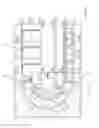
FIG. 1 is a schematic representation of the curved stretch of the horizontal turning system, object of the present invention.
FIG. 2 represents an embodiment of the turning system, object of the present invention.
FIG. 3 represents an alternative embodiment of the turning system, object of the present invention.
FIG. 4 represents an embodiment of a cart used in an embodiment of the turning system, joined to a pallet.
FIG. 5 is a profile view of the cart joined to the pallet shown in the previous figure.
In these figures, reference is made to an assembly of elements, which are as follows:
- 1. Transport system belt
- 2. Belt pallets
- 3. Transport system turn input
- 4. Transport system turn output
- 5. Turning system
- 6. Curved stretch of the turning system
- 7. External guide of the curved stretch
- 8. Internal guide of the curved stretch
- 9. Central chain
- 10. Drive wheel of the central chain
- 11. Central guide
- 12. Turning system carts
- 13. Arm joining the carts to the pallets
- 14. Cart wheels
- 15. Internal face of the central guide
- 16. External face of the central guide
DETAILED DESCRIPTION
The object of the present invention is a turning system for a belt transport system 1, of the variety formed by a plurality of pallets 2. The transport system has a turn input 3 and a turn output 4, arranged on the same horizontal plane. The turning system 5 has a curved stretch 6, which connects the turn input 3 to the turn output 4. This curved stretch 6 is arranged on the same horizontal plane as the turn input 3 and as the turn output 4.
According to a specific embodiment of the invention, the curved stretch 6 of the turning system 5 is formed by an external guide 7, corresponding to the external guide of the turn input 3 and the turn output 4 and by an internal guide 8 corresponding to the internal guide of the turn input 3 and the turn output 4, in such a way that the pallets 2 of the belt 1 are arranged between the external guides 7 and internal guides 8, being displaced along the length of the curved stretch 6 between the same.
In order to achieve this movement of the pallets 2 along the length of the curved stretch 6, the turning system 5 may have a central chain 9 to which the pallets 2 are joined and which drives the same in their journey. This central channel 9 is arranged between the external guide 7 and the internal guide 8 of the curved stretch 6. According to this embodiment and in a preferred way, the central channel 9 is arranged on a horizontal plane which is lower to the plane formed by the external guide 7 and the internal guide 8 of the curved stretch 6. This central chain 9 is in turn driven by a drive wheel 10, which is coplanar to said central chain 9, although there may also be alternative ways to drive the central chain 9.
An alternative way to successfully move the pallets 2 along the length of the curved stretch 6 is by means of a central guide 11 arranged between the external guide 7 and the internal guide 8, in such a way that it is also arranged on a horizontal plane which is slightly lower than the plane formed by the external 7 and internal 8 guides of the curved stretch 6. A number of carts 12 are displaced along the length of this central guide 11, each one of which is fixed to a pallet 2 on the belt 1. These carts 12 drag the pallets 2 along the curved stretch 6, whilst the carts 12 are displaced along the length of the central guide 11, preferably being dragged by linear motors, although any other means may be used.
According to a preferred embodiment of the carts 12, the same are joined to the lower face of the pallets 2 by means of a joining arm 13.
Likewise, according to a preferred embodiment of the invention, the carts 12 are joined to the central guide 11 and are displaced along the length of the same by means of a wheel 14 arranged on the internal face 15 of the central guide 11 and two wheels 14 arranged on the external face 16 of said central guide 11. Alternatively, the carts 12 may be joined to the central guide 11 and be displaced along the length of the same by means of four or more wheels.
After having described the invention clearly, it must be noted that details of the specific embodiments described above may be amended, provided that these amendments do not change the fundamental principle and essence of the invention.
Claims
1. A turning system for a belt transport system, the belt being of the variety formed by a plurality of pallets, the transport system comprising a turn input and a turn output, arranged on the same horizontal plane, the turning system also comprising a curved stretch, which connects said turn input and said turn output. Said turning system is characterised in that the curved stretch is arranged on the same horizontal plane as the turn input and turn output.
2. The turning system for a belt transport system according to claim 1, wherein
the curved stretch of the turning system comprises:
an external guide corresponding to the external guide of the turn input and turn output,
an internal guide corresponding to the internal guide of the turn input and the turn output,
the pallets of the belt being arranged between the external and internal guides,
wherein the turning system comprises a central chain to which the pallets are joined, which also drives the same in their journey along the central curve, said central chain being arranged between the external guide and the internal guide of the curved stretch.
3. The turning system for a belt transport system according to claim 2 wherein the central chain is arranged on a horizontal plane which is lower to the plane formed by the external guide and the internal guide of the curved stretch.
4. The turning system for a belt transport system of claim 2 wherein the central chain is in turn driven by a drive wheel, which is coplanar to said central chain.
5. The turning system for a belt transport system according to claim 1, wherein the curved stretch of the turning system comprises:
an external guide corresponding to the external guide of the turn input and turn output,
an internal guide corresponding to the internal guide of the turn input and turn output,
the pallets of the belt being arranged between the external and internal guides,
wherein the turning system comprises:
a central guide arranged between the external guide and the internal guide of the curved stretch on a horizontal plane lower than the plane formed by said external and internal guides of the curved stretch, along the length of which
a plurality of carts are displaced, each one of which is fixed to a pallet of the belt, which drag said pallets along the length of the curved stretch.
6. The turning system for a belt transport system of claim 5 wherein the carts are displaced along the length of the central guide, being dragged by linear motors.
7. The turning system for a belt transport system according to claim 6 wherein each one of the carts is joined to the central guide and displaced along the length the same by means of a wheel arranged on the internal face of the central guide and two wheels arranged on the external face of said central guide.
8. The turning system for a belt transport system according to claim 7 wherein the carts are joined to the lower face of the pallets by means of a joining arm.
Images & Drawings included:





Sources:
- United States Patent and Trademark Office - verify current appl. status at the USPTO↗
Recent applications in this class:
- » 20210147186 2021-05-20
Escalator - » 20150307327 2015-10-29
Offset pallet guidance for passenger conveyor - » 20150284217 2015-10-08
Turnaround mechanism for passenger conveyors - » 20150274489 2015-10-01
Pallet return in moving walkways - » 20150259177 2015-09-17
Passenger Conveyor Systems with Separate Chain and Pallet Tracks - » 20120298480 2012-11-29
Support, module, transport system for displacement of people/goods and modernization method of people/goods transport systems - » 20080087522 2008-04-17
Shock absorbing device for passenger conveyors - » 20080038104 2008-02-14
Method and apparatus for moving a pallet running on wheels in a travelator or equivalent - » 20060266617 2006-11-30
Conveyor
Recent applications for this Assignee:
- » 20150336772 2015-11-26
Conveyor system for the transport of passengers/goods - » 20130153362 2013-06-20
Braking system for escalators and moving walkways - » 20130092507 2013-04-18
Bidirectional moving walkway - » 20130022389 2013-01-24
Longitudinal joint - » 20120325617 2012-12-27
Escalator step - » 20110155538 2011-06-30
Drive system for escalators and moving walkways - » 20110000762 2011-01-06
Moving ramp for the transportation of people and/or goods - » 20100326791 2010-12-30
Conveyor system for the transportation of passengers/goods - » 20100089718 2010-04-15
Auxiliary drag mechanism at variable speed - » 20090120762 2009-05-14
Drive system for moving walkways and stairs