Veterinary orthopedic kit
US20150366616A1
2015-12-24
14/765,918
2013-07-15
✅ Patent granted
US 10,045,822 B2
2018-08-14
WO; PCT/UA2013/000075; 20130715
WO; WO2014/123503; 20140814
Rafael Ortiz
Leason Ellis LLP
2033-07-15
Abstract:
The VOSIS veterinary orthopedic kit relates to veterinary science and more specifically to orthopedics and traumatology, and can be used in veterinary clinics in the treatment and restoration of function to damaged limbs of dogs, cats and other animals. The technical problem to be solved consists in the timely and quality provision of emergency care to injured animals, an increase in the effectiveness of treatment and the prevention of serious complications. This problem is solved in that orthopedic external fixation systems are provided in a universal and multifunctional set. The VOSIS veterinary orthopedic kit consists of a rectangular container (1) in the form of a box (2) having a lid (3) and being divided by partitions into a plurality of sections. The sections accommodate a set of components and instruments for the purposes of external fixation: polyfunctional monoblocks (4), plates (5), rods and pins (6), bars (7), fasteners (8) and instruments (9). All of the components of the set are marked for ease of identification.
Assignee:
- Ihor Heorhiovych KYSELIOV 1 🇺🇦 Sevastopol, Ukraine
Applicant:
Interested in similar patents?
Get notified when new applications in this technology area are published.
Classification:
A61B50/00 IPC
Containers, covers, furniture or holders specially adapted for surgical or diagnostic appliances or instruments, e.g. sterile covers
A61B50/30 » CPC further
Containers, covers, furniture or holders specially adapted for surgical or diagnostic appliances or instruments, e.g. sterile covers Containers specially adapted for packaging, protecting, dispensing, collecting or disposing of surgical or diagnostic appliances or instruments
A61B2050/0056 » CPC further
Containers, covers, furniture or holders specially adapted for surgical or diagnostic appliances or instruments, e.g. sterile covers with a lid or cover closable by rotation about a lateral axis in the lid plane
A61B2050/3008 » CPC further
Containers, covers, furniture or holders specially adapted for surgical or diagnostic appliances or instruments, e.g. sterile covers; Containers specially adapted for packaging, protecting, dispensing, collecting or disposing of surgical or diagnostic appliances or instruments having multiple compartments
B65D69/00 IPC
Kinds or types of packages
B65D69/00 IPC
Articles joined together for convenience of storage or transport without the use of packaging elements
B65D71/00 IPC
Bundles of articles held together by packaging elements for convenience of storage or transport, e.g. portable segregating carrier for plural receptacles such as beer cans or pop bottles; Bales of material
A61D1/00 » CPC further
Surgical instruments for veterinary use
A61B17/56 » CPC further
Surgical instruments, devices or methods, e.g. tourniquets Surgical instruments or methods for treatment of bones or joints; Devices specially adapted therefor
Description
FIELD
The invention is related to veterinary medicine, and more specifically to orthopedics and traumatology (external fixation systems). This kit can be used in veterinary hospitals in treatment and restoration of damaged limb function in dogs, cats and other animals.
RELATED ART
At present, for treatment of diaphyseal fractures of long bones of limbs in small family animals, in particular dogs and cats, in many cases are used traditional conservative (plaster bandages, splints) and operational (extramedullary and intraosteal anchors) methods for bone immobilization that do not always ensure an accurate reposition and stable rigid fixation of bone fragments throughout the entire treatment. Traumas during surgery on osteogenic tissues (periosteum, bone marrow), and also on surrounding soft tissues and bone feeding vessels result in various complications, and as a consequence, prolong the time of healing. The method of transosseous osteosynthesis, developed by G. A. Ilizarov, as well as similar methods of other authors, applied to bone fractures of different etiology, severity and location, made it possible to create conditions for a favorable course of reparative osteogenesis and positive outcome of treatment. Yet these technical and technological possibilities of treatment for limb bone fractures in small home animals in some cases are not justified and require the development of new methods of osteosynthesis, systems and techniques due to the fact that:
-
- universal versions of layout of external osteosynthesis devices for treatment of limb long bones, depending on species, age and sex of home animals, location and the nature of a fraction have not been adequately developed;
- existing devices do not provide for accurate repositioning of bone fragments and their stable fixation until fracture healing and deformity correction are complete, and surgical intervention in the area of the fracture is required.
There are known [see WWW document]. URL: http://reko-med.ru (Jan. 9, 2013) products for orthopedics which include various orthopedic products used in modern treatment and rehabilitation programs in traumatology and orthopedics. The disadvantage is that these products make it possible to achieve precise reposition of bone fragments yet do not provide for their stable fixation, since they are not designed for application in veterinary medicine.
There is a need for a comprehensive veterinary orthopedic set which would increase efficiency of contemporary hi-tech surgical intervention procedures in treatment and restoration of damaged limbs of dogs, cats and other animals.
This utility model entitled VOSIS Veterinary Orthopedic Kit meets the above requirement, making it possible for a specialist in the field of veterinary surgery and orthopedics, equipped with a set of required external fixation orthopedic systems in a compact package, to provide timely and quality treatment to injured animals, to improve efficiency of treatment, and to prevent the development of serious complication.
This result is achieved due to the fact that the suggested veterinary orthopedic kit is designed for application in various clinical cases in veterinary practice. All components of the kit can be used multiple times (except for consumables). Increased efficiency of surgical intervention is provided by application of specially designed and assembled universal and multifunctional orthopedic devices.
DISCLOSURE OF INVENTION
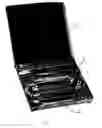
The veterinary orthopedic kit comprises (FIG. 1) a rectangular container 1 made in the form of a box 2 with a lid 3, which is divided by partitions into several sections to accommodate a set of components and tools for external osteosynthesis. It contains (FIG. 2) polyfunctional single units 4, plates 5, rods and pins 6, beams 7, hardware 8, and tools 9. All kit components are marked for convenient recognition.
1. Polyfunctional single units 4 (MP 20.5 and MP 20.4) are designed to form a mounting assembly between the supporting beam and the bone anchor, or between the radial plate and the fixing rod. Depending on the size of an operated animal, the diameter of a hole in the single unit and the method of fastening make it possible to fix the supporting beam of 0.8 to 5.0 mm in diameter. Diameter of the bone anchor also ranges from 0.8 mm to 5.0 mm. When two single units are combined with the aid of the supporting beam, the arrangement with two degrees of freedom is formed which allows to insert the bone anchor at different angles and in different planes. The single unit design is the original development (see Patent # 76446, Ukraine).
2. Plates 5 (see Patent # 70025, Ukraine)
2.1. Reconstruction plates (RPSSH-5, RPSSH-7, and RPSSH-9) are used in external osteosynthesis. They are used with large and medium-size dogs, and have 5-9 holes for fixing screws
Features of reconstruction plates:
-
- Low contact with tissue
- Ability to fit different bone profile
- Three-point bone fixation with a single screw
- Solid stiffening rib over all fasteners
- Absolute stability with a single fixation point
- Compression capability due to different density (tension in the thread-bone system)
- Significant antirotational capability
- The same type of plates can be used in animals with different weight due to doubling the thickness of the plate in hazardous fracture areas
2.2. Radial plates (PR-7 and PR-9) are designed to form monolateral, double plane and arc-ring sets of medium-small, medium and large diameter (up to 110 mm) with the use of polyfunctional single units.
3. Rods and Pins:
3.1. A self-tapping fixing rod (SFS 100.5) is designed for fixating in the bone at an angle with capturing the cortical plates.
3.2. A self-tapping fixing rod (SFS 100.5.30) is used as the main anchor in arc-ring, bilateral, momolateral and large-size structures.
3.3. A fixing, one-side sharpened rod (SFS 100.3.0) is designed for transosseous and intraosseous insertion in small- and large-size structures.
3.4. A fixing, one-side sharpened rod (SFS 100.2.2) is designed for transosseous and intraosseous insertion in small- and medium-size structures.
3.5. A fixing, one-side sharpened rod (SFS 100.2.06) is designed for transosseous and intraosseous insertion in small-size structures.
3.6. A fixing, one-side sharpened rod (SFS 100.1.6) is designed for transosseous and intraosseous insertion in small-size structures.
3.7. A fixing, one-side sharpened rod (SFS 100.1.0) is designed for transosseous and intraosseous insertion in small-size structures.
3.8. A transosseous, one-side sharpened pin (ST-150.1.6) is used for transosseous insertion with the possibility of tension.
4. Beams
4.1. A supporting beam (BO 200.5, BO 150.5, and BO 100.5):
It is used to form a stiffening rib and to support single units upon installation of monolateral and arc-ring devices compatible with the length of a limb. The stiffening rib is strengthened due to additional fixation in the single unit. The stiffening rib is strengthened upon additional arrangement with two or three beams connected through the single units.
4.2. Supporting beam (BO 50.5)
It is used to form a stiffening rib and to support single units upon installation of monolateral and arc-ring devices. The supporting bean is extended due to additional fixation in the single unit (MP 20.5).
4.3. Supporting beam (BO 30.5)
It is designed for connecting the single units (MP 20.5, MP 20.4), and also forms a short lever arm between the radial plates (PR7, PR9).
4.4. Supporting beam (BO 15.5)
It is designed for connecting the single units (MP 20.4), and also is used for fastening the single unit (MP 20.5) to the radial plates (PR7, PR9).
5. Hardware
5.1. Stabilizing screw (SSH 25, SSH 20)
It is used to fix reconstruction plates. Due to a fragment with metric thread, it makes an integral unit with the plate with the maximum rigidity.
5.2. Screw for fixation of VF plates
It is used for connecting the reconstruction plate when it is needed to increase plate thickness in the area of increased load, or when the area of fixation must be expanded.
5.3. Screw
It is used for fixing in the single unit MP 20.5 and MP 20.4.
5.4. Nut
It is used to fasten a supporting structure
6. Tools
6.1. A wrench with scratch-resistant coating which is a special wrench for assembly and installation of the system.
6.2. Drill 3*100 and drill 2*85
SHORT DESCRIPTION OF DRAWINGS
FIG. 1 gives the general view of the veterinary orthopedic device;
FIG. 2 shows a list of components of the veterinary orthopedic device.
BEST EMBODIMENT OF INVENTION
The VOSIS veterinary orthopedic device is set to be used as follows. A specialist who has this kit and who was properly trained, when a clinical case occurs, shall use for an animal the suggested orthopedic products in either configuration justified by the clinical case. For example, after preparing the operated limb (fur shaving, washing), anesthetic was administered to the animal. The operation field was treated and closed reduction of fragment was performed. Two rods 6 were inserted into the bone into proximal and distal epiphyses. The rods 6 were fastened in the single unit 4, moderate compression was applied to the site of the fracture, and additional anchors were inserted. Diameter of the inserted anchors was selected according to size of the animals, and the single unit 4 was used as the anchor holder. When the radial plates 5 were used, at first the system was installed, then manual fragment reduction was performed, and after that the rods were inserted. The single unit 4 was used as the anchor holder.
Claims
1. A VOSIS veterinary orthopedic kit which comprises orthopedic products is distinguished by the fact that the orthopedic kit for extra-cortical osteosynthesis is placed in sections of a rectangular container made in the form of a box with a lid, divided into sections by partitions.
2. The orthopedic kit of claim 1 further contains polyfunctional single units, reconstruction plates, fixing and self-tapping rods, radial plates, supporting beams, hardware, screws, nuts and tools for installation and assembly of extramedullary systems.
Images & Drawings included:


Sources:
- United States Patent and Trademark Office - verify current appl. status at the USPTO↗
Recent applications in this class:
- » 20160128779 2016-05-12
WASHCLOTH FOR MEATAL AREA CLEANING OF AN INDWELLING URINARY CATHETERIZED PATIENT - » 20150272680 2015-10-01
ENDOSCOPE TRANSPORTATION INSTRUMENT - » 20150265352 2015-09-24
ENTERAL NUTRITION DELIVERY SUPPORT SYSTEM - » 20150069728 2015-03-12
MULTIFUNCTIONAL ENCLOSURE SYSTEM FOR MEDICAL PROBES AND METHOD OF USE - » 20140299506 2014-10-09
Method Of Cause-Based Marketing Using Visually Enhanced Removable Body Fluid Monitor Protective Sleeves