Process of manufacturing of soft magnetic ceramic and its use
US20160005535A1
2016-01-07
14/764,120
2014-01-27
✅ Patent granted
US 9,589,723 B2
2017-03-07
WO; PCT/PL2014/000006; 20140127
WO; WO2014/120030; 20140807
Erin Snelting
Andrew W. Chu | Craft Chu PLLC
2034-01-27
Abstract:
A process for the manufacture of magnetic ceramic is provided including the steps of: die compacting a powder composition into a compacted body, the composition including a mixture of soft magnetic, iron or iron-based powder, core particles of which are surrounded by an electrically insulating, inorganic coating an amount of 1 to 35% by weight of the composition; and heating and pressing the compacted body in an atmosphere to a temperature and a pressure below the decomposition temperature and pressure of the magnetic, iron or iron-based powder.
Inventors:
- Karen OGANISIAN 2 🇵🇱 Wroclaw, Poland
- Wieslaw STREK 8 🇵🇱 Bielany Wroclawskie, Poland
- Andrzej VOGT 5 🇵🇱 Wroclaw, Poland
- Pawel GLUCHOWSKI 2 🇵🇱 Kamienna Gora, Poland
Assignee:
- INSTYTUT NISKICH TEMPERATUR I BADAN STRUKTURALNYCH 1 🇵🇱 Wroclaw, Poland
Applicant:
Interested in similar patents?
Get notified when new applications in this technology area are published.
Classification:
H01F41/02 » CPC main
Apparatus or processes specially adapted for manufacturing or assembling magnets, inductances or transformers; Apparatus or processes specially adapted for manufacturing materials characterised by their magnetic properties for manufacturing cores, coils, or magnets
H01F1/34 » CPC further
Magnets or magnetic bodies characterised by the magnetic materials therefor; Selection of materials for their magnetic properties of inorganic materials characterised by their coercivity of soft-magnetic materials non-metallic substances, e.g. ferrites
C04B35/626 IPC
Shaped ceramic products characterised by their composition ; Ceramics compositions ; Processing powders of inorganic compounds preparatory to the manufacturing of ceramic products; Forming processes; Processing powders of inorganic compounds preparatory to the manufacturing of ceramic products Preparing or treating the powders individually or as batches ; preparing or treating macroscopic reinforcing agents for ceramic products, e.g. fibres; mechanical aspects section
C04B35/6261 » CPC further
Shaped ceramic products characterised by their composition ; Ceramics compositions ; Processing powders of inorganic compounds preparatory to the manufacturing of ceramic products; Forming processes; Processing powders of inorganic compounds preparatory to the manufacturing of ceramic products; Preparing or treating the powders individually or as batches ; preparing or treating macroscopic reinforcing agents for ceramic products, e.g. fibres; mechanical aspects section; Treating the starting powders individually or as mixtures Milling
H01F41/0246 » CPC further
Apparatus or processes specially adapted for manufacturing or assembling magnets, inductances or transformers; Apparatus or processes specially adapted for manufacturing materials characterised by their magnetic properties for manufacturing cores, coils, or magnets; Manufacturing of magnetic cores by mechanical means Manufacturing of magnetic circuits by moulding or by pressing powder
C04B2235/405 » CPC further
Aspects relating to ceramic starting mixtures or sintered ceramic products; Composition of constituents of the starting material or of secondary phases of the final product; Constituents and secondary phases not being of a fibrous nature; Metallic constituents or additives not added as binding phase Iron group metals
C22C2202/02 » CPC further
Physical properties Magnetic
H01F1/24 » CPC further
Magnets or magnetic bodies characterised by the magnetic materials therefor; Selection of materials for their magnetic properties of inorganic materials characterised by their coercivity of soft-magnetic materials metals or alloys in the form of particles, e.g. powder pressed, sintered, or bound together the particles being insulated
C04B35/62836 » CPC further
Shaped ceramic products characterised by their composition ; Ceramics compositions ; Processing powders of inorganic compounds preparatory to the manufacturing of ceramic products; Forming processes; Processing powders of inorganic compounds preparatory to the manufacturing of ceramic products; Preparing or treating the powders individually or as batches ; preparing or treating macroscopic reinforcing agents for ceramic products, e.g. fibres; mechanical aspects section; Coating the powders or the macroscopic reinforcing agents; Powder coating materials; Non-oxide ceramics Nitrides
C04B35/583 » CPC further
Shaped ceramic products characterised by their composition ; Ceramics compositions ; Processing powders of inorganic compounds preparatory to the manufacturing of ceramic products based on non-oxide ceramics based on borides, nitrides, or silicides based on boron nitride
C04B35/645 » CPC further
Shaped ceramic products characterised by their composition ; Ceramics compositions ; Processing powders of inorganic compounds preparatory to the manufacturing of ceramic products; Forming processes; Processing powders of inorganic compounds preparatory to the manufacturing of ceramic products; Burning or sintering processes Pressure sintering
C04B35/628 IPC
Shaped ceramic products characterised by their composition ; Ceramics compositions ; Processing powders of inorganic compounds preparatory to the manufacturing of ceramic products; Forming processes; Processing powders of inorganic compounds preparatory to the manufacturing of ceramic products; Preparing or treating the powders individually or as batches ; preparing or treating macroscopic reinforcing agents for ceramic products, e.g. fibres; mechanical aspects section Coating the powders or the macroscopic reinforcing agents
C22C33/02 » CPC further
Making ferrous alloys by powder metallurgy
Description
RELATED U.S. APPLICATIONS
Not applicable.
STATEMENT REGARDING FEDERALLY SPONSORED RESEARCH OR DEVELOPMENT
Not applicable.
REFERENCE TO MICROFICHE APPENDIX
Not applicable.
BACKGROUND OF THE INVENTION
1. Field of the Invention
The invention concerns a new soft magnetic composite material—soft magnetic ceramic. Particularly, the invention concerns a process for the manufacturing of new soft magnetic ceramics having improved soft magnetic properties and its use.
2. Description of Related Art Including Information Disclosed Under 37 CFR 1.97 and 37 CFR 1.98.
The present soft magnetic ceramic belongs to the class of the soft magnetic composite (SMC) materials which are based on soft magnetic particles, usually iron based, with an electrically insulating coating on each particle. Following the traditionally powder metallurgy process, the SMC are obtaining by compacting the insulated, with lubricants and/or binders, particles. Obtained in this manner, SMC materials have a higher degree of freedom in comparison with that of commonly using steel laminates. During the compaction process, it is possible to obtain the SMC material of three dimensional shapes possessing a three dimensional magnetic flux. As a result, this increased interest in the SMC materials in the last decades and improvements of the soft magnetic characteristics of the SMC materials are the subject of intense studies in order to expand the application of these materials. In order to achieve such improvement, new powders and processes are continuously being developed. In addition, the values of the saturation of magnetic induction, and electric resistivity are very important parameters of SMC materials. But due to the high content of lubricants and/or binders, which are using for improving of resistivity and hardness of SMC materials, the values of magnetic induction are reducing. Best known SMC materials possess the values of saturation of magnetic induction of 1.2-1.6 T whereas the saturation of pure iron is about 2.2 T. The present process of manufacturing obtains a magnetic ceramic characterized by high value of the saturation of magnetic induction and high electric resistivity simultaneously.
SUMMARY OF THE INVENTION
A The present invention concerns a process for the manufacture of magnetic ceramic comprising the steps of:
-
- die compacting a powder composition comprising a mixture of soft magnetic, iron or iron-based powder, the core particles of which are surrounded by an electrically insulating, inorganic coating in an amount of 1 to 35% by weight of the composition and pressing into a pellet;
- ejecting the compacted body from the die; pressing and heating the compacted body in a non reducing atmosphere to the pressure and temperature below (but nearby) the decomposition conditions of the iron or iron-based powder, and optionally subjecting the obtained body to heat treatment at a temperature between 300° C. and 600° C. in reduced atmosphere.
According to the present invention soft magnetic ceramics having superior magnetic, electric and mechanic properties can be obtained. These ceramics may be distinguished by superior properties such as high value of the saturation of magnetic flux at least 1.6 T, a permeability at least 7, frequency independent resistivity at least 0.01 Ohm-m up to 10 MHz with saturation 2.01 T, hardness at least 1 GPa in the Vickers Hardness units.
BRIEF DESCRIPTION OF THE DRAWINGS
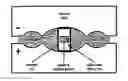
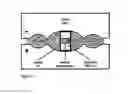
FIG. 1 shows a schematic view of the hydraulic press which was used for preparation of soft magnetic ceramic. “Green body” means compacted body.
DETAILED DESCRIPTION OF THE DRAWINGS
The According to the present invention the soft magnetic powders are composed of iron. Preferably, the soft magnetic powder comprises nanosized carbonyl iron or essentially pure iron. A preferred electrically insulating layer that can be used according to the invention is the fine powder of the hexagonal boron nitride (BN).
The type of lubricant/binder used in iron or iron based powder is important, and BN and TiO2 are selected due to their ability to thoroughly coat the iron or iron based powder particles by thin layers that significantly improve the corrosion resistance and electric resistivity of obtained materials. Using BN as lubricant allows exclusion of any binder at all from leading to an increase of iron or iron based powder content.
The compaction may be performed between 2 and 8 GPa and temperature 1000-2000° C. Best compositions may be obtained at the conditions corresponding to that of nearby (slightly below) decomposition of iron or iron based powder. If compaction is performed at pressures below 2 GPa and/or at temperatures below 1200° C. then obtained ceramic may has reduced strength. If compaction is performed at conditions corresponding to that above decomposition, then the insulating layer may be destroyed.
This procedure reduces strains in the involved iron or iron based particles that lead to increasing of permeability. If an annealing performing at temperatures below 300° C. then time of treatment may be unacceptably long. If, on the other hand, annealing performing at temperatures above 600 ° C. then insulating layer may be destroyed. The treatment will preferably be performed in an inert atmosphere, such as nitrogen, argon or helium.
There is an ability to add another lubricant such as titanium dioxide, graphite, graphene, silicon carbide, rare earth metals and d-block. Adding of mentioned materials controls the hardness, electric resistivity and magnetic properties of obtained ceramics.
As can be seen from the following examples soft magnetic ceramic components having remarkable properties as regards electrical resistivity, magnetic induction, and magnetic permeability can be obtained by the method according to the invention.
EXAMPLES
Example 1
Iron obtained from iron pentacarbonyl Fe(CO)5, was grinded in an agate mortar (1 h) with commercial hexagonal boron nitride (BN) in different weight ratio. The resulting powder was cold pressed at a pressure of 0.2 GPa. The cold pressed pellet “compacted body” was placed in a calcium carbonate container (CaCO3) with a graphite heater, then treated during I min.
| TABLE 1 | |||||||
| Saturation | |||||||
| of | |||||||
| Fe:BN | Pressure | Temperature | Magnetic | Resistivity | Density | ||
| Sample | wt % | GPa | ° C. | Induction T | Permeability | Ohm-m | g/cm3 |
| 2/1750 | 95:5 | 2 | 1750 | 2.05 | 12 | 2 × 10⁻⁷ | 7.58 |
| 8/1450 | 94:6 | 8 | 1450 | 1.93 | 9.3 | 0.2 | 7.53 |
| 8/1600 | 95:5 | 8 | 1600 | 2.01 | 7 | 0.01 | 7.58 |
| 8/450 | 94:6 | 8 | 450 | 1.8 | 7 | 100 | 7.53 |
| 8/750 | 94/6 | 8 | 750 | n/a | n/a | 10 | 7.53 |
As can be seen from table 1, the best samples are obtained at the conditions slightly below decomposition ones (2/1450, 8/1600 and 8/450). Whereas application of high temperature destroyed the insulating layer that led to reduction of resistivity up to 8 orders (2/1750).
Example 2
Iron obtained from iron pentacarbonyl Fe(CO)5 was grinded in an agate mortar (1 h) with titanium dioxide (TiO2) and BN in the % weight ratio 79:16:5. The resulting powder was cold pressed at a pressure of 0.2 GPa. The cold pressed pellet “compacted body” was placed in a calcium carbonate container (CaCO3) with a graphite heater, then treated.
The sample was treated in a high-pressure hydraulic press at 4 GPa and 1450° C. during 1 minute.
| TABLE 2 | |||||||
| Saturation | |||||||
| of | |||||||
| Fe:BN | Pressure | Temperature | Magnetic | Resistivity | Density | ||
| Sample | wt % | GPa | ° C. | Induction T | Permeability | Ohm-m | g/cm3 |
| 2/1750 | 79:16:5 | 4 | 1450 | 1.6 | 4.3 | 7 × 10⁻⁷ | 7.00 |
Claims
1. A process for manufacture of soft magnetic ceramic components, the process comprising the steps of:
die compacting a powder composition into a compacted body in a die, the powder composition comprising a mixture of iron obtained from iron pentacarbonyl Fe(CO)5, and BN;
ejecting the compacted body from the die;
placing the compacted body in a calcium carbonate container (CaCO3) with a graphite heater; and
treating the compacted body in the 2-8 GPa and 1000-2000° C. conditions in said calcium carbonate container.
2. The process according to claim 1, wherein iron and BN have a weight % relationship of at least 1:1.
3. The process according to claim 1, wherein said mixture of iron is dispersed inside BN media so as to form a ceramic polycrystalline structure.
4. The process according to claim 1, further comprising the step of:
grinding said mixture of iron and BN for at least 1 hour.
5. The process according to claim 1, wherein the step of die compacting is at room temperature.
6. The process according to claim 1, wherein the step of die compacting is at a pressure between 0.1 and 0.2 GPa.
7. The process according to claim 1, wherein the step of treating is at a temperature between 1000° C. and 2000° C.
8. The process according to claim 1, wherein the step of treating is at a pressure between 2 and 8 GPa.
9. The process according to claim 1, wherein said BN is in an insulating layer so as to reduce corrosion of obtained ceramic.
10. The process according to claim 1, wherein said BN is in an insulating layer so as to increase electric resistivity of obtained ceramic.
11. The process according to claim 1, wherein the electric resistivity of obtained ceramic at least 0.01 Ohm-m.
12. The process according to claim 1, said powder composition being comprised of at least of a group consisting of: titanium dioxide, graphite, graphene, silicon carbide, rare earth metals and d-block.
13. The process according to claim 1, wherein iron and BN have a weight % relationship to other lubricants of at least 1:1.
14. The process according to claim 1, wherein the composition possesses resistive character of conductivity with saturation of magnetic induction of at least 1.8 T.
15. The process according to claim 1, further comprising the step of: forming at least one of a group consisting of inductors, electromagnetic absorbers and wave filter components.
Images & Drawings included:
Sources:
- United States Patent and Trademark Office - verify current appl. status at the USPTO↗
Recent applications in this class:
- » 20250166893 2025-05-22
FILM PASTING ASSEMBLY AND ASSEMBLING METHOD - » 20250166892 2025-05-22
FILM PASTING ASSEMBLY AND ASSEMBLING METHOD - » 20250166891 2025-05-22
FILM PASTING ASSEMBLY AND ASSEMBLING METHOD - » 20250166890 2025-05-22
FILM PASTING ASSEMBLY AND ASSEMBLING METHOD - » 20250166889 2025-05-22
METHOD FOR CO-SINTERING TRANSFORMER - » 20240363285 2024-10-31
SYSTEMS AND METHODS FOR ADDITIVE MANUFACTURING MAGNETIC SOLENOIDS - » 20240312703 2024-09-19
LAMINATED MAGNETIC CORES - » 20230298812 2023-09-21
Systems and methods for additive manufacturing magnetic solenoids - » 20230238176 2023-07-27
Film pasting assembly and assembling method - » 20230113317 2023-04-13
PRODUCTION METHOD FOR RARE-EARTH SINTERED MAGNET, AND WET-MOLDING DEVICE