Elastic Cord for a Pull Exerciser
US20160023036A1
2016-01-28
14/554,099
2014-11-26
Abstract:
An elastic cord includes a hollow outer elastic cord having a first end and a second end spaced from the first end in a longitudinal direction. The hollow outer elastic cord further includes a hole extending from the first end thereof through the second end thereof. The hollow outer elastic cord further includes an outer periphery and an inner periphery spaced from the outer periphery in a radial direction perpendicular to the longitudinal direction. A rib is provided in the hole of the hollow outer elastic cord and extends from the first end through the second end of the hollow outer elastic rod. The rib includes a first portion connected to the inner periphery of the hollow outer elastic cord and a second portion connected to the inner periphery of the hollow outer elastic cord.
Interested in similar patents?
Get notified when new applications in this technology area are published.
Classification:
A63B21/0555 » CPC main
Exercising apparatus for developing or strengthening the muscles or joints of the body by working against a counterforce, with or without measuring devices using resilient force-resisters extension element type; Elastic ropes or bands Details of the rope or band, e.g. shape or colour coding
A63B23/1209 » CPC further
Exercising apparatus specially adapted for particular parts of the body for limbs, i.e. upper or lower limbs, e.g. simultaneously for upper limbs or related muscles, e.g. chest, upper back or shoulder muscles Involving a bending of elbow and shoulder joints simultaneously
A63B21/055 IPC
Exercising apparatus for developing or strengthening the muscles or joints of the body by working against a counterforce, with or without measuring devices using resilient force-resisters extension element type
A63B23/12 IPC
Exercising apparatus specially adapted for particular parts of the body for limbs, i.e. upper or lower limbs, e.g. simultaneously for upper limbs or related muscles, e.g. chest, upper back or shoulder muscles
A63B21/00 IPC
Exercising apparatus for developing or strengthening the muscles or joints of the body by working against a counterforce, with or without measuring devices
Description
BACKGROUND OF THE INVENTION
The present invention relates to an elastic cord for a pull exerciser and, more particularly, to an elastic cord including a rib to avoid injury to a user when the elastic cord breaks during use.
Pull exercisers utilizing elastic cords allow exercise of muscles of the breast and arms of a user. These pull exercisers are light, small, and easy to carry and are, thus, a preferred option to modern people.
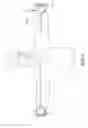
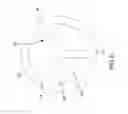
A typical elastic cord of a pull exerciser is hollow and attached between two handles. An exercise effect in the muscles of the breast and arms of a user can be attained when the user holding the handles repeatedly stretches and releases the elastic cords. However, with reference to FIG. 1, when a user 1 holds the handles 101 of a conventional pull exerciser 10 and stretches the elastic cord 102, the elastic cord 102 could break and injure the user 1.
Thus, a need exists for an improved elastic cord for an exerciser that would not injure the user when it breaks during use.
BRIEF SUMMARY OF THE INVENTION
An elastic cord according to the present invention includes a hollow outer elastic cord having a first end and a second end spaced from the first end in a longitudinal direction. The hollow outer elastic cord further includes a hole extending from the first end thereof through the second end thereof. The hollow outer elastic cord further includes an outer periphery and an inner periphery spaced from the outer periphery in a radial direction perpendicular to the longitudinal direction. A rib is provided in the hole of the hollow outer elastic cord and extends from the first end through the second end of the hollow outer elastic rod. The rib includes a first portion connected to the inner periphery of the hollow outer elastic cord and a second portion connected to the inner periphery of the hollow outer elastic cord.
In an example, the rib further includes a third portion connected to the inner periphery of the hollow outer elastic cord. The rib has substantially Y-shaped cross sections perpendicular to the longitudinal direction.
In another example, the rib further includes a fourth portion connected to the inner periphery of the hollow outer elastic cord. The rib has substantially cruciform cross sections perpendicular to the longitudinal direction.
The present invention will become clearer in light of the following detailed description of illustrative embodiments of this invention described in connection with the drawings.
DESCRIPTION OF THE DRAWINGS
The illustrative embodiments may best be described by reference to the accompanying drawings where:
FIG. 1 is a schematic view of a user and a conventional pull exerciser with an elastic cord of the pull exerciser broken during use.
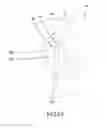
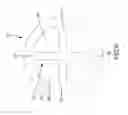
FIG. 2 is an exploded, perspective view of a pull exerciser utilizing an elastic cord of a first embodiment according to the present invention.
FIG. 2A is an enlarged view of a circled portion of FIG. 2.
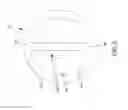
FIG. 3 is a side view of the elastic cord of FIG. 2.
FIG. 4 is a partial, perspective view of the pull exerciser utilizing the elastic cord of FIG. 2.
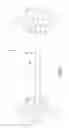
FIG. 5 is a side view of an elastic cord of a second embodiment according to the present invention.
FIG. 6 is a side view of an elastic cord of a third embodiment according to the present invention.
All figures are drawn for ease of explanation of the basic teachings only; the extensions of the figures with respect to number, position, relationship, and dimensions of the parts to form the illustrative embodiments will be explained or will be within the skill of the art after the following teachings have been read and understood. Further, the exact dimensions and dimensional proportions to conform to specific force, weight, strength, and similar requirements will likewise be within the skill of the art after the following teachings have been read and understood.
Where used in the various figures of the drawings, the same numerals designate the same or similar parts. Furthermore, when the terms “first”, “second”, “third”, “fourth”, “end”, “portion”, “outer”, “longitudinal”, “radial”, “length”, and similar terms are used herein, it should be understood that these terms have reference only to the structure shown in the drawings as it would appear to a person viewing the drawings and are utilized only to facilitate describing the illustrative embodiments.
DETAILED DESCRIPTION OF THE INVENTION
An elastic cord of a first embodiment according to the present invention is shown in FIGS. 2-4 of the drawings and generally designated 16. In an example shown in FIG. 2, the elastic cord 16 is utilized with a pull exerciser 12 of the type including two handles 38. Each end of the elastic cord 16 is knotted after extending through a through-hole 40 of one of the handles 38 to prevent the elastic cord 16 from disengaging from the through-hole 40.
With reference to FIGS. 2-4, the elastic cord 16 of the first embodiment includes a hollow outer elastic cord 50 that is elongated and that can be formed by extruding thermoplastic rubber (TPR). The hollow outer elastic cord 50 can be repeatedly stretched with a force and can restore its original length after the force is released. The hollow outer elastic cord 50 includes a first end 52 and a second end 54 spaced from the first end 52 in a longitudinal direction. The hollow outer elastic cord 50 includes a hole 60 extending from the first end 52 through the second end 54. The hollow outer elastic cord 50 further includes an outer periphery 56 and an inner periphery 58 spaced from the outer periphery 56 in a radial direction perpendicular to the longitudinal direction. The inner periphery 58 defines the hole 60. A rib 62 is formed in the hole 60 and includes a first portion 64 connected to the inner periphery 58 and a second portion 66 connected to the inner periphery 58. The first portion 64 and the second portion 66 are spaced from each other in a radial direction perpendicular to the longitudinal direction and form a rectilinear shape (FIGS. 2A and 3). In this embodiment, the rib 62 extends from the first end 52 through the second end 54 of the hollow outer elastic rod 50.
The rib 62 increases the structural strength of the elastic cord 16. When the outer periphery 56 or the inner periphery 58 of the elastic cord 16 is damaged and if the hollow outer elastic cord 50 begins to break from the damaged portion, the rib 62 resists the crack from running through the rib 62 to prevent complete breakage of the elastic cord 16. Thus, the user has a higher chance to find observe the damage of the elastic cord 16 before the elastic cord completely breaks, reducing the risks of injury to the user by the elastic cord 16 in an unexpected situation.
FIG. 5 shows an elastic cord 16 of a second embodiment modified from the first embodiment. In this embodiment, the rib 62 includes first, second and third portions 64, 66, and 70. All of the first, second, and third portions 64, 66, and 70 are connected to the inner periphery 58 of the hollow outer elastic cord 50. The first, second, and third portions 64, 66, and 70 are spaced from each other by 120°. Thus, the rib 62 has substantially Y-shaped cross sections perpendicular to the longitudinal direction.
FIG. 6 shows an elastic cord 16 of a third embodiment modified from the first embodiment. In this embodiment, the rib 62 includes first, second, third, and fourth portions 64, 66, 70, and 72. All of the first, second, third, and fourth portions 64, 66, 70, and 72 are connected to the inner periphery 58 of the hollow outer elastic cord 50. The first, second, third, and fourth portions 64, 66, 70, and 72 are spaced from each other by 90°. Thus, the rib 62 has substantially cruciform cross sections perpendicular to the longitudinal direction.
The second and third embodiments of the elastic cord 16 also provide the same effect of increasing the structural strength of the elastic cord 16. Thus, when the outer periphery 56 or the inner periphery 58 of the elastic cord 16 is damaged, the rib 62 can delay complete breakage of the elastic cord 16 for a period of time. Thus, the user has a higher chance to observe the damage to the elastic cord 16 before the elastic cord completely breaks.
Now that the basic teachings have been explained, many extensions and variations will be obvious to one having ordinary skill in the art. For example, the elastic cord 16 can be made of thermoplastic rubber or other elastic materials. Furthermore, the rib 62 having three portions 64, 66, and 70 can have solid triangular cross sections perpendicular to the longitudinal direction or hollow triangular cross sections perpendicular to the longitudinal direction. The rib 62 having four portions 64, 66, 70, and 72 can have solid rectangular cross sections perpendicular to the longitudinal direction or hollow rectangular cross sections perpendicular to the longitudinal direction. Thus, the structural strength of the elastic cord 16 can be increased if a plurality of portions of the rib 62 is connected to the inner periphery 58 of the hollow outer elastic cord 50. The shape of the cross sections of the rib 62 is not limited.
Thus since the illustrative embodiments disclosed herein may be embodied in other specific forms without departing from the spirit or general characteristics thereof, some of which forms have been indicated, the embodiments described herein are to be considered in all respects illustrative and not restrictive. The scope is to be indicated by the appended claims, rather than by the foregoing description, and all changes which come within the meaning and range of equivalency of the claims are intended to be embraced therein.
Claims
1. An elastic cord comprising a hollow outer elastic cord including a first end and a second end spaced from the first end in a longitudinal direction, with the hollow outer elastic cord further including a hole extending from the first end thereof through the second end thereof, with the hollow outer elastic cord further including an outer periphery and an inner periphery spaced from the outer periphery in a radial direction perpendicular to the longitudinal direction, with a rib provided in the hole of the hollow outer elastic cord and extending from the first end through the second end of the hollow outer elastic rod, and with the rib including a first portion connected to the inner periphery of the hollow outer elastic cord and a second portion connected to the inner periphery of the hollow outer elastic cord.
2. The elastic cord as claimed in claim 1, wherein the rib further includes a third portion connected to the inner periphery of the hollow outer elastic cord.
3. The elastic cord as claimed in claim 2, wherein the rib has substantially Y-shaped cross sections perpendicular to the longitudinal direction.
4. The elastic cord as claimed in claim 2, wherein the rib further includes a fourth portion connected to the inner periphery of the hollow outer elastic cord.
5. The elastic cord as claimed in claim 4, wherein the rib has substantially cruciform cross sections perpendicular to the longitudinal direction.
Images & Drawings included:


Sources:
- United States Patent and Trademark Office - verify current appl. status at the USPTO↗
Similar patent applications:
- » 20070015643
Exercising elastic pull cord - » 20070207904
ELASTIC CORD AND PULL EXERCISER HAVING THE SAME - » 20090176634
Elastic Cord Unit for Pull Exerciser
Recent applications in this class:
- » 20250065177 2025-02-27
EXPANDER WITH DEGRESSIVE STRESS BEHAVIOUR - » 20250001231 2025-01-02
Oneband resistance exercise system - » 20240390723 2024-11-28
Multifunctional Hair Band and Exercise Device and Method of Use - » 20240382794 2024-11-21
Elastic Resistance Exercising Device And Method Of Use - » 20240342537 2024-10-17
EXERCISE LOOP WITH ENHANCED FEATURES - » 20240261620 2024-08-08
WEIGHT LIFTING SUPPORT DEVICE INCLUDING A RESTRICTION PANEL - » 20240198162 2024-06-20
RESISTANCE EXERCISE BAND - » 20240173589 2024-05-30
Oneband resistance exercise system - » 20240075333 2024-03-07
Dynamic rope - » 20240066344 2024-02-29
Non-Slip Fabric Resistance Band with Soft Cloth Handles