Welded structural joint between a high-performance thermoplastic matrix composite material and an elastomer
US20160059478A1
2016-03-03
14/781,577
2014-04-01
✅ Patent granted
US 10,131,093 B2
2018-11-20
WO; PCT/EP2014/056493; 20140401
WO; WO2014/161833; 20141009
Daniel McNally
Im IP Law | C. Andrew Im
2035-04-30
Abstract:
A method for producing, by welding, a joint between a thermoplastic matrix composite material and an elastomeric material. The elastomeric material is functionalized by incorporating, onto the surface of the elastomer, a nonwoven fabric consisting of fibers of thermoplastic material. The functionalized surface of the elastomeric material is welded to the thermoplastic material of the composite. The functionalization of the elastomeric material is performed during the vulcanization of the raw elastomer. The vulcanization is performed under a sufficient pressure for the nonwoven fabric placed on the surface of the raw elastomer to become incorporated with same, at least at the surface, during the vulcanization process. The welding operation includes interposing a metal fabric coated with thermoplastic material between the surfaces of the elastomer and the composite that are welded to each other, and passing an electric current through same, resulting in the surface melting of the two materials.
Assignee:
- ArianeGroup SAS 118 🇫🇷 Paris, France
Applicant:
Interested in similar patents?
Get notified when new applications in this technology area are published.
Classification:
B29C66/712 » CPC main
General aspects of processes or apparatus for joining preformed parts characterised by the composition, physical properties or the structure of the material of the parts to be joined; Joining with non-plastics material characterised by the composition of the plastics material of the parts to be joined the composition of one of the parts to be joined being different from the composition of the other part
B29C65/364 » CPC further
Joining of preformed parts ; Apparatus therefor by heating, with or without pressure using heated elements which remain in the joint, e.g. "verlorenes Schweisselement" heated by induction characterised by the type of elements heated by induction which remain in the joint being a woven or non-woven fabric or being a mesh
B29C66/45 » CPC further
General aspects of processes or apparatus for joining preformed parts; General aspects of joining substantially flat articles, e.g. plates, sheets or web-like materials; Making flat seams in tubular or hollow articles; Joining single elements to substantially flat surfaces; Joining substantially flat articles ; Making flat seams in tubular or hollow articles Joining of substantially the whole surface of the articles
B29C66/742 » CPC further
General aspects of processes or apparatus for joining preformed parts characterised by the composition, physical properties or the structure of the material of the parts to be joined; Joining with non-plastics material; Joining plastics material to non-plastics material to metals or their alloys
B29C66/7465 » CPC further
General aspects of processes or apparatus for joining preformed parts characterised by the composition, physical properties or the structure of the material of the parts to be joined; Joining with non-plastics material; Joining plastics material to non-plastics material to inorganic materials not provided for in groups - Glass
B29K2071/00 » CPC further
Use of polyethers, e.g. PEEK, i.e. polyether-etherketone or PEK, i.e. polyetherketone or derivatives thereof , as moulding material
B29C65/00 IPC
Joining of preformed parts ; Apparatus therefor
B29C65/20 » CPC further
Joining of preformed parts ; Apparatus therefor by heating, with or without pressure using heated tools with direct contact, e.g. using "mirror"
B29C65/344 » CPC further
Joining of preformed parts ; Apparatus therefor by heating, with or without pressure using heated elements which remain in the joint, e.g. "verlorenes Schweisselement" characterised by the type of heated elements which remain in the joint being a woven or non-woven fabric or being a mesh
B29C65/348 » CPC further
Joining of preformed parts ; Apparatus therefor by heating, with or without pressure using heated elements which remain in the joint, e.g. "verlorenes Schweisselement" characterised by the composition of the heated elements which remain in the joint being metallic with a polymer coating
B29C65/4815 » CPC further
Joining of preformed parts ; Apparatus therefor using adhesives, i.e. using supplementary joining material; solvent bonding characterised by the type of adhesives; Non-reactive adhesives, e.g. physically hardening adhesives Hot melt adhesives, e.g. thermoplastic adhesives
B29C65/5021 » CPC further
Joining of preformed parts ; Apparatus therefor using adhesives, i.e. using supplementary joining material; solvent bonding using adhesive tape, e.g. thermoplastic tape; using threads or the like characterised by the structure of said adhesive tape, threads or the like being multi-layered
B29C65/5028 » CPC further
Joining of preformed parts ; Apparatus therefor using adhesives, i.e. using supplementary joining material; solvent bonding using adhesive tape, e.g. thermoplastic tape; using threads or the like characterised by the structure of said adhesive tape, threads or the like being textile in woven or non-woven form
B29C65/5057 » CPC further
Joining of preformed parts ; Apparatus therefor using adhesives, i.e. using supplementary joining material; solvent bonding using adhesive tape, e.g. thermoplastic tape; using threads or the like positioned between the surfaces to be joined
B29C66/1122 » CPC further
General aspects of processes or apparatus for joining preformed parts; General aspects dealing with the joint area or with the area to be joined; Particular design of joint configurations particular design of the joint cross-sections; Joint cross-sections comprising a single joint-segment, i.e. one of the parts to be joined comprising a single joint-segment in the joint cross-section; Single lapped joints Single lap to lap joints, i.e. overlap joints
B29C66/3034 » CPC further
General aspects of processes or apparatus for joining preformed parts; General aspects dealing with the joint area or with the area to be joined; Particular design of joint configurations the joint involving an anchoring effect making use of additional elements, e.g. meshes
B29C66/71 » CPC further
General aspects of processes or apparatus for joining preformed parts characterised by the composition, physical properties or the structure of the material of the parts to be joined; Joining with non-plastics material characterised by the composition of the plastics material of the parts to be joined
B29C66/721 » CPC further
General aspects of processes or apparatus for joining preformed parts characterised by the composition, physical properties or the structure of the material of the parts to be joined; Joining with non-plastics material characterised by the structure of the material of the parts to be joined Fibre-reinforced materials
B29C66/7212 » CPC further
General aspects of processes or apparatus for joining preformed parts characterised by the composition, physical properties or the structure of the material of the parts to be joined; Joining with non-plastics material characterised by the structure of the material of the parts to be joined; Fibre-reinforced materials characterised by the composition of the fibres
B29C66/7392 » CPC further
General aspects of processes or apparatus for joining preformed parts characterised by the composition, physical properties or the structure of the material of the parts to be joined; Joining with non-plastics material characterised by the intensive physical properties of the material of the parts to be joined, by the optical properties of the material of the parts to be joined, by the extensive physical properties of the parts to be joined, by the state of the material of the parts to be joined or by the material of the parts to be joined being a thermoplastic or a thermoset characterised by the material of the parts to be joined being a thermoplastic or a thermoset characterised by the material of at least one of the parts being a thermoplastic
B29C66/73755 » CPC further
General aspects of processes or apparatus for joining preformed parts characterised by the composition, physical properties or the structure of the material of the parts to be joined; Joining with non-plastics material characterised by the intensive physical properties of the material of the parts to be joined, by the optical properties of the material of the parts to be joined, by the extensive physical properties of the parts to be joined, by the state of the material of the parts to be joined or by the material of the parts to be joined being a thermoplastic or a thermoset characterised by the state of the material of the parts to be joined uncured, partially cured or fully cured the to-be-joined area of at least one of the parts to be joined being fully cured, i.e. fully cross-linked, fully vulcanized
B29C66/81455 » CPC further
General aspects of processes or apparatus for joining preformed parts; General aspects of machine operations or constructions and parts thereof; General aspects of the pressing elements, i.e. the elements applying pressure on the parts to be joined in the area to be joined, e.g. the welding jaws or clamps characterised by the design of the pressing elements, e.g. of the welding jaws or clamps characterised by the constructional aspects of the pressing elements, e.g. of the welding jaws or clamps being a fluid inflatable bag or bladder, a diaphragm or a vacuum bag for applying isostatic pressure
B32B5/022 » CPC further
Layered products characterised by the non- homogeneity or physical structure, i.e. comprising a fibrous, filamentary, particulate or foam layer; Layered products characterised by having a layer differing constitutionally or physically in different parts characterised by structural features of a layer Non-woven fabric
B32B27/08 » CPC further
Layered products comprising synthetic resin as the main or only constituent of a layer, next to another layer of a of synthetic resin
B32B27/12 » CPC further
Layered products comprising synthetic resin next to a fibrous or filamentary layer
B32B27/322 » CPC further
Layered products comprising synthetic resin comprising polyolefins comprising halogenated polyolefins, e.g. PTFE
C08J5/12 » CPC further
Manufacture of articles or shaped materials containing macromolecular substances Bonding of a preformed macromolecular material to the same or other solid material such as metal, glass, leather, e.g. using adhesives
B29C35/02 » CPC further
Heating, cooling or curing, e.g. crosslinking or vulcanising; Apparatus therefor Heating or curing, e.g. crosslinking or vulcanizing during moulding, e.g. in a mould
B29C65/02 » CPC further
Joining of preformed parts ; Apparatus therefor by heating, with or without pressure
B29C66/02 » CPC further
General aspects of processes or apparatus for joining preformed parts; General aspects dealing with the joint area or with the area to be joined Preparation of the material, in the area to be joined, prior to joining or welding
B29C66/02245 » CPC further
General aspects of processes or apparatus for joining preformed parts; General aspects dealing with the joint area or with the area to be joined; Preparation of the material, in the area to be joined, prior to joining or welding; Mechanical pre-treatments, e.g. reshaping with removal of material Abrading, e.g. grinding, sanding, sandblasting or scraping
B29C66/7294 » CPC further
General aspects of processes or apparatus for joining preformed parts characterised by the composition, physical properties or the structure of the material of the parts to be joined; Joining with non-plastics material characterised by the structure of the material of the parts to be joined; Textile or other fibrous material made from plastics Non woven mats, e.g. felt
B29C66/73751 » CPC further
General aspects of processes or apparatus for joining preformed parts characterised by the composition, physical properties or the structure of the material of the parts to be joined; Joining with non-plastics material characterised by the intensive physical properties of the material of the parts to be joined, by the optical properties of the material of the parts to be joined, by the extensive physical properties of the parts to be joined, by the state of the material of the parts to be joined or by the material of the parts to be joined being a thermoplastic or a thermoset characterised by the state of the material of the parts to be joined uncured, partially cured or fully cured the to-be-joined area of at least one of the parts to be joined being uncured, i.e. non cross-linked, non vulcanized
B29C66/919 » CPC further
General aspects of processes or apparatus for joining preformed parts; Measuring or controlling the joining process by measuring or controlling the temperature, the heat or the thermal flux characterised by specific temperature, heat or thermal flux values or ranges
B29C66/91443 » CPC further
General aspects of processes or apparatus for joining preformed parts; Measuring or controlling the joining process by measuring or controlling the temperature, the heat or the thermal flux by controlling or regulating the temperature, the heat or the thermal flux by controlling or regulating the temperature the temperature being non-constant over time following a temperature-time profile
B29C66/91655 » CPC further
General aspects of processes or apparatus for joining preformed parts; Measuring or controlling the joining process by measuring or controlling the temperature, the heat or the thermal flux by controlling or regulating the temperature, the heat or the thermal flux by controlling or regulating the heat or the thermal flux, i.e. the heat flux by controlling or regulating the heat generated by Joule heating or induction heating by controlling or regulating the current intensity
B29C66/949 » CPC further
General aspects of processes or apparatus for joining preformed parts; Measuring or controlling the joining process by measuring or controlling the time characterised by specific time values or ranges
B29C2035/0211 » CPC further
Heating, cooling or curing, e.g. crosslinking or vulcanising; Apparatus therefor; Heating or curing, e.g. crosslinking or vulcanizing during moulding, e.g. in a mould resistance heating
B29K2995/0005 » CPC further
Properties of moulding materials, reinforcements, fillers, preformed parts or moulds having particular electrical or magnetic properties, e.g. piezoelectric Conductive
B29K2995/0046 » CPC further
Properties of moulding materials, reinforcements, fillers, preformed parts or moulds; Other properties Elastic
B29K2995/0087 » CPC further
Properties of moulding materials, reinforcements, fillers, preformed parts or moulds; Other properties Wear resistance
B29L2007/008 » CPC further
Flat articles, e.g. films or sheets Wide strips, e.g. films, webs
B29L2009/00 » CPC further
Layered products
B29L2031/3097 » CPC further
Other particular articles; Vehicles, e.g. ships or aircraft, or body parts thereof Cosmonautical vehicles; Rockets
B32B2260/021 » CPC further
Layered product comprising an impregnated, embedded, or bonded layer wherein the layer comprises an impregnation, embedding, or binder material; Composition of the impregnated, bonded or embedded layer Fibrous or filamentary layer
B32B2260/046 » CPC further
Layered product comprising an impregnated, embedded, or bonded layer wherein the layer comprises an impregnation, embedding, or binder material; Impregnation, embedding, or binder material Synthetic resin
B32B2307/304 » CPC further
Properties of the layers or laminate having particular thermal properties Insulating
B29C65/34 IPC
Joining of preformed parts ; Apparatus therefor by heating, with or without pressure using heated elements which remain in the joint, e.g. "verlorenes Schweisselement"
B29C65/48 IPC
Joining of preformed parts ; Apparatus therefor using adhesives, i.e. using supplementary joining material; solvent bonding
B29C65/50 IPC
Joining of preformed parts ; Apparatus therefor using adhesives, i.e. using supplementary joining material; solvent bonding using adhesive tape, e.g. thermoplastic tape; using threads or the like
B32B5/02 IPC
Layered products characterised by the non- homogeneity or physical structure, i.e. comprising a fibrous, filamentary, particulate or foam layer; Layered products characterised by having a layer differing constitutionally or physically in different parts characterised by structural features of a layer
B32B27/32 IPC
Layered products comprising synthetic resin comprising polyolefins
B29C65/36 IPC
Joining of preformed parts ; Apparatus therefor by heating, with or without pressure using heated elements which remain in the joint, e.g. "verlorenes Schweisselement" heated by induction
Description
FIELD OF THE INVENTION
The invention relates to the field of structural chemical assemblies from dissimilar materials, and more precisely assembly of elastomeric materials with thermoplastic materials. Speaking quite generally, the term thermoplastic material is used here to describe any material comprising a certain percentage of thermoplastic material constituting a matrix, whether it is a material consisting solely of thermoplastic material or for example a composite material with continuous fibers and a thermoplastic matrix.
The invention finds particular application, for example, in the context of the fabrication of propulsion stages of powder rockets, for joining the tank to the skirts.
CONTEXT OF THE INVENTION
Prior Art
Assembly of two high-performance thermoplastic matrix composites by welding generally involves the use of known assembly techniques. Moreover, in order to heat the assembly zone to the desired temperature, it is possible to employ several known principles of heating such as heating by hot gas (stove, autoclave), by vibration (ultrasound, rotation), by induction, by resistance, etc. This type of assembly is notably described in the book by Michael J. Troughton with the title “Handbook of plastics joining” (Plastics Design Library). ISBN: 978-1-884207-17-4.
Conversely, to date, there is no known means for assembly of a thermoplastic matrix composite and a material of the elastomer type by welding. This absence seems to have its origin in the fact that since the elastomers do not have the property of passing reversibly from the solid state to the molten state, an assembly technique requiring heating of the materials to be assembled, at least at the level of the assembly zone, does not seem obvious to a person skilled in the art.
For certain applications, the known assembly techniques, allowing assembly of an element made of thermoplastic material with an element made of polymer material, do not give the required qualities, notably in terms of mechanical durability.
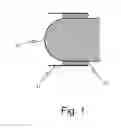
This is the case for example, as illustrated schematically in FIG. 1, for assembly of a shroud 11 (of metallic material or composite with thermoplastic or thermosetting matrix) on a tank 12 of thermoplastic matrix composite to constitute a propulsion stage of a powder launch vehicle, or a consumer gas tank.
In fact this assembly requires the insertion of a layer 13 of elastomeric material within the joint, said layer of elastomeric material having the role of absorbing the large differential strains that develop between the two structures. Therefore insertion of this interposed layer 13 of elastomeric material requires assembling this layer on the two elements of composite material that constitute the tank 12 and the shroud 11, and said assembly must necessarily be of high mechanical quality, owing to the stresses imposed on the assembly.
Now, in terms of mechanical durability, a welded joint is generally superior to a glued joint. In fact, after welding, there is no longer a differentiated interface between the two assembled parts, owing to diffusion of molecules from one part to the other, whereas in the case of a glued joint, there are as many interfaces as there are layers required for creating the joint, said layers mainly including, besides the layer of adhesive proper, the adhesion primers, as well as the treatments applied on the surfaces to be assembled.
Moreover, in the case of welding, we also no longer have the constraints due to preparation of the surfaces before assembly and protection of them against contaminants, these operations being necessary, or even imperative, in the case of assembly by gluing.
GENERAL DESCRIPTION OF THE INVENTION
One aim of the invention is to propose a solution for performing structural assembly by welding of a thermoplastic material and an elastomeric material, attention being focused on these two classes of materials.
Accordingly, the invention relates to a method for making a welded structural joint between a thermoplastic matrix composite and an elastomer, characterized in that said method comprises the following operations:
-
- a first operation of functionalization of the elastomeric material by means of a nonwoven textile formed from thermoplastic material fibers, functionalization being carried out by penetration of the textile into the surface layer of the elastomeric material during the operation of vulcanization of said elastomeric material under pressure;
- a second operation of welding proper, during which the thermoplastic composite material is welded to the functionalized layer of elastomeric material.
According to various particular arrangements, which may be considered jointly, the method according to the invention may in addition have the following features.
According to a particular arrangement, the operation for producing the functionalized elastomer itself comprises several steps:
-
- a first step of cleaning the various parts of the vulcanizing mold used;
- a second step during which the nonwoven textile is applied on the surface of the elastomeric material;
- a third step during which vulcanization of the elastomeric material under pressure is carried out; the pressure applied being such that the nonwoven textile placed at the surface of the elastomer becomes incorporated therein, at least at the surface, during the vulcanizing process.
According to another particular arrangement, the nonwoven textile is produced by carrying out the following operations:
-
- carding of thermoplastic material monofilaments;
- producing webs that are superposed on one another and held together by needlepunching;
- reinforcing the textile by hydroentangling.
According to another particular arrangement, the nonwoven textile is made from a thermoplastic material selected so that it is both able to be welded to the thermoplastic material forming the matrix of the composite material and to display good compatibility with the elastomeric material.
According to a variant of this particular arrangement, the nonwoven textile is made from a thermoplastic material identical to that forming the matrix of the composite material.
According to another particular arrangement, the composite material being a carbon/polyetheretherketone composite and the elastomeric material being of the HNBR type, the nonwoven textile used is formed from polyetherimide fibers.
According to another particular arrangement, the second welding operation consists in heating the faying surfaces of the two materials to be welded by interposing, between these two surfaces, a woven metal wire cloth which performs the function of heating resistance, the woven metal wire cloth itself being impregnated with thermoplastic material.
According to another particular arrangement, the welding operation is preceded by a preliminary operation of preparation of the surfaces of the materials to be assembled, and said operation may, depending on the state of these surfaces, consist either of a simple degreasing using a suitable solvent, or fine grinding of the functionalized surface of the element made of elastomer, followed by cleaning the surfaces with the same solvent.
According to another particular arrangement, the composite material being a carbon/polyetheretherketone composite and the elastomeric material being of the HNBR type, the operation of functionalization of the elastomeric material comprises the following operations:
a) a first operation of placing the following elements on the bottom plate of the vulcanizing mold:
-
- two superposed layers of Teflon-coated glass cloth;
- a sheet of nonwoven textile composed of polyetherimide fibres;
- the sheets of unvulcanized raw elastomeric material;
- a set of edging blocks;
- two superposed layers of Teflon-coated glass cloth;
the whole being covered with the top plate of the vulcanizing mold;
b) a second operation of placing the stack prepared on the plate of a heating press preheated to a temperature θ2 of 140° C.;
c) a third operation of hot pressing of the stack, during which the nominal pressing cycle appropriate to the elastomer in question is applied;
d) a fourth operation during which the mold is removed from the press while the latter maintains the temperature θ2 of 140° C., the functionalized elastomer is removed from the mold and is left to cool to room temperature.
According to a variant of this particular arrangement, the pressing cycle in the third operation comprises:
-
- a phase of gradual increase in temperature up to a high temperature θ1 of 230° C. at a gradient of 2.5° C./min,
- a phase of holding at the temperature θ1 for 10 minutes,
- a phase of temperature decrease to the temperature θ2 of 140° C. at a gradient of 2.5° C./min.
According to another particular arrangement, the composite material being a carbon/polyetheretherketone composite and the elastomeric material being of the HNBR type, the operation of welding proper II) comprises the following steps:
a) A first step of setting up, during which mainly the following elements are arranged, in the order shown, on a plate of heat-insulating material:
-
- a first film of heat-resistant polyimide,
- the functionalized elastomeric material,
- a first film of polyetherimide,
- a woven metal wire cloth preimpregnated with polyetherimide,
- a second film of polyetherimide,
- the thermoplastic composite material,
- a second polyimide film,
- a layer of heat-insulating material,
- glass cloth;
b) A second step during which a bladder is produced under vacuum with a polyimide film arranged so as to allow the woven metal wire cloth to stand out, hermeticity of said bladder being ensured by means of high-temperature mastic.
c) A third step during which the bladder is placed under vacuum, an electric power supply unit is connected to the woven metal wire cloth and different values of current are applied according to an appropriate cycle.
d) A fourth step during which the polyimide film serving as vacuum enclosure is removed and the stack is dismounted.
According to another particular arrangement, during the third step, a current of 15.6 A is applied to the woven metal wire cloth for 200 seconds and then a current of 10 A for 100 seconds.
DESCRIPTION OF THE FIGURES
The features and advantages of the invention will be better understood from the description that follows, which is based on the appended figures, in which:
FIG. 1 is a schematic illustration of an example of a structure for which assembly of the different elements by welding seems particularly suitable, in view of the mechanical stresses imposed on said assembly;
FIG. 2 is an illustration of an embodiment example of the elastomer functionalization step of the method according to the invention; and
FIG. 3 is an illustration of an embodiment example of the welding operation according to the invention.
DETAILED DESCRIPTION
The principle of the method according to the invention consists mainly of carrying out an operation of preparation of the elastomeric material, before welding proper. This operation consists of functionalizing, i.e. of modifying the surface, or the actual core, of the elastomer in order to endow it with the necessary properties so that it can be welded to the thermoplastic material. “Functionalizing the elastomeric material” means therefore “modifying” the composition of the surface layers of this elastomeric material by incorporating a thermoplastic material therein.
For this purpose, a nonwoven textile formed from fibres of a thermoplastic material having both compatibility with the elastomeric material and being weldable to the matrix of the thermoplastic composite material to which we wish to assemble the elastomeric material in question, is introduced into the elastomeric material, or at least at its surface.
Compatibility between the elastomeric material and the thermoplastic material forming the nonwoven textile mainly means, in this case, physicochemical compatibility between the two materials. This compatibility is reflected in possible interaction between the thermoplastic material of the nonwoven textile and the elastomer, an interaction that a person skilled in the chemistry of plastics is able to characterize by specific criteria, which are rather of a chemical nature: wettability, mutual diffusion between the materials, chemical bonds.
However, we are also interested in compatibility of application between the different materials (physical compatibility), notably regarding the need to be able to hot-vulcanize the elastomer but without causing degradation of the thermoplastic material forming the incorporated textile.
The operation of producing the functionalized elastomer comprises several steps:
-
- a first step of cleaning the various parts of the vulcanizing mold, said cleaning being carried out for example with methyl ethyl ketone (or MEK).
- a second step during which the nonwoven textile is applied on the surface of the raw (i.e. not yet vulcanized) elastomeric material and vulcanization of the elastomeric material under pressure is carried out. According to the invention, the pressure applied is determined such that the nonwoven textile placed at the surface of the elastomer becomes incorporated therein, at least at the surface, during the vulcanizing process.
Thus, for example, in a particular embodiment of the invention, more particularly suitable for welding a composite material with a matrix of polyetheretherketone (PEEK) and with carbon fiber reinforcement (carbon/PEEK thermoplastic composite) to an elastomer of the type of hydrogenated nitrile rubbers (hydrogenated butadiene-acrylonitrile), or Buna or else HNBR (hydrogenated nitrile butadiene rubber), the production proper of the functionalized elastomer may itself comprise the following operations:
a) A first operation of setting up, on the bottom plate 21 of the vulcanizing mold, the elements necessary for carrying out functionalization of the elastomeric material, namely in the following order, and as illustrated in FIG. 2:
-
- two superposed layers 22 and 23 of Teflon-coated glass cloth, whose role consists of allowing mold release of the elastomer after polymerization;
- a sheet of nonwoven textile 24 composed of polyetherimide (or PEI) fibers,
- the sheets of raw elastomeric material 25 (unvulcanized), to be functionalized,
- a set of edging blocks 26, 27, blocks of type 304L stainless steel for example,
- two superposed layers 28 and 29 of Teflon-coated glass cloth, performing a role similar to that provided by layers 22 and 23.
After setting up, the whole is covered with the top plate 211 of the vulcanizing mold so that all the elements listed above are positioned between the bottom plate 21 and the top plate 211 of the mold;
b) a second operation of placing the stack prepared on the plate of a heating press preheated to a temperature θ2 of 140° C.;
c) a third operation of hot pressing of the stack, during which the nominal pressing cycle appropriate to the elastomer in question is applied, said cycle comprising:
-
- a phase of gradual increase in temperature up to a high temperature θ1 (230° C. at 2.5° C./min),
- a phase of holding at the temperature θ1 (230° C. plateau for 10 minutes),
- a phase of temperature decrease to the temperature θ2 (140° C. at 2.5° C./min);
d) a fourth operation during which the mold is removed from the press while the latter maintains the temperature θ2 (140° C.), the functionalized elastomer is removed from the mold and is left to cool to room temperature.
A surface-functionalized vulcanized elastomer is thus obtained, comprising a conventional elastomer base having a surface layer of elastomer functionalized by the layer of nonwoven textile 24 formed from thermoplastic material fibers, a layer having a thickness of 0.4 mm for example.
It should be noted that, according to the invention, the nonwoven textile used here consists, preferably, of short fibers of thermoplastic material, of PEI for example, entangled and distributed in a random orientation. The method for manufacturing this nonwoven textile mainly comprises the following operations:
-
- carding of thermoplastic material monofilaments;
- producing webs that are superposed on one another and held together by needlepunching;
- reinforcing the textile by hydroentangling.
In a particular embodiment, the nonwoven textile is selected to be the same material as that which constitutes the matrix of the composite material to which the elastomeric material is to be welded, a textile having a density of 100 g/m2, needlepunched and hydroentangled under a pressure of 40 bar for example.
However, it should be noted that this nonwoven textile may be produced from a different material, notably to better satisfy the dual requirement of good adhesion of the two thermoplastic materials (i.e. that of the composite material and that of the textile for functionalization of the elastomer) and of good compatibility of the material constituting the textile for functionalization and of the elastomeric material.
Once the polymer material is functionalized, the method according to the invention continues with the welding step proper, an operation which, owing to the functionalization of the polymer material, takes place advantageously similarly to an operation of welding of two parts made of thermoplastic matrix composite. This operation may notably be carried out by induction or by resistance.
It should be noted that, advantageously, the welding operation is not subject to any constraint of delay in being carried out, in contrast to what may happen in the case of assembly by gluing. Since the functionalized elastomeric material is vulcanized before assembly, welding of the two materials may thus be carried out at the time that is considered to be the most suitable, which may be a varying length of time after completion of functionalization.
The resistance method consists of local heating of the interface between the composite material and the functionalized elastomer, to obtain a bond between the thermoplastic matrix of composite material and the thermoplastic part of the functionalized elastomer.
According to the invention, the welding step proper begins with a preliminary operation of preparation of the surfaces to be assembled. Depending on the state of these surfaces, preparation may consist of simple degreasing using a suitable solvent, ethanol for example, or fine grinding of the functionalized surface of the element made of elastomer, with SiC paper abrasive of 400 grain for example, followed by cleaning the surfaces and in particular the ground surface, using the same solvent. Here, “suitable solvent” means a solvent of fats, which by its nature or its composition does not present any risk of causing dissolution of the material itself.
There then follows an operation consisting of heating the faying surfaces of the two materials to be welded by interposing, between these two surfaces, a woven metal wire cloth, which performs the function of heating resistance; said operation being carried out under vacuum.
According to the invention, the woven metal wire cloth is itself impregnated with thermoplastic material.
Thus, for example, in a particular embodiment of the invention, more particularly suitable for welding a composite material with a PEEK matrix and with carbon fiber reinforcement (carbon/PEEK thermoplastic composite) to an elastomer of the HNBR type (Buna), the operation of welding proper may itself comprise the following steps:
a) A first step of setting up, during which, as illustrated in FIG. 3, mainly the following elements are arranged, in the order shown, on a plate 31 of heat-insulating material, NL FIH for example:
-
- a first film 32 of heat-resistant polyimide, preferably a film of Upilex®, intended to promote disassembly of the assembly after welding,
- the functionalized elastomeric material 33,
- a first film 34 of polyetherimide (PEI), of the type Ultem® 1000 for example,
- a woven metal wire cloth 35 preimpregnated with PEI, for example a cloth of reference 102083 manufactured by the company Gantois,
- a second film 36 of polyetherimide (PEI),
- the thermoplastic composite material 36 (C/PEEK) coated with PEI,
- a second film 37 of polyimide Upilex also intended to promote disassembly of the assembly after welding,
- a layer of heat-insulating material 38 (NL FIH),
- glass cloth 311, of the type E5555 for example, intended to promote drainage of the air present.
b) A second step during which a bladder is produced under vacuum with a film 312 of polyimide (Thermalimide) arranged so as to allow the woven metal wire cloth impregnated with PEI to stand out; hermeticity being obtained with a high-temperature mastic A800 3G.
c) A third step during which the bladder 312 thus produced is placed under vacuum, an electric power supply unit is connected to the woven metal wire cloth 35 and different values of current are applied according to an appropriate cycle: for example 15.6 A for 200 seconds and then 10 A for 100 seconds.
d) A fourth step during which the polyimide film 312 serving as vacuum enclosure is removed and the stack is dismounted, so as to recover the elastomer-thermoplastic composite assembly thus produced.
Claims
1-12. (canceled)
13. A method for producing a welded structural joint between a thermoplastic matrix composite and an elastomer, comprising the steps of:
functionalizing an elastomeric material using a nonwoven textile formed from thermoplastic material fibers, functionalization is carried out by penetration of the non-woven textile into a surface layer of the elastomeric material during vulcanization of the elastomeric material under pressure to provide a functionalized layer of the elastomeric material; and
welding a thermoplastic composite material of the thermoplastic matrix composite to the functionalized layer of the elastomeric material.
14. The method as claimed in claim 13, wherein the step of functionalizing comprises the steps of:
cleaning various parts of a vulcanizing mold;
applying the nonwoven textile on a surface of the elastomeric material; and
vulcanizing the elastomeric material under a pressure so that the nonwoven textile placed at a surface of the elastomer material becomes incorporated therein, at least at the surface, during the vulcanization process.
15. The method as claimed in claim 13, further comprising the steps of producing the nonwoven textile by:
carding thermoplastic material monofilaments;
producing webs superposed on one another and held together by needle-punching; and
reinforcing the nonwoven textile by hydro-entangling.
16. The method as claimed in claim 13, further comprising the step of producing the nonwoven textile from a thermoplastic material that is both weldable to a thermoplastic material forming the thermoplastic matrix composite and compatible with the elastomeric material.
17. The method as claimed in claim 16, further comprising the step of producing the nonwoven textile from a thermoplastic material identical to the thermoplastic material forming the thermoplastic matrix composite.
18. The method as claimed in claim 13, wherein the thermoplastic composite material is a carbon/polyetheretherketone composite; wherein the elastomeric material is of a hydrogenated nitrile butadiene rubber type; and wherein the nonwoven textile is formed from polyetherimide fibers.
19. The method as claimed in claim 13, wherein the step of welding comprises the steps of heating faying surfaces of two materials to be welded by interposing a woven metal wire cloth between the faying surfaces of the two materials, the woven metal wire cloth functions as a heating resistance and the woven metal wire cloth is impregnated with a thermoplastic material.
20. The method as claimed in claim 19, further comprising the step of preparing the faying surfaces of the two materials to be assembled prior to the step of welding.
21. The method of claim 20, wherein the step of preparing comprises the steps of degreasing using a solvent, and cleaning the faying surfaces of the two materials with the solvent.
22. The method of claim 20, wherein the step of preparing comprises the steps of grinding a surface of the functionalized layer of the elastomeric material forming the elastomer, and cleaning the surface of the functionalized layer with a solvent.
23. The method as claimed in claim 13, wherein the thermoplastic composite material is a carbon/polyetheretherketone composite; wherein the elastomeric material is of a hydrogenated nitrile butadiene rubber type; and wherein the step of functionalizing the elastomeric material comprises the steps of:
setting up the following elements on a bottom plate of a vulcanizing mold and covering the elements with a top plate of the vulcanizing mold to provide a stack:
a first set of two superposed layers of Teflon-coated glass cloth;
a sheet of nonwoven textile composed of polyetherimide fibers;
sheets of unvulcanized raw elastomeric material;
a set of edging blocks; and
a second set of two superposed layers of Teflon-coated glass cloth; and
placing the stack on plate of a heating press preheated to a temperature θ2 of 140° C.;
hot pressing the stack by applying a nominal pressing cycle of the elastomer in question is applied;
removing the vulcanizing mold from the heating press which maintains the temperature θ2 of 140° C.; and
removing the functionalized layer of elastomeric material from the vulcanizing mold to cool to a room temperature.
24. The method as claimed in claim 23, wherein the nominal pressing cycle comprises:
a phase of gradual increase in temperature to a high temperature θ1 of 230° C. at a gradient of 2.5° C./min;
a phase of maintaining a temperature θ1 for 10 minutes; and
a phase of temperature decrease to the temperature θ2 of 140° C. at a gradient of 2.5° C./min.
25. The method as claimed in claim 13, wherein the thermoplastic composite material is a carbon/polyetheretherketone composite; wherein the elastomeric material is of a hydrogenated nitrile butadiene rubber type, and wherein the step of welding comprises the steps of:
setting up and arranging the following elements in order on a plate of heat-insulating material to provide a stack:
a first film of heat-resistant polyimide;
the functionalized layer of elastomeric material;
a first film of polyetherimide;
a woven metal wire cloth pre-impregnated with polyetherimide;
a second film of polyetherimide;
the thermoplastic composite material;
a second film of heat-resistant polyimide;
a layer of heat-insulating material; and
a glass cloth;
producing a bladder under a vacuum with a third film of heat-resistant polyimide arranged to allow the woven metal wire cloth to stand out and ensuring a hermeticity of the bladder by a high-temperature mastic;
placing the bladder under the vacuum, connecting an electric power supply unit to the woven metal wire cloth, and applying different values of current according to a predetermined cycle;
removing the third film of heat-resistant polyimide serving as a vacuum enclosure and dismounting the stack.
26. The method as claimed in claim 25, further comprising the steps of applying a current of 15.6 amps to the woven metal wire cloth for 200 seconds, and then applying a current of 10 amps to the woven metal wire cloth for 100 seconds.
Images & Drawings included:


Sources:
- United States Patent and Trademark Office - verify current appl. status at the USPTO↗
Similar patent applications:
Recent applications in this class:
- » 20220212418 2022-07-07
DIRECT APPLICATION OF THERMOSETTING COMPOSITE SURFACING FILMS TO UV-TREATED THERMOPLASTIC SURFACES AND RELATED COMPOSITE STRUCTURES - » 20210394459 2021-12-23
Composite article and method of forming a composite article - » 20210237369 2021-08-05
ENERGY CONVERTING FILMS AND ASSEMBLIES INCLUDING THE SAME - » 20190232573 2019-08-01
Fibrous joinery interface between structures - » 20180036962 2018-02-08
Bonded structure - » 20160185037 2016-06-30
Method for Manufacturing a Composite Resilient Product that is Selected from Thermosetting Material and Thermoplastic Material - » 20160176107 2016-06-23
FIBROUS JOINERY INTERFACE BETWEEN STRUCTURES - » 20160059479 2016-03-03
Welded structural joint between a high-performance thermoplastic matrix composite material and an elastomer by powder functionalization - » 20110200802 2011-08-18
Laser Welding of Polymeric Materials - » 20070095479 2007-05-03
Device for permanently joining at least two components, comprising at least one power source
Recent applications for this Assignee:
- » 20230341088 2023-10-26
REFRIGERATION METHOD USING AN ARTIFICIAL NEURAL NETWORK - » 20220220926 2022-07-14
Jet nozzle equipped with a thermally regulated ring - » 20220161440 2022-05-26
Device and method for finishing a solid-propellant charge - » 20220153712 2022-05-19
PROCESS FOR PRODUCING A POLYBENZOXAZINE MONOMER - » 20220153619 2022-05-19
Method for biologically treating ammonium perchlorate with pooling of the microfiltration - » 20220085500 2022-03-17
Antenna with improved coverage over a wider frequency band - » 20220034360 2022-02-03
Lockable modular connection device - » 20210403636 2021-12-30
Polyepoxidized biphenyl compounds, preparation and uses - » 20210403180 2021-12-30
Tank for a spacecraft engine - » 20210324818 2021-10-21
CHILLDOWN DEVICE AND METHOD