Retractable treadmill desk
US20160074701A1
2016-03-17
14/851,126
2015-09-11
✅ Patent granted
US 9,795,827 B2
2017-10-24
-
-
Joshua Lee
Sheridan Ross P.C.
2035-09-11
Abstract:
A retractable walking treadmill which may be connected to an adjustable-height desk, in such a way as to be able to be retracted and stowed vertically when not in use.
Inventors:
- Cole Dalton 6 🇺🇸 Snohomish, WA, United States
- Ron Wiener 6 🇺🇸 Mercer Island, WA, United States
- Andrew Rosenbaum 6 🇺🇸 Mercer Island, WA, United States
Assignee:
- THERMOGENESIS GROUP, INC. 5 🇺🇸 Bellevue, WA, United States
Applicant:
Interested in similar patents?
Get notified when new applications in this technology area are published.
Classification:
A63B22/02 » CPC main
Exercising apparatus specially adapted for conditioning the cardio-vascular system, for training agility or co-ordination of movements with movable endless bands, e.g. treadmills
A63B22/0023 » CPC further
Exercising apparatus specially adapted for conditioning the cardio-vascular system, for training agility or co-ordination of movements with an adjustable movement path of the support elements the inclination of the main axis of the movement path being adjustable, e.g. the inclination of an endless band
A63B22/0235 » CPC further
Exercising apparatus specially adapted for conditioning the cardio-vascular system, for training agility or co-ordination of movements with movable endless bands, e.g. treadmills driven by a motor
A47B2220/06 » CPC further
General furniture construction, e.g. fittings Treadmill combined with furniture
A63B21/152 » CPC further
Exercising apparatus for developing or strengthening the muscles or joints of the body by working against a counterforce, with or without measuring devices; Arrangements for force transmissions; Using flexible elements for reciprocating movements, e.g. ropes or chains Bowden-type cables
A63B71/0054 » CPC further
Games or sports accessories not covered in groups - Features for injury prevention on an apparatus, e.g. shock absorbers
A63B2071/0081 » CPC further
Games or sports accessories not covered in groups -; Features for injury prevention on an apparatus, e.g. shock absorbers Stopping the operation of the apparatus
A63B2208/0204 » CPC further
Characteristics or parameters related to the user or player posture Standing on the feet
A63B2208/0233 » CPC further
Characteristics or parameters related to the user or player posture; Sitting on the buttocks in 90/90 position, like on a chair
A63B2210/06 » CPC further
Space saving incorporated in cabinets
A63B2210/50 » CPC further
Space saving Size reducing arrangements for stowing or transport
A63B2220/803 » CPC further
Measuring of physical parameters relating to sporting activity; Special sensors, transducers or devices therefor Motion sensors
A63B71/00 IPC
Games or sports accessories not covered in groups -
A63B21/00 IPC
Exercising apparatus for developing or strengthening the muscles or joints of the body by working against a counterforce, with or without measuring devices
A63B22/00 IPC
Exercising apparatus specially adapted for conditioning the cardio-vascular system, for training agility or co-ordination of movements
A63B2225/093 » CPC further
Miscellaneous features of sport apparatus, devices or equipment; Adjustable dimensions Height
Description
BACKGROUND
Treadmill desks are rapidly becoming more commonplace in the workplace and home office. However, a major limiting factor in the adoption of treadmill desks has been the space required for the treadmill, especially when not in use. Since treadmill desks are typically only used for a few hours per day at most, a major convenience would be the ability to make the treadmill “vanish” in order to recover the floor space, and to be able to use the desk in a standing or sitting modality, at the correct ergonomic height.
“Incline” mechanisms and “folding” mechanisms are known.
Incline mechanisms vary in design, but are designed to raise the front of the treadmill to increase exertion level. None reach a position that makes the treadmill no longer functional for walking/running, hence none are designed to continue lifting the treadmill until it is stowed vertically.
Folding mechanisms hinge the treadmill at the front. There are some designs in the market that fold the desk up along with the treadmill, though this is an impractical solution as most people do not want to clear their desk of all items before stowing the treadmill. Also, this means the desk cannot be used so long as the treadmill is stowed.
BRIEF DESCRIPTION OF THE DRAWINGS
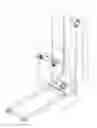
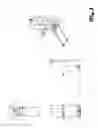
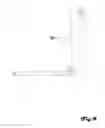
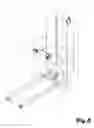
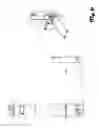
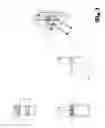
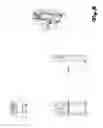
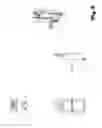
FIG. 1 illustrates multiple graphical projections of an embodiment of a retractable treadmill desk.
FIG. 2 illustrates one of the graphical projections of FIG. 1, with greater detail.
FIG. 3 illustrates one of the graphical projections of FIG. 1, with greater detail.
FIG. 4 illustrates one of the graphical projections of FIG. 1, with greater detail.
FIG. 5 illustrates one of the graphical projections of FIG. 1, with greater detail.
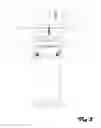
FIG. 6 illustrates the retractable treadmill desk of FIG. 1, with the treadmill partially retracted.
FIG. 7 illustrates the retractable treadmill desk of FIG. 1, with the treadmill partially retracted.
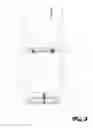
FIG. 8 illustrates the retractable treadmill desk of FIG. 1, with the treadmill partially or fully retracted.
FIG. 9 illustrates the retractable treadmill desk of FIG. 1, with the treadmill partially or fully retracted and with the desk reduced in height.
DETAILED DESCRIPTION
The disclosed retractable treadmill desk is a walking treadmill which may be connected to an adjustable-height desk, in such a way as to be able to be retracted and stowed vertically behind the desk when not in use. This can be done in a single operation when the user presses the “Retract” button, wherein the desk is automatically raised to its highest position, the treadmill is pulled up and locked into a safe vertical position behind the desk, and the desk is then lowered back down to either a standing-height or sitting-height position, per the user's preference. The disclosed retractable treadmill may be integrated with a desk or may be a stand-alone item.
Retracting the treadmill and movement of the desk may be fully automated, through user activation of a “Retract” button, or may be partially automated, such as through separate commands to move the desk and to retract the treadmill.
The desktop may incorporate a “cabinet” for the treadmill, for safety and to conceal the treadmill from view atop the desk when stowed.
The mechanism for lifting the treadmill shown in the figures includes a track and a cable connecting the motor to the treadmill. The motor can wind and unwind the cable to raise and lower the treadmill. The track keeps the treadmill aligned as it is raised and lowered so the long sides of the treadmill stay perpendicular to the front and rear edges of the desk. Other mechanisms for keeping the treadmill aligned can be devised, including mechanisms without a track.
Another aspect of the track would be a mechanism for keeping the treadmill in the track. Examples of mechanisms for that include guide wheels or glides on the treadmill portion of the guiding system riding in a channel shaped rail or other shape capable of capturing the guide wheels/glides.
Another variant of the design, in place of a single cable as shown in the figures, would have cables attached to both sides of the treadmill and those cables would be attached to both ends of an axle. The axle could then be rotated by the motor (or alternately a manual mechanism) to raise and lower the treadmill by winding and unwinding the cable on the axle. Other mechanisms for sensing and controlling the movement of the treadmill to keep it moving in the desired direction could include two motor/cable systems and sensors or encoders to detect the differential in motion of the treadmill—and automatic correction, etc.
Another variant of this mechanism would be use a chain mechanism instead of a track and cables.
Other lifting mechanisms besides the motor and cable can be devised. These can include springs and other linkages. Many different linkages including but are not limited to equal and unequal length paired arms (a.k.a. 4-bar linkages), single lever systems, combinations of cams, levers and so-called “geneva” mechanisms. These and other examples of kinematic linkages could be actuated with cables, as on the previous examples, or by direct or indirect acting linear actuators. Actuators could be electro-mechanical, hydraulic, pneumatic, or a combination of these. Manually driven mechanisms are also possible, utilizing human power as the prime mover. Spring-loaded mechanisms, mechanical, pressurized gas, or other typical devices could be used to support portions of the load and assist the manual, electro-mechanical, or other driving mechanisms which move the treadmill.
Pulley systems may also be employed to either manually or automatically raise and lower the treadmill. The pulleys may be used to provide a convenient means to manually actuate—as on some window shade or roll-up warehouse doors. Or, an actuator of some sort may be attached to the cable/chain/rope to provide automatic actuation. Push-pull (“Bowden”) cables could also be used to deploy and retract, providing positive positioning throughout the entire range of motion. Pulley/gantry systems may also be used to amplify force or motion to allow for shorter stroke actuators and/or provide a more compact mechanism envelope.
A purely mechanical mechanism for lifting and lowering the treadmill may also be utilized.
Safety is a key consideration when moving the treadmill up and down. Various levels of safety can be built into these mechanisms.
One safety feature would be a mechanism to lock the treadmill into the upright position. One example of this would be an actuator that slides a restraining bar across the mechanism that allows (or prevents) the treadmill to be (or from being) lowered.
Another safety mechanism would be similar to the way an inertial reel or car seat belt mechanism works that keeps the treadmill from unwinding and sliding out of the upright position. These mechanical mechanisms operate by sensing unexpected or unallowed acceleration or deceleration events and, as a result, causes a mechanism to move into a position that locks the unwinding mechanism.
Claims
1. A retractable treadmill which may be used in combination with a desk.
Images & Drawings included:
Sources:
- United States Patent and Trademark Office - verify current appl. status at the USPTO↗
Recent applications in this class:
- » 20250222302 2025-07-10
EXERCISE DEVICE AND EXERCISE SYSTEM HAVING THE SAME - » 20250213913 2025-07-03
FOLDABLE TREADMILL - » 20250195944 2025-06-19
Rollback Braking for Non-Motorized Treadmills - » 20250195943 2025-06-19
HANDRAIL FOLDING STRUCTURE FOR TREADMILL - » 20250186829 2025-06-12
LIFTING STRUCTURE FOR PLATFORM OF TREADMILL - » 20250144468 2025-05-08
Locking mechanism for upright post of walking machine - » 20250082987 2025-03-13
TREADMILL CAPABLE OF ADJUSTING SLOPE RISING AND FALLING BY SCREW ROD - » 20250082986 2025-03-13
TREADMILL - » 20240408443 2024-12-12
FOLDING TREADMILL - » 20240399196 2024-12-05
LIFTING STRUCTURE FOR TREADMILL
Recent applications for this Assignee:
- » 20210065916 2021-03-04
Standing desk mat - » 20190282012 2019-09-19
Standing desk mat - » 20190159586 2019-05-30
Powered sit-stand desk - » 20170273454 2017-09-28
Ergonomic keyboard and peripheral positioning system