AUTOMATIC SOLAR POWER SYSTEM ISOLATION SWITCH
US20160111919A1
2016-04-21
14/517,869
2014-10-19
Abstract:
In the case of solar, wind, or other such resource being chosen as a primary power system (hereafter means “normal state”) of a dwelling or recreational vehicle, this process is for automatic protection or disconnection of the preferred electrical system whenever an alternate power source is applied.
Whenever two power sources may not be applied simultaneously to a normally closed circuit, this process opens the circuit such that the alternate power source may become primary. As an example: Recreational vehicles or other craft, prior to conversion to solar power, normally receive power from a generator or public utility. To modify such a system, this process is inserted into the existing system to temporarily substitute external power to devices within, or devoted to, the existing system without human participation.
Assignee:
- ALEXIE SCHAUERTE 1 🇺🇸 ST.PETERSBURG, FL, United States
Interested in similar patents?
Get notified when new applications in this technology area are published.
Classification:
H02J9/062 » CPC main
Circuit arrangements for emergency or stand-by power supply, e.g. for emergency lighting in which the distribution system is disconnected from the normal source and connected to a standby source with automatic change-over, e.g. UPS systems for AC powered loads
H02J9/06 IPC
Circuit arrangements for emergency or stand-by power supply, e.g. for emergency lighting in which the distribution system is disconnected from the normal source and connected to a standby source with automatic change-over, e.g. UPS systems
Description
BRIEF DESCRIPTION OF THE DRAWINGS
“Fig.” is to be defined as the word Figure.
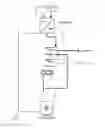
Figure A is a flowchart of the process.
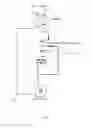
Figure B is an electrical schematic of a system.
DETAILED DESCRIPTION OF THE INVENTION
An inverter is a device that converts electrical direct current (DC) to alternating current (AC). An inverter provides the ability to run AC devices from DC batteries which may be charged by sources such as a solar panel/array. In an independent (off-grid) system, inverters are powered by direct connection to the battery or batteries.
A normally closed (NC) relay will remain as the primary electrical source conductor while it remains in its normal (inactivated) state. (See Figure A)
When external power is applied, this switching process empowers the NC relay, or series of otherwise unpowered relays, resulting in an exchange of power sources and temporary exclusion of the inverter's output from the electrical system.
Whenever the double throw relay's solenoid is energized by an external (secondary) source, the secondary source automatically becomes primary. (See Figure B)
Claims
1. No power is consumed by the device in its normal state. When an external power source is applied it empowers a normally closed double throw relay, which takes the primary (default) system offline and temporarily substitutes the new power source.
2. When external power is removed, the relay reverts back to the default power source (its “normal state”) until any external power is reapplied.
3. The process begins at attachments to the inverter's alternating current output terminals (power outlet), and ends at a connection to the input terminals of the domicile's power distribution system (line, neutral, and ground).
Images & Drawings included:

Sources:
- United States Patent and Trademark Office - verify current appl. status at the USPTO↗
Recent applications in this class:
- » 20250167586 2025-05-22
ENERGY COUPLING METHOD AND SYSTEM FOR HOUSEHOLD ENERGY STORAGE - » 20250141259 2025-05-01
UNINTERRUPTIBLE POWER SUPPLY - » 20250141258 2025-05-01
Thermal-Power Direct-Hung Energy-Storage Frequency Modulation Plant Backup Power System - » 20250132597 2025-04-24
POWER SUPPLY DEVICE - » 20250105659 2025-03-27
UNINTERRUPTIBLE POWER SUPPLY DEVICE - » 20250096596 2025-03-20
POWER SUPPLY APPARATUS - » 20250096595 2025-03-20
UNINTERRUPTIBLE POWER SUPPLY, POWER SYSTEM, CONTROL DEVICE, AND CONTROL METHOD - » 20250079881 2025-03-06
METHODS AND SYSTEMS FOR POWER SUPPLY - » 20250070593 2025-02-27
DEVICE FOR CONTROLLING LINE CONNECTION TYPE FUEL CELL SYSTEM AND METHOD FOR THE SAME - » 20250055311 2025-02-13
Method, System, and Computer Program Product for Uninterrupted Power Using an Array of Ultra-Capacitors