Exchanger for heating boilers
US20160146500A1
2016-05-26
14/904,477
2014-07-10
✅ Patent granted
US 9,587,852 B2
2017-03-07
WO; PCT/ES2014/000117; 20140710
WO; WO2015/004292; 20150115
Gregory A Wilson
Egbert Law Offices, PLLC
2034-07-10
Abstract:
An exchanger for heating boilers is formed of an external prismatic framework, a burner and an exhaust duct, characterized in that it includes a block of tubes formed of a plurality of tube sections positioned against one another horizontally and vertically, separated at equal distances from one another and integrated in a prismatic housing creating between them a closed circuit of water, leaving the tube sections free, forming different levels separated by deflectors in order to control the inflow and outflow of the gases produced by combustion, directing the gases as desired through the different levels, capturing the heat along the path of the gases in order to quickly heat the water in the circuit without losing calories and reducing fuel consumption as much as possible.
Inventors:
- CORDÓN URBIOLA Jose Luis 1 🇪🇸 Sartaguda (Navarra), Spain
- Jose, Luis CORDÓN URBIOLA 2 🇪🇸 Sartaguda (Navarra), Spain
- Jose Luis Cordón Urbiola 1 🇪🇸 Sartaguda, Spain
Applicant:
Interested in similar patents?
Get notified when new applications in this technology area are published.
Classification:
F28D7/085 » CPC further
Heat-exchange apparatus having stationary tubular conduit assemblies for both heat-exchange media, the media being in contact with different sides of a conduit wall the conduits being otherwise bent, e.g. in a serpentine or zig-zag with serpentine or zig-zag configuration in the form of parallel conduits coupled by bent portions
F24H1/14 IPC
Water heaters, e.g. boilers, continuous-flow heaters or water-storage heaters; Continuous-flow heaters, i.e. heaters in which heat is generated only while the water is flowing, e.g. with direct contact of the water with the heating medium in which the water is kept separate from the heating medium by tubes, e.g. bent in serpentine form
F28D7/08 IPC
Heat-exchange apparatus having stationary tubular conduit assemblies for both heat-exchange media, the media being in contact with different sides of a conduit wall the conduits being otherwise bent, e.g. in a serpentine or zig-zag
F28F9/001 » CPC further
Casings; Header boxes; Auxiliary supports for elements; Auxiliary members within casings Casings in the form of plate-like arrangements; Frames enclosing a heat exchange core
F28D2021/0024 » CPC further
Heat-exchange apparatus not covered by any of the groups - ; Other heat exchangers for particular applications; Heat exchange systems not otherwise provided for for combustion apparatus, e.g. for boilers
F28D7/1623 » CPC further
Heat-exchange apparatus having stationary tubular conduit assemblies for both heat-exchange media, the media being in contact with different sides of a conduit wall the conduits being arranged in parallel spaced relation the conduits being inside a casing and extending at an angle to the longitudinal axis of the casing; the conduits crossing the conduit for the other heat exchange medium with particular pattern of flow of the heat exchange media, e.g. change of flow direction
F24H9/0026 » CPC further
Details for water heaters; Guiding means in combustion gas channels
F28D21/00 IPC
Heat-exchange apparatus not covered by any of the groups -
F24H9/00 IPC
Details
F28D7/1661 » CPC further
Heat-exchange apparatus having stationary tubular conduit assemblies for both heat-exchange media, the media being in contact with different sides of a conduit wall the conduits being arranged in parallel spaced relation with conduit assemblies having a particular shape, e.g. square or annular; with assemblies of conduits having different geometrical features; with multiple groups of conduits connected in series or parallel and arranged inside common casing the conduit assemblies having a square or rectangular shape with particular pattern of flow of the heat exchange media, e.g. change of flow direction
F28D7/1684 » CPC further
Heat-exchange apparatus having stationary tubular conduit assemblies for both heat-exchange media, the media being in contact with different sides of a conduit wall the conduits being arranged in parallel spaced relation the conduits having a non-circular cross-section
F28D7/1692 » CPC further
Heat-exchange apparatus having stationary tubular conduit assemblies for both heat-exchange media, the media being in contact with different sides of a conduit wall the conduits being arranged in parallel spaced relation the conduits having a non-circular cross-section with particular pattern of flow of the heat exchange media, e.g. change of flow direction
F28F9/22 » CPC further
Casings; Header boxes; Auxiliary supports for elements; Auxiliary members within casings Arrangements for directing heat-exchange media into successive compartments, e.g. arrangements of guide plates
F28F9/00 IPC
Casings; Header boxes; Auxiliary supports for elements; Auxiliary members within casings
F28F1/04 » CPC further
Tubular elements; Assemblies of tubular elements; Tubular elements of cross-section which is non-circular polygonal, e.g. rectangular
F28D7/16 » CPC further
Heat-exchange apparatus having stationary tubular conduit assemblies for both heat-exchange media, the media being in contact with different sides of a conduit wall the conduits being arranged in parallel spaced relation
F24H1/145 » CPC main
Water heaters, e.g. boilers, continuous-flow heaters or water-storage heaters; Continuous-flow heaters, i.e. heaters in which heat is generated only while the water is flowing, e.g. with direct contact of the water with the heating medium in which the water is kept separate from the heating medium by tubes, e.g. bent in serpentine form using fluid fuel
F24H8/00 » CPC further
Fluid heaters characterised by means for extracting latent heat from flue gases by means of condensation
Description
CROSS-REFERENCE TO RELATED U.S. APPLICATIONS
Not applicable.
STATEMENT REGARDING FEDERALLY SPONSORED RESEARCH OR DEVELOPMENT
Not applicable.
NAMES OF PARTIES TO A JOINT RESEARCH AGREEMENT
Not applicable.
REFERENCE TO AN APPENDIX SUBMITTED ON COMPACT DISC
Not applicable.
BACKGROUND OF THE INVENTION
1. Field of the Invention
The present invention relates to an exchanger for heating boilers of those formed of an external prismatic framework, a burner and an exhaust duct, characterized by comprising a block of tubes formed of a plurality of tube sections positioned against one another horizontally and vertically, separated at equal distances from one another and integrated in a prismatic housing, creating between them a closed circuit of water, leaving the tube sections free, forming different levels separated by deflectors in order to control the inflow and outflow of the gases produced by combustion, directing said gases as desired through the different levels, capturing the heat along the path of the gases in order to quickly heat the water in the circuit without losing calories and reducing fuel consumption as much as possible and thereby making the exchanger more environmentally friendly.
The invention disclosed has the advantage of providing a high heating efficiency with any type of fuel, as well as an increased lifetime as no maintenance is required.
2. Description of Related Art Including Information Disclosed Under 37 CFR 1.97 and 37 CFR 1.98.
All boilers consist of three parts: the burner, where combustion takes place and energy is released from the fuel; the exhaust, where combustion gases escape; and the boiler body or boiler itself, which is the vessel in which the heat exchange occurs and therefore where the water is heated.
A new technology is currently being implemented for saving fuel in boilers based on using any available opportunity to ensure using all the energy stored in the fuel, reducing heat losses when heating the water as much as possible to obtain high efficiencies.
This is achieved by several simple methods, one of which is using the latent heat of condensation, using the energy released by water when changing state from gas to liquid.
When combustion takes place steam is generated naturally. Old boilers wasted this steam by simply releasing it through the gas exhaust duct as if it were as useless gas; however, new condensation boilers use this steam, condensing it and using the energy obtained in the process to heat the water contained in the boiler.
To increase efficiency even further, some boilers limit the water temperature to about 50° C. This option increases the start-up time of the boiler but considerably reduces its consumption as a low power is required, as well as promoting condensation.
According to the energy saving technology of patent ES2136609 a heating installation is disclosed that comprises a condensation catalyst that uses latent heat such that hot exhaust gases or fumes circulating in the condensation catalyst transfer their heat to the heating system water.
Another solution is provided in Spanish utility model U201130149, which describes a rustic stove formed of a rectangular prismatic body where at least the part considered the front has a zig-zag profile having a staggered profile which provides a means for deriving the heat generated by combustion, generally of wood, placed at a lower area of the stove body.
BRIEF SUMMARY OF THE INVENTION
To provide a solution that provides significant saving of energy an exchanger for heating boilers has been designed characterized by comprising a block of tubes formed of a plurality of tube sections positioned against one another horizontally and vertically, separated at equal distances from one another and integrated in a prismatic housing with deflectors.
The block of tubes does not require any maintenance but can be removed to be cleaned or replaced.
The prismatic housing comprises two side walls folded at 90° and two base walls, front and rear, that incorporate recesses coinciding with the plurality of tube sections, which are inserted in the ends thereof, creating an inner chamber meant for the water circuit, incorporating on the top part thereof a connection for the hot water outlet and a bottom connection for the cold water inlet.
The deflectors consist of a rectangular plate that can be moved as desired through side walls vertically positioned at the four ends of the prismatic housing. The deflectors can be oriented to increase or reduce the travel time of the gases inside the tubular block.
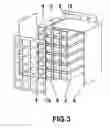
When the burner flame is produced with any type of fuel, gases and fumes are generated instantaneously in the combustion. Said gases, directed by the position of the deflectors, rise and alternately enter and exit the various levels of tubes, transmitting the heat to the water circuit in the inner chamber and heating the water quickly, as the gases travel several meters until they are expelled through the gas exhaust duct.
By using the combustion gases and fumes through the circuit created by the various levels of tubes, a high efficiency is achieved as the water is heated simultaneously to start-up, resulting in significant energy savings.
Advantages of the Invention
The heat exchanger for heating boilers of the invention disclosed herein provides several advantages over currently available exchangers, the most important one being that it comprises a plurality of tube sections horizontally and vertically positioned against one another and integrated in a prismatic housing, creating an inner chamber for the closed water circuit, having on the top part thereof a connection for hot water outlet and a bottom connection for water inlet.
Another no less important advantage is that the exchanger incorporates deflectors placed between side walls arranged vertically on the ends of the prismatic casing, which can be moved as desired.
Another important advantage is that the arrangement of the various levels of tubes separated by the deflectors create a conduct for alternate passage of the gases and fumes produced by combustion, heating the water simultaneously with the start-up and providing significant energy savings.
Lastly, a further advantage is that the exchanger is maintenance free and can be removed to be replaced or cleaned.
BRIEF DESCRIPTION OF THE DRAWINGS
To aid a better understanding of the subject matter of the present addition, the accompanying set of drawings represents a preferred practical embodiment thereof.
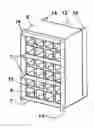
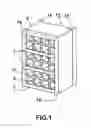
In said drawings FIG. 1 shows a perspective view of the exchanger for heating boilers.
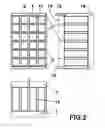
FIG. 2 shows a plan, elevation and profile view of the exchanger for heating boilers.
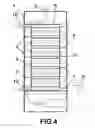
FIG. 3 shows a cross-sectional view of a boiler with the exchanger of the invention, showing the cycle of gases and fumes through the various levels formed by the tube sections.
DETAILED DESCRIPTION OF THE INVENTION
Preferred Embodiment of the Invention
The exchanger for heating boilers consisting of an external prismatic framework (1), a burner (2) and a gas exhaust (3) is characterized by comprising a block of tubes (4) configured by a plurality of tube sections (5) positioned horizontally and vertically against one another, separated by equal distances and integrated in a prismatic housing (6) with deflectors (7).
The prismatic housing (6) comprises two side walls (8) folded at 90° and two front and rear walls (9) provided with recesses (10) coinciding with the plurality of tube sections (5), which are inserted in said recesses at the ends thereof, defining an inner chamber (11) meant for the water circuit, incorporating at its top part a hot water outlet connection (12) and a bottom cold water inlet connection (13).
The deflectors (7) consist of a rectangular plate that can be moved as desired through side walls (14) vertically positioned against the four ends of the prismatic housing (6). The deflectors (7) consist of a rectangular plate that can be moved as desired through side walls (14) vertically positioned against the four ends of the prismatic housing (6).
Claims
1. Exchanger for heating boilers of those formed of an external prismatic framework (1), a burner (2) and a gas exhaust (3), characterized by comprising a block of tubes (4) formed of a plurality of tube sections (5), positioned against one another horizontally and vertically, separated at equal distances from one another and integrated in a prismatic housing (6) with deflectors (7).
2. Exchanger for heating boilers according to preceding claim, characterized in that the prismatic housing (6) comprises two side walls (8) folded at 90° and two front and rear walls (9) that incorporate recesses (10) coinciding with the plurality of tube sections (5), which are inserted in said recesses at their ends, creating an inner chamber (11) meant for the water circuit, incorporating at the top part thereof a hot water outlet connection (12) and a bottom cold water inlet connection (13).
3. Exchanger for heating boilers according to preceding claims, characterized in that the deflectors (7) consist of a rectangular plate that can be moved as desired through side walls (14) positioned vertically against the four ends of the prismatic housing (6).
Images & Drawings included:
Sources:
- United States Patent and Trademark Office - verify current appl. status at the USPTO↗
Similar patent applications:
- » 20190226774
Heat exchanger, boiler, and setting method for heat exchanger - » 20200096265
Systems and methods of using cleaning robots for removing deposits from heat exchange surfaces of boilers and heat exchangers - » 20190041201
System and methods for detecting, monitoring, and removing deposits on boiler heat exchanger surfaces using vibrational analysis - » 20180119945
Multistage boiler heat exchange apparatus - » 20160025486
System and methods for detecting, monitoring, and removing deposits on boiler heat exchanger surfaces using vibrational analysis - » 20160025485
System and methods for detecting, monitoring, and removing deposits on boiler heat exchanger surfaces using vibrational analysis - » 20090308568
Storage type boiler heating exchanging structure for preventing condensation - » 20140250888
Heat exchangers, boilers, and systems incorporating the same - » 20180195860
System and methods for detecting, monitoring, and removing deposits on boiler heat exchanger surfaces using vibrational analysis - » 20190271463
Boiler Heat Exchanger
Recent applications in this class:
- » 20240133586 2024-04-25
COMPACT FLUID HEATING SYSTEM WITH HIGH BULK HEAT FLUX USING ELEVATED HEAT EXCHANGER PRESSURE DROP - » 20230030298 2023-02-02
Heat Exchanger Tubes and Tube Assembly Configurations - » 20220196284 2022-06-23
COMBUSTION DEVICE AND WATER HEATING DEVICE - » 20220042716 2022-02-10
Heat exchangers providing low pressure drop - » 20210325084 2021-10-21
Water heating device - » 20210215392 2021-07-15
Compact fluid heating system with high bulk heat flux using elevated heat exchanger pressure drop - » 20210102730 2021-04-08
Heat exchanger tubes and tube assembly configurations - » 20200116389 2020-04-16
Heat transfer fin - » 20200064020 2020-02-27
Heat exchanging unit, heat exchanging apparatus, and hot water supply system - » 20190360723 2019-11-28
Heat source machine