Method for the methylation of nitrogen-containing organic compounds
US20160168043A1
2016-06-16
14/902,704
2014-06-25
✅ Patent granted
US 9,650,310 B2
2017-05-16
WO; PCT/EP2014/063343; 20140625
WO; WO2015/000753; 20150108
Sun Jae Yoo
Schmeiser, Olsen & Watts, LLP
2034-06-25
Abstract:
A method for the methylation of amines, amides and imines comprises the step of reacting these compounds with CO2 and H2 in the presence of a Ruthenium-phosphine complex.
Inventors:
- Walter Leitner 73 🇩🇪 Aachen, Germany
- Jürgen Klankermayer 8 🇩🇪 Essen, Germany
- JÜRGEN KLANKERMAYER 1 🇩🇪 ESSEN, Germany
- Kassem BEYDOUN 1 🇩🇪 Aachen, Germany
- Thorsten VOM STEIN 1 🇩🇪 Köln, Germany
- Thorsten Vom Stein 1 🇺🇸 Köln, DE, United States
Assignee:
- RHEINISCHE-WESTFÄLISCHE TECHNISCHE HOCHSCHULE (RWTH) AACHEN 1 🇩🇪 , Germany
Applicant:
Interested in similar patents?
Get notified when new applications in this technology area are published.
Classification:
C07D209/08 » CPC further
Heterocyclic compounds containing five-membered rings, condensed with other rings, with one nitrogen atom as the only ring hetero atom condensed with one carbocyclic ring; Indoles; Hydrogenated indoles with only hydrogen atoms or radicals containing only hydrogen and carbon atoms, directly attached to carbon atoms of the hetero ring
C07C209/66 » CPC further
Preparation of compounds containing amino groups bound to a carbon skeleton from or metallo-organic compounds
C07C209/50 » CPC further
Preparation of compounds containing amino groups bound to a carbon skeleton by reduction of carboxylic acids or esters thereof in presence of ammonia or amines, or by reduction of nitriles, carboxylic acid amides, imines or imino-ethers by reduction of carboxylic acid amides
C07C213/08 » CPC further
Preparation of compounds containing amino and hydroxy, amino and etherified hydroxy or amino and esterified hydroxy groups bound to the same carbon skeleton by reactions not involving the formation of amino groups, hydroxy groups or etherified or esterified hydroxy groups
C07B43/04 » CPC main
Formation or introduction of functional groups containing nitrogen of amino groups
C07C209/52 » CPC further
Preparation of compounds containing amino groups bound to a carbon skeleton by reduction of carboxylic acids or esters thereof in presence of ammonia or amines, or by reduction of nitriles, carboxylic acid amides, imines or imino-ethers by reduction of imines or imino-ethers
B01J31/00 » CPC further
Catalysts comprising hydrides, coordination complexes or organic compounds
C07C213/02 » CPC further
Preparation of compounds containing amino and hydroxy, amino and etherified hydroxy or amino and esterified hydroxy groups bound to the same carbon skeleton by reactions involving the formation of amino groups from compounds containing hydroxy groups or etherified or esterified hydroxy groups
C07C211/48 IPC
Compounds containing amino groups bound to a carbon skeleton having amino groups bound to carbon atoms of six-membered aromatic rings of the carbon skeleton having amino groups bound to only one six-membered aromatic ring; Monoamines N-alkylated amines
C07C209/26 » CPC further
Preparation of compounds containing amino groups bound to a carbon skeleton by reductive alkylation of ammonia, amines or compounds having groups reducible to amino groups, with carbonyl compounds by reduction with hydrogen
C07C211/52 IPC
Compounds containing amino groups bound to a carbon skeleton having amino groups bound to carbon atoms of six-membered aromatic rings of the carbon skeleton having amino groups bound to only one six-membered aromatic ring the carbon skeleton being further substituted by halogen atoms or by nitro or nitroso groups
C07C217/84 IPC
Compounds containing amino and etherified hydroxy groups bound to the same carbon skeleton having amino groups and etherified hydroxy groups bound to carbon atoms of six-membered aromatic rings of the same carbon skeleton having amino groups and etherified hydroxy groups bound to carbon atoms of non-condensed six-membered aromatic rings of the same non-condensed six-membered aromatic ring the oxygen atom of at least one of the etherified hydroxy groups being further bound to an acyclic carbon atom
C07C209/08 IPC
Preparation of compounds containing amino groups bound to a carbon skeleton by substitution of functional groups by amino groups by substitution of halogen atoms with formation of amino groups bound to acyclic carbon atoms or to carbon atoms of rings other than six-membered aromatic rings
Description
CROSS-REFERENCE TO RELATED APPLICATIONS
This application claims priority to PCT Application No. PCT/EP2014/063343, having a filing date of Jun. 25, 2014, based on EP 13175305.5, having a filing date of Jul. 5, 2013, the entire contents of which are hereby incorporated by reference.
FIELD OF TECHNOLOGY
The following relates to a method for the (reductive) N-methylation of nitrogen-containing organic compounds, especially amines, amides and imines.
BACKGROUND
The methylation of these compounds is synthetically interesting due to the importance of many of these compounds e.g. as bioactive compounds or pharmaceuticals. The conventional methods include alkylation reagents such as methyliodide or dimethylsulfate or the Eschweiler-Clark-reaction.
However, due to the significance of this reaction there is a constant need in the art for alternative methylation methods of nitrogen-containing organic compounds.
SUMMARY
An aspect relates to a method for the N-methylation of nitrogen-containing organic compounds, comprising the step of:
a) reacting the nitrogen-containing organic compound with CO2 and H2 in the presence of a Ruthenium-Phosphine-complex
The term “nitrogen-containing organic compound” in the sense of embodiments of the present invention especially means organic compounds which contain a nitrogen in the formal oxidation state (<0), e.g. primary and secondary amines, amides, imines and imides. Especially preferred—although not limiting—are aromatic amines, amides, imines and imides since it has been observed for many of these compounds that these are especially suitable for the inventive method.
CO2 and/or H2 are usually used as gases. However, this is not limiting and the reaction may also be used in applications where either CO2 and/or H2 are set free or (at least formally) made from precursor compounds or in reactions, including transfer hydrogenations. CO2 can also be used as solvent, i.e. the CO2 would be in liquid or near or supercritical form then.
The term “phosphine” in the sense of embodiments of the present invention especially means and/or includes trivalent phosphororganic compounds, especially compounds with the general formula PR1R2R3, R1 to R3 being independent from each other an organic residue such as e.g. a substituted or unsubstituted alkyl, aryl and/or heteroaryl.
The term “Ruthenium-Phosphine-complex” especially means and/or includes a ruthenium complex where in the coordination sphere of the ruthenium a trivalent phosphororganic component is present so that a bond (may it be a covalent and/or a coordination bond) between the ruthenium and the trivalent phosphororganic component is formed at least temporarily during the reaction.
Surprisingly it has been found that by doing so it is possible to methylate the nitrogen-containing compound, using only CO2 and H2 as sources. It should be noted that in case the nitrogen-containing compound is an imine or amide, usually also reduction of the imino or amido-function to amines occurs. Therefore in these cases the method is a reductive N-methylation method.
For most applications within embodiments of the present invention, at least one of the following advantages could be observed:
The reaction can be used on an industrial scale as well as on a small scale
The reaction is easily adaptable to various applications and their demands
The reaction tolerates many functional groups
The reaction is atom-efficient, using CO2 as carbon source
It should be noted that the Ruthenium-Phosphine-complex may be used as a homogenous catalyst or in immobilized form. Also two-phase systems and phase-transfer-catalysis may be used depending on the actual application of embodiments of the invention. Besides a reaction in batch mode, also a continuous reaction system is possible.
It should furthermore be noted that the Ruthenium-Phosphine-complex may include other ligands such as (but not limited to) carbene, nitrogen containing-ligands such as amines or amides, phosphites, phosphoamidites, phosphoric ethers or esters, sulfides etc.
According to a preferred embodiment of the present invention, step a) is performed under acidic conditions. This has been shown to greatly increase the efficiency for most applications within embodiments of the present invention.
The term “acidic conditions” in the sense of embodiments of the present invention especially means and/or includes that during the reaction at least temporarily more acid than base is present.
According to a preferred embodiment the Phosphine in the Ruthenium-Phosphine-Complex is a Tri(hetero)aryl and/or Bi(hetero)arylalkyl-Phosphine. These compounds have proven themselves in practice.
Generic group definition: Throughout the description and claims generic groups have been used, for example alkyl, alkoxy, aryl. Unless otherwise specified the following are preferred groups that may be applied to generic groups found within compounds disclosed herein:
alkyl: linear and branched C1-C8-alkyl,
alkenyl: C2-C6-alkenyl,
cycloalkyl: C3-C8-cycloalkyl,
alkoxy: C1-C6-alkoxy,
alkylene: selected from the group consisting of: methylene; 1,1-ethylene; 1,2-ethylene; 1,1-propylidene; 1,2-propylene; 1,3-propylene; 2,2-propylidene; butan-2-ol-1,4-diyl; propan-2-ol-1, 3-diyl; 1, 4-butylene; cyclohexane-1,1-diyl; cyclohexan-1,2-diyl; cyclohexan-1,3-diyl; cyclohexan-1,4-diyl; cyclopentane-1,1-diyl; cyclopentan-1,2-diyl; and cyclopentan-1,3-diyl,
aryl: selected from homoaromatic compounds having a molecular weight under 300,
arylene: selected from the group consisting of: 1,2-phenylene; 1,3-phenylene; 1,4-phenylene; 1,2-naphtalenylene; 1,3-naphtalenylene; 1,4-naphtalenylene; 2,3-naphtalenylene; 1-hydroxy-2, 3-phenylene; 1-hydroxy-2,4-phenylene; 1-hydroxy-2,5-phenylene; and 1-hydroxy-2, 6-phenylene,
heteroaryl: selected from the group consisting of: pyridinyl; pyrimidinyl; pyrazinyl; triazolyl; pyridazinyl; 1,3,5-triazinyl; quinolinyl; isoquinolinyl; quinoxalinyl; imidazolyl; pyrazolyl; benzimidazolyl; thiazolyl; oxazolidinyl; pyrrolyl; carbazolyl; indolyl; and isoindolyl, wherein the heteroaryl may be connected to the compound via any atom in the ring of the selected heteroaryl,
Unless otherwise specified the following are more preferred group restrictions that may be applied to groups found within compounds disclosed herein:
alkyl: linear and branched C1-C6-alkyl,
alkenyl: C3-C6-alkenyl,
cycloalkyl: C6-C8-cycloalkyl,
alkoxy: C1-C4-alkoxy,
alkylene: selected from the group consisting of: methylene; 1,2-ethylene; 1,3-propylene; butan-2-ol-1,4-diyl; 1,4-butylene; cyclohexane-1,1-diyl; cyclohexan-1,2-diyl; cyclohexan-1,4-diyl; cyclopentane-1,1-diyl; and cyclopentan-1,2-diyl,
aryl: selected from group consisting of: phenyl; biphenyl; naphthalenyl; anthracenyl; and phenanthrenyl,
arylene: selected from the group consisting of: 1,2-phenylene; 1,3-phenylene; 1,4-phenylene; 1,2-naphtalenylene; 1,4-naphtalenylene; 2,3-naphtalenylene and 1-hydroxy-2,6-phenylene,
heteroaryl: selected from the group consisting of: pyridinyl; pyrimidinyl; quinolinyl; pyrazolyl; triazolyl; isoquinolinyl; imidazolyl; and oxazolidinyl, wherein the heteroaryl may be connected to the compound via any atom in the ring of the selected heteroaryl, heteroarylene: selected from the group consisting of: pyridin 2,3-diyl; pyridin-2,4-diyl; pyridin-2,6-diyl; pyridin-3,5-diyl; quinolin-2,3-diyl; quinolin-2,4-diyl; isoquinolin-1,3-diyl; isoquinolin-1,4-diyl; pyrazol-3,5-diyl; and imidazole-2,4-diyl.
According to a preferred embodiment of the present invention, the Ruthenium-Phosphine-Complex comprises more than one Phosphine, i.e. that in the coordination sphere of the ruthenium two or more trivalent phosphororganic components are present so that bonds (may it be covalent or coordination bonds) between the ruthenium and the phosphororganic components are formed at least temporarily during the reaction. Especially preferred are Ruthenium-Triphosphine-Complexes.
It should be noted that embodiments of the present invention are not limited to Ruthenium-Phosphine-Complexes where all phosphines are bound to the Ruthenium. Actually in many applications of embodiments of the present invention, the phosphine is used in excess so that also non-bound phosphines are present.
According to a preferred embodiment of the present invention, the Ruthenium-Phosphine-Complex comprises a bisphosphororganic component, trisphosphororganic component or a higher phosphororganic component. The term “bisphosphororganic component” and “trisphosphororganic component” in this context especially means and/or includes organic components in which two and three, respectively, trivalent phosphors are present. It should be noted that not necessarily all of the phosphines are bound to the Ruthenium during step a). Especially if higher phosphororganic components (in the sense of embodiments of the present invention organic compounds with more than three trivalent phosphors) are used, not all of the phosphors are catalytically involved in the reaction; nevertheless these compounds are preferred compounds within embodiments of the present invention as well.
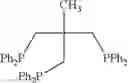
Especially preferred in this context are phosphororganic components where the “bridging” moiety between the phosphors is an alkyl or alkylene moiety whereas the further ligands at the phosphor are aryl or heteroaryl. An especially preferred component in this context is Triphos=1,1,1-tris(diphenylphosphinomethyl)ethane, which has the following structure:
According to a preferred embodiment of the present invention, the Ruthenium-Phosphine-Complex comprises a bisphosphororganic component, trisphosphororganic component or a higher phosphororganic component which furthermore includes one or more donor moieties which can serve as ligands for the Ruthenium. Especially preferred in this context are carbenes, nitrogen containing-ligands such as amines or amides, sulfides, phosphites, phosphoamidites, phosphoric ethers or esters. These compounds have proven themselves in practice. Yet especially preferred are bisphosphororganic components with one further donor moiety.
It should be noticed that according to one preferred embodiment of the present invention, the Ruthenium-Phosphine-complex may (prior to the reaction) comprise one or more “volatile” or easy removable ligand which stabilizes the complex so that it may be handled before the reaction but during the reaction sequence is replaced by the reactants. Suitable ligands are i.e. trimethylmethane, cyclopentadienyl, allyl, methylallyl, ethylene, cyclooctadiene, acetylactonate, acetate or carbon monoxide.
According to a preferred embodiment of the present invention, step a) is performed under acidic conditions whereby the (initial) concentration of acid is ≧0.5 times the concentration of Ruthenium (in mol:mol). It has been found that by doing so the reaction speed and the TON can be increased for many applications within embodiments of the present invention. More preferred the concentration of acid is ≧0.8 to ≦20 times the concentration of Ruthenium (in mol:mol), yet more preferred ≧1 to ≦10 times.
According to a preferred embodiment of the present invention, step a) is performed under acidic conditions whereby the acid is selected out of the group comprising organic or inorganic acids, especially sulfonic acids, especially methanesulfonic acid, trifluormethansulfonic acid, p-toluolsulfonic acid, p-bromobenzosulfonic acid, p-nitrobenzosulfonic acid, sulfuric acid, hydrochloric acid, hydrofluoric acid, trifluoracetic acid, perchloric acid or mixtures thereof. Even more preferred are acids which provide weak coordinating anions after deprotonation, such as bis(trifluoromethane)sulfonimide or mixtures thereof with aforementioned acids. These compounds have proven themselves in practice.
According to a preferred embodiment of the present invention, step a) is carried out at a temperature of ≧0° C. to ≦200° C., preferably ≧20° C. to ≦190° C., more preferred ≧60° C. to ≦180° C., even more preferred ≧100° C. to ≦170° C. and most preferred at ≧120° C. to ≦160° C. This has been shown to be most efficient for most applications within embodiments of the present invention.
According to a preferred embodiment of the present invention, step a) is carried out in a dipolar protic or aprotic solvent or in CO2 (either liquid or near or supercritical). Preferred solvents are ethers, cyclic ethers (such as THF or dioxane) and CO2.
According to a preferred embodiment of the present invention, step a) is carried out at an initial H2 pressure of ≧1 bar, preferably ≧10 bar, yet preferred ≧20 bar, most preferred ≧60 bar . This has been shown to greatly increase the reaction speed and efficiency for most applications of embodiments of the present invention.
According to a preferred embodiment of the present invention, step a) is carried out at an initial CO2 pressure of ≧1 bar, preferably ≧10 bar, yet preferred ≧20 bar. This has been shown to greatly increase the reaction speed and efficiency for most applications of embodiments of the present invention.
In case that the nitrogen-containing organic compound is an amide, it is especially preferred that step a) is carried out at an initial CO2 pressure of ≧30 bar, yet preferred ≧40 bar. It has been observed that under these conditions the side-reaction of decarbonylation (which may occur with some amides) can be suppressed or greatly reduced.
According to a preferred embodiment of the present invention, the initial pressure ratio of H2:CO2 is ≧0.5:1 to ≦5:1, more preferably ≧1:1 to ≦4:1 and most preferred ≧1.5:1 to ≦3:1. This has been shown to greatly increase the reaction speed and efficiency for most applications of embodiments of the present invention.
According to a preferred embodiment of the present invention, the method furthermore comprises a step a0) to be performed before step a):
a0) Reacting suitable precursor compounds to form the Ruthenium-Phosphine-Complex
Suitable Ruthenium-containing precursor compounds include Ru(acac)3, [Ru(cod)(methylallyl)2] Ru(nbd)(methylallyl)2, Ru(ethylene)2(methylallyl)2.
Step a0) may be carried out at room temperature or at the same temperature at step a).
The aforementioned components, as well as the claimed components and the components to be used in accordance with embodiments of the invention in the described embodiments, are not subject to any special exceptions with respect to their size, shape, material selection and technical concept such that the selection criteria known in the pertinent field can be applied without limitations.
Additional details, characteristics and advantages of the object of embodiments of the invention are disclosed in the subclaims and the following description of the respective Examples which are for illustration of embodiments of the invention only and non-binding.
EXAMPLES
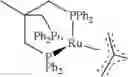
Synthesis of [Ru(Triphos)(TMM)]
A 35 mL schlenk tube was charged with 159.5 mg (0.5 mmol) [Ru(cod)(methylallyl)2] and 312.0 mg 1,1,1-tris(diphenylphosphinomethyl)ethane (Triphos) in 25 mL toluene. After heating for 2 h at 110° C., the resulting solution was concentrated in vacuo and treated with 10 mL of pentane. The precipitating complex was isolated and washed three times with 10 mL pentane. After drying, [Ru(Triphos)(TMM)] was obtained as a bright yellow powder in 75% yield.
General procedures for direct methylation of amines with CO2/H2.
All high pressure batch experiments were conducted in stainless steel 10 mL autoclaves equipped with a glass inlet and a magnetic stir bar. Prior to use, the autoclave was dried under vacuum for 3 hours and repeatedly filled with argon. Under an argon atmosphere, catalyst [Ru(Triphos)(TMM)] (0.019 g, 0.025 mmol) and HNTf2 (0.014 g, 0.05 mmol) were weighed in a Schlenk tube. After dissolving in THF (1.0 mL), the mixture was transferred via cannula to the autoclave followed by the addition of the aniline substrate (1.0 mmol) in THF (1.0 mL). The autoclave was then pressurized with CO2 to 20 bar and then H2 was added up to a total pressure of 80 bar. The reaction mixture was stirred and heated to 150° C. in an oil bath. After 10 h, the autoclave was cooled in an ice bath and then carefully vented. The reaction solution was analyzed by 1H-NMR with internal standard mesitylene and the results confirmed by gas chromatography using dodecane as internal standard.
Example I
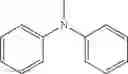
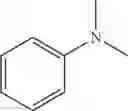
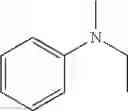
Methylation of N-methylaniline to N,N-Dimethylaniline
The reaction was carried out as described above, except where indicated. The results are shown in the following Table I:
| TABLE I |
| Temp | Time | Yield | ||
| Entry | Acid [mol %] | [° C.] | [h] | [%] |
| 1 | — | 140 | 10 | 2 |
| 2 | HNTf2 (0.5) | 140 | 22 | 11 |
| 3 | HNTf2 (2.5) | 140 | 22 | 84 |
| 4 | HNTf2 (5), | 140 | 22 | 0 |
| no catalyst | ||||
| added | ||||
| 5 | HNTf2 (5), 1% | 140 | 10 | 50 |
| catalyst used | ||||
| 6 | HNTf2 (5) | 140 | 22 | 97 |
| 7 | HNTf2 (5), | 140 | 22 | 25 |
| CO2/H2: | ||||
| (10/30 bar) | ||||
| 8 | HNTf2 (5) | 120 | 22 | 81 |
| 9 | HNTf2 (5) | 100 | 22 | 58 |
| 10 | HNTf2 (5) | 150 | 0.5 | 9 |
| 11 | HNTf2 (5) | 150 | 1 | 20 |
| 12 | HNTf2 (5) | 150 | 1.5 | 29 |
| 13 | HNTf2 (5) | 150 | 2 | 34 |
| 14 | HNTf2 (5) | 150 | 3 | 49 |
| 15 | HNTf2 (5) | 150 | 4 | 69 |
| 16 | HNTf2 (5) | 150 | 8 | 97 |
| 17 | HNTf2 (5) | 150 | 10 | 99 |
| 18 | MSA (5) | 150 | 10 | 95 |
| 19 | p-TsOH (5) | 150 | 10 | 97 |
Example II
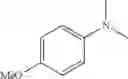
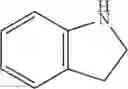
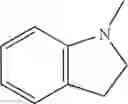
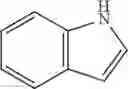
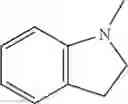
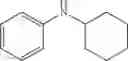
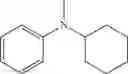
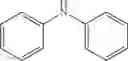
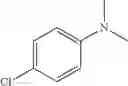
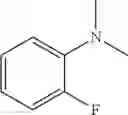
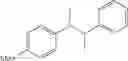
Methylation of Various Secondary Amines
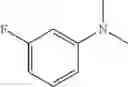
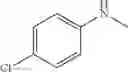
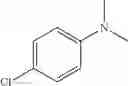
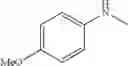
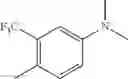
The following amides were reacted as described above, using the following conditions: Substituted aromatic amine (1.0 mmol), [Ru(Triphos)(TMM)] (2.5 mol %), HNTf2 (5 mol %), THF (2 mL), CO2/H2 (20/60 bar), 150° C. Results are shown in the following Table II:
| TABLE II | ||||
| Entry | Amine | Product | Time [h] | Yield [%] |
| 1 | 22 | 90 | ||
| 2 | 10 | 90 | ||
| 3 | 10 | 35 | ||
| 4 | 20 | 73 | ||
| 5 | 20 | 70 | ||
| 6 | 15 | 64 | ||
| 7 | 48 | 27 | ||
Example III
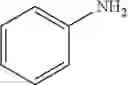
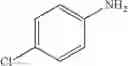
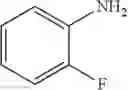
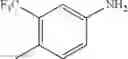
Methylation of Various Primary amines and Amides
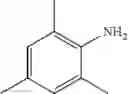
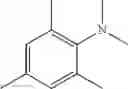
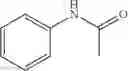
Several primary amines and Acetanilide were reacted using the following conditions: Substituted primary aniline or amide (1.0 mmol), [Ru(Triphos)(TMM)] (2.5 mol %), HNTf2 (5 mol %), THF (2 mL), CO2/H2 (20/60 bar), 150 ° C. The results are shown in the following Table III
| TABLE III | ||||
| En- | Time | Yield | ||
| try | amine/amide | Product | [h] | [%] |
| 1 | 15 | 94 | ||
| 2 | 10 | 93 | ||
| 3 | 24 | 93 | ||
| 4 | 20 | 94 | ||
| 5 | 15 | 84 | ||
| 6 | 24 | 69 | ||
Example IV
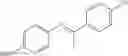
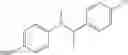
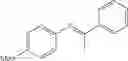
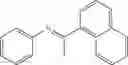
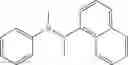
Reductive Methylation of Various Imines
Several imines were reacted using the following conditions: Substituted imine (1.0 mmol), [Ru(Triphos)(TMM)] (2.5 mol %), HNTf2 (5 mol %), THF (2 mL), CO2/H2 (20/60 bar), 100° C. The results are shown in the following Table IV
| TABLE IV | ||||
| Time | Yield | |||
| Entry | Imine | Product | [h] | [%] |
| 1 | 24 | 90 | ||
| 2 | 24 | 80 | ||
| 3 | 24 | 96 | ||
Although the present invention has been disclosed in the form of preferred embodiments and variations thereon, it will be understood that numerous additional modifications and variations could be made thereto without departing from the scope of the invention.
For the sake of clarity, it is to be understood that the use of “a” or “an” throughout this application does not exclude a plurality, and “comprising” does not exclude other steps or elements. The mention of a “unit” or a “module” does not preclude the use of more than one unit or module.
Claims
1. A method for the N-methylation of nitrogen-containing compounds comprising the step of:
a) reacting the nitrogen-containing organic compound with CO2 and H2 in the presence of a Ruthenium-Phosphine-complex.
2. The method according to claim 1, wherein step a) is performed under acidic conditions.
3. The method according to claim 1, wherein the Phosphine in the Ruthenium-Phosphine-Complex is a Tris(hetero)aryl and/or Bis(hetero)arylalkyl Phosphine.
4. The method according to one of claim 1, wherein the Ruthenium-Phosphine-Complex comprises a bisphosphororganic component, trisphosphororganic or higher phosphororganic component.
5. The method according to claim 1, wherein step a) is performed under acidic conditions whereby the (initial) concentration of acid is ≧0.5 times the concentration of Ruthenium (in mol:mol).
6. The method according to claim 5, wherein step a) is performed under acidic conditions whereby the acid is selected out of the group comprising sulfonic acids, especially methanesulfonic acid, trifluormethansulfonic acid, p-toluolsulfonic acid, p-bromobenzosulfonic acid, p-nitrobenzosulfonic acid, sulfuric acid, hydrochloric acid, hydrofluoric acid, trifluoracetic acid, perchloric acid, bis(trifluoromethane)sulfonimide or mixtures thereof.
7. The method according to claim 1, wherein step a) is carried out at an initial hydrogen pressure of ≧1 bar.
8. The method according to claim 1, wherein step a) is carried out at an initial CO2 pressure of ≧1 bar.
9. The method according to claim 1, wherein the initial pressure ratio of H2:CO2 is ≧0.5:1 to ≧5:1.
10. The method according to claim 1, wherein step a) is carried out in a dipolar protic or aprotic solvent or in CO2.
Images & Drawings included:
Sources:
- United States Patent and Trademark Office - verify current appl. status at the USPTO↗
Recent applications in this class:
- » 20130310555 2013-11-21
Synthesis of therapeutic and diagnostic drugs centered on regioselective and stereoselective ring opening of aziridinium ions - » 20130245276 2013-09-19
Process for homogeneously catalyzed, highly selective direct amination of primary alcohols with ammonia to primary amines with a high volume ratio of liquid phase to gas phase and/or high pressures - » 20130150624 2013-06-13
Method for producing primary aliphatic amines from aldehydes - » 20060287544 2006-12-21
Nucleophilic heterocyclic carbene derivatives of Pd(acac)for cross-coupling reactions - » 20050240039 2005-10-27
Method for the telomerisation of non-cyclic olefins