Dough line for processing dough
US20170079283A1
2017-03-23
15/265,068
2016-09-14
✅ Patent granted
US 10,219,520 B2
2019-03-05
-
-
Laura Edwards
Varnum, Riddering, Schmidt & Howlett LLP
2037-05-26
Abstract:
The present specification relates to a dough line for processing dough, specifically sheeted dough, having a conveyor, for conveying the dough, a sensor, for detecting the beginning of a dough piece at a detection point in the dough line, a controllable flour sifter, arranged above the conveyor, for depositing flour on the conveyor or on dough on the conveyor, a controller, for controlling the amount of flour deposited by the flour sifter based on the sensor signal, wherein the controller is configured for disabling the flour sifter when there is no dough piece on or to be placed on the conveyor at the location of the flour sifter, enabling the flour sifter to deposit a first amount of flour per amount of displacement of the conveyor when there is a dough piece on or to be placed on the conveyor at the location of the flour sifter.
Assignee:
- Radie B.V. 16 🇳🇱 Culemborg, Netherlands
Applicant:
Interested in similar patents?
Get notified when new applications in this technology area are published.
Classification:
A21C9/08 » CPC further
Other apparatus for handling dough or dough pieces Depositing, arranging and conveying apparatus for handling pieces, e.g. sheets of dough
B05C5/0245 » CPC further
Apparatus in which liquid or other fluent material is projected, poured or allowed to flow on to the surface of the work from an outlet device in contact or almost in contact, with the work the liquid or other fluent material being discharged through an outlet orifice by pressure, e.g. for applying liquid or other fluent material to a moving work of indefinite length, e.g. to a moving web
G05D7/06 IPC
Control of flow characterised by the use of electric means
G05D7/0676 » CPC further
Control of flow characterised by the use of electric means specially adapted for fluid materials characterised by the type of regulator means by action on flow sources
A21C9/04 » CPC main
Other apparatus for handling dough or dough pieces Apparatus for spreading granular material on, or sweeping or coating the surfaces of, pieces or sheets of dough
B05C5/02 IPC
Apparatus in which liquid or other fluent material is projected, poured or allowed to flow on to the surface of the work from an outlet device in contact or almost in contact, with the work the liquid or other fluent material being discharged through an outlet orifice by pressure, e.g.
B05C19/06 » CPC further
Apparatus specially adapted for applying particulate materials to surfaces Storage, supply or control of the application of particulate material; Recovery of excess particulate material
B05C19/04 » CPC further
Apparatus specially adapted for applying particulate materials to surfaces the particulate material being projected, poured or allowed to flow onto the surface of the work
Description
TECHNICAL FIELD
The present specification relates to a dough line for processing dough, in particular sheeted dough.
BACKGROUND
Dough lines are known in the art and are formed by several dough processing stages along which dough is conveyed. The conveyor may be built up from several sequential conveyor belts, rolls and other items that engage the dough.
It is a known problem that dough sticks to the conveyor, rolls and/or other parts it comes in touch with, and it is also known that this problem can be solved by providing a layer of flour in between the dough and the part it comes in contact with.
In a process where sheeted dough is used, the dough pieces are very long, and sometimes the process is even continuous. Here, the dough is normally put in a funnel, and then formed to a sheet by multiple pairs of rolls, or any type of laminator. When the funnel is filled before it is empty the dough sheet is endless. Nevertheless, from time to time a new batch of dough is started and it has appeared to that such new dough piece gives the most problems of sticking in the dough line.
Normally, the amount of flour to be used to avoid sticking is determined experimentally, and set to a value or level where no sticking problems occurs. However, a first aspect of the present specification is the insight that such mode of operating the dough line leads to a setting wherein in the average, too much flour is applied to the dough and/or conveyor, since it is mainly the beginning of a new dough sheet that has sticking problems. Once a dough piece follows its intended path through the dough line, the sheet is coherent enough to stick to itself and has less tendency to stick to the conveyor, rolls or other parts of the dough line.
It is therefore a goal of the present specification to provide a solution for dough unintendedly sticking onto the dough line, and more in particular to provide a solution that avoids the use of too much flour.
SUMMARY
The specification thereto proposes a dough line for processing dough, in particular sheeted dough, comprising a conveyor, for conveying the dough along dough processing stages, a sensor, for detecting the beginning of a dough piece at a detection point in the dough line, a controllable flour sifter, arranged above the conveyor, for depositing flour on the conveyor or on dough on the conveyor, a controller, for controlling the amount of flour deposited by the flour sifter based on the sensor signal, wherein the controller is configured for disabling the flour sifter when there is no dough piece on or to be placed on the conveyor at the location of the flour sifter, enabling the flour sifter to deposit a first amount of flour per amount of displacement of the conveyor when there is a dough piece on or to be placed on the conveyor at the location of the flour sifter wherein the controller is further configured for temporarily switching the amount of flour dispensed by the flour sifter to a second, higher than the first, amount of flour per amount of displacement of the conveyor during a predetermined distance from where the beginning of a dough piece is on or to be placed on the conveyor.
The sensor may be a photo cell which determines a colour difference between the conveyor and the dough, but also a weighing section, a photo cell in the or near the funnel, or a dough in- or output roll with a detector. The phrasing on or to be placed on refers the fact that flour may be applicable both on the conveyor as on the dough sheet on the conveyor, so on both sides. By only temporarily switching the amount of flour dispensed by the flour sifter to a second, higher than the first, amount of flour per amount of displacement of the conveyor during a predetermined distance from where the beginning of a dough piece is on or to be placed on the conveyor, extra flour is only used if and where it is necessary. This has the advantage of a reduced waste of flour, and also to a more consistent dough composition, since flour added by the sifters in the end arrives in the final product.
In general, the second amount may be between 10 and 30 and in particular about 20 percent higher than the first amount, and the predetermined distance is between 20 cm and 2 meter, and in particular about 1 meter.
The dough line according to the specification may comprise multiple controllable flour sifters, arranged at different locations above the conveyor, wherein the controller is configured for disabling each flour sifter when there is no dough piece on or to be placed on the conveyor at the location of said flour sifter, enabling each flour sifter to deposit a first amount of flour per amount of displacement of the conveyor when there is a dough piece on or to be placed on the conveyor at the location of said flour sifter and temporarily switching the amount of flour dispensed by said flour sifter to a second, higher than the first, amount of flour per amount of displacement of the conveyor during a predetermined distance from where the beginning of a dough piece is on or to be placed on the conveyor.
In other words, when the beginning of a dough sheet arrives at a sifter along the dough line, during a first interval, an extra amount of flour is applied. The sifters are in such case normally placed at locations where there is a higher risk of sticking, for instance at transitions from one conveyor belt to another or when the dough engages a roll or other part of a dough processing stage.
In a preferred embodiment the controller is configured to calculate the beginning of a new sheeted dough piece at locations of flour sifters in the dough line, based on one detected position by the sensor and a known speed and distance of the conveyor. This embodiment has the advantage that a minimum of sensors is required, which saves components and reduces the risk of failures due to mal functioning sensors.
However, as an alternative, a dough line according to the specification may comprise multiple sensors, each for detecting the beginning of a new sheeted dough piece at respective detection point in the dough line. This embodiment may be preferred when the dough position with respect to the conveyor tends to shift along the dough line, so that a calculated position becomes less reliable at a larger distance from the sensor.
BRIEF DESCRIPTION OF THE DRAWINGS
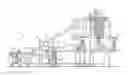
The specification will now be elucidated into more detail with reference to FIG. 1.
FIG. 1 shows a dough line according to the present specification.
DETAILED DESCRIPTION
FIG. 1 shows a dough line 10 according to the present specification. The dough line comprises a funnel wherein dough is put to be laminated, before it is deposited on a conveyor 2 for conveying the dough along dough processing stages. At the end of the dough sheet former, a sensor 7 is present for detecting the beginning of a dough piece, before it reaches the conveyor 2 at point 8. Arranged above the conveyor 2 is a first controllable flour sifter 3 for depositing flour on the conveyor. The sifter 3 deposits the flour upstream point 8 on the conveyor, so that it prevents the dough to stick to the conveyor. A second controllable flour sifter 4 is arranged downstream point 8, for depositing flour on dough on the conveyor 2, before it reaches a dough processing stage 9.
A non-depicted controller is present for controlling the amount of flour deposited by the flour sifters 3 and 4 based on the sensor signal from sensor 7, wherein the controller is configured for disabling the flour sifters 4, 3 respectively when there is no dough piece on or to be placed on the conveyor at the location of the flour sifter, and enabling the flour sifters 4, 3 to deposit a first amount of flour per amount of displacement of the conveyor when there is a dough piece on or to be placed on the conveyor at the location of the flour sifters 4, 3 and temporarily switching the amount of flour dispensed by the flour sifter to a second, higher than the first, amount of flour per amount of displacement of the conveyor during a predetermined distance from where the beginning of a dough piece is on or to be placed on the conveyor 2.
Further downstream the dough line 10 yet another flour sifter 5 is present, for delivering flour to conveyor belt 11 where the dough is delivered to after processing stage 6.
The above example serves as an example only and does not limit the scope of protection of the present application, as defined in the following claims.
Claims
1. A dough line for processing dough, in particular sheeted dough, comprising:
a conveyor, for conveying the dough along dough processing stages;
a sensor, for detecting the beginning of a dough piece at a detection point in the dough line;
a controllable flour sifter, arranged above the conveyor, for depositing flour on the conveyor or on dough on the conveyor;
a controller, for controlling the amount of flour deposited by the flour sifter based on the sensor signal;
wherein the controller is configured for:
disabling the flour sifter when there is no dough piece on or to be placed on the conveyor at the location of the flour sifter;
enabling the flour sifter to deposit a first amount of flour per amount of displacement of the conveyor when there is a dough piece on or to be placed on the conveyor at the location of the flour sifter;
characterised by:
temporarily switching the amount of flour dispensed by the flour sifter to a second, higher than the first, amount of flour per amount of displacement of the conveyor during a predetermined distance from where the beginning of a dough piece is on or to be placed on the conveyor.
2. The dough line according to claim 1, wherein the second amount is between 10 and 30 and in particular about 20 percent higher than the first amount.
3. The dough line according to claim 1, wherein the predetermined distance is between 20 cm and 2 meter, and in particular about 1 meter.
4. The dough line according to claim 1, comprising multiple controllable flour sifters, arranged at different locations above the conveyor, wherein the controller is configured for:
disabling each flour sifter when there is no dough piece on or to be placed on the conveyor at the location of said flour sifter;
enabling each flour sifter to deposit a first amount of flour per amount of displacement of the conveyor when there is a dough piece on or to be placed on the conveyor at the location of said flour sifter;
characterised by:
temporarily switching the amount of flour dispensed by said flour sifter to a second, higher than the first, amount of flour per amount of displacement of the conveyor during a predetermined distance from where the beginning of a dough piece is on or to be placed on the conveyor.
5. The dough line according to claim 4, wherein the controller is configured to calculate the beginning of a new sheeted dough piece at locations of flour sifters in the dough line, based on one detected position by the sensor and a known speed and distance of the conveyor.
6. The dough line according to claim 4, comprising multiple sensors, each for detecting the beginning of a new sheeted dough piece at respective detection point in the dough line.
Images & Drawings included:
Sources:
- United States Patent and Trademark Office - verify current appl. status at the USPTO↗
Similar patent applications:
- » 20180132490
Dough line for processing sticky dough types - » 20190191719
Dough processing device, for use on a dough line
Recent applications in this class:
- » 20250248407 2025-08-07
SYSTEM AND METHOD FOR PREPARING FOOD AUTONOMOUSLY - » 20250169510 2025-05-29
TOPPING SYSTEM OF PIZZA DISC FOR AUTOMATIC PIZZA PREPARATION MACHINES - » 20240365795 2024-11-07
Machine for forming doughs for oven-baked products - » 20240349738 2024-10-24
DOUGH PRESSING DEVICE - » 20240081347 2024-03-14
Food Preparation and Decoration System - » 20240081346 2024-03-14
SYSTEM AND METHOD FOR PLACING TOPPINGS ON A PRODUCT - » 20240023562 2024-01-25
RING FOR TOPPING PIZZA AND OTHER FOOD PRODUCTS - » 20230413830 2023-12-28
AUTOMATED FOOD COOKING SYSTEM - » 20230292770 2023-09-21
Pizza Sauce Applicator - » 20230077697 2023-03-16
AUTOMATED FOOD ARTICLE MAKING SYSTEM AND METHOD
Recent applications for this Assignee:
- » 20230312266 2023-10-05
Method and Device for Collecting Litter or Scrapings - » 20220338486 2022-10-27
Dough handling device - » 20220322683 2022-10-13
Dough piece rolled up with a separator sheet, and method and device for preparing these - » 20220312780 2022-10-06
Method and device for creating an inverted puff pastry dough or a croissant dough - » 20220217982 2022-07-14
Funnel, lining for a funnel, dough line and method for cleaning a funnel - » 20190223452 2019-07-25
Device, dough line and method for rolling dough - » 20190191719 2019-06-27
Dough processing device, for use on a dough line - » 20170071216 2017-03-16
Device for folding at least one dough piece, folding shoe for use in such device and dough line - » 20160316770 2016-11-03
Device for cutting dough - » 20150327559 2015-11-19
Device and method for pressing a dough part