Process for drying of BIBW2992, of its salts and of solid pharmaceutical formulations comprising this active ingredient
US20170079980A1
2017-03-23
15/371,252
2016-12-07
✅ Patent granted
US 10,004,743 B2
2018-06-26
-
-
Robert T. Crow | John P Nguyen
Marc A. Began | Atabak R. Royaee
2036-12-07
Abstract:
The present invention relates to a drying process of BIBW 2992 or the salts thereof, preferably the dimaleate salt, as well as of solid pharmaceutical formulations comprising BIBW2992 or a salt thereof, and to pharmaceutical compositions comprising BIBW 2992 or a salt thereof as the active product ingredient, characterized by a water activity of the formulation of not more than 0.20 or a water content (Karl-Fischer) of not more than 4.2%.
Assignee:
- BOEHRINGER INGELHEIM INTERNATIONAL GMBH 1,537 🇩🇪 Ingelheim am Rhein, Germany
Applicant:
Interested in similar patents?
Get notified when new applications in this technology area are published.
Classification:
A61K9/2009 » CPC further
Medicinal preparations characterised by special physical form; Pills, tablets, discs, rods; Excipients; Inactive ingredients Inorganic compounds
A61K9/2013 » CPC further
Medicinal preparations characterised by special physical form; Pills, tablets, discs, rods; Excipients; Inactive ingredients Organic compounds, e.g. phospholipids, fats
A61K9/2018 » CPC further
Medicinal preparations characterised by special physical form; Pills, tablets, discs, rods; Excipients; Inactive ingredients; Organic compounds, e.g. phospholipids, fats Sugars, or sugar alcohols, e.g. lactose, mannitol; Derivatives thereof, e.g. polysorbates
A61K9/2027 » CPC further
Medicinal preparations characterised by special physical form; Pills, tablets, discs, rods; Excipients; Inactive ingredients; Organic macromolecular compounds obtained by reactions only involving carbon-to-carbon unsaturated bonds, e.g. polyvinyl pyrrolidone, poly(meth)acrylates
A61K9/2054 » CPC further
Medicinal preparations characterised by special physical form; Pills, tablets, discs, rods; Excipients; Inactive ingredients; Organic macromolecular compounds; Polysaccharides, e.g. alginate, gums; Cyclodextrin Cellulose; Cellulose derivatives, e.g. hydroxypropyl methylcellulose
A61K9/2813 » CPC further
Medicinal preparations characterised by special physical form; Pills, tablets, discs, rods; Dragees; Coated pills or tablets, e.g. with film or compression coating; Coating materials Inorganic compounds
A61K9/2826 » CPC further
Medicinal preparations characterised by special physical form; Pills, tablets, discs, rods; Dragees; Coated pills or tablets, e.g. with film or compression coating; Coating materials; Organic compounds, e.g. fats Sugars or sugar alcohols, e.g. sucrose; Derivatives thereof
A61K9/2853 » CPC further
Medicinal preparations characterised by special physical form; Pills, tablets, discs, rods; Dragees; Coated pills or tablets, e.g. with film or compression coating; Coating materials; Organic macromolecular compounds obtained otherwise than by reactions only involving carbon-to-carbon unsaturated bonds, e.g. polyethylene glycol, polyethylene oxide, poloxamers, poly(lactide-co-glycolide)
A61K9/2866 » CPC further
Medicinal preparations characterised by special physical form; Pills, tablets, discs, rods; Dragees; Coated pills or tablets, e.g. with film or compression coating; Coating materials; Organic macromolecular compounds; Polysaccharides, e.g. gums; Cyclodextrin Cellulose; Cellulose derivatives, e.g. hydroxypropyl methylcellulose
A61K9/28 IPC
Medicinal preparations characterised by special physical form; Pills, tablets, discs, rods Dragees; Coated pills or tablets, e.g. with film or compression coating
A61K31/517 » CPC main
Medicinal preparations containing organic active ingredients; Heterocyclic compounds having nitrogen as a ring hetero atom, e.g. guanethidine or rifamycins having six-membered rings with two nitrogen atoms as the only ring heteroatoms, e.g. piperazine; Pyrimidines; Hydrogenated pyrimidines, e.g. trimethoprim ortho- or peri-condensed with carbocyclic ring systems, e.g. quinazoline, perimidine
A61K9/1641 » CPC further
Medicinal preparations characterised by special physical form; Particulate form, e.g. powders, Processes for size reducing of pure drugs or the resulting products, Pure drug nanoparticles; Agglomerates; Granulates; Microbeadlets ; Microspheres; Pellets; Solid products obtained by spray drying, spray freeze drying, spray congealing,(multiple) emulsion solvent evaporation or extraction; Excipients; Inactive ingredients; Organic macromolecular compounds obtained otherwise than by reactions only involving carbon-to-carbon unsaturated bonds, e.g. polyethylene glycol, poloxamers
A61K9/1652 » CPC further
Medicinal preparations characterised by special physical form; Particulate form, e.g. powders, Processes for size reducing of pure drugs or the resulting products, Pure drug nanoparticles; Agglomerates; Granulates; Microbeadlets ; Microspheres; Pellets; Solid products obtained by spray drying, spray freeze drying, spray congealing,(multiple) emulsion solvent evaporation or extraction; Excipients; Inactive ingredients; Organic macromolecular compounds Polysaccharides, e.g. alginate, cellulose derivatives; Cyclodextrin
A61K9/2095 » CPC further
Medicinal preparations characterised by special physical form; Pills, tablets, discs, rods Tabletting processes; Dosage units made by direct compression of powders or specially processed granules, by eliminating solvents, by melt-extrusion, by injection molding, by 3D printing
A61K31/4375 IPC
Medicinal preparations containing organic active ingredients; Heterocyclic compounds having nitrogen as a ring hetero atom, e.g. guanethidine or rifamycins having six-membered rings with one nitrogen as the only ring hetero atom ortho- or peri-condensed with heterocyclic ring systems the heterocyclic ring system containing a six-membered ring having nitrogen as a ring heteroatom, e.g. quinolizines, naphthyridines, berberine, vincamine
A61K9/00 IPC
Medicinal preparations characterised by special physical form
A61K9/16 IPC
Medicinal preparations characterised by special physical form; Particulate form, e.g. powders, Processes for size reducing of pure drugs or the resulting products, Pure drug nanoparticles Agglomerates; Granulates; Microbeadlets ; Microspheres; Pellets; Solid products obtained by spray drying, spray freeze drying, spray congealing,(multiple) emulsion solvent evaporation or extraction
A61K9/20 IPC
Medicinal preparations characterised by special physical form Pills, tablets, discs, rods
Description
FIELD OF THE INVENTION
The present invention relates to a drying process of BIBW 2992 or the salts thereof, preferably the dimaleate salt (abbreviated hereinafter BIBW 2992 MA2), as well as of solid pharmaceutical formulations comprising BIBW 2992 or a salt thereof, and to pharmaceutical compositions comprising BIBW 2992 or a salt thereof as the active product ingredient (API), characterized by a water activity of the formulation of not more than 0.20 or a water content (Karl-Fischer) of the formulation of not more than 4.2%.
BACKGROUND OF THE INVENTION
BIBW 2992 (also named TOMTOVOK®) is known as the compound 4-[(3-chloro-4-fluorophenyl)amino]-6-{[4-(N,N-dimethylamino)-1-oxo-2-buten-1-yl]amino}-7-((S)-tetrahydrofuran-3-yloxy)-quinazoline,
BIBW 2992 is a potent and selective dual inhibitor of erbb1 receptor (EGFR) and erbB2 (Her2/neu) receptor tyrosine kinases. Furthermore, BIBW 2992 was designed to covalently bind to EGFR and HER2 thereby irreversibly inactivating the receptor molecule it has bound to. This compound, salts thereof such as the dimaleate BIBW 2992 MA2 and its crystalline modification, their preparation as well as pharmaceutical formulations comprising BIBW 2992 or a salt thereof are disclosed in WO 02/50043 and WO 2005/037824. These documents are incorporated by reference regarding these aspects.
BIBW 2992 is suitable for the treatment of tumoral diseases, hypersecretory diseases of the lungs and respiratory tract, diseases of the gastrointestinal tract, the bile duct and gall bladder. Indications to be treated with BIBW 2992 and combination treatments are disclosed in WO 2007/054550 and WO 2007/054551.
Besides the pharmacological activity of an active pharmaceutical ingredient (API) there are a variety of chemical, physical or physicochemical characteristics of the active substance relevant for the preparation of solid oral dosage forms, as oral powders, granules, pellets, tablets, capsules, chewable tablets, dispersible tablets, or lozenges. To achieve adequate formulation characteristics, as correct assay, content and mass uniformity, chemical and physical stability of the drug product and a proper dissolution rate, also the characteristics of the product intermediates have to be adequate for robust, fast and cost efficient processing.
Without being restrictive, examples of these parameters relevant for processing of the active agent (the drug substance) are
the stability of the drug substance under various environmental conditions which strongly may influence the stability of the final pharmaceutical formulation (the drug product), and physical characteristics of the drug substance such as bulk densities (i.e. poured and tapped density), particle morphology, shape, the ratio of length to width for needles, size distribution, electrostatic charging and surface adhesive properties, which may vary due to precipitation and drying conditions of the drug substance. These characteristics may significantly influence key features for processing of the drug substance into a final formulation, such as flowability and compressibility.
For actives sensitive to hydrolytic degradation it is substantial to minimize access of moisture within the manufacture of the drug product up to packaging as well as to take effective measures to prevent entrance of water into the final packaging in order to achieve an adequate shelf life of the product.
BIBW 2992 is a moisture sensitive compound and can quickly hydrolytically degrade at humid conditions, e.g. in the presence of water, moisture or moisture released by further excipients in the drug product, resulting a main API degradation product by release of dimethylamine from the side chain attached to position 6 of the quinazoline.
BRIEF SUMMARY OF THE INVENTION
A first object of the present invention is directed to a process for drying of BIBW 2992 or a salt thereof, preferably BIBW 2992 MA2, comprising drying with a gas which is inert towards BIBW 2992 at the drying conditions and which has a relative humidity (rh) of not more than 15%, preferably not more than 12% rh, at a temperature below 40° C., preferably below 30° C.
A second object of the present invention is directed to a process for drying of a pharmaceutical formulation containing BIBW 2992 or a salt thereof, preferably BIBW 2992 MA2, as the active ingredient and at least one further excipient, with a gas, e.g. air which is inert towards the ingredients of the mentioned pharmaceutical formulation at the drying conditions, and which has a relative humidity of not more than 15%, preferably not more than 12% rh, at temperatures below 40° C., preferably below 30° C.
A third object of the present invention is a pharmaceutical composition comprising BIBW 2992 or a salt thereof, preferably BIBW 2992 MA2, as an active ingredient and at least one further excipient, e.g. an oral, pharmaceutical dosage form, such as a tablet, which is characterized by a water activity of not more than 0.20, preferably of not more than 0.17, or, most preferred, of not more than 0.15.
A fourth object of the present invention is a pharmaceutical composition comprising BIBW 2992 or a salt thereof, preferably BIBW 2992 MA2, as an active ingredient and at least one further excipient, e.g. an oral, pharmaceutical dosage form, such as a tablet, which is characterized by a water content (Karl-Fischer) of not more than 4.2%, preferably of not more than 4.0%, particularly of not more than 3.8%, or, most preferred, of not more than 3.7%.
DETAILED DESCRIPTION OF THE INVENTION
BIBW 2992 to be dried according to the process of the invention or referred to herein within the context of the invention includes the API in any form, e.g. in the form of the free base itself, in the form of a solvate and in the form of a salt, preferably a pharmaceutically acceptable salt.
Pharmaceutically acceptable salts are for instance selected from the group consisting of the hydrochloride, hydrobromide, hydroiodide, hydrosulphate, hydrophosphate, hydromethanesulphonate, hydronitrate, hydromaleate, hydroacetate, hydrobenzoate, hydrocitrate, hydrofumarate, hydrotartrate, hydrolactate, hydroxalate, hydrosuccinate, hydrobenzoate and hydro-p-toluenesulphonate, preferably the hydrochloride, hydrobromide, hydrosulphate, hydrophosphate, hydromaleate, hydrofumarate and hydromethanesulphonate. In a particularity preferred embodiment with regard to any aspects of the invention BIBW 2992 is applied as its hydromaleate, preferably in the ratio BIBW 2992:maleic acid=1:2 as depicted in the formula (1a) below (also denoted herein as the “dimaleate” or BIBW 2992 MA2).
BIBW 2992 also includes combinations with at least one pharmaceutical excipient, e.g. a pharmaceutical composition comprising BIBW 2992 in the form of the free base, in the form of a solvate or in the form of a salt as the active ingredient, as an intermediate for further processing or as a final dosage form ready for ingestion.
Preferred pharmaceutical compositions as an intermediate for further processing includes a compacted intermediate or a dry granulated intermediate comprising BIBW 2992 MA2 in form of a powder obtainable by a combined compaction (either roller compaction, briquetting or slugging) or dry granulation and subsequent sieving of the compacted active, optionally in mixture with a lubricant, to adjust and equilibrate its bulk properties and therefore ensure its suitability for further processing into a finished dosage form,
the intermediate and final blends prepared from said compacted (or dry granulated) intermediate, suitable for further processing in the preparation of solid oral dosage forms.
Particularly preferred pharmaceutical compositions are those comprising BIBW 2992 MA2 in final dosage forms ready for ingestion, including solid oral formulations made from said compacted intermediate, from said intermediate blends or from said final blends, in powdery, compacted, granulated or compressed, form e.g.
dry powder formulations,
uncoated or coated granules,
uncoated or coated pellets, and
uncoated or film-coated tablets, e.g. prepared by direct-compression,
-
- any of those optionally filled in capsules, e.g. hard gelatin capsules or HPMC (hydroxypropylmethylcellulose) capsules.
The process according to the present invention may be carried out by drying the sample comprising BIBW 2992 (or a pharmaceutically acceptable salt thereof) or any of the pharmaceutical compositions comprising BIBW 2992 (or a pharmaceutically acceptable salt thereof) mentioned hereinbefore, which contains humidity, e.g. water moisture from a formulation procedure, such as aqueous film-coating or adsorbed from a further excipient containing genuine non-crystalline water or moisture adsorbed from environmental air, using continuous contact of the sample with a gas flowing through which is inert towards BIBW2992 at the drying conditions and has a relative humidity of not more than 15%, preferably of not more than 12% rh, at temperatures below 40° C., preferably below 30° C., until the targeted water activity (equilibrium moisture content) in the sample is achieved. The water activity is a measure of the water that is freely available in the sample and is available for exchange with the atmosphere. A desired water activity reduces the water which may be present free or as solvate bound in excipients in the drug product and includes moisture of the form in which BIBW 2992 is present after completion of drying, e.g. 0.20 water activity and less, or Karl-Fischer water content of 4.2% and less.
The water activity mentioned in the context of the invention is meant to be determined as mentioned in the United States Pharmacopeia (USP) <921>. Furthermore, the Karl-Fischer water content mentioned in the context of the invention is meant to be a titrimetric method (i.e. biamperometric Karl Fischer titration) specified in the United States Pharmacopeia (USP) <1112>. Examples for the methods used are provided hereinafter.
It is essential that the gas used, e.g. inert gas, dried compressed or constantly supply dried air, nitrogen or carbon dioxide, has a relative humidity of not more than 15% rh, preferably not more than 12%, in order to guarantee a sufficiently high humidity gradient between the product and the drying gas. Consequently a permanent gas flow has to be assured in order to maintain the humidity gradient and achieve the targeted humidity of BIBW2992. Such could be achieved either by a continuous flow-through of dried compressed air or by continuous flow generated by ventilators (e.g using a Munters® device).
The process according to the present invention is carried out by placing the sample in a container having an inlet and an outlet opening for the supply and removal of the gas.
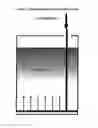
In one embodiment of the invention the gas stream is purged through the container and the sample as a continuous flow-through of dried compressed air with a pressure at the outlet of approximately 0.5 to 3 bar, preferably 0.8 to 1.5 bar, most preferred about 1 bar. Especially for this purpose containers with a bi-layer bottom are used, in which the upper one is perforated in order to allow the gas to pass through. The gas is introduced into the space between the two bottoms, flows through the perforated upper bottom and then through the product. Finally the gas containing moisture from the product is discharged through the outlet.
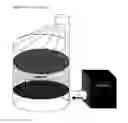
In a second embodiment of the invention the gas stream is purged through the container and the sample as a continuous flow generated by ventilators (e.g using a Munters® device) providing an air flow rate of 20-1000 ncm/h, preferably of 30-500 ncm/h, most preferred, of 40-150 ncm/h. The expression “ncm” denotes “norm cubic meter”, alternatively abbreviated in the literature as “m3 (i.N.)”, defining a volume of a gas under norm or standard conditions, here of 1013 mbar, a relative humidity (rh) of 0% and a temperature of 0° C.
According to any embodiment of the invention drying temperature is set in the range of 20-40° C., preferably in the range of 20-30° C., e.g. room temperature. During drying, water which may be present as solvate bound in BIBW2992 as dihydrate or Lactose as monohydrate is substantially not removed.
It has been found that at the given conditions drying has to be performed for at least 8 hours, preferably for at least 12 h, most preferred for at least 24 h, in order to achieve the targeted water activity of the formulation of 0.20 and less or Karl-Fischer water content of the formulation of 4.2% and less.
In contrast, an alternative approach to reduce moisture content as conventional drying of film-coated tablets comprising BIBW 2992 in a film-coater at temperatures clearly higher than room temperature e.g. 50° C. led only intermediately to a low level of moisture during the drying process itself. Finally the product (film-coated tablets) have to be cooled down to room temperature associated with moisture re-uptake, since the relative humidity of the cooling air is above 15% rh.
A further alternative conventional approach to reduce moisture content could be storage of BIBW 2992 bulk in close contact with desiccants. The desiccants remove unbound water from the product via physical adsorption of water. For drying of bulk products as e.g. film-coated tablet such a method requires a much longer drying time as the presented method in order to achieve the targeted moisture content and thus is unsuitable to be used in production scale.
SHORT DESCRIPTION OF THE FIGURES
FIG. 1 schematically shows a container suitable for the process according to the present invention comprising an inlet line and an outlet opening for the supply and removal of the gas, a bi-layer bottom (upper and lower bottom) connected with the inlet line, wherein the upper bottom is perforated in order to allow the drying gas to pass through the inner space of the container comprising the sample.
FIG. 2 schematically shows a container suitable for the process according to the present invention with Munters® device gas supply.
The following non-limiting examples serve to illustrate the invention:
EXAMPLE 1
50 kg of film-coated tablets containing 20 mg BIBW 2992 base each are filled into a drying container that is equipped with a double bottom, an air inlet and an air outlet. The tablets are flushed in the container with dried compressed air with relative humidity of not more than 12% and a temperature of approximately 20° C. until the water activity of the formulation is less than 0.15 or the water content (Karl Fischer) of the formulation is not more than 4.0%. Finally a water content of 3.7% (Karl Fischer) after drying was achieved.
After 6 months storage in Alu/Alu-blister at 40° C./75 rh an increase of 1.6% main API degradation product was observed.
EXAMPLE 2 (COMPARATIVE EXAMPLE)
Without initial drying film-coated tablets containing 20 mg BIBW 2992 base showed a water content of the formulation of 4.3%. After 6 months storage in Alu/Alu-blister at 40° C./75 rh an increase of 2.6% main API degradation product was detected.
EXAMPLE 3: DOSAGE FORMS COMPRISING BIBW 2992 MA2 (1A) TO BE DRIED USING THE PROCESS OF THE INVENTION
In the following section the manufacturing method for dosage forms of 1a is described.
Process for Preparing Compacted Intermediates Comprising 1a
A compacted intermediate comprising 1a in form of a powder is prepared by a roller compaction step for densification of the material, combined with at least one sieving step additional to the break-up of the ribbon or briquettes, optionally in mixture with a lubricant.
The roller compaction may be carried out with
-
- the API 1a alone or, optionally, with
- a pre-blend of the API with 0 to 1.0% of a lubricant in a freefall or tumble blender to prevent major sticking on the compaction rolls.
- Addition of a lubricant can be avoided if agitated API is used and kept under agitation when loading onto the roller compactor.
The API or pre-blend of the API is compacted on a conventional roller compactor
-
- optionally with horizontally, vertically or 45° angle alignment of the compaction rolls,
- which may be smooth or shaped on their surface.
The compaction force may vary
-
- between 1 kN/cm and 20 kN/cm,
- preferably between 2 kN/cm and 10 kN/cm,
at a compaction speed of the compaction rolls
-
- between 1 rpm and 30 rpm,
- preferably between 1 rpm and 10 rpm,
and a gap width between the compaction rolls
-
- between 1 mm and 10 mm
- preferably between 1 and 5 mm
The compacted intermediate is received from the compaction rolls in form of ribbons which are directly broken up into granules by a granulation-unit with a mesh size between 0.5 mm and 1.6 mm, resulting the compacted intermediate in form of granules. In the second step subsequently the granules are sieved by a sieving machine, as e.g. an oscillating or conical sieving machine or hammer mill, with a mesh size of 0.5 to 2.0 mm, preferably about 1.0 mm, resulting the compacted intermediate in the form of a powder. Optionally a second sieving step is performed, whereas this one should be conducted with a mesh size of 0.3 to 0.5 mm, preferably about 0.5 mm
Process for Preparing Intermediate Blends and Final Blends
Intermediate Blends:
Any intermediate blends comprising 1a in form of a powder are prepared by mixing the API with carrier, binder or combination thereof, glidants, colorants and solid flavours in a freefall or tumble blender.
Final Blends:
Oral Powders:
-
- The intermediate blend comprising 1a in form of a powder is mixed with carriers, binders, glidants, colorants and solid flavours in a freefall or tumble blender.
Oral Granules:
-
- The intermediate blend comprising 1a in form of a powder is mixed with fillers carriers, binders, solid binders, colorants and solid flavours in a freefall or tumble blender. The blend is compacted on a roller compactor and broken up by a granulation-unit with a mesh size of about 2 mm
Pellets in Capsules:
-
- The intermediate blend comprising 1a in form of a powder is mixed with solid polyethylene glycol and microcrystalline cellulose and extruded through a heated extruder. The pellets are spheronized. After spheronization the resulting pellets are filled in capsules, e.g. hard gelatin or HPMC capsules.
Tablets and Filmcoated Tablets:
-
- The intermediate blend comprising 1a in form of a powder is mixed with fillers carriers, binders, glidants and disintegrants in a freefall or tumble blender. Finally the lubricant is added to the main-blend and further mixing is performed.
Process for Preparing the Solid Oral Formulations
Oral Powders:
-
- The final powder blend is filled in sachets.
Oral Granules:
-
- The granules are filled in sachets.
Pellets in Capsules:
-
- After spheronization the resulting pellets are filled in capsules, e.g. hard gelatin or HPMC capsules.
Tablets and Filmcoated Tablets:
-
- The final blend is compressed on a suitable tablet press to produce tablets by an adequate compression force to obtain the quality parameters with regard to resistance to crushing, tablet height and disintegration.
- Optionally the tablet cores are coated in a drum-coater by a coating suspension e.g. using a Glatt GC 550/750 or GC 1250 coater.
| TABLE 1 |
| Exemplary composition of solid Tablets comprising 1a |
| Formulation |
| A | B | C | D | E | ||
| % per | mg per | mg per | mg per | mg per | mg per | |
| Ingredient | tablet | tablet | tablet | tablet | tablet | tablet |
| 1a, un-milled | 16.42 | 29.5600 | 44.3400 | 59.1200 | 73.9000 | 103.4600 |
| (corresponding to | (20.0000) | (30.0000) | (40.0000) | (50.0000) | (70.0000) | |
| free base 1) | ||||||
| Lactose monohydrate | 68.81 | 123.8600 | 185.7900 | 247.7200 | 309.6500 | 433.5100 |
| Microcrystalline | 10.27 | 18.4800 | 27.7200 | 36.9600 | 46.2000 | 64.6800 |
| cellulose | ||||||
| Crospovidone | 2.00 | 3.6000 | 5.4000 | 7.2000 | 9.0000 | 12.6000 |
| Colloidal anhydrous | 0.50 | 0.9000 | 1.3500 | 1.8000 | 2.2500 | 3.1500 |
| silica* | ||||||
| Magnesium stearate | 2.00 | 3.6000 | 5.4000 | 7.2000 | 9.0000 | 12.6000 |
| Total | 100.00 | 180.0000 | 270.0000 | 360.0000 | 450.0000 | 630.0000 |
Formulations A, B and C, D and E are tablets which can be coated with a film-coat according to Table 2.
| TABLE 2 |
| Exemplary composition of filmcoatings for Formulation A-E |
| Coating for Formulation |
| A | B | C | D | E |
| Ingredient | mg per tablet |
| Hypromellose | 2.5000 | 3.5000 | 4.0000 | 5.0000 | 6.0000 |
| Polyethylene | 0.5000 | 0.7000 | 0.8000 | 1.0000 | 1.2000 |
| glycol 400 | |||||
| Titanium dioxid | 1.1300 | 0.6825 | 1.8080 | 0.9750 | 1.1700 |
| Indigo Carmine | 0.0700 | 0.2450 | 0.1120 | 0.3500 | 0.4200 |
| aluminum lake | |||||
| Talcum | 0.6500 | 1.6625 | 1.0400 | 2.3750 | 2.8500 |
| Polysorbate 80 | 0.1500 | 0.2100 | 0.2400 | 0.3000 | 0.3600 |
| Purified water | — | — | — | — | — |
| (volatile component) | |||||
| Total | 5.0000 | 7.0000 | 8.0000 | 10.0000 | 12.0000 |
EXAMPLE 4: WATER CONTENT/BIAMPEROMETRIC KARL FISCHER TITRATION
Solvents and Reagents
-
- Solvent: Methanol, anhydrous
- Titrant: Hydranal® Composite 1(*)
Procedure
- Apparatus: Karl Fischer apparatus
- Syringe 5.0 mL (Hamilton)
| Parameter: |
| Titrant | Minimum volume increment | Stop drift | |
| Composite 1 | 6 μL | 70 μL/min | |
- Determination: Four film-coated tablets are accurately weighed into a 50 mL injection vial, immediately 25 mL anhydrous methanol is added and the vial will be directly tightly closed with a septum and a crimp cap. After 3 hours of shaking (automated equipment) and about 20 hours of sedimentation time a 4.0 mL aliquot is removed with a syringe and transferred into the titration vessel, which contains about 30 mL pre-titrated methanol. Blank titration of extraction vial:
- 25 mL of anhydrous methanol is added into a 50 mL injection vial (n=2) and the vial will be directly tightly closed with a septum and a crimp cap. After 3 hours of shaking (automated equipment) and about 20 hours of sedimentation time a 4.0 mL aliquot is removed with a syringe and transferred into the titration vessel, which contains about 30 mL pre-titrated methanol.
| Sample preparation/determination scheme |
| number of separately prepared samples | 1 | |
-
- Film-coated tablets should be handled open as short as possible.
Water content [%] is calculated as follows:
-
- Error!
a=volume of Karl Fischer solution required to titrate the test sample [mL]
b=average volume of Karl Fischer solution required for blank titration [mL]
F=factor of titrant [mg water/mL]
WtTS=weight of test sample [mg]
(*) Hydranal® is a registered trademark of Sigma-Aldrich Biotechnology LP and Sigma-Aldrich Co. Hydranal® Composite 1 is a single component pyridine-free Karl Fischer reagent, Sigma-Aldrich® product ID 34827.
EXAMPLE 5: WATER CONTENT/DETERMINATION OF WATER ACTIVITY
Procedure
- Apparatus: e.g. Novasina Labmaster aw
| Parameter: | Temperature | 25° C. | |
| Obs. Time aw | 1 min | ||
| Obs. Time temp. | 1 min | ||
- Determination: Fill 20 film-coated tablets (20 mg, 30 mg, or 40 mg) or 15 film-coated tablets (50 mg) into a sample cup Immediately place the sample into the measurement chamber. Close the instrument and start the measurement with the Start/Stop button. When the aw-value becomes “stable”, the green LED lights up and the aw-value is displayed.
| Sample preparation/determination scheme |
| number of determinations | 1 | |
-
- Film-coated tablets should be handled open as short as possible.
Claims
1-10. (canceled)
11. A pharmaceutical composition comprising BIBW 2992 or a salt thereof as the active product ingredient (API) and at least one further excipient, characterized by a water activity of the formulation of not more than 0.17.
12. A pharmaceutical composition comprising BIBW 2992 or a salt thereof as the active product ingredient (API) and at least one further excipient, characterized by a water content (Karl-Fischer) of not more than 4.0%.
13. (canceled)
14. The pharmaceutical composition according to claim 11, wherein the pharmaceutical composition is an uncoated or film-coated tablet.
15. The pharmaceutical composition according to claim 11, wherein the pharmaceutical composition is selected from uncoated and film-coated tablets comprising BIBW 2992 dimaleate salt as the active product ingredient (API) and each of the tablets is a composition selected from the group consisting of compositions A, B, C, D and E:
| Formulation |
| A | B | C | D | E | ||
| % per | mg per | mg per | mg per | mg per | mg per | |
| Ingredient | tablet | tablet | tablet | tablet | tablet | tablet |
| BIBW 2992 MA2, | 16.42 | 29.5600 | 44.3400 | 59.1200 | 73.9000 | 103.4600 |
| un-milled | (20.0000) | (30.0000) | (40.0000) | (50.0000) | (70.0000) | |
| (corresponding to | ||||||
| free base BIBW | ||||||
| 2992) | ||||||
| Lactose monohydrate | 68.81 | 123.8600 | 185.7900 | 247.7200 | 309.6500 | 433.5100 |
| Microcrystalline | 10.27 | 18.4800 | 27.7200 | 36.9600 | 46.2000 | 64.6800 |
| cellulose | ||||||
| Crospovidone | 2.00 | 3.6000 | 5.4000 | 7.2000 | 9.0000 | 12.6000 |
| Colloidal anhydrous | 0.50 | 0.9000 | 1.3500 | 1.8000 | 2.2500 | 3.1500 |
| silica[[*]] | ||||||
| Magnesium stearate | 2.00 | 3.6000 | 5.4000 | 7.2000 | 9.0000 | 12.6000 |
| Total | 100.00 | 180.0000 | 270.0000 | 360.0000 | 450.0000 | 630.0000 |
and wherein said film coat, if present, is selected from the group consisting of formulations A, B, C, D and E:
| Coating for Formulation |
| A | B | C | D | E |
| Ingredient | mg per tablet |
| Hypromellose | 2.5000 | 3.5000 | 4.0000 | 5.0000 | 6.0000 |
| Polyethylene | 0.5000 | 0.7000 | 0.8000 | 1.0000 | 1.2000 |
| glycol 400 | |||||
| Titanium dioxide | 1.1300 | 0.6825 | 1.8080 | 0.9750 | 1.1700 |
| Indigo Carmine | 0.0700 | 0.2450 | 0.1120 | 0.3500 | 0.4200 |
| aluminum lake | |||||
| Talcum | 0.6500 | 1.6625 | 1.0400 | 2.3750 | 2.8500 |
| Polysorbate 80 | 0.1500 | 0.2100 | 0.2400 | 0.3000 | 0.3600 |
| Purified water | — | — | — | — | — |
| (volatile component) | |||||
| Total | 5.0000 | 7.0000 | 8.0000 | 10.0000 | 12.0000 |
16. The pharmaceutical composition according to claim 15, wherein each of the tablets is a composition selected from the group consisting of compositions A, B, C and D.
Images & Drawings included:
Sources:
- United States Patent and Trademark Office - verify current appl. status at the USPTO↗
Similar patent applications:
Recent applications in this class:
- » 20250281489 2025-09-11
BIOMARKERS FOR PREDICTING SENSITIVITY TO CANCER TREATMENTS - » 20250281488 2025-09-11
VCP INHIBITORS AND USES THEREOF FOR TREATMENT - » 20250275973 2025-09-04
USE OF ALC1 INHIBITORS AND SYNERGY WITH PARPI - » 20250262210 2025-08-21
LZTR1 MUTANT TUMORS AND METHODS THEREOF - » 20250255867 2025-08-14
Belumosudil for Treating Chronic Lung Allograft Dysfunction - » 20250241915 2025-07-31
COMPOUNDS FOR THE TREATMENT OF BRAF-ASSOCIATED DISEASES AND DISORDERS - » 20250228855 2025-07-17
PYRAZINAMIDE COMPOUNDS - » 20250221996 2025-07-10
HETEROCYCLIC COMPOUNDS, COMPOSITIONS THEREOF, AND METHODS OF TREATMENT THEREWITH - » 20250213568 2025-07-03
KIF5B-RET FUSION MOLECULES AND USES THEREOF - » 20250213567 2025-07-03
ALPHA POLYGLUTAMATED RALTITREXED AND USES THEREOF
Recent applications for this Assignee:
- » 20250130222 2025-04-24
IDENTIFICATION OF COMMON TUMOR-SPECIFIC T CELL RECEPTORS AND ANTIGENS - » 20250101093 2025-03-27
ANTI-IL-23 ANTIBODIES - » 20250092126 2025-03-20
TREATMENT AND PREVENTION OF ALCOHOLIC LIVER DISEASE - » 20250051759 2025-02-13
METHODS AND MOLECULES FOR RNA INTERFERENCE (RNAi) - » 20240417394 2024-12-19
NOVEL SUBSTITUTED PYRAZINE-CARBOXAMIDE DERIVATIVES - » 20240401057 2024-12-05
ADAMTS14 INHIBITION - » 20240385113 2024-11-21
METHOD OF DETERMINING A FUTURE COLOR VALUE OR CORRESPONDING PROPERTY AND ARRANGEMENT THEREFOR - » 20240317875 2024-09-26
USE OF ANTI-CD40 ANTIBODIES FOR TREATMENT OF INFLAMMATORY CONDITIONS - » 20240309105 2024-09-19
ANTI-CD40 ANTIBODIES FOR USE IN TREATING AUTOIMMUNE DISEASE - » 20240301363 2024-09-12
METHODS FOR CONTINUOUSLY INACTIVATING A VIRUS DURING MANUFACTURE OF A PROTEIN