Squat rack for group fitness classes
US20170080276A1
2017-03-23
15/268,727
2016-09-19
✅ Patent granted
US 10,245,464 B2
2019-04-02
-
-
Megan Anderson
The Roy Gross Law Firm, LLC | Roy Gross
2036-09-19
Abstract:
A squat rack for group fitness exercises specifically designed for storability and mobility. Storability is achieved by making one of the edges narrower than the other allowing one unit to fit in another. Mobility is achieved through two small wheels placed on one edge and a set of handles on the opposite edge. The rack is to be used in group classes in gyms, health clubs and other sport venues.
Applicant:
Interested in similar patents?
Get notified when new applications in this technology area are published.
Classification:
A63B23/0405 » CPC main
Exercising apparatus specially adapted for particular parts of the body for limbs, i.e. upper or lower limbs, e.g. simultaneously for lower limbs involving a bending of the knee and hip joints simultaneously
A63B23/1218 » CPC further
Exercising apparatus specially adapted for particular parts of the body for limbs, i.e. upper or lower limbs, e.g. simultaneously for upper limbs or related muscles, e.g. chest, upper back or shoulder muscles; Involving a bending of elbow and shoulder joints simultaneously Chinning, pull-up, i.e. concentric movement
A63B21/4035 » CPC further
Exercising apparatus for developing or strengthening the muscles or joints of the body by working against a counterforce, with or without measuring devices; Interfaces with the user related to strength training; Details thereof; Specific exercise interfaces; Handles, pedals, bars or platforms for operation by hand
A63B23/1227 » CPC further
Exercising apparatus specially adapted for particular parts of the body for limbs, i.e. upper or lower limbs, e.g. simultaneously for upper limbs or related muscles, e.g. chest, upper back or shoulder muscles; Involving a bending of elbow and shoulder joints simultaneously Dips, i.e. push-ups in a vertical position, i.e. eccentric movement, e.g. between parallel bars
A63B2225/687 » CPC further
Miscellaneous features of sport apparatus, devices or equipment with article holders for others, e.g. keys, wallets, books
A63B21/068 » CPC further
Exercising apparatus for developing or strengthening the muscles or joints of the body by working against a counterforce, with or without measuring devices; User-manipulated weights using user's body weight
A63B23/12 IPC
Exercising apparatus specially adapted for particular parts of the body for limbs, i.e. upper or lower limbs, e.g. simultaneously for upper limbs or related muscles, e.g. chest, upper back or shoulder muscles
A63B21/0004 » CPC further
Exercising apparatus for developing or strengthening the muscles or joints of the body by working against a counterforce, with or without measuring devices Exercising devices moving as a whole during exercise
A63B21/00 IPC
Exercising apparatus for developing or strengthening the muscles or joints of the body by working against a counterforce, with or without measuring devices
A63B21/078 » CPC further
Exercising apparatus for developing or strengthening the muscles or joints of the body by working against a counterforce, with or without measuring devices; User-manipulated weights Devices for bench press exercises, e.g. supports, guiding means
A63B21/0724 » CPC main
Exercising apparatus for developing or strengthening the muscles or joints of the body by working against a counterforce, with or without measuring devices; User-manipulated weights; Dumb-bells, bar-bells or the like, e.g. weight discs having an integral peripheral handle Bar-bells; Hand bars
A63B2023/0411 » CPC further
Exercising apparatus specially adapted for particular parts of the body for limbs, i.e. upper or lower limbs, e.g. simultaneously for lower limbs involving a bending of the knee and hip joints simultaneously Squatting exercises
A63B2210/00 » CPC further
Space saving
A63B2225/093 » CPC further
Miscellaneous features of sport apparatus, devices or equipment; Adjustable dimensions Height
A63B2225/682 » CPC further
Miscellaneous features of sport apparatus, devices or equipment with article holders for beverages
A63B23/04 IPC
Exercising apparatus specially adapted for particular parts of the body for limbs, i.e. upper or lower limbs, e.g. simultaneously for lower limbs
A63B21/072 IPC
Exercising apparatus for developing or strengthening the muscles or joints of the body by working against a counterforce, with or without measuring devices; User-manipulated weights Dumb-bells, bar-bells or the like, e.g. weight discs having an integral peripheral handle
Description
FIELD OF THE INVENTION
This invention is a movable squat rack for group fitness classes. It comprises a barbell rack specifically designed for group classes in gyms, health clubs and other sport venues.
BACKGROUND OF THE INVENTION
In addition to overall physical fitness, the objective of a large segment of gym and health club clients is that of developing, shaping and toning muscles. Furthermore, there is particular focus on the leg and gluteus muscles in the female segment. Given these objectives, the most sought after activities are weight-training and targeted muscle training.
An essential piece of equipment for weight-training is the squat rack, a rack designed to hold a barbell. This piece of equipment is used to perform the back squat, an exercise considered to be one of the most complete particularly for the legs, glutes and core. This piece of equipment is also used for other variations of the squat, various types of lunges and a wide range of exercises for other muscle groups.
Weight-training is a highly effective form of training that produces results in a relatively short period of time. However, despite its effectiveness a large segment of the training population is uncomfortable in a weight room environment. This causes many people to prefer group classes targeted at specific muscle groups despite their inferior effectiveness with regards to the quality and speed of results when compared to weight-training.
Currently, the squat rack is exclusively found in weight-training rooms. The racks are not movable, their shape and size make them inadequate for fitness studios and it is very difficult to store a large quantity of racks in a studio after use.
Therefore, targeted muscled training classes such as “Body Pump”, “GAP”, “MIB” (Made in Brazil) amongst others, use an unsupported (no rack) weighted barbell supported only by the users' shoulders to exercise the legs through squats and lunges. The lack of proper support for the barbell during these classes presents the following limitations and risks:
-
- 1. For participants in general, and particularly for beginners, it is unsafe to perform squats and lunges supported by the shoulders without the extra support of a barbell rack. The lack of support reduces the safety and control of movement. This also applies to exercises for other muscle groups such as biceps, triceps and the back muscles.
- 2. With regards to intermediate and advanced participants, the lack of support does not allow the use of the correct load for the legs and glutes, which are the most powerful muscles in the human body. Therefore a load that a practitioner can raise manually (using the arms) off the floor and place on his/her trapezoids (or anterior deltoids in the case of the front squat) is generally insufficient to effectively stimulate the leg and glute muscles. This is particularly true for squats but also applies to lunges.
- 3. There is a high level of risk involved with handling loads in order to achieve adequate stimulus for the legs and glutes. Consequently, a large number of accidents and injuries occur during the process by which the participant places, or removes, the loaded barbell on his/her shoulders.
- 4. The risks of poor form are heightened due to the lack of a physical reference to aid the participant in the orientation and control of the movements.
- 5. The participants carry the loaded barbell on their shoulders for an excessive amount of time (various minutes) while they perform the full range of leg exercises which are performed with almost no rest periods.
- 6. The participants are unable to adjust the load (weight) to the different exercise types during the entire session. This results in the use of inadequate loads for certain exercises. For example, the adequate load for squats is very different to the adequate load for lunges.
SUMMARY OF THE INVENTION
The objective of the invention is to adapt the squat rack to group classes. To achieve this, the traditional barbell rack used in weight rooms must undergo significant changes to produce a model that is specifically adapted for fitness studios:
-
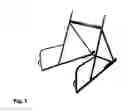
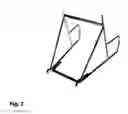
- 1. The squat rack will be similar to the traditional squat rack found in weight rooms, however, it will be smaller, lighter and mobile. Mobility is achieved through two small wheels placed on one edge and a set of handles on the opposite edge. The wheels only touch the floor when the equipment is raised from the opposite edge (see FIG. 1 and FIG. 2).
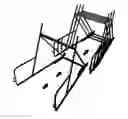
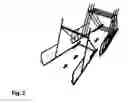
- 2. The most important aspect of the design is that one of the edges is narrower than the other thus allowing one unit to fit in another (see FIG. 1 and FIG. 2) similar to the way supermarket karts and airport baggage trolleys are stored (see FIG. 3). This feature allows for the storage of a large number of units in a small area (e.g. studio) after use.
- 3. In addition to the variety of squats, lunges, dips and pull-ups that the rack can accommodate, with the addition of adequate benches the rack can also be used for the bench press, incline press and shoulder press.
- 4. As with the traditional rack, the adapted rack will include various heights for barbell support so that it can be adjusted to fit the user's height. Other additional features could include: plate holders, water bottle holders, and others.
BRIEF DESCRIPTION OF THE DRAWINGS
FIG. 1 shows a perspective view of a squat rack of an embodiment of the invention;
FIG. 2 shows a rear perspective view of the squat rack of FIG. 1; and
FIG. 3 shows a perspective view of the squat rack of FIG. 1 inserted into other corresponding squat racks.
DETAILED DESCRIPTION OF THE DRAWINGS
The rack's mobility and storability could make it a standard piece of equipment in fitness studios thus presenting the following advantages for group classes:
-
- 1. The rack allows the use of adequate loads for the various muscle groups, particularly the legs and glutes, and allows participants to use heavy loads similar to those used in weight rooms.
- 2. The rack allows the easy and safe change of weights in order to adjust the load to the different exercise types, different series and different class objectives.
- 3. The rack allows the participant to rest the barbell on the rack pins whenever necessary and in the rest periods between series.
- 4. The rack increases the level of safety in the class particularly in relation to the handling of weights and execution of movements.
- 5. The rack allows for the integration of the main weight-training methods and systems with group classes to create a new class model which combines the pleasure of group classes with the efficiency of weight-lifting.
The process described in this document, of applying structural changes to a piece of equipment in order to enhance its functionality for Fitness is very similar to the process used to create the Spinning class. To create Spinning, Johnny G. transformed the conventional bicycle to create a new exercise model combining an adapted piece of equipment (the spinning bike) with its specific class methodology (the spinning class).
Claims
1. A stackable squat rack designed for storability and mobility, comprising:
a pair of vertical rack members angled on an incline from a vertical position and connected via a crossbar;
a pair of vertical support members connected to each of the pair of vertical rack members, the pair of vertical support members configured to support the vertical rack members;
a pair of base members connected via a floorbar, said plurality of base members adapted to engage a floor surface, said pair of base members connected to said pair of vertical rack members and to said pair of vertical support members;
a pair of horizontal support members connected to a portion of said pair of vertical support members at one end and to said pair of base members at another end;
a plurality of bar supports located on the pair of vertical support members and said horizontal support members; and
two wheels connected to an end of said pair of base members,
wherein the plurality of base members are angled such that the rear of the stackable squat rack is narrower than the front of the stackable squat rack to allow the stackable squat rack to fit into another stackable squat rack of similar configuration for storage.
2. The stackable squat rack of claim 1, further comprising a set of handles located on each of the pair of horizontal support members.
3. The stackable squat rack of claim 1, wherein said squat rack is specifically designed for storability and mobility.
4. The stackable squat rack of claim 1, wherein said squat rack is made of a durable material such as metal or a metal alloy.
5. The stackable squat rack of claim 1, wherein the pair of wheels are configured to only touch the floor when the squat rack is raised from the opposite end.
6. The stackable squat rack of claim 1, wherein the rack is adjustable to fit a user's height.
7. The stackable squat rack of claim 1, further comprising a plate holder.
8. The stackable squat rack of claim 1, further comprising a water bottle holder.
9. A squat rack for group fitness exercises specifically designed for storability and mobility:
Storability is achieved by making one of the edges narrower than the other allowing one unit to fit in another for storage;
Mobility is achieved through two small wheels placed on one edge and a set of handles on the opposite edge.
Images & Drawings included:
Sources:
- United States Patent and Trademark Office - verify current appl. status at the USPTO↗
Recent applications in this class:
- » 20250269220 2025-08-28
SLIDABLE FREE-ROTATING BARBELL GRIP - » 20250099801 2025-03-27
NOISE REDUCTION WEIGHTLIFTING ACCESSORY - » 20250065179 2025-02-27
Barbell Sleeve Assembly - » 20250032839 2025-01-30
Barbell - » 20240350854 2024-10-24
LEVEL BAR - » 20240316388 2024-09-26
Barbell - » 20240226639 2024-07-11
DUMBBELL - » 20240198165 2024-06-20
EXERCISE BAR - » 20240198164 2024-06-20
Exercise bar - » 20240139575 2024-05-02
EXERCISE APPARATUSES