SHOVEL-BUCKET ATTACHMENT
US20170081825A1
2017-03-23
14/732,397
2015-06-05
Abstract:
This invention relates to the use of an attachment to power construction equipment machine (10) such as backhoes or shovels or bulldozers or skid steers of other equipment that moves earth materials. The attachment is mounted by welding the attachment to a part of the power equipment (10) such that the reach of the equipment is greatly enhanced and safety is obtained due to materials not falling into the power equipment. The main use is to excavate hard-to-reach areas. The attachment comprises of a steel tube (2); welded to a bucket (1); support plates are welded to bucket for support (3); attached to the steel tube is shovel-bucket plate (4); with a pointed end (5) and braces are attached with 2″×2″×¼″ steel angles as required.
Interested in similar patents?
Get notified when new applications in this technology area are published.
Classification:
E02F3/962 » CPC main
Dredgers; Soil-shifting machines mechanically-driven with arrangements for alternate use of different digging elements Mounting of implements directly on tools already attached to the machine
E02F3/96 IPC
Dredgers; Soil-shifting machines mechanically-driven with arrangements for alternate use of different digging elements
E02F3/36 » CPC further
Dredgers; Soil-shifting machines mechanically-driven with digging tools mounted on a dipper- or bucket-arm, i.e. there is either one arm or a pair of arms , e.g. dippers, buckets Component parts
Description
BACKGROUND OF THE INVENTION
In order to be able to reach and excavate hard to get at places this invention was created to do. The invention is a process where an attachment is attached to construction equipment (10) such that it may stretch out beyond the equipment itself to excavate materials.
BRIEF SUMMARY OF THE INVENTION
The object is to be able to reach difficult places to excavate. A typical use is that a bucket (1) on construction equipment (10) has attached to it a steel tube or other structural shape. (“tube”) (2) by welding the tube (2) to the bucket. (1) A 6×6×½ steel tube has been used. Plates or angles (3) are also welded to the bucket and tube for stability. Plates or angles (8) are also welded to the bucket and tube for stability. Lengths may vary. The length of the tube of 12 feet has been used. At the far end of the tube a steel plate (“shove-bucket plate”) (4) is welded to the tube (2). The shovel-bucket plate (4) has the far corners cut out forming a point. A typical shovel-bucket plate (4) is 4 feet×4 feet by ½″. A typical cut off is 1 foot but may vary for specific applications. The shovel bucket plate (4) is welded to the tube (2) The plate is cantilevered such that ¼ of the length is welded to the tube. A typical length is 1 foot. Steel angles or plates (5) and welded to shovel-bucket plate (4) and tube (2). The tube (2) has an end cap (7). Angles (6) are welded to the end cap. (7) And to the shovel-bucket plate (4). These angles stop about midpoint of the plate and are cut down near end.
The tube (2) may be eliminated so that the shovel-bucket attachment may be used for specific job. The shovel-bucket plate (4) is welded to the bucket (1). The width of the plate is being 1 inch less than the bucket width. Usually the size of the plate approximately 7′×5′.
Connections stated above are welded but bolting is also acceptable. Lengths and sizes of tube and plates may vary according to the specific job the shovel-bucket attachment is being used.
BRIEF DESCRIPTION OF THE VIEWS OF THE DRAWINGS
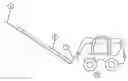
Drawing 1 is a side view of the equipment with the shovel bucket attachment.
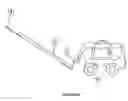
Drawing 2 is a plan view arid side view of the shovel-bucket attachment.
Drawing 3 is a plan view and-side view of the shovel-bucket attachment without tube.
DISCLOSURES
The aim of the invention is to provide a method to be able to excavate materials in inaccessible areas.
Claims
What is claimed is:1. The attachment is a method by which hard to get at areas can be excavated in complete safety for the operator of the equipment.
2. The attachment will give the operator the ability to reach areas where without attachment can not be reached.
3. The attachment provides a safety condition for the operator of the work or equipment.
Images & Drawings included:


Sources:
- United States Patent and Trademark Office - verify current appl. status at the USPTO↗
Recent applications in this class:
- » 20240125085 2024-04-18
ATTACHMENT WITH GROUND SUPPORT MEMBER - » 20230287651 2023-09-14
IMPROVEMENTS IN & RELATING TO THE WORKING OF GROUND AND OTHER SURFACES - » 20230081597 2023-03-16
Asphalt Cutting Attachment - » 20230054384 2023-02-23
Front load bucket attachment assembly with receiver - » 20220267987 2022-08-25
VARIABLE GRIP GRAPPLE - » 20220064899 2022-03-03
FORK LIFT ATTACHMENT FOR A FRONT END LOADER BUCKET - » 20210388576 2021-12-16
TRACTOR BUCKET ADAPTER SYSTEM - » 20200291602 2020-09-17
ATTACHMENT SYSTEM FOR VEHICLE BUCKET - » 20200181876 2020-06-11
Attachment-configurable system for a work machine - » 20200131733 2020-04-30
Chisel arrangement for excavator