Pistachio rootstock named clone 'UCB1-D90'
US20170094849P1
2017-03-30
14/756,672
2015-09-29
Abstract:
Disclosed is a new and distinct variety of pistachio rootstock called ‘UCB1-D90’ characterized in that, when compared to the industry standard ‘UCB1-D1’ rootstock, it has greater growth and tolerance to the soil salts of calcium chloride, sodium sulfate, sodium carbonate and sodium bicarbonate; greater growth and tolerance to high levels of dissolved salts in irrigation water; earlier vegetative bud break; and greater graft compatibility with commercial pistachio clones.
Inventors:
- Javier Castillon 4 🇺🇸 Hughson, CA, United States
- Kendall Ash 4 🇺🇸 Hughson, CA, United States
- Dharam Sharma 4 🇺🇸 Hughson, CA, United States
- John Scott Duarte 4 🇺🇸 Modesto, CA, United States
- Jeffrey Thomas Duarte 3 🇺🇸 Modesto, CA, United States
Assignee:
- John Scott Duarte 4 🇺🇸 Modesto, CA, United States
- Jeffrey Thomas Duarte 4 🇺🇸 Modesto, CA, United States
Interested in similar patents?
Get notified when new applications in this technology area are published.
Classification:
A01H5/00 IPC
Products
A01H5/00 IPC
Angiosperms, i.e. flowering plants, characterised by their plant parts; Angiosperms characterised otherwise than by their botanic taxonomy
Description
Latin name: Pistacia atlantica×Pistacia integerrima.
Varietal denomination: ‘UCB1-D90’.
BACKGROUND OF THE NEW VARIETY
The present invention comprises a new and distinct cultivar of hybrid pistachio (Pistacia atlantica×Pistacia integerrima) used as a rootstock known by the varietal name, clone ‘UCB1-D90.’ The clone, ‘UCB1-D90,’ is an in vitro, single selection of the segregating controlled cross of (P. atlantica×P. integerrima) made at Foundation Plant Services, University of California, Davis. The purpose of the selection program was to develop rootstocks with superior tolerance to soil salts. Seedlings were tested in salt trials in the laboratory and compared to the ‘UCB1-D1’ rootstock. Those seedlings that exhibited high tolerance to various soil salts were selected. The new variety exhibits high tolerance to numerous, common salts found in the soil and irrigation water.
The following characteristics distinguish clone ‘UCB1-D90’ from the industry standard, ‘UCB1-D1’ rootstock:
1. Greater growth and tolerance to the soil salts, calcium chloride, sodium sulfate, sodium carbonate and sodium bicarbonate.
2. Greater growth and tolerance to high levels of dissolved salts in irrigation water.
3. Earlier vegetative bud break.
4. Greater graft compatibility with commercial pistachio clones.
ORIGIN AND ASEXUAL REPRODUCTION OF THE NEW VARIETY
Asexual reproduction of the new and distinct variety of rootstock was accomplished by germinating seed in vitro under aseptic conditions and propagating the resulting seedlings using micropropagation techniques. Shoot epicotyl and hypocotyl tissue was collected from germinating seedlings and placed on a standard growth media to produce shoots. The shoots were sub-cultured and multiplied until desired numbers were obtained and then transferred to standard rooting media for rooting. Rooted plantlets were then transferred to a peat:perlite media in acclimation chambers under 100% humidity. Field environmental parameters were gradually introduced to harden plantlets which were then successively transferred to larger pots in the greenhouse as their size increased. These potted trees were used to establish field performance trials. Subsequent evaluations have shown those asexual reproductions are true-to-type to the original rootstock selection. All characteristics of the original tree were established and appear to be transmitted completely through succeeding asexual propagations.
SUMMARY OF THE NEW VARIETY
The clone ‘UCB1-D90’ rootstock is characterized by its tolerance to high levels of the soil salts, calcium chloride, sodium sulfate, sodium carbonate and sodium bicarbonate. In each case clone ‘UCB1-D90’ had greater growth in laboratory salt trials than the industry standard rootstock, ‘UCB1-D1.’ In another laboratory salt trial, media was supplemented with the total salt load detected in San Joaquin Valley irrigation water and also supplemented with twice that load. In all cases, growth of clone ‘UCB1-D90’ outperformed that of ‘UCB1-D1’ in the presence of these high salt levels. Vegetative bud break of ‘UCB1-D90’ was observed to be approximately 8 days earlier than ‘UCB1-D1’ and ‘UCB1-D90’ graft compatibility with 5 commercial pistachio clones, ‘Golden Hills,’ ‘Kerman,’ ‘Lost Hills,’ ‘Peters,’ and ‘Randy’ was 10% greater than the graft success rate of ‘UCB1-D1.’
DESCRIPTION OF THE ILLUSTRATIONS
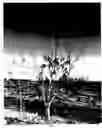
The accompanying photographic illustrations show typical specimens of vegetative growth of the new variety, with the color being as nearly true as is possible with color illustrations of this type:
FIG. 1 shows a 4 year old pistachio tree of the new variety.
FIG. 2 shows a close-up of the mature leaves of the new variety.
DESCRIPTION OF THE NEW VARIETY
The following detailed description sets forth the characteristics of the new variety. The data which defines these characteristics was collected under natural daylight on plants grown in the central valley of California in Stanislaus County in the greenhouse and in the field. Descriptions may vary in slight detail due to climatic, soil and cultural conditions under which the variety may be grown. Color designations are presented with reference to the Inter-Society Color Council, National Bureau of Standards, except where common color names are also included.
- Tree: Trunk circumference 1 foot off the ground is 28.4 cm. Trunk lenticels are approximately 2.4 mm in length and 1.1 mm in width. Trunk lenticels are elliptic in shape. Trunk lenticel color is strong brown [55. s.B]. Trunk lenticels number approximately 60 per square inch. Bark color is dark grayish yellow [91. d.g.Y]. Branch lenticels are approximately 2.2 mm in length and 0.6 mm in width. Branch lenticels are linear in shape. Branch lenticel color is strong brown [55. s.B]. Branch lenticels number approximately 62 per square inch.
- Vegetative buds:
-
- Size.—Approximately 50 mm in length and 4 mm in width.
- Shape.—Conical.
- Color.—Brilliant, yellowish green [130. b.y.G] with strong, orange yellow [68. s.OY] exterior basal scales. As tips unfurl they become strong purplish red [255. s.p.R]. First vegetative buds of ‘UCB1-D90’ opened approximately 8 days earlier than ‘UCB1-D1.’Leaflet blade color on the top and bottom surfaces is vivid red [11. v.R]. At the junction of the base of the petiole with the rachis, tissue color is brilliant, yellowish green [130. b.y.G]. Expanding rachis color is brilliant, yellowish green [130. b.y.G] at the extreme tip and very dark purplish red [260. v.d.p.R] on all sides elsewhere. Leaf venation pattern is pinnate and alternate. Midrib and veins are brilliant, yellowish green [130. b.y.G].
-
- Foliage: Leaves are pinnately compound composed of alternate leaflets numbering between 14 and 17. Compound leaf size variations are great but average approximately 46 cm in length and 47 cm in width at the widest point. Young leaflets are glossy and dark greyish red [20. d.g.R] on upper surfaces and moderate olive green [125. m.OG] on lower surfaces. Older leaflet surfaces are strong olive green [123. s.OG] on upper surfaces and moderate olive green [125. m.OG] on lower surfaces. Leaflet shape is lanceolate with an acute apex and cuneate base. There is great variation in leaf and leaflet size depending on the time of the season, position on the tree and tree age. Leaflet size varies considerably but averages 78 mm in length and 27 mm in width. Leaf venation pattern is pinnate and venation is brilliant yellowish green [130. b.y.G]. The midrib is prominent and the same color as the venation pattern. Leaf margins are entire and surfaces are glabrous. Petiole and rachis younger tissue upper and lower surface color is predominately strong purplish red [255. s.p.R] with some strong yellowish green [131. s.y.G] streaking on lower surfaces of older tissues. Petiole length varies considerably but averages 60 mm in length from point of rachis attachment to basal leaflet, and is glabrous with no wings. Rachis length varies considerably and averages about 35 cm in length.
- Salt tolerance: Different concentrations of individual salts that contribute to soil salinity and alkalinity ranging from 0 to 10,000 mg/l were added to the culture medium that rootstock was growing in. Each clone-salt combination was replicated four times. Observations were taken on visual injury symptoms and growth measured by number of shoots and leaves per plant. Clone ‘UCB1-D90’ rootstock is characterized by its tolerance to high levels of the soil salts, calcium chloride (at 10,000 mg/l), sodium sulfate (at 10,000 mg/l), sodium carbonate (at 1,000 mg/l) and sodium bicarbonate (at 1,000 mg/l). As measured on a growth scale of 1 to 10, in the case of each of these salt trials clone ‘UCB1-90D’ had greater growth than the industry standard rootstock, ‘UCB1-D1.’ In another salt trial, media was supplemented with the comparable total salt load detected in San Joaquin Valley irrigation water (Sanden, B. et al. 2009. Large-Scale Utilization of Saline Groundwater for Irrigation of Pistachios Interplanted with Cotton. 2009 Progress Rpt. of CA Pistachio Comm.) plus twice the detected salt load. In all cases, growth of clone ‘UCB1-D90’ outperformed that of ‘UCB1-D1’ in the presence of high soluble salts.
Claims
Having thus described and illustrated the new variety of rootstock, what is claimed as new and desired to be secured by plant letters patent is:1. A new and distinct variety of pistachio rootstock substantially as illustrated and described called ‘UCB1-D90’ characterized in that, when compared to the industry standard ‘UCB1-D1’ rootstock, it has greater growth and tolerance to the soil salts of calcium chloride, sodium sulfate, sodium carbonate and sodium bicarbonate; greater growth and tolerance to high levels of dissolved salts in irrigation water; earlier vegetative bud break; and greater graft compatibility with commercial pistachio clones.
Images & Drawings included:


Sources:
- United States Patent and Trademark Office - verify current appl. status at the USPTO↗
Recent applications in this class:
- » 20240292771 2024-08-29
Campanula plant named 'Twilight' - » 20240251691 2024-07-25
HYDRANGEA PLANT NAMED 'HYLV17520' - » 20240251690 2024-07-25
Vaccinium Plant Named 'BWPBLUE02' - » 20240251689 2024-07-25
BLUEBERRY PLANT NAMED 'FC13-113' - » 20240251688 2024-07-25
BLUEBERRY PLANT NAMED 'FCM14-057' - » 20240237567 2024-07-11
PONGAMIA VARIETIES - » 20240224827 2024-07-04
PELARGONIUM PLANT NAMED 'PEQZ0103' - » 20240215470 2024-06-27
Agapanthus plant named 'Monsapho' - » 20240215469 2024-06-27
plant named ‘LOCORA3519’ - » 20240206359 2024-06-20
CORYLUS PLANT NAMED 'BWM01'
Recent applications for this Assignee:
- » 20170094852 2017-03-30
Pistachio rootstock named clone 'UCB1-D154' - » 20170094852 2017-03-30
Pistachio rootstock named clone 'UCB1-D154' - » 20170094851 2017-03-30
PISTACHIO ROOTSTOCK NAMED CLONE 'UCB1-D110' - » 20170094851 2017-03-30
PISTACHIO ROOTSTOCK NAMED CLONE 'UCB1-D110' - » 20170094850 2017-03-30
Pistachio rootstock named clone 'UCB1-D71' - » 20170094850 2017-03-30
Pistachio rootstock named clone 'UCB1-D71'