Insulation material and a method to produce
US20170101337A1
2017-04-13
15/127,228
2015-03-10
✅ Patent granted
US 9,926,222 B2
2018-03-27
WO; PCT/EP2015/054957; 20150310
WO; WO2015/140007; 20150924
Noah S Wiese
GE Global Patent Operation | Rita D. Vacca
2035-03-10
Abstract:
The present disclosure relates to an insulation material for a conductor bar of an electric machine. An object of the invention is to provide for an alternative insulation material in the field of electric machines. The object is solved by an insulation material for a conductor bar for an electric machine comprising glass-ceramic flakes made from a heat treated silica glass precursor in the shape of flakes. Further disclosed are a corresponding method and the use of glass-ceramic flakes as an insulation material for a conductor bar of an electric machine
Inventors:
- Thomas BAUMANN 24 🇨🇭 Wettingen, Switzerland
- Thomas HILLMER 3 🇨🇭 Suhr, Switzerland
- Paul HOWARD 1 🇬🇧 Stafford, Staffordshire, United Kingdom
- Iwona SZKODA-GIANNAKI 1 🇬🇧 Stafford Staffordshire, United Kingdom
- Paul Howard 1 🇬🇧 Stafford, United Kingdom
- Iwona Szkoda-Giannaki 1 🇬🇧 Stafford, United Kingdom
Assignee:
- General Electric Technology GmbH 781 🇨🇭 Baden, Switzerland
Applicant:
Interested in similar patents?
Get notified when new applications in this technology area are published.
Classification:
C03C10/0009 » CPC main
Devitrified glass ceramics, i.e. glass ceramics having a crystalline phase dispersed in a glassy phase and constituting at least 50% by weight of the total composition containing silica as main constituent
H01B3/002 » CPC further
Insulators or insulating bodies characterised by the insulating materials; Selection of materials for their insulating or dielectric properties Inhomogeneous material in general
C03C10/00 IPC
Devitrified glass ceramics, i.e. glass ceramics having a crystalline phase dispersed in a glassy phase and constituting at least 50% by weight of the total composition
H01B3/08 » CPC further
Insulators or insulating bodies characterised by the insulating materials; Selection of materials for their insulating or dielectric properties mainly consisting of inorganic substances quartz; glass; glass wool; slag wool; vitreous enamels
C03B32/02 » CPC further
Thermal after-treatment of glass products not provided for in groups, - , e.g. crystallisation, eliminating gas inclusions or other impurities Thermal crystallisation, e.g. for crystallising glass bodies into glass-ceramic articles
C03B37/005 » CPC further
Manufacture or treatment of flakes, fibres, or filaments from softened glass, minerals, or slags Manufacture of flakes
H01B3/00 IPC
Insulators or insulating bodies characterised by the insulating materials; Selection of materials for their insulating or dielectric properties
C09K5/14 » CPC further
Heat-transfer, heat-exchange or heat-storage materials, e.g. refrigerants; Materials for the production of heat or cold by chemical reactions other than by combustion; Materials not undergoing a change of physical state when used Solid materials, e.g. powdery or granular
C03C4/16 » CPC further
Compositions for glass with special properties for dielectric glass
H02K3/30 » CPC further
Details of windings Windings characterised by the insulating material
C03C2204/00 » CPC further
Glasses, glazes or enamels with special properties
Description
TECHNICAL FIELD
The present disclosure relates to an insulation material, a method to manufacture an insulation material for an electric machine, a use of polycrystalline flakes from at least one silicate glass, and the use of an insulation material as a conductor bar in an electric machine.
The electric machine is, in particular, a rotating electric machine such as a synchronous generator to be connected to a gas or steam turbine (turbogenerator) or a synchronous generator to be connected to a hydro turbine (hydro generator) or an asynchronous generator or a synchronous or asynchronous electric motor or also other types of electric machines.
BACKGROUND
In electric machines, commonly electrically conductive bars are used for the stator or the rotor. The conductive bars are accommodated in notches usually milled into the stator or rotor body. The conductor bars, sometimes having a drilled arrangement of the leads and then referred to as Roebel bars are insulated for high voltages when used in the technical field of generators. The insulation layers at the conductor bars often are composed of three components of which mica is the main component. Mica has a relatively low thermal conductivity of approximately 0.5 W/mK in the axial (normal-to-plane) direction, thus limiting the heat transfer within the entire insulation composite. The mica also governs the coefficient of thermal expansion (CTE) of the insulation in the in-plane direction, forcing it to a CTE of approximately 10×10−6 K−1, which is substantially lower than the CTE of the copper conductor. Hence, there is a need for an alternative electrical insulation material that has higher thermal conductivity and CTE.
EP2102968A1 describes a conductor bar for the stator of a generator which includes multiple internally positioned partial conductors which are surrounded externally by an insulation layer including impregnated glass/mica bands wound around the partial conductors. To improve the mechanical adhesion between the partial conductors and the insulation layer, at least one intermediate layer is provided between the insulation layer and the partial conductors.
An aspect of embodiments of the present invention is to provide an alternative insulation material in the field of electric machines.
BRIEF DESCRIPTION
An aspect of the disclosure includes an insulation material for an electric machine including a polycrystalline glass-ceramic material as a main component.
Another aspect of the disclosure provides a method to produce an insulation material including the step of heat treating a silicate glass to obtain a glass-ceramic material.
A further aspect of the present disclosure is the use of an insulation material for a conductor bar in an electric machine.
Further examples of the invention are described herein.
BRIEF DESCRIPTION OF THE DRAWINGS
Further characteristics and advantages will be more apparent from the description of a preferred but non-exclusive embodiment of the insulation material and the use thereof, illustrated by way of a non-limiting example in the accompanying drawings, in which:
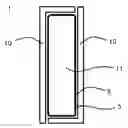
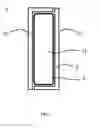
FIG. 1 is a schematic view of the cross-section of a conductor bar with an insulation material according to an embodiment.
DETAILED DESCRIPTION
FIG. 1 shows a schematic cross-section of a conductor bar 1 with an insulation material 3 according to an embodiment of the invention. Inside, a conductive bar 11 is arranged, which is covered by an insulation layer made of insulation material 3, also referred to as main wall insulation. The common insulation according to the state of the art includes a mica material impregnated with a resin different to the material 3 used according to an embodiment. The conductive bar 11 consists of the actual half-winding out of copper-strands where the voltage is induced and the electrical current is flowing during the operation of a generator in which the conductor bar 1 is assembled. Optionally, around the insulation layer 3 a release tape 5 is arranged which serves for unpacking the conductor bar 1 after curing of a resin without damaging the insulation material 3. Further, around the release tape 5 two shapes 10 or accommodating tools are arranged essentially enclosing the three former items. The shapes 10 are for creating defined dimensions and smooth surfaces of the straight sections of the insulated conductive bar 11. The shapes 10 are made of steel and have the form of an ‘L’ with one long side and a shorter side at the end perpendicular to the long side. The shapes 10 are arranged in a way to create a closed loop around the oval arrangement and are to be removed after manufacture of the conductor bar 1.
Described herein by way of an example is the production of a glass-ceramic as an alternative to mica material based upon two material production processes. The first of these is the production of silicate glasses having a composition in the form of thin amorphous flakes. The second process is to transform the silicate glass flakes into a polycrystalline form by a heat treatment. The product of these two processes is a glass-ceramic flake. Thus, in this example, glasses of particular compositions are produced first as amorphous glass flakes and then heat treated to produce polycrystalline glass-ceramic flakes. The definition of the particular compositions of the silicate glasses is described in the following.
As a first process, two silicate glasses are described by example in the following. The first embodiment of a composition of a silicate glass is composed of silica, lithium oxide, zinc oxide and phosphorus pentoxide. The latter materials are also referred to as glass precursors. In one embodiment, the compositional ranges are silica 50-65 wt. %, lithium oxide 8-16 wt. %, zinc oxide 22-32 wt. %, and phosphorous pentoxide 1.5-3.5 wt. %. In another embodiment, the compositional ranges are silica 73-85 wt. %, lithium oxide 8-15 wt. %, zinc oxide 2-7 wt. %, phosphorous pentoxide 1-3 wt. %, and potassium oxide 1.5-3.5 wt. %. This silicate glass is melted in air at 1300° C. then processed to produce amorphous glass flakes. When heat treated, these silicate glass flakes are transformed into lithium-zinc-silicate-type glass-ceramic flakes. The second embodiment of a glass is composed of silica, lithium oxide, zinc oxide, potassium oxide and phosphorus pentoxide. This glass is melted in air at 1400° C. then processed to produce amorphous glass flakes. When heat treated, these glass flakes are transformed into lithium disilicate-type glass-ceramic flakes.
In an embodiment, a glass-ceramic flake includes 80% crystallinity, another embodiment includes 40% crystallinity, and a further embodiment includes 44% crystallinity. Certain properties of the glass-ceramics have been measured as follows. The average coefficient of thermal expansion of one glass-ceramic between room temperature and 200° C. is measured to be 11.4×10⁻⁶ K−1 and the dielectric strength is in the range of 30-42 kV/mm. The average coefficient of thermal expansion of another glass-ceramic between room temperature and 200° C. is measured to be 16.5×10⁻⁶K−1. The thermal conductivity is 2.6 W/mK and the dielectric strength is in the range of 20-32 kV/mm.
The resulting glass-ceramic material that forms the main component of insulation material 3 has a complex microstructure consisting mainly of micron-scale crystallites with a small proportion of residual amorphous glass. Being predominantly polycrystalline, the glass-ceramic flake has an isotropic thermal conductivity of approximately 3 W/mK. This is six times greater than the thermal conductivity of mica in its axial direction.
After transformation of the glasses by heat treatment, the obtained glass-ceramics contains various crystalline phases that have been identified as lithium zinc silicate, lithium metasilicate, lithium disilicate, quartz, crystobalite and tridymite.
The present disclosure also relates to the use of the polycrystalline glass-ceramic material as the main component of an insulation material 3 for a conductor bar 1 in an electric machine. In this application the commonly used mica material as insulation for a conductor bar, for example a Roebel bar, is replaced by the material disclosed.
It is to be understood that even though numerous characteristics and advantages of various embodiments have been set forth in the foregoing description, together with details of the structure and functions of various embodiments, this disclosure is illustrative only, and changes may be made in detail, especially in matters of structure and arrangement of parts within the principles of the embodiments to the full extent indicated by the broad general meaning of the terms in which the appended claims are expressed. It will be appreciated by those skilled in the art that the teachings disclosed herein can be applied to other systems without departing from the scope and spirit of the application.
Claims
What is claimed is:1. An insulation material for an electric machine, comprising a polycrystalline glass-ceramic material.
2. The insulation material according to claim 1, wherein the polycrystalline glass-ceramic material comprises a proportion of residual amorphous glass.
3. The insulation material according to claim 2, wherein the insulation material comprises a glass-ceramic flake that comprises a crystal phase lithium zinc silicate, lithium metasilicate, lithium disilicate, quartz, cristobalite, or tridymite.
4. The insulation material according to claim 3, further comprising a glass precursor, wherein the glass precursor comprises silica, lithium oxide, zinc oxide, and phosphorous pentoxide.
5. The insulation material according to claim 4, further comprising a second glass precursor, wherein the second glass precursor comprises silica, lithium oxide, zinc oxide, potassium oxide, and phosphorous pentoxide.
6. The insulation material according to claim 1, wherein the insulation material comprises an inorganic component having around 80% crystallinity.
7. The insulation material according to claim 1, wherein the insulation material comprises an inorganic component having around 40% crystallinity.
8. The insulation material according to claim 1, wherein the insulation material comprises an inorganic component having around 44% crystallinity.
9. A glass-ceramic produced from amorphous flakes, the amorphous flakes comprising at least one silicate glass, wherein the amorphous flakes undergo a heat treatment and thereby become polycrystalline.
10. A method to produce an insulation material, comprising the step of heat treating a silicate glass flake to obtain a glass-ceramic flake material.
11. The method according to claim 10, wherein the silicate glass flake comprises amorphous flakes formed from a first and/or second silicate glass.
12. The method according to claim 11, further comprising heating the first and/or the second silicate glass to obtain the amorphous flakes.
13. The insulation material according to claim 1, wherein the insulation material is used as insulation for a conductor bar in an electric machine.
14. The glass-ceramic of claim 9, wherein the at least one silicate glass comprises a first silicate glass composed of silica, lithium oxide, zinc oxide and phosphorus pentoxide and a second silicate glass composed of silica, lithium oxide, zinc oxide, potassium oxide and phosphorus pentoxide.
15. The method of claim 12, wherein the amorphous flakes are formed from the first silicate glass and the second silicate glass, the step of heating comprises heating the first silicate glass and the second silicate glass, the first silicate glass is composed of silica, lithium oxide, zinc oxide and phosphorus pentoxide, and the second silicate glass is composed of silica, lithium oxide, zinc oxide, potassium oxide and phosphorus pentoxide.
16. The method of claim 15, wherein the glass-ceramic flake material is polycrystalline.
17. The method of claim 16, wherein at least one of the heating step or the heat treating step results in a residual amorphous glass, the insulation material comprising a proportion of the residual amorphous glass.
Images & Drawings included:
Sources:
- United States Patent and Trademark Office - verify current appl. status at the USPTO↗
Similar patent applications:
- » 10240215
Insulating material, method for producing insulating material, method for manufacturing multilayer circuit board - » 20150248948
Resin composition for producing insulating material and method for producing insulating material - » 20240181758
INSULATION MATERIAL, METHOD FOR PRODUCING AN INSULATION MATERIAL, AND METHOD FOR RECYCLING AN INSULATION MATERIAL - » 20220251412
Impregnating Formulation, Insulation Material, Method for Producing an Insulation Material, and Electrical Machine with an Insulation Material - » 20090186176
Vacuum Heat Insulating Material, Method of Producing Vacuum Heat Insulating Material, and Heat Insulating Box Body Using Vacuum Heat Insulating Material - » 20110030892
Vacuum heat insulating material, method of producing vacuum heat insulating material, and heat insulating box body using vacuum heat insulating material - » 20230278928
THERMAL INSULATION MATERIAL AND METHOD FOR PRODUCING THERMAL INSULATION MATERIAL - » 20220048275
Sound insulation material and method of producing sound insulation material - » 20240336534
THERMAL INSULATION MATERIAL AND METHOD FOR PRODUCING THERMAL INSULATION MATERIAL - » 20240400464
THERMAL INSULATION MATERIAL AND METHOD FOR PRODUCING THERMAL INSULATION MATERIAL
Recent applications in this class:
- » 20250250193 2025-08-07
GLASS CERAMIC, MANUFACTURING METHOD THEREOF, AND DEVICE - » 20250100924 2025-03-27
INORGANIC COMPOSITION ARTICLE - » 20250100923 2025-03-27
GLASS CERAMIC AND MANUFACTURING METHOD THEREOF - » 20240300851 2024-09-12
GLASS CERAMIC WITH QUARTZ SOLID SOLUTION PHASE - » 20240294420 2024-09-05
STUFFED a-QUARTZ AND GAHNITE GLASS-CERAMIC ARTICLES HAVING IMPROVED MECHANICAL DURABILITY - » 20240228366 2024-07-11
GLASS CERAMIC WITH QUARTZ SOLID SOLUTION PHASES - » 20240228365 2024-07-11
GLASS CERAMIC MATERIAL, METHOD FOR PREPARING THE SAME, AND DENTURE - » 20240199474 2024-06-20
TRANSPARENT GLASS CERAMIC, ESPECIALLY AS A COVER PANE - » 20240199473 2024-06-20
TRANSPARENT GLASS CERAMIC AND COVER PANE - » 20240150224 2024-05-09
CRYSTALLIZED GLASS, CHEMICALLY STRENGTHENED GLASS, AND ELECTRONIC DEVICE
Recent applications for this Assignee:
- » 20240378493 2024-11-14
SYSTEMS AND METHODS FOR PERFORMING MACHINE LEARNING AND DATA ANALYTICS IN HYBRID SYSTEMS - » 20240369646 2024-11-07
SYSTEMS AND METHODS FOR MONITORING A THROUGH FAULT CURRENT - » 20240348047 2024-10-17
SYSTEMS AND METHODS FOR MALICIOUS CONTROL DETECTION IN A POWER GRID - » 20240319253 2024-09-26
SYSTEMS AND METHODS FOR DETERMINING A DISTANCE TO A FAULT IN HYBRID LINE SYSTEMS - » 20240319252 2024-09-26
SYSTEMS AND METHODS FOR DETERMINING A DISTANCE TO A FAULT IN A POWER SYSTEMS NETWORK - » 20240274384 2024-08-15
FAST EARTHING SWITCH IMPLEMENTING THE COANDA EFFECT - » 20240266129 2024-08-08
CIRCUIT BREAKER COMPRISING AN IMPROVED GAS FLOW MANAGEMENT - » 20240258049 2024-08-01
SF6 FREE GAS INSULATED DISCONNECTOR WITH LIMITED ARCING VOLUME - » 20240229683 2024-07-11
SYSTEM FOR READYING SUB-CRITICAL AND SUPER-CRITICAL STEAM GENERATOR, SERVICING METHOD OF SAID SUB-CRITICAL AND SUPER-CRITICAL STEAM GENERATOR AND METHOD OF OPERATION OF SUB-CRITICAL AND SUPER-CRITICAL STEAM GENERATOR - » 20240151762 2024-05-09
Systems and methods for identifying grid fault type and faulted phase