Flexible cable
US20170186513A1
2017-06-29
15/372,234
2016-12-07
✅ Patent granted
US 9,905,330 B2
2018-02-27
-
-
Timothy Thompson | Charles Pizzuto
McGinn IP Law Group, PLLC
2036-12-07
Abstract:
A flexible cable includes an outer sheath at an outermost portion. The outer sheath includes an inner layer made of an elastomer containing polypropylene resin, and an outer layer surrounding the inner layer and made of polypropylene resin.
Inventors:
- Detian HUANG 40 🇯🇵 Hitachi, Japan
- Takanobu WATANABE 35 🇯🇵 Hitachi, Japan
- Haruyuki WATANABE 16 🇯🇵 Hitachi, Japan
- Kimika Kudo 16 🇯🇵 Kitaibaraki, Japan
Assignee:
- HITACHI METALS, LTD. 1,753 🇯🇵 TOKYO, Japan
Applicant:
Interested in similar patents?
Get notified when new applications in this technology area are published.
Classification:
H01B7/048 » CPC main
Insulated conductors or cables characterised by their form; Flexible cables, conductors, or cords, e.g. trailing cables for implantation into a human or animal body, e.g. pacemaker leads
H01B7/0275 » CPC further
Insulated conductors or cables characterised by their form; Disposition of insulation comprising one or more extruded layers of insulation
H01B7/0216 » CPC further
Insulated conductors or cables characterised by their form; Disposition of insulation; Cables with several layers of insulating material Two layers
H01B7/04 IPC
Insulated conductors or cables characterised by their form Flexible cables, conductors, or cords, e.g. trailing cables
H01B3/441 » CPC main
Insulators or insulating bodies characterised by the insulating materials; Selection of materials for their insulating or dielectric properties mainly consisting of organic substances plastics; resins; waxes vinyl resins; acrylic resins from alkenes
H01B13/24 » CPC further
Apparatus or processes specially adapted for manufacturing conductors or cables; Sheathing; Armouring; Screening; Applying other protective layers by extrusion
H01B7/0208 » CPC further
Insulated conductors or cables characterised by their form; Disposition of insulation Cables with several layers of insulating material
H01B7/02 IPC
Insulated conductors or cables characterised by their form Disposition of insulation
H01B13/02 » CPC further
Apparatus or processes specially adapted for manufacturing conductors or cables Stranding-up
H01B3/44 IPC
Insulators or insulating bodies characterised by the insulating materials; Selection of materials for their insulating or dielectric properties mainly consisting of organic substances plastics; resins; waxes vinyl resins; acrylic resins
Description
The present application is based on Japanese patent application No. 2015-254821 filed on Dec. 25, 2015, the entire contents of which are incorporated herein by reference.
BACKGROUND OF THE INVENTION
1. Field of the Invention
The present invention relates to flexible cables handled manually by a human operator.
2. Description of the Related Art
In, for example, a health care site, health care professionals, such as doctors or nurses, are required to manually handle cables in some cases. For example, when providing an ultrasonic diagnosis, a health care professional has to manually handle a probe cable when applying a probe to an affected area. When providing endoscopy, a health care professional has to manually handle an endoscopic cable to insert an endoscope into the body. A flexible cable is thus used as a cable that requires manual handling, the flexible cable including an outer sheath made of a highly flexible material such as polyurethane resin, silicone rubber, a compound of styrene-based rubber and polypropylene resin, a compound of styrene-based rubber and polystyrene resin, or plasticized polyvinyl chloride (see, for example, Japanese Unexamined Patent Application Publication No. H5-205537).
SUMMARY OF THE INVENTION
However, a flexible cable including an outer sheath made of polyurethane resin, silicone rubber, a compound of styrene-based rubber and polypropylene resin, or a compound of styrene-based rubber and polystyrene resin is disadvantageous in that a human operator feels unsmoothness while manually handling the flexible cable because the outer sheath has a sticky surface. In the case of a flexible cable including an outer sheath made of plasticized polyvinyl chloride, the surface of the outer sheath is not sticky. However, the outer sheath made of plasticized polyvinyl chloride has lower thermal resistance than the outer sheet made of polyurethane resin, silicone rubber, a compound of styrene-based rubber and polypropylene resin, or a compound of styrene-based rubber and polystyrene resin. Thus, the outer sheath made of plasticized polyvinyl chloride is disadvantageous in that it may be damaged while being sterilized using an autoclave.
Accordingly, it is an object of the present invention to provide a flexible cable that is smoothly movable while being manually handled by a human operator and having an outer sheath that is less likely to be damaged while being sterilized using an autoclave.
The present invention is a flexible cable including an outer sheath at an outermost layer, the outer sheath including an inner layer made of an elastomer containing polypropylene resin and an outer layer surrounding the inner layer and made of polypropylene resin.
Desirably, the outer layer has a large number of cracks in a surface of the outer layer.
Desirably, the outer layer has a layer thickness of more than 0 μm and less than or equal to 100 μm.
Desirably, the outer layer is fusion-bonded with the inner layer.
The present invention is capable of providing a flexible capable that is smoothly movable while being manually handled by a human operator and having an outer sheath that is less likely to be damaged while being sterilized using an autoclave.
BRIEF DESCRIPTION OF THE DRAWINGS
The foregoing and other exemplary purposes, aspects and advantages will be better understood from the following detailed description of the invention with reference to the drawings, in which:
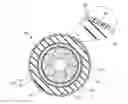
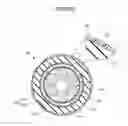
FIGURE is a cross-sectional view of a flexible cable according to an embodiment of the present invention.
DESCRIPTION OF THE PREFERRED EMBODIMENT
Referring now to the drawings, and more particularly to FIGURE, there is shown exemplary embodiments of the methods and structures according to the present invention.
An embodiment of the present invention is described below in accordance with the appended drawing.
As illustrated in FIGURE, a flexible cable 100 according to an embodiment of the present invention includes, for example, a strand 102 obtained by stranding multiple core wires 101 up, a first tape 103 wound around the strand 102, a braid shield 104 disposed around the first tape 103, a second tape 105 wound around the braid shield 104, and an outer sheath 106 disposed around the second tape 105.
The flexible cable 100 according to the embodiment of the present invention includes an outer sheath 106 at least at the outermost layer. The outer sheath 106 has a double layer structure including an inner layer 107, made of an elastomer containing polypropylene resin, and an outer layer 108, disposed around the inner layer 107 and made of polypropylene resin.
Examples of an elastomer containing polypropylene resin include Rabalon (registered trade mark), which is a compound of styrene-based rubber and polypropylene resin. Rabalon is a material having flexibility as high as the flexibility of a material such as polyurethane resin, silicone rubber, a compound of styrene-based rubber and polystyrene resin, or plasticized polyvinyl chloride. Moreover, Rabalon is a material having thermal resistance as high as the thermal resistance of silicone rubber, a compound of styrene-based rubber and polypropylene resin, or a compound of styrene-based rubber and polystyrene resin. Thus, using the inner layer 107 made of Rabalon can reliably provide the outer sheath 106 with flexibility and thermal resistance.
Rabalon, however, is a material having slidability as low as the slidability of a material such as polyurethane resin, silicone rubber, a compound of styrene-based rubber and polypropylene resin, or a compound of styrene-based rubber and polystyrene resin. Thus, when only the inner layer 107 made of Rabalon is used as an outer sheath, a human operator feels unsmoothness while manually handling the flexible cable because the outer sheath has a sticky surface. Thus, in the flexible cable 100 according to the embodiment of the present invention, a thin outer layer 108 made of polypropylene resin, which is a material having high thermal resistance and high slidability, is disposed around the inner layer 107 made of Rabalon to coat the inner layer 107.
Desirably, the outer layer 108 has a large number of cracks 109 in its surface. If the outer layer 108 has a large number of cracks 109 in its surface, the outer sheath 106 can have a smaller friction coefficient since the area over which the outer sheath 106 is brought into contact with other object is reduced. Thus, a human operator is less likely to feel unsmoothness while manually handling the flexible cable 100.
Desirably, the outer layer 108 has a layer thickness of more than 0 μm and less than or equal to 100 μm, more desirably, more than 0 μm and less than or equal to 50 μm. The reason why the layer thickness of the outer layer 108 of more than 0 μm and less than or equal to 100 μm is desirable is described as follows. If the layer thickness of the outer layer 108 exceeds 100 μm, the outer sheath 106 is more likely to have a protuberance (crease) as a result of the flexible cable 100 being bent. Thus, the outer sheath 106 is more likely to be easily foldable at a particular portion and may be broken at the portion. The reason why the layer thickness of the outer layer 108 of more than 0 μm and less than or equal to 50 μm is more desirable is because, a large number of cracks 109 are more likely to naturally occur in the surface of the outer layer 108 as the outer layer 108 has a smaller layer thickness.
Desirably, the outer layer 108 is fusion-bonded with the inner layer 107. By concurrently performing tube extrusion of the outer layer 108 and the inner layer 107 to surround the second tape 105, the outer layer 108 can be fusion-bonded with the inner layer 107 using the extrusion heat. When the outer layer 108 is fusion-bonded with the inner layer 107, the outer layer 108 is brought into close contact with the inner layer 107. Thus, the outer layer 108 is not separated from the inner layer 107 even when a large number of cracks 109 occur in the surface of the outer layer 108. Thus, the outer layer 108 can reliably fulfill its function.
As described above, the flexible cable 100 according to an embodiment of the present invention includes the outer sheath 106 having an unsticky surface while having high flexibility and high thermal resistance as a whole. Thus, a human operator is less likely to feel unsmoothness while manually handling the flexible cable 100 and the outer sheath 106 is less likely to be damaged while being sterilized using an autoclave.
Although the invention has been described with respect to specific exemplary embodiments for complete and clear disclosure, the appended claims are not to be thus limited but are to be construed as embodying all modifications and alternative constructions that may occur to one skilled in the art which fairly fall within the basic teaching herein set forth.
Further, it is noted that Applicant's intent is to encompass equivalents of all claim elements, even if amended later during prosecution.
Claims
What is claimed is:1. A flexible cable comprising an outer sheath at an outermost portion,
wherein the outer sheath includes
an inner layer made of an elastomer containing polypropylene resin, and
an outer layer surrounding the inner layer and made of polypropylene resin.
2. The flexible cable according to claim 1, wherein the outer layer has a large number of cracks in a surface of the outer layer.
3. The flexible cable according to claim 1, wherein the outer layer has a layer thickness of more than 0 μm and less than or equal to 100 μm.
4. The flexible cable according to claim 1, wherein the outer layer is fusion-bonded with the inner layer.
Images & Drawings included:
Sources:
- United States Patent and Trademark Office - verify current appl. status at the USPTO↗
Similar patent applications:
- » 20100291790
Flexible cable connecting structure and flexible cable connector - » 20090046390
System, method, and apparatus for an independent flexible cable damper for reducing flexible cable fatigue in a hard disk drive - » 20240275093
FLEXIBLE CABLE CONNECTOR AND METHOD FOR MANUFACTURING FLEXIBLE CABLE CONNECTOR - » 20080009180
Pair of flat-type flexible cable connectors and harness of flat-type flexible cable - » 20160185565
Apparatus for unwinding flexible cables on seabeds and method for loading a reel of flexible cable on said apparatus - » 20250179729
Flexible Cable with Increased Life Span, and a Method for Producing a Flexible Cable - » 20220323071
Surgical stapler adapter with flexible cable assembly, flexible fingers, and contact clips - » 20170273170
Method and apparatus for reducing corrosion in flat flexible cables and flexible printed circuits - » 20190165502
Flexible flat cable connector, flexible flat cable connection structure, and rotary connector device - » 20200163670
Surgical stapler adapter with flexible cable assembly, flexible fingers, and contact clips
Recent applications in this class:
- » 20220199285 2022-06-23
WIRE ARRAY AND BIO-IMPLANTABLE DEVICE COMPRISING SAME - » 20180061524 2018-03-01
Devices and systems for obtaining conductance data and methods of manufacturing and using the same - » 20180019039 2018-01-18
Methods to generate elongated wires having a metallic substrate thereon and devices comprising the same - » 20160005509 2016-01-07
Multi-layered structure and method - » 20150170792 2015-06-18
Devices, systems and methods to reduce coupling of a shield and a conductor within an implantable medical lead - » 20150114681 2015-04-30
Coiled cable - » 20150025608 2015-01-22
LUBRICIOUS, BIOCOMPATIBLE HYDROPHILIC THERMOSET COATING USING INTERPENETRATING HYDROGEL NETWORKS - » 20140318859 2014-10-30
Cable for medical instruments - » 20130333918 2013-12-19
Wire constructs - » 20130096455 2013-04-18
Devices and systems for obtaining conductance data and methods of manufacturing and using the same
Recent applications for this Assignee:
- » 20230178272 2023-06-08
RESISTOR AND ITS MANUFACTURING METHOD - » 20230166318 2023-06-01
Metal gasket and production method therefor - » 20230150571 2023-05-18
STROKE SENSOR - » 20230122004 2023-04-20
PRODUCTION METHOD OF ALLOY MEMBER, ALLOY MEMBER, AND PRODUCT USING ALLOY MEMBER - » 20230099300 2023-03-30
STEEL FOR HOT WORKING DIE, DIE FOR HOT WORKING, AND MANUFACTURING METHOD FOR SAME - » 20230086395 2023-03-23
Black Heart Malleable Cast Iron and Method for Producing Same - » 20230075843 2023-03-09
METHOD FOR PRODUCING MARTENSITIC STAINLESS STEEL STRIP, AND MARTENSITIC STAINLESS STEEL STRIP - » 20220364207 2022-11-17
Alloy, alloy powder, alloy member, and composite member - » 20220344980 2022-10-27
STATOR FOR ROTATING ELECTRICAL MACHINE, ROTATING ELECTRICAL MACHINE, METHOD FOR MANUFACTURING STATOR FOR ROTATING ELECTRICAL MACHINE, AND METHOD FOR MANUFACTURING ROTATING ELECTRICAL MACHINE - » 20220341002 2022-10-27
Zr-Nb-BASED ALLOY MATERIAL, METHOD FOR MANUFACTURING THE ALLOY MATERIAL, AND Zr-Nb-BASED ALLOY PRODUCT