Dithiolene metal complex colorless IR absorbers
US20170285232A1
2017-10-05
15/623,699
2017-06-15
✅ Patent granted
US 9,920,087 B2
2018-03-20
-
-
Joseph R Kosack
Marshall, Gerstein & Borun LLP
2037-06-15
Abstract:
The invention relates to the use of compounds of formulae (I) and/or (II) as colorless IR absorbers wherein M is Ni, Pd, Pt, Au, Ir, Fe, Zn, W, Cu, Mo, In, Mn, Co, Mg, V, Cr or Ti, X1, X2 and X3 are each independently of the others sulfur or oxygen, R1, R2, R3, R4, R5 and R6 are each independently of the others hydrogen, NR7R8, unsubstituted or substituted C1-C18alkyl, C1-C18 alkyl wherein the alkylene chain is interrupted with oxygen, unsubstituted or substituted C1-C18alkenyl, unsubstituted or substituted aryl, unsubstituted or substituted arylalkyl or unsubstituted or substituted heteroarylalkyl, R2 and R8, each independently of the other, being unsubstituted or substituted C1-C18alkyl, unsubstituted or substituted aryl, unsubstituted or substituted arylalkyl or unsubstituted or substituted heteroarylalkyl, a further IR absorber optionally being added to the compounds of formulae (I) and (II). The invention relates also to novel dithiolene compounds of formulae (I) and (II) wherein X1 is oxygen and X2 and X3 are oxygen or sulfur. The invention relates furthermore to novel dithiolene compounds of formulae (I) and (II) wherein R1 to R6 arc NR7R8.
Assignee:
- BASF SE 6,681 🇩🇪 Ludwigshafen, Germany
Applicant:
Interested in similar patents?
Get notified when new applications in this technology area are published.
Classification:
B29B13/024 » CPC further
Conditioning or physical treatment of the material to be shaped by heating; Half-products, e.g. films, plates Hollow bodies, e.g. tubes or profiles
B29C65/1677 » CPC further
Joining of preformed parts ; Apparatus therefor by heating, with or without pressure using wave energy or particle radiation; Laser beams making use of an absorber or impact modifier
C07F15/00 IPC
Compounds containing elements of Groups 8, 9, 10 or 18 of the Periodic System
C07F15/0066 » CPC further
Compounds containing elements of Groups 8, 9, 10 or 18 of the Periodic System compounds of the platinum group; Palladium compounds without a metal-carbon linkage
B29B13/02 IPC
Conditioning or physical treatment of the material to be shaped by heating
B29K2995/0026 » CPC further
Properties of moulding materials, reinforcements, fillers, preformed parts or moulds having particular optical properties, e.g. fluorescent or phosphorescent Transparent
G02B5/22 » CPC main
Optical elements other than lenses; Filters Absorbing filters
B29C65/16 IPC
Joining of preformed parts ; Apparatus therefor by heating, with or without pressure using wave energy or particle radiation Laser beams
B41M3/14 » CPC further
Printing processes to produce particular kinds of printed work, e.g. patterns Security printing
C07D239/22 » CPC further
Heterocyclic compounds containing 1,3-diazine or hydrogenated 1,3-diazine rings not condensed with other rings having two double bonds between ring members or between ring members and non-ring members with hetero atoms directly attached to ring carbon atoms
B29C65/1616 » CPC further
Joining of preformed parts ; Apparatus therefor by heating, with or without pressure using wave energy or particle radiation; Laser beams characterised by the type of electromagnetic radiation; Infrared [IR] radiation, e.g. by infrared lasers Near infrared radiation [NIR], e.g. by YAG lasers
C07D233/84 » CPC further
Heterocyclic compounds containing 1,3-diazole or hydrogenated 1,3-diazole rings, not condensed with other rings having two double bonds between ring members or between ring members and non-ring members with hetero atoms or with carbon atoms having three bonds to hetero atoms with at the most one bond to halogen, e.g. ester or nitrile radicals, directly attached to ring carbon atoms Sulfur atoms
B29C35/02 IPC
Heating, cooling or curing, e.g. crosslinking or vulcanising; Apparatus therefor Heating or curing, e.g. crosslinking or vulcanizing during moulding, e.g. in a mould
C07F15/0093 » CPC further
Compounds containing elements of Groups 8, 9, 10 or 18 of the Periodic System compounds of the platinum group; Platinum compounds without a metal-carbon linkage
C07F15/045 » CPC main
Compounds containing elements of Groups 8, 9, 10 or 18 of the Periodic System; Nickel compounds without a metal-carbon linkage
B29C66/71 » CPC further
General aspects of processes or apparatus for joining preformed parts characterised by the composition, physical properties or the structure of the material of the parts to be joined; Joining with non-plastics material characterised by the composition of the plastics material of the parts to be joined
C07D233/88 » CPC further
Heterocyclic compounds containing 1,3-diazole or hydrogenated 1,3-diazole rings, not condensed with other rings having two double bonds between ring members or between ring members and non-ring members with hetero atoms or with carbon atoms having three bonds to hetero atoms with at the most one bond to halogen, e.g. ester or nitrile radicals, directly attached to ring carbon atoms Nitrogen atoms, e.g. allantoin
G02B5/208 » CPC further
Optical elements other than lenses; Filters for use with infra-red or ultraviolet radiation, e.g. for separating visible light from infra-red and/or ultraviolet radiation
B29C35/0272 » CPC further
Heating, cooling or curing, e.g. crosslinking or vulcanising; Apparatus therefor; Heating or curing, e.g. crosslinking or vulcanizing during moulding, e.g. in a mould using lost heating elements, i.e. heating means incorporated and remaining in the formed article
B29C65/1674 » CPC further
Joining of preformed parts ; Apparatus therefor by heating, with or without pressure using wave energy or particle radiation; Laser beams characterised by the way of heating the interface making use of laser diodes
B29C66/7332 » CPC further
General aspects of processes or apparatus for joining preformed parts characterised by the composition, physical properties or the structure of the material of the parts to be joined; Joining with non-plastics material characterised by the intensive physical properties of the material of the parts to be joined, by the optical properties of the material of the parts to be joined, by the extensive physical properties of the parts to be joined, by the state of the material of the parts to be joined or by the material of the parts to be joined being a thermoplastic or a thermoset characterised by the optical properties of the material of the parts to be joined, e.g. fluorescence, phosphorescence at least one of the parts to be joined being coloured
B29C66/73366 » CPC further
General aspects of processes or apparatus for joining preformed parts characterised by the composition, physical properties or the structure of the material of the parts to be joined; Joining with non-plastics material characterised by the intensive physical properties of the material of the parts to be joined, by the optical properties of the material of the parts to be joined, by the extensive physical properties of the parts to be joined, by the state of the material of the parts to be joined or by the material of the parts to be joined being a thermoplastic or a thermoset characterised by the optical properties of the material of the parts to be joined, e.g. fluorescence, phosphorescence at least one of the parts to be joined being opaque, transparent or translucent to visible light at least one of the parts to be joined being transparent or translucent to visible light both parts to be joined being transparent or translucent to visible light
B29C66/73921 » CPC further
General aspects of processes or apparatus for joining preformed parts characterised by the composition, physical properties or the structure of the material of the parts to be joined; Joining with non-plastics material characterised by the intensive physical properties of the material of the parts to be joined, by the optical properties of the material of the parts to be joined, by the extensive physical properties of the parts to be joined, by the state of the material of the parts to be joined or by the material of the parts to be joined being a thermoplastic or a thermoset characterised by the material of the parts to be joined being a thermoplastic or a thermoset characterised by the material of at least one of the parts being a thermoplastic characterised by the materials of both parts being thermoplastics
B29C2035/0822 » CPC further
Heating, cooling or curing, e.g. crosslinking or vulcanising; Apparatus therefor; Heating or curing, e.g. crosslinking or vulcanizing during moulding, e.g. in a mould by wave energy or particle radiation using electromagnetic radiation using IR radiation
B29K2023/12 » CPC further
Use of polyalkenes or derivatives thereof as moulding material; Polymers of propylene PP, i.e. polypropylene
B29K2025/08 » CPC further
Polymers of styrene Copolymers of styrene, e.g. AS or SAN, i.e. acrylonitrile styrene
B29K2027/16 » CPC further
Use of polyvinylhalogenides or derivatives thereof as moulding material containing fluorine PVDF, i.e. polyvinylidene fluoride
B29K2055/02 » CPC further
ABS polymers, i.e. acrylonitrile-butadiene-styrene polymers
B29K2067/00 » CPC further
Use of polyesters or derivatives thereof , as moulding material
B29K2067/006 » CPC further
Use of polyesters or derivatives thereof , as moulding material PBT, i.e. polybutylene terephthalate
B29K2069/00 » CPC further
Use of PC, i.e. polycarbonates or derivatives thereof , as moulding material
B29K2081/04 » CPC further
Use of polymers having sulfur, with or without nitrogen, oxygen or carbon only, in the main chain, as moulding material Polysulfides, e.g. PPS, i.e. polyphenylene sulfide or derivatives thereof
B29K2105/0085 » CPC further
Condition, form or state of moulded material or of the material to be shaped Copolymers
B29K2105/0088 » CPC further
Condition, form or state of moulded material or of the material to be shaped Blends of polymers
B29K2995/002 » CPC further
Properties of moulding materials, reinforcements, fillers, preformed parts or moulds having particular optical properties, e.g. fluorescent or phosphorescent Coloured
B29K2995/0017 » CPC further
Properties of moulding materials, reinforcements, fillers, preformed parts or moulds having particular thermal properties Heat stable
B29K2995/0027 » CPC further
Properties of moulding materials, reinforcements, fillers, preformed parts or moulds having particular optical properties, e.g. fluorescent or phosphorescent; Transparent for light outside the visible spectrum
G02B5/20 IPC
Optical elements other than lenses Filters
C07F15/04 IPC
Compounds containing elements of Groups 8, 9, 10 or 18 of the Periodic System Nickel compounds
C07D233/86 » CPC further
Heterocyclic compounds containing 1,3-diazole or hydrogenated 1,3-diazole rings, not condensed with other rings having two double bonds between ring members or between ring members and non-ring members with hetero atoms or with carbon atoms having three bonds to hetero atoms with at the most one bond to halogen, e.g. ester or nitrile radicals, directly attached to ring carbon atoms Oxygen and sulfur atoms, e.g. thiohydantoin
B29C35/08 IPC
Heating, cooling or curing, e.g. crosslinking or vulcanising; Apparatus therefor; Heating or curing, e.g. crosslinking or vulcanizing during moulding, e.g. in a mould by wave energy or particle radiation
B29K2081/06 » CPC further
Use of polymers having sulfur, with or without nitrogen, oxygen or carbon only, in the main chain, as moulding material PSU, i.e. polysulfones; PES, i.e. polyethersulfones or derivatives thereof
B29C65/00 » CPC further
Joining of preformed parts ; Apparatus therefor
G02B5/223 » CPC further
Optical elements other than lenses; Filters; Absorbing filters containing organic substances, e.g. dyes, inks or pigments
Description
The invention relates to the use of specific dithiolene metal complexes as colorless IR absorbers. The invention relates also to novel dithiolene metal complexes.
Colorless, or at least barely colored, IR absorbers meet a significant technical need in a wide range of applications, such as security printing (bank notes, credit cards, identity cards, passports etc.), invisible and IR readable bar codes, the laser-welding of plastics, the curing of surface-coatings using IR radiators, the drying and curing of print, the fixing of toners on paper, optical filters for PDPs (plasma display panels), laser marking, the heating of plastics preforms etc.
Several classes of IR absorbers are known, such as, for example, quinone-diimmonium or aminium salts, polymethines (e.g. cyanines, squaraines, croconaines), phthalocyanines and naphthalocyanines, dithiolene and other metal complexes. Newer structures, such as, for example, quaterrylene diimides, have also recently become known. Also known, besides those organic substances, are inorganic substances such as, for example, lanthanum hexaboride, indium tin oxide (ITO), antimony tin oxide (ATO) in nano-particulate form and coated mica materials (“Lazerflair” from Merck).
Notwithstanding that large number of known compound classes and structures, as yet no IR absorbers have become known that are satisfactory from the technical standpoint. Especially in respect of “colorlessness”, that is, minimum inherent color, no truly satisfactory solutions are known that simultaneously meet the other technical stability requirements (heat stability and/or light stability). IR absorbers, for example for security printing, are available, for example, from “American Dye Source”, but virtually all of them have an absorption in the VIS range of the spectrum (from 400 to 700 nm).
It has now been found, surprisingly, that a class of heterocyclic dithiolene metal complexes, known per se, is able to meet those requirements. Especially in respect of colorlessness, these compounds are appreciably superior to the known IR absorbers—while simultaneously meeting other technical requirements, such as, for example, good fastness to light (for security printing) or good heat stability when incorporated into plastics material (laser-welding of plastics).
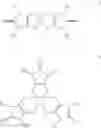
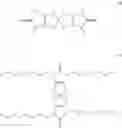
The invention accordingly relates to the use of compounds of formula I and/or II as colorless IR absorbers
wherein
M is Ni, Pd, Pt, Au, Ir, Fe, Zn, W, Cu, Mo, In, Mn, Co, Mg, V, Cr or Ti,
X1, X2 and X3 are each independently of the others sulfur or oxygen,
R1, R2, R3, R4, R5 and R6 are each independently of the others hydrogen, NR7R8, unsubstituted or substituted C1-C18alkyl, C1-C18 alkyl wherein the alkylene chain is interrupted with oxygen, unsubstituted or substituted C1-C18alkenyl, unsubstituted or substituted aryl, unsubstituted or substituted arylalkyl or unsubstituted or substituted heteroarylalkyl, R7 and R8, each independently of the other, being unsubstituted or substituted C1-C18alkyl, unsubstituted or substituted aryl, unsubstituted or substituted arylalkyl or unsubstituted or substituted heteroarylalkyl,
a further IR absorber optionally being added to the compounds of formulae I and II.
Preference is given to compounds of formula I wherein the metal M is Ni, Pd or Pt. (claim 2)
If the substituents R1 to R6 or R1 to R4 are C1-C18alkyl radicals they are preferably unsubstituted C1-C18alkyl radicals, more preferably C1-C8alkyl radicals, including straight-chain and branched and also cyclic alkyl radicals. The following may be mentioned as examples: propyl, isopropyl, n-butyl, sec-butyl, tert-butyl, n-hexyl, 2-ethylhexyl, n-octyl, cyclopentyl, cyclohexyl.
If the substituents R1 to R6 or R1 to R4 are C1-C18alkyl radicals wherein the alkylene chain is interrupted with oxygen, they are preferably —(CH2)n—[O—(CH2)m]k—OCH3 with n=2-6, m=2 or 3, k=1-6.
If the substituents R1 to R6 or R1 to R4 are C1-C18alkenyl radicals they are preferably unsubstituted C1-C18alkenyl radicals, more preferably C1-C6alkenyl radicals. Examples may be vinyl or allyl.
If the substituents R1 to R6 or R1 to R4 are aryl groups, they are preferably unsubstituted aryl groups, for example, phenyl, naphthyl, anthryl or phenanthryl groups.
If the substituents R1 to R6 or R1 to R4 are arylalkyl groups, they are preferably unsubstituted arylalkyl groups, for example, —(CH2)q-phenyl with q=1-6, especially benzyl, ethylphenyl, propylphenyl.
If the substituents R1 to R6 or R1 to R4 are heteroarylalkyl radicals they are preferably unsubstituted heteroarylalkyl radicals which denotes that a heteroaromatic ring is bonded directly to an alkyl group. The heteroaromatic ring is, for example, imidazolyl, pyridyl, thienyl, furyl, thiazolyl, indolyl, quinolinyl, pyrazolyl, pyrazyl, pyridazyl or pyrimidinyl.
The substituents R1 to R6 or R1 to R4 are preferably unsubstituted C1-C18alkyl, —(CH2)n—[O—(CH2)m]k—OCH3 with n=2-6, m=2 or 3, k=1-6, unsubstituted C1-C18alkenyl, unsubstituted arylalkyl or —N(C1-C6alkyl)2.
The substituents R7 and R8 are preferably C1-C6alkyl radicals.
In a preferred embodiment compounds of the formula I are used as colorless IR absorber wherein
M is Ni, Pd, Pt,
X1, X2 and X3 are each independently of the others sulfur or oxygen,
R1, R2, R3, R4 are each independently of the others —N(C1-C6alkyl)2, unsubstituted C1-C8alkyl, —(CH2)n—[O—(CH2)m]k—OCH3 with n=2-6, m=2 or 3, k=1-6; vinyl or allyl, —(CH2)q-phenyl with q=1-6. (Claim 3)
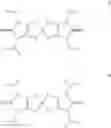
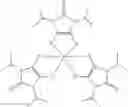
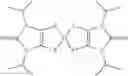
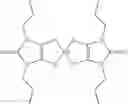
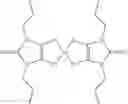
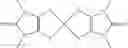
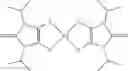
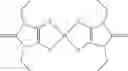
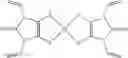
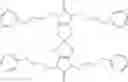
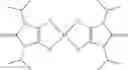
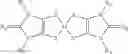
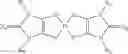
Of particular interest are the structures Ia to Ih.
(Claim 4)
Colorless IR absorbers can be used in all fields of application that depend on the IR absorber's remaining invisible. The following uses may be mentioned by way of example: security printing (bank notes, credit cards, identity cards, passports etc.), invisible and IR readable bar codes, the laser-welding of plastics, the curing of surface-coatings using IR radiators, the drying and curing of print, the fixing of toners on paper, laser marking (plastics materials, paper, wood etc.) and the heating of plastics preforms. (Claim 5)
An especially suitable field of application is the use of the compounds of formula I and/or II in security printing and in the laser-welding of plastics material. (Claim 6)
In another embodiment the compounds of formulae I and II are used in security printing and printing of bar codes. (claim 7)
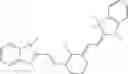
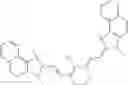
The IR absorbers of formulae I and II can also be in the form of mixtures with further known IR absorbers, especially mixtures with polymethines (cyanines, squaraines and croconaines). Such IR absorber mixtures are suitable especially for security printing. (claim 8)
Examples of preferred polymethines are listed in the following Tables:
Cyanines
Squaraines
Croconaines
The IR absorbers are used in a concentration of from 10 ppm to 10%, preferably 100 ppm to 2% depending on the chosen application.
The laser welding is preferably carried out using an ND:YAG laser at 1064 nm or using a diode laser at 980 nm or 940 nm, and the concentration of IR absorber is, for example, from 5 to 500 ppm, preferably from 10 to 100 ppm.
In laser welding, plastics components are welded to one another. The dithiolenes according to the invention are suitable especially for welding transparent plastics materials, such as polypropylene, polyvinylbutyral, polyamide, polycarbonate, polycarbonate-polyethylene terephthalate blends, polycarbonate-polybutylene terephthalate blends, polycarbonate-acrylonitrile-styrene-acrylonitrile copolymer blends, polycarbonate-acrylonitrile-butadiene-styrene copolymer blends, polymethyl methacrylate-acrylonitrile-butadiene-styrene co-polymer blends (MABS), polyethylene terephthalate, polybutylene terephthalate, polymethyl methacrylate, polybutyl acrylate, polymethyl methacrylate-polyvinylidene difluoride blends, acrylonitrile-butadiene-styrene copolymers (ABS), styrene-acrylonitrile copolymers (SAN) and polyphenylene sulfone and also mixtures thereof.
Especially advantageous in welding is the use of two identically transparent plastics workpieces, for example colorless-transparent/colorless-transparent or colored-trans-parent/colored-transparent.
In security printing, the IR absorber is added to the printing ink. Suitable printing inks are water-based, oil-based or solvent-based printing inks, based on pigment or dye, for inkjet printing, flexographic printing, screen printing, intaglio printing, offset printing, laser printing or letterpress printing and for use in electrophotography.
The invention relates also to novel dithiolene compounds of formulae I and II wherein
M is Ni, Pd, Pt, Au, Ir, Fe, Zn, W, Cu, Mo, In, Mn, Co, Mg, V, Cr or Ti,
X1 is oxygen and X2 and X3 are oxygen or sulfur,
R1, R2, R3, R4, R5 and R6 are each independently of the others hydrogen, NR7R8, unsubstituted or substituted C1-C18alkyl, C1-C18 alkyl wherein the alkylene chain is interrupted with oxygen, unsubstituted or substituted C1-C18alkenyl, unsubstituted or substituted aryl, unsubstituted or substituted arylalkyl or unsubstituted or substituted heteroarylalkyl, R7 and R8, each independently of the other, being unsubstituted or substituted C1-C18alkyl, unsubstituted or substituted aryl, unsubstituted or substituted arylalkyl or unsubstituted or substituted heteroarylalkyl. (Claim 9)
Those compounds are obtained from the corresponding sulfur compounds (X1, X2, X3═S) by oxidation with a suitable solvent or as described by the examples.
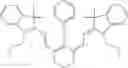
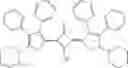
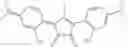
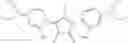
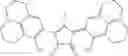
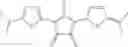
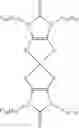
The following compounds may be mentioned by way of example:
The invention relates also to novel dithiolene compounds of formulae I and II wherein
M is Ni, Pd, Pt, Au, Ir, Fe, Zn, W, Cu, Mo, In, Mn, Co, Mg, V, Cr or Ti,
X1, X2 and X3 are each independently of the others sulfur or oxygen,
R1, R2, R3, R4, R5 and R6 are NR7R8, wherein R7 and R8 are each independently of the other unsubstituted or substituted C1-C18alkyl, unsubstituted or substituted aryl, unsubstituted or substituted arylalkyl or unsubstituted or substituted heteroarylalkyl. (claim 10).
Preferably —NR7R8 is —N(C1-C6alkyl)2
The following compounds Ic and Id may be mentioned by way of example:
The novel dithiolene compounds, like the known dithiolene compounds, are suitable for use in security printing (bank notes, credit cards, identity cards, passports etc.), invisible and IR readable barcodes, the laser-welding of plastics, the curing of surface-coatings using IR radiators, the curing and drying of print, the fixing of toners on paper, laser marking (plastics, paper, wood etc.) and the heating of plastics preforms etc.
Additionally, the novel dithiolene compounds of formulae I and II are suitable for use as optical filters for plasma display panels (PDPs). For this application absorption below 1000 nm, especially around 900 nm, is of special interest.
EXAMPLES
Example 1
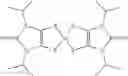
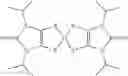
Preparation of
The compound is known from J. Chem. Soc., Dalton Trans 1998, 3731-3736, and its preparation is described therein.
1,3-Diisopropyl-4,5-dioxo-imidazoline-2-thione is reacted under reflux conditions with metallic nickel and Lawesson's reagent
in chlorobenzene.
Absorption maximum (chloroform): 1001 nm (79 000)
Example 2
Preparation of
Reaction is carried out analogously to Example 1, with platinum dichloride and Lawesson's reagent.
Absorption maximum (chloroform): 1000 nm (113 000).
Example 3a
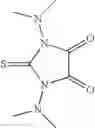
Preparation of
12.26 parts of N,N-dimethylhydrazine are added at room temperature, with stirring, to a solution of 7.65 parts of carbon disulfide in 250 parts of dichloroethane. The temperature is then increased to 40° C. and stirring is carried out for 16 hours at that temperature to complete the reaction. The temperature is subsequently increased to 80° C. for one hour. A further 750 parts of dichloroethane are then added, and 13.88 parts of oxalyl chloride (dissolved in a small amount of dichloroethane) are added dropwise over a period of 90 minutes. The reaction mixture is then heated to reflux and maintained at reflux for 2 hours, after which it is concentrated and the yellow crystals are filtered off and washed with a small amount of dichloroethane. After drying, 14 parts of product having the structure indicated above are obtained.
Example 3b
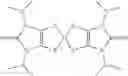
Preparation of
0.333 part of platinum dichloride is added to a solution of 0.541 part of the product from example 3a and 1.085 parts of Lawesson's reagent in 50 parts of toluene. The reaction mixture is maintained at 110′C for 90 minutes and filtered while hot, and 500 parts of n-hexane are added to the filtrate after cooling. The resulting precipitate is filtered off and dried, yielding 0.5 part of product (absorption maximum 994 nm).
Example 4
The procedure is analogous to that in the previous examples, except that the metal used is molybdenum, thus yielding the corresponding 1:3 molybdenum complex:
Example 5
Preparation of
The compound from Example 2 is oxidised with atmospheric oxygen in dichloromethane at reflux temperature to form the corresponding oxo compound. Its absorption maximum is found at 968 nm.
Example 6a
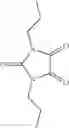
Preparation of
29.14 parts of 1,3-di-n-propyl-urea are dissolved in 300 parts of toluene at 40° C. Over a period of 40 minutes 27.18 parts of oxalyl chloride are added at 80° C. to the stirred solution. After a further hour of stirring at 100° C. the solution is evaporated at 60° C. to dryness: 36.8 parts of the product are obtained.
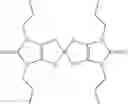
Example 6b
Preparation of
1.59 parts of the product from Example 6a, 1.06 parts of platinum dichloride and 3.47 parts of Lawesson's reagent are heated to 110° C. under nitrogen in 100 parts of toluene. After 45 minutes reaction time the dark solution is cooled down to −10° C. and the precipitation is filtered off, washed with ethanol and some acetone. For purification the crude product is dissolved in dichloromethane and precipitated slowly by addition of methanol. Dark blue crystals are collected by filtration. The absorption maximum of the product is found at 900 nm (chloroform).
Example 7
Preparation of
Proceeding analogously to Example 6b but using palladium chloride instead of platinum chloride the corresponding palladium complex with an absorption maximum of 921 nm is obtained.
Example 8
Preparation of
Proceeding analogously to Example 6b but using metallic nickel instead of platinum chloride the corresponding nickel complex with an absorption maximum of 891 nm is obtained.
Example 9 to 24
Compounds of Examples 9 to 24 (structures given in the table below) are obtained by analogous procedures as described in Examples 1 to 8:
| Example | |
| 9 | 990 nm |
| 10 | 1020 nm |
| 11 | 996 nm |
| 12 | 999 nm |
| 13 | 1009 nm |
| 14 | 991 nm |
| 15 | 1002 nm |
| 16 | 1007 nm |
| 17 | 1006 nm |
| 18 | 1003 nm |
| 19 | 1011 nm |
| 20 | 1007 nm |
| 21 | 1003 nm |
| 22 | 1005 nm |
| 23 | 1002 nm |
| 24 | 903 nm |
APPLICATION EXAMPLES
Example A1
Security Printing
11.9 parts of vinyl chloride, 2.1 parts of vinyl acetate, 10 parts of ethoxypropanol, 75.5 parts of methyl ethyl ketone and 0.5 part of the product from Example 1 are shaken together with 150 g of glass beads for 30 minutes in a Skandex mixer.
The resulting printing ink is applied to contrast paper using a doctor blade (film thickness when damp: 6 μm). The print is visually colorless, but is clearly visible in the IR range using an IR-viewing device (cut-off filter 715 nm). The fastness to light is excellent.
Example A2
Security Printing
By proceeding as indicated in Example A1 but using the IR absorber from Example 2, there accordingly is likewise obtained a colorless print having excellent fastness to light, which is clearly visible in the infrared range using an IR-viewing device.
Example A3
Laser-Welding of Plastics Material
Using an injection-moulding machine, the IR absorber from Example 1 is incorporated into a polycarbonate disc having a thickness of 2 mm (concentration: 100 ppm). Using an Nd:YAG laser, the resulting, virtually colorless disc is welded at a power of 30 watt and a rate of advance of 20 mm/s to a second 1 mm-thick pure polycarbonate disc not containing IR absorber. The resulting weld is characterised by an excellent bond, unchanged transparency, no melt irruptions and no bubbling. Under heavy mechanical loading, breakage of the discs does not occur at the welded seam.
Example A4
Laser-Welding of Plastics Material
By proceeding as indicated in Example A3 but using the IR absorber from Example 2, a virtually colorless polycarbonate disc is likewise obtained which has excellent welding properties. The resulting weld has unchanged transparency, the welding leaves no melt irruptions or bubbling and the strength of the weld is excellent.
Examples A5 and A6
By proceeding as indicated in Examples A3 and A4 but, instead of using an Nd:YAG laser (1064 nm), using a diode laser having an emission wavelength of 980 nm, similarly good results to those described in Examples A3 and A4 are obtained.
Examples A7 and A8
By proceeding as indicated in Examples A3 and A4 but, instead of using an Nd:YAG laser (1064 nm), using a diode laser having an emission wavelength of 940 nm, a comparably good weld is obtained at a laser power of 80 watt.
Example A9
By proceeding as indicated in Example A3, but using polypropylene discs having a thickness of 1.5 mm, the welds obtained are likewise very good.
Claims
1.-11. (canceled)
12. A method of using colorless IR absorbers comprising
a) treating a material with a compound of formula I and/or II
wherein
M is Ni, Pd, Pt,
X1 is oxygen,
X2 and X3 are each independently of the other sulfur or oxygen,
R1, R2, R3, R4, R5 and R6 are each independently of the others hydrogen, NR7R8, unsubstituted or substituted C1-C18alkyl, C1-C18 alkyl wherein the alkylene chain is interrupted with oxygen, unsubstituted or substituted C1-C18alkenyl, unsubstituted or substituted aryl, unsubstituted or substituted arylalkyl or unsubstituted or substituted heteroarylalkyl, R7 and R8, each independently of the other, being unsubstituted or substituted C1-C18alkyl, unsubstituted or substituted aryl, unsubstituted or substituted arylalkyl or unsubstituted or substituted heteroarylalkyl,
wherein the material is a security print, an invisible and IR readable bar code, a laser-welded plastic, a dried print, a fixed toner on paper, a laser marked plastic, or a heated preform,
optionally a further IR absorber; and
b) using the treated material of a) for security printing, invisible and IR readable bar codes, laser-welding of plastics, drying of print, fixing of toners on paper, laser marking, and heating of plastics preforms.
13. The method of claim 12, wherein for formulae I and II
R1, R2, R3, R4, R5 and R6 are NR7R8, wherein R7 and R8 are each independently of the other unsubstituted or substituted C1-C18alkyl, unsubstituted or substituted aryl, unsubstituted or substituted arylalkyl or unsubstituted or substituted heteroarylalkyl.
14. The method according to claim 12, wherein R1, R2, R3, R4 are each independently of the others —N(C1-C6alkyl)2, unsubstituted C1-C8alkyl, —(CH2)n-[O—(CH2)m]k—OCH3 with n=2-6, m=2 or 3, k=1-6; vinyl or allyl, —(CH2)q-phenyl with q=1-6.
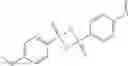
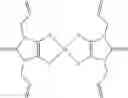
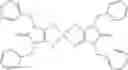
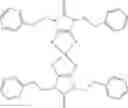
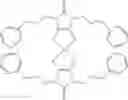
15. The method of claim 12, wherein the compound of formulae I or II is selected from the group consisting of
16. The method of claim 12, wherein the material is treated with a compound of formula I
wherein
M is Ni, Pd, or Pt,
X1 is oxygen,
X2 is sulfur or oxygen,
R1, R2, R3, and R4, are each independently of the others hydrogen, NR7R8, unsubstituted C1-C18alkyl wherein the alkylene chain is interrupted with oxygen, unsubstituted C1-C18alkenyl,
R7 and R8, each independently of the other, being unsubstituted C1-C18alkyl.
17. The method of claim 12 wherein the material is treated with a compound of formula I
wherein
M is Ni, Pd, or Pt,
X1 and X2 are each independently of the other sulfur or oxygen,
R1, R2, R3, and R4, are NR7R8, wherein R7 and R8 are each independently of the other unsubstituted C1-C18alkyl.
18. The method of claim 17, wherein R7 and R8 are each independently of the other unsubstituted C1-C6alkyl.
19. The method according to claim 12, wherein step b) is using the treated material for laser-welding of plastics.
20. The method according to claim 12, wherein step b) is using the treated material for security printing or producing invisible and IR readable bar codes.
21. The method according to claim 1, wherein the further IR absorbers are polymethines.
Images & Drawings included:















Sources:
- United States Patent and Trademark Office - verify current appl. status at the USPTO↗
Similar patent applications:
- » 20100021833
DITHIOLENE METAL COMPLEX COLORLESS IR ABSORBERS - » 20160368940
Dithiolene metal complex colorless IR absorbers - » 20180099988
Dithiolene metal complex colorless IR absorbers
Recent applications in this class:
- » 20250277925 2025-09-04
WAVELENGTH SELECTIVE ABSORPTION FILTER, LIQUID CRYSTAL DISPLAY DEVICE, AND ORGANIC ELECTROLUMINESCENT DISPLAY DEVICE - » 20250244512 2025-07-31
OPTICAL DEVICE FOR CONTROLLING COLOR ATTRIBUTES - » 20250231330 2025-07-17
Light Control Film - » 20250189708 2025-06-12
OPTICAL FILTER - » 20250180792 2025-06-05
LIGHT ABSORPTION ANISOTROPIC FILM, MANUFACTURING METHOD THEREOF, LAMINATE, AND IMAGE DISPLAY DEVICE - » 20250164679 2025-05-22
OPTICAL FILTER, LIGHT ABSORBING COMPOSITION, METHOD FOR PRODUCING OPTICAL FILTER, SENSING DEVICE AND SENSING METHOD - » 20250147210 2025-05-08
LIGHT ABSORPTION ANISOTROPIC FILM, MANUFACTURING METHOD OF LIGHT ABSORPTION ANISOTROPIC FILM, LAMINATE, AND IMAGE DISPLAY DEVICE - » 20250116802 2025-04-10
OPTICAL FILTER AND IMAGING APPARATUS - » 20250067914 2025-02-27
LIGHT CONTROL FILM - » 20250067913 2025-02-27
COMPOSITE FILM LAYER CAPABLE OF TRANSMITTING WHITE LIGHT, PREPARATION METHOD THEREFOR AND APPLICATION
Recent applications for this Assignee:
- » 20250185653 2025-06-12
Herbicidal compositions comprising 2,4-D - » 20250040553 2025-02-06
Herbicidal compositions comprising trifludimoxazin - » 20240402694 2024-12-05
METHOD FOR MONITORING AND/OR CONTROLLING ONE OR MORE CHEMICAL PLANT(S) - » 20240402684 2024-12-05
MANUFACTURING SYSTEM FOR MONITORING AND/OR CONTROLLING ONE OR MORE CHEMICAL PLANT(S) - » 20240360314 2024-10-31
PROCESS FOR PREPARATION OF ASPHALT MIX COMPOSITION - » 20240309409 2024-09-19
Methods for making L-glufosinate - » 20240301452 2024-09-12
Methods for making L-glufosinate - » 20240239728 2024-07-18
Method and Plant for Producing Ethylene and/or Other Olefins by Steam Cracking - » 20240211517 2024-06-27
KNOWLEDGE INSIGHT CAPTURING SYSTEM - » 20240130221 2024-04-18
HETEROLEPTIC CARBENE COMPLEXES AND THE USE THEREOF IN ORGANIC ELECTRONICS