Acoustic Performance of Timber Frame Partitions
US20170306622A1
2017-10-26
15/517,569
2015-10-09
Abstract:
A partition for a building structure comprises a support frame and a plasterboard affixed to the support frame with a plurality of screws. The plasterboard comprises a gypsum matrix having fibres embedded therein in an amount of at least 1 wt % relative to the gypsum, as well as a polymeric additive that is present in an amount of at least 1 wt % relative to the gypsum. The support frame comprises a plurality of elongate timber members and the average spacing between nearest-neighbour screws is greater than 400 mm.
Interested in similar patents?
Get notified when new applications in this technology area are published.
Classification:
E04B2/7412 » CPC main
Walls, e.g. partitions, for buildings; Wall construction with regard to insulation; Connections specially adapted to walls; Removable non-load-bearing partitions; Partitions with a free upper edge modular coordination assembled using frames with infill panels or coverings only; made-up of panels and a support structure incorporating posts special measures for sound or thermal insulation, including fire protection Posts or frame members specially adapted for reduced sound or heat transmission
E04B2/707 » CPC further
Walls, e.g. partitions, for buildings; Wall construction with regard to insulation; Connections specially adapted to walls walls of framework or pillarwork Load-bearing ; Walls incorporating load-bearing elongated members with elongated members of wood with supporting function obturation by means of panels
E04B2002/7477 » CPC further
Walls, e.g. partitions, for buildings; Wall construction with regard to insulation; Connections specially adapted to walls; Removable non-load-bearing partitions; Partitions with a free upper edge modular coordination; Details of connection of sheet panels to frame or posts Details of connections using screws or nails
C04B28/14 » CPC further
Compositions of mortars, concrete or artificial stone, containing inorganic binders or the reaction product of an inorganic and an organic binder, e.g. polycarboxylate cements containing calcium sulfate cements
E04B1/84 » CPC further
Constructions in general; Structures which are not restricted either to walls, e.g. partitions, or floors or ceilings or roofs; Insulation or other protection; Elements or use of specified material therefor; Heat, sound or noise insulation, absorption, or reflection . Other building methods affording favourable thermal or acoustical conditions, e.g. accumulating of heat within walls specifically with respect to sound only Sound-absorbing elements
E04B2/04 » CPC further
Walls, e.g. partitions, for buildings; Wall construction with regard to insulation; Connections specially adapted to walls built-up from layers of building elements Walls having neither cavities between, nor in, the solid elements
E04B2/70 IPC
Walls, e.g. partitions, for buildings; Wall construction with regard to insulation; Connections specially adapted to walls walls of framework or pillarwork Load-bearing ; Walls incorporating load-bearing elongated members with elongated members of wood
E04B2/74 IPC
Walls, e.g. partitions, for buildings; Wall construction with regard to insulation; Connections specially adapted to walls Removable non-load-bearing partitions; Partitions with a free upper edge modular coordination
Description
FIELD OF THE INVENTION
The present invention relates to the field of timber frame partitions that have improved acoustic performance, in particular to timber frame partitions having plasterboard cladding.
BACKGROUND TO THE INVENTION
It is thought that timber stud partitions having gypsum board cladding exhibit worse acoustic performance that metal stud partitions with equivalent cladding.
It is desirable to improve the acoustic performance of timber stud partitions, without having a negative impact on other aspects of the performance of the partition.
SUMMARY OF THE INVENTION
Surprisingly, it has been found that when the gypsum board used as cladding contains relatively high levels of fibre and a polymeric additive, the number of fixing screws joining the gypsum cladding to the timber frame may be reduced so as to improve the acoustic performance of the partition, while the fire resistance is maintained at acceptable levels. This result is counter-intuitive, as it had previously been thought that a reduction in the number of fixing screws would inevitably result in a significant decrease in fire resistance.
Therefore, in a first aspect, the present invention may provide a partition for a building structure, the partition comprising a support frame and at least one plasterboard affixed to the support frame by means of a plurality of screws, wherein:
-
- the plasterboard comprises a gypsum matrix having fibres embedded therein in an amount of at least 1 wt % relative to the gypsum, the gypsum matrix further comprising a polymeric additive that is present in an amount of at least 1 wt % relative to the gypsum;;
- the support frame comprises a plurality of elongate timber members; and
- the average spacing between nearest-neighbour screws is greater than 400 mm.
Preferably, the average spacing between nearest-neighbour screws is greater than 500 mm, preferably greater than 550 mm.
By reducing the number of screws, the installation costs for the partition are also reduced.
Typically, at least a portion of the screws is distributed around the perimeter of the plasterboard, and engages with timber members disposed at the perimeter of the plasterboard.
In general, at least one screw is located in a central region of the plasterboard, displaced from the perimeter of the plasterboard, and engages with a timber member disposed along a central region of the plasterboard, wherein the average distance between nearest-neighbour screws disposed along the central region of the plasterboard is greater than 600 mm.
Preferably, the average distance between nearest-neighbour screws disposed along the central region of the plasterboard is greater than 800 mm, preferably greater than 1000 mm.
Preferably, the fibres are present in the gypsum matrix in an amount of at least 3 wt % relative to the gypsum, more preferably at least 5 wt %.
Preferably, the polymeric additive is present in an amount of at least 3 wt % relative to the gypsum, more preferably at least 5 wt %.
Typically, the fibres are glass fibres.
Typically, the polymeric additive is one of starch or polyvinyl acetate.
Preferably, the plasterboard is in direct contact with the support frame, that is, no adhesive is used to bond the plasterboard to the support frame. The plasterboard may comprise a gypsum core having a liner on one or both faces. In that case, the liner is typically in direct contact with the support frame.
DETAILED DESCRIPTION
The invention will now be described by way of example with reference to the following Figures in which:
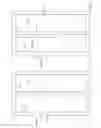
FIG. 1 shows a schematic elevation view of an embodiment of a partition according to the first aspect of the present invention. The cladding is rendered transparent to show the detail of the frame;
FIG. 2 shows a schematic elevation view of a partition according to an illustrative example of the present invention; the cladding is rendered transparent to show the detail of the frame.
FIG. 3 is a graph showing the results of acoustic testing for Example 1 and Comparative Example 1.
EXAMPLE 1
A test specimen was constructed from a timber frame, insulation and a gypsum plasterboard.
The timber frame consisted of 63 mm×38 mm head and base rails connected by 63 mm×38 mm timber studs extending therebetween. The distance between the head and base rails was 2400 mm, while the timber studs were spaced at 600 mm intervals. 65 mm insulation was placed within the stud cavity.
The frame was clad on each side with a single layer of boards having the following characteristics:
-
- a gypsum core containing 3 wt % 6 mm glass fibre and 5 wt % Merifilm starch from Tate & Lyle; and
- a paper liner.
The stucco slurry used to prepare the boards had a water gauge (that is, a weight ratio of water to stucco) of 0.7.
The board had a thickness of 12.5 mm and a weight of about 12 kg/m2. The board dimensions were 1200 mm×2400 mm.
The boards were fixed to the frame as shown in FIG. 1. Referring to FIG. 1, the frame comprised a top rail 10 and a bottom rail 12, two lateral studs 14a,b and a central stud 16.
The board 20 is fixed to the frame by means of screws 22 that are spaced at 600 mm intervals along the top and bottom rails 10,12 and the lateral studs 14a,b, and that are spaced at 1200 mm intervals along the central stud 16.
Comparative Example 1
A test specimen was constructed from a timber frame, insulation and a gypsum plasterboard.
The timber frame consisted of 63 mm×38 mm head and base rails connected by 63 mm×38 mm timber studs extending therebetween. The distance between the head and base rails was 2400 mm, while the timber studs were spaced at 600 mm intervals. 65 mm insulation was placed within the stud cavity.
The frame was clad on each side with a single layer of boards having the following characteristics:
-
- a gypsum core containing 3 wt % 6 mm glass fibre and 5 wt % Merifilm starch from Tate & Lyle; and
- a paper liner.
The stucco slurry used to prepare the boards had a water gauge (that is, a weight ratio of water to stucco) of 0.7.
The board had a thickness of 12.5 mm and a weight of about 12 kg/m2. The board dimensions were 1200 mm×2400 mm.
The boards were fixed to the frame as shown in FIG. 2. Referring to FIG. 2, the frame comprised a top rail 10′ and a bottom rail 12′, two lateral studs 14′a,b and a central stud 16′.
The board 20′ is fixed to the frame by means of screws 22′ that are spaced at 300 mm intervals along the top and bottom rails 10′,12′ and the lateral studs 14′a,b, and that are spaced at 300 mm intervals along the central stud 16′.
Acoustic Testing
Acoustic testing was carried out according to BS EN ISO 10140-2:2010. The results are shown in FIG. 3.
The results were processed as set out in ISO 717-1:1997, and the result of these calculations was an Rw value of 42 for Example 1 and an Rw value of 39 for Comparative Example 1.
Fire Tests
Fire testing was carried out according to the standards BS EN 1364-1 and BS 476: part 22. The requirements of the standard were shown to be satisfied for both Example 1 and Comparative Example 1.
Claims
1. A partition for a building structure, the partition comprising a support frame and at least one plasterboard affixed to the support frame with a plurality of screws, wherein:
the plasterboard comprises a gypsum matrix having fibres embedded therein in an amount of at least 1 wt % relative to the gypsum of the gypsum matrix, the gypsum matrix further comprising a polymeric additive that is present in an amount of at least 1 wt % relative to the gypsum;
the support frame comprises a plurality of elongate timber members; and
an average spacing between nearest-neighbour screws is greater than 500 mm.
2. The partition of claim 1, wherein the average spacing between nearest-neighbour screws is greater than 550 mm.
3. (canceled)
4. The partition of claim 1, wherein the fibres are present in the gypsum matrix in an amount of at least 3 wt % relative to the gypsum.
5. The partition of claim 1, wherein the polymeric additive is present in an amount of at least 3 wt % relative to the gypsum.
6. The partition of claim 5, wherein the polymeric additive is present in an amount of at least 5 wt % relative to the gypsum.
7. The partition of claim 1, wherein the fibres are present in an amount of about 3 wt % relative to the gypsum and the polymeric additive is present in an amount of about 5 wt % relative to the gypsum.
8. The partition of claim 1, wherein the plasterboard is in direct contact with the support frame.
9. The partition of claim 1, wherein at least a portion of the screws is distributed around a perimeter of the plasterboard, and engages with timber members disposed at the perimeter of the plasterboard.
10. The partition of claim 1, wherein at least one screw is located in an inner region of the plasterboard that is displaced from a perimeter of the plasterboard, and engages with a central timber member that contacts the inner region of the plasterboard, wherein the average spacing between nearest-neighbour screws disposed along the central timber member is greater than 600 mm.
11. The partition of claim 10, wherein the average spacing between nearest-neighbour screws disposed along the central timber member is greater than 800 mm.
12. The partition of claim 11, wherein the average spacing between nearest-neighbour screws disposed along the central timber member is greater than 1000 mm.
Images & Drawings included:


Sources:
- United States Patent and Trademark Office - verify current appl. status at the USPTO↗
Recent applications in this class:
- » 20250122723 2025-04-17
WALL STUD MEMBER AND WALL CONSTRUCTION USING WALL STUD MEMBERS - » 20250052058 2025-02-13
APPARATUS FOR INSTALLATION BETWEEN AN INTERNAL WALL TO A BUILDING FACADE AND A METHOD THEREFOR - » 20240218661 2024-07-04
STRUCTURAL STUD POST WITH THERMAL BREAK - » 20230058019 2023-02-23
Sound isolation assemblies for walls supporting heavy loads - » 20220333375 2022-10-20
Wall stud member and wall construction using wall stud members - » 20220064943 2022-03-03
Structural stud post with thermal break - » 20210340759 2021-11-04
Structural stud post with thermal break - » 20210040736 2021-02-11
Partition wall - » 20200123766 2020-04-23
Partition Wall - » 20120117917 2012-05-17
Slotted metal stud with a plurality of slots having supplemental flanges and fold back supplemental web support at the root of the primary flanges