External trap for the beetle
US20180064089A1
2018-03-08
15/557,683
2016-03-30
✅ Patent granted
US 10,729,120 B2
2020-08-04
WO; PCT/IT2016/000078; 20160330
WO; WO2016/157232; 20161006
Kathleen I Alker
David Guerra
2036-03-30
Abstract:
The external trap for the small hive beetle A. Tumida is composed of an opened on top plywood box and a grid of metal sheet with holes closes the box. The grid can be removed for inspection. Two angle aluminum hang the trap to the front wall of the beehive to catch the larva when it leaves the hive for pupation. The grid address the larvae inside the box filled with ground and nematodes that destroy them.
Inventors:
- Maurizio IORI 1 🇮🇹 Roma, Italy
- Mauro CIACCAFAVA 1 🇮🇹 Montopoli in Sabina, Italy
- Maurizio Iori 1 🇮🇹 Rome, Italy
Assignee:
- Maurizio Iori 1 🇮🇹 Rome, Italy
- Mauro Ciaccafava 1 🇮🇹 Montopoli di Sabina, Italy
Applicant:
Interested in similar patents?
Get notified when new applications in this technology area are published.
Classification:
A01M1/103 » CPC main
Stationary means for catching or killing insects; Traps for crawling insects
A01M1/02 » CPC further
Stationary means for catching or killing insects with devices or substances, e.g. food, pheronones attracting the insects
A01K47/06 » CPC further
Beehives Other details of beehives, e.g. ventilating devices, entrances to hives, guards, partitions or bee escapes
A01M1/10 IPC
Stationary means for catching or killing insects Traps
Description
DESCRIPTION OF THE TRAP
The external trap for the small hive beetle is part of the control of the infestation of apiaries by blocking the cycle of small hive beetle in the soil. The development cycle of the beetle takes place in the following steps: after entering the hive in a few days, at most a week, the beetle lays eggs not easy identification (1 mm) from which arise larvae that after no more two weeks are directed outside to become pupa in the soil. In the growing phase, having to feed the eggs a damage partially visible in the combs is created and not always identifiable if the number of hives is quite high because the time of cycle is short (1-2 weeks). Studies on the propagation of A. Tumida conducted by Spiwock S. et al. (Apidologie 39 (2008) 683-693) show that the beetle can move in apiaries also 10 km away.
To stop the cycle described have been developed various traps to be placed inside the hive: the Hood beetle trap that fits inside the hive between two combs and filled with apple cider vinegar and mineral oil to attract and to kill the adults A. Tumida (U.S. Pat. No. 7,632,167 B1 Miller David 15 Dec. 2009), the West beetle trap that is designed to be resting on the bottom of the hive (EP 2 322 035 Infantidis Michael Grece 18 May 2011). Chemicals are also used with the active principles Permethrin, (family of pyrethroids) to stop the development process of pupation in the soil surrounding the hive.
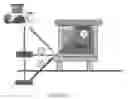
FIG. 1 describes the cycle: (1) the adult beetle enters, (2) the adult lays eggs inside the hive, (3) the larvae come out to finish their cycle and to start a new one.
So there are three places where you can take action to stop the cycle of the beetle: when the adult enters (1), when the adult search for a place to lay the eggs (2) or when the larvae come out (3).
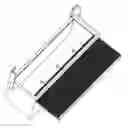
The trap for the beetle A. Tumida is described in FIG. 2 in perspective. It consists of:
-
- a box of plywood, 10 mm thickness, length 42.5 cm, width 14.0 cm, height 16.0 cm for the side walls and front wall, 14 cm height for the back wall. The box is opened on top as shown in FIG. 2.
- a grid of sheet metal, thickness 1 mm with holes of diameter 4 mm staggered and 10 mm present on the entire surface that closes the box
- a rectilinear groove 2 cm from the top edge of the box, 4 mm depth, 3 mm height internally the two side walls of the box and to the face placed below the entrance of the hive.
- A slit 2 cm from the top edge, height of 3 mm, length 40.5 cm is on the front wall to extract the grid
- Two aluminum angular dimensions of 2.5 cm×3.0 cm, height 14.0 cm with two slotted holes horizontal, vertically spaced 4 cm to anchor and center the trap to the front wall of the beehive.
- On the bottom there are 4 holes, 2 cm in diameter, closed by a net 0.5 mm×0.5 mm required for the rainwater runoff.
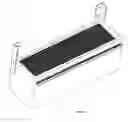
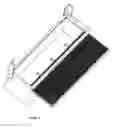
- FIG. 3 shows that the grid can be removed to allow filling or emptying the trap from the earth or for inspection.
The external trap of A. Tumida aims to limit the spread of the beetle in the rest of the apiary confining the larvae in a drawer located directly at the level of the front door of the hive, in front of it. The larva when it comes out for pupation is addressed by the presence of a perforated grill within a tank containing alkaline earth (sand) and soil nematodes that destroy the larvae. The application of the trap requires that the hive has a closed bottom or a grid of 2 mm×2 mm pitch used for the control of Varroa so as not to allow other routes of exit at the larva in addition to the front door of the hive where lies the trap.
The external trap is useful for the purposes of a productive activity in the field of beekeeping with the possibility of industrial use. Companies potentially interested are those that produce material beekeeping. The box and the grid, the main components of the trap, can be industrially manufactured with plastic materials UV protected, non-food or even metal. Geographical areas in which the implementation of the invention is of potential interest in several Continents including the Europe.
Claims
1—The trap external to the beetle Aethina Tumida includes:
A box of thickness 10 mm, length 42.5 cm, width 14.0 cm, height 16.0 cm for the two side walls and front wall, 14 cm height for the back wall. The box is open above.
a rectilinear groove 2 cm from the top edge of the box, 4 mm depth, 3 mm height internally the two side walls of the box and to the face placed below the entrance of the hive.
A slit of 3 mm height, 42.5 cm long placed on the front wall to 2 cm from the top
A grid of galvanized steel sheet, thickness 1 mm with holes of dimensions 4 mm staggered and spaced 10 mm are present on the entire surface that closes the box.
Two aluminum angular dimensions of 2.5 cm×3.0 cm, height 14.0 cm with two slotted holes horizontal away vertically between them 4 cm.
the bottom of the box has 4 holes, diameter, 2 cm closed by a net 0.5 mm×0.5 mm.
2—The trap according to claim 1 by means of the slotted horizontal holes of the angular that hold anchored to the front wall of the beehive regulate the position of the trap.
3—The trap according to claim 1 has 4 holes to allow water drainage.
4—The trap according to claim 1 has a fill volume of between 400 ml 1000 ml of earth
5—A method of manufacture of the trap according to claim 1 is achievable with plastics or metals in one body.
Images & Drawings included:
Sources:
- United States Patent and Trademark Office - verify current appl. status at the USPTO↗
Recent applications in this class:
- » 20250098658 2025-03-27
CRAWLING INSECT PITFALL TRAP AND METHODS OF USING - » 20220386584 2022-12-08
Insect Feeder - » 20220142138 2022-05-12
Device for Humanely Catching and Releasing Flying and Crawling Insects - » 20210000098 2021-01-07
Furniture protector against bed bugs and other crawling insects - » 20200267963 2020-08-27
Crawling insect detection and protection system - » 20190261615 2019-08-29
Arthropod pest trapping device, system and method - » 20190098886 2019-04-04
BED BUG TRAP AND MONITOR - » 20180271081 2018-09-27
Cockroach trap - » 20180220636 2018-08-09
Furniture protector against crawling arthropods - » 20180168139 2018-06-21
Furniture Protector Against Bed Bugs and Other Crawling Insects