Swivel tailgate bracket
US20180086283A1
2018-03-29
15/710,562
2017-09-20
✅ Patent granted
US 10,328,867 B2
2019-06-25
-
-
Clayton E. LaBalle | Warren K Fenwick
Laurence S. Roach, Esq.
2037-09-20
Abstract:
A motor vehicle includes a horizontally oriented bed. A tailgate is pivotably attached to the bed. The tailgate is pivotable between an upright position and a horizontal position. A camera is pivotably attached to the tailgate. The camera has a field of view. An orientation sensor detects an orientation of the tailgate and/or the camera. An actuator pivots the camera relative to the tailgate. An electronic processor is communicatively coupled to the orientation sensor and to the actuator. The electronic processor receives a sensor signal from the orientation sensor. The electronic processor causes the actuator to pivot the camera dependent upon the sensor signal such that a field of view of the camera remains in a horizontal orientation throughout pivoting of the tailgate.
Assignee:
- Panasonic Automotive Systems Company of America, Division of Panasonic Corporation of North America 214 🇺🇸 Peachtree City, GA, United States
Applicant:
Interested in similar patents?
Get notified when new applications in this technology area are published.
Classification:
B62D33/027 IPC
Superstructures for load-carrying vehicles; Platforms; Open load compartments; Sideboard or tailgate structures movable
B62D33/0273 » CPC further
Superstructures for load-carrying vehicles; Platforms; Open load compartments; Sideboard or tailgate structures movable Movable tailboards for vehicles comprising non-movable sideboards, e.g. pick-up trucks
B60R11/04 » CPC main
Arrangements for holding or mounting articles, not otherwise provided for Mounting of cameras operative during drive; Arrangement of controls thereof relative to the vehicle
B60R1/00 » CPC further
Optical viewing arrangements; Real-time viewing arrangements for drivers or passengers using optical image capturing systems, e.g. cameras or video systems specially adapted for use in or on vehicles
B60R2011/004 » CPC further
Arrangements for holding or mounting articles, not otherwise provided for characterised by position outside the vehicle
B60R2011/0092 » CPC further
Arrangements for holding or mounting articles, not otherwise provided for characterised by mounting means; Adjustable or movable supports with motorization
B60R2300/10 » CPC further
Details of viewing arrangements using cameras and displays, specially adapted for use in a vehicle characterised by the type of camera system used
B60R2300/8046 » CPC further
Details of viewing arrangements using cameras and displays, specially adapted for use in a vehicle characterised by the intended use of the viewing arrangement for replacing a rear-view mirror system
B60R11/00 IPC
Arrangements for holding or mounting articles, not otherwise provided for
B60R2011/0085 » CPC further
Arrangements for holding or mounting articles, not otherwise provided for characterised by mounting means; Adjustable or movable supports with adjustment by rotation in their operational position
Description
CROSS-REFERENCE TO RELATED APPLICATION
This application claims benefit of U.S. Provisional Application No. 62/399,701 filed on Sep. 26, 2016, which the disclosure of which is hereby incorporated by reference in its entirety for all purposes.
BACKGROUND OF THE INVENTION
1. Field of the Invention
The present invention relates to mounting a rear-facing camera on a truck tailgate.
2. Description of the Related Art
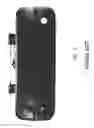
All production trucks use a fixed position bracket to mount a rear-facing camera on the truck's tailgate, as shown in FIG. 1.
SUMMARY OF THE INVENTION
The invention may provide a truck tailgate camera bracket with a rotating camera head. When the truck tail gate is lowered, the camera head may rotate outward toward the rear of the vehicle, enabling the camera head to be used when the truck is hauling large objects.
The invention is related to rear camera mounting on trucks. The mounting position is located on the tailgate, which could cause a problem if the driver is hauling an oversized load (e.g., long wood, etc.), and when the tailgate is lowered the camera is facing toward the front of the vehicle such that the camera is no longer capable of capturing images to the rear of the truck. The present invention may enable the camera to be used when the tailgate is lowered.
The invention comprises, in one form thereof, a motor vehicle including a horizontally oriented bed. A tailgate is pivotably attached to the bed. The tailgate is pivotable between an upright position and a horizontal position. A camera is pivotably attached to the tailgate. The camera has a field of view. An orientation sensor detects an orientation of the tailgate and/or the camera. An actuator pivots the camera relative to the tailgate. An electronic processor is communicatively coupled to the orientation sensor and to the actuator. The electronic processor receives a sensor signal from the orientation sensor. The electronic processor causes the actuator to pivot the camera dependent upon the sensor signal such that the field of view of the camera remains in a horizontal orientation throughout pivoting of the tailgate.
The invention comprises, in another form thereof, a method of operating a motor vehicle, including providing a horizontally oriented bed. A tailgate is pivotably attached to the bed. A camera is pivotably attached to the tailgate. The camera has a field of view. The tailgate is pivoted between an upright position and a horizontal position. An orientation of at least one of the tailgate and the camera is detected after the pivoting of the tailgate has commenced. The camera is pivoted relative to the tailgate dependent upon the detecting of the orientation such that a field of view of the camera remains in a horizontal orientation throughout pivoting of the tailgate.
The invention comprises, in yet another form thereof, a motor vehicle including a camera pivotably attached to a portion of a rear end of the motor vehicle. The camera has a field of view. An orientation sensor detects an orientation of the portion of the rear end of the motor vehicle anti/or the camera. An actuator pivots the camera relative to the portion of the rear end of the motor vehicle. An electronic processor is communicatively coupled to the orientation sensor and to the actuator. The electronic processor receives a sensor signal from the orientation sensor, and causes the actuator to pivot the camera dependent upon the sensor signal such that the field of view of the camera remains in a substantially horizontal, substantially rearward orientation during operation of the motor vehicle.
BRIEF DESCRIPTION OF THE DRAWINGS
The above-mentioned and other features and objects of this invention, and the manner of attaining them, will become more apparent and the invention itself will be better understood by reference to the following description of embodiments of the invention taken in conjunction with the accompanying drawings, wherein:
FIG. 1 is a block diagram of one embodiment of a truck tailgate with rear-facing camera of the prior art.
FIG. 2A is a fragmentary, side cross-sectional view of one embodiment of a truck tailgate with rear-geeing camera arrangement of the present invention with the tailgate in a closed or vertical position.
FIG. 2B is a fragmentary, side cross-sectional view of the track tailgate with rear-facing camera arrangement of the present invention of FIG. 2A with the tailgate in an open or horizontal position.
FIG. 3 is a block diagram of the camera of FIG. 2 and associated electronics.
FIG. 4 is a flow chart of one embodiment of a method of the present invention for operating a motor vehicle.
DETAILED DESCRIPTION
The embodiments hereinafter disclosed are not intended to be exhaustive or limit the invention to the precise forms disclosed in the following description. Rather the embodiments are chosen and described so that others skilled in the art may utilize its teachings.
FIG. 2A is a fragmentary, side cross-sectional view of one embodiment of a truck tailgate with rear-facing camera arrangement 10 of the present invention with a tailgate 12 in a closed or vertical position. Tailgate 12 is pivotably attached to a truck bed 14, and may pivot relative to bed 14 about a pivot point 16. A rearward-facing camera 18 has a field of view approximately centered in a rearward direction indicated by arrow 20. Camera 18 is pivotably attached to a distal edge 21 of tailgate 12, and may pivot relative to tailgate 12 about a pivot point 22.
FIG. 3 illustrates camera 18 and associated electronics for maintaining the field of view of camera 18 in horizontal direction 20 regardless of the orientation of tailgate 12. Camera 18 is pivoted by an actuator 24, which, in turn, is controlled by an electronic processor 26, A camera orientation sensor 28, which may be a geomagnetic field sensor, accelerometer and/or gyroscope, for example, determines the orientation of camera 18 and hence the orientation of the field of view of camera 18. Processor 26 may use the feedback signal from orientation sensor 28 to keep camera 18 pointed in a horizontal direction.
During use, tailgate 12 may be lowered to an open or horizontal orientation, as shown in FIG. 2B. As tailgate 12 pivots about pivot point 16, orientation sensor 28 senses the changing orientation of camera 18 and informs processor 26 of the changing orientation. Processor 26 responds by causing actuator 24 to pivot camera 18 about pivot point 22 to thereby maintain the field of view of camera 18 being centered in horizontal direction 20.
FIG. 4 is a flow chart of one embodiment of a method 400 of the present invention for operating a motor vehicle. In a first step 402, a tailgate is pivotably attached to a horizontally oriented bed. For example, tailgate 12 is pivotably attached to a horizontally oriented truck bed 14
Next, in step 404, a camera is pivotably attached to the tailgate. The camera has a field of view. For example, camera 18 has a field of view approximately centered in a rearward direction indicated by arrow 20. Camera 18 is pivotably attached to a distal edge 21 of tailgate 12.
In a next step 406, the tailgate is pivoted between an upright position and a horizontal position. For example, tailgate 12 is pivoted between the upright position shown in FIG. 2A and the horizontal position shown in FIG. 2B.
In step 408, an orientation of the tailgate and/or the camera is detected after the pivoting of the tailgate has commenced. For example, as tailgate 12 pivots about pivot point 16, orientation sensor 28 senses the changing orientation of camera 18
In a final step 410, the camera is pivoted relative to the tailgate dependent upon the detecting step such that a field of view of the camera remains in a horizontal orientation throughout pivoting of the tailgate. For example, orientation sensor 28 informs processor 26 of the changing orientation. Processor 26 responds by causing actuator 24 to pivot camera 18 about pivot point 22 to thereby maintain the field of view of camera 18 being centered in horizontal direction 20.
The foregoing description may refer to “motor vehicle”, “automobile”, “automotive”, or similar expressions. It is to be understood that these terms are not intended to limit the invention to any particular type of transportation vehicle. Rather, the invention may be applied to any type of transportation vehicle whether traveling by air, water, or ground, such as airplanes, boats, etc.
While this invention has been described as having an exemplary design, the present invention may be further modified within the spirit and scope of this disclosure. This application is therefore intended to cover any variations, uses, or adaptations of the invention using its general principles. Further, this application is intended to cover such departures from the present disclosure as come within known or customary practice in the art to which this invention pertains.
Claims
What is claimed is:1. A motor vehicle, comprising:
a horizontally oriented bed;
a tailgate pivotably attached to the bed, the tailgate being pivotable between an upright position and a horizontal position;
a camera pivotably attached to the tailgate, the camera having a field of view;
an orientation sensor configured to detect an orientation of at least one of the tailgate and the camera;
an actuator configured to pivot the camera relative to the tailgate; and
an electronic processor communicatively coupled to the orientation sensor and to the actuator, the electronic processor being configured to:
receive a sensor signal from the orientation sensor; and
cause the actuator to pivot the camera dependent upon the sensor signal such that the field of view of the camera remains in a horizontal orientation throughout pivoting of the tailgate.
2. The motor vehicle of claim 1, wherein the camera is attached to a distal edge of the tailgate.
3. The motor vehicle of claim 1, wherein the orientation sensor comprises a geomagnetic field sensor.
4. The motor vehicle of claim 1, wherein the orientation sensor comprises an accelerometer.
5. The motor vehicle of claim 1, wherein the orientation sensor comprises a gyroscope.
6. The motor vehicle of claim 1, wherein the electronic processor is configured to cause the actuator to pivot the camera dependent upon the sensor signal such that the field of view of the camera remains in a rearward, horizontal orientation throughout pivoting of the tailgate.
7. The motor vehicle of claim 1, wherein the orientation sensor is configured to detect an orientation of the camera.
8. A method of operating a motor vehicle, the method comprising:
providing a horizontally oriented bed;
pivotably attaching a tailgate to the bed;
pivotably attaching a camera to the tailgate, the camera having a field of view;
pivoting the tailgate between an upright position and a horizontal position;
detecting an orientation of at least one of the tailgate and the camera after the pivoting of the tailgate has commenced; and
pivoting the camera relative to the tailgate dependent upon the detecting step such that a field of view of the camera remains in a horizontal orientation throughout pivoting of the tailgate.
9. The method of claim 8, wherein the camera is attached to a distal edge of the tailgate.
10. The method of claim 8, wherein the orientation is detected by a geomagnetic field sensor.
11. The method of claim 8, wherein the orientation is detected by an accelerometer.
12. The method of claim 8, wherein the orientation is detected by a gyroscope.
13. The method of claim 8, wherein the pivoting comprises pivoting the camera dependent upon the detecting step such that the field of view of the camera remains in a rearward, horizontal orientation throughout pivoting of the tailgate.
14. The method of claim 8, wherein the detecting step includes detecting an orientation of the camera.
15. A motor vehicle, comprising:
a camera pivotally attached to a portion of a rear end of the motor vehicle, the camera having a field of view;
an orientation sensor configured to detect an orientation of at least one of the portion of the rear end of the motor vehicle and the camera;
an actuator configured to pivot the camera relative to the portion of the rear end of the motor vehicle; and
an electronic processor communicatively coupled to the orientation sensor and to the actuator, the electronic processor being configured to:
receive a sensor signal from the orientation sensor; and
cause the actuator to pivot the camera dependent upon the sensor signal such that the field of view of the camera remains in a substantially horizontal, substantially rearward orientation during operation of the motor vehicle.
16. The motor vehicle of claim 15, wherein the portion of the rear end of the motor vehicle includes a proximal end and a distal end, the camera being attached to the distal end.
17. The motor vehicle of claim 15, wherein the orientation sensor comprises a geomagnetic field sensor.
18. The motor vehicle of claim 15, wherein the orientation sensor comprises an accelerometer.
19. The motor vehicle of claim 15, wherein the orientation sensor comprises a gyroscope.
20. The motor vehicle of claim 15, wherein the electronic processor is configured to cause the actuator to pivot the camera dependent upon the sensor signal such that the field of view of the camera remains in a rearward, horizontal orientation throughout pivoting of the portion of the rear end of the motor vehicle.
21. The motor vehicle of claim 15, wherein the orientation sensor is configured to detect an orientation of the camera.
Images & Drawings included:



Sources:
- United States Patent and Trademark Office - verify current appl. status at the USPTO↗
Recent applications in this class:
- » 20250282303 2025-09-11
CAMERA MOUNTING DEVICE AND VEHICLE - » 20250263025 2025-08-21
Interior Camera System for a Self Driving Car - » 20250263024 2025-08-21
Sensor Assembly for a Motor Vehicle, and Mirror Assembly Comprising Such a Sensor Assembly - » 20250263023 2025-08-21
SURVEILLANCE PLATFORM HAVING A RETRACTABLE TELESCOPING STRUCTURE THAT FULLY RETRACTS WITHIN A VEHICLE AND WHICH HAS SURVEILLANCE EQUIPMENT MOUNTED THEREON, AND SEALING DEVICE MOUNTED TO THE TELESCOPING STRUCTURE - » 20250263022 2025-08-21
BRACKET ASSEMBLY FOR VEHICLE CAMERA MONITOR SYSTEMS - » 20250256663 2025-08-14
SYSTEM AND METHOD FOR OPERATING A VEHICLE ACCESS POINT - » 20250256662 2025-08-14
IMAGING SYSTEM FOR BULK TRANSPORT VEHICLES - » 20250242762 2025-07-31
VEHICLE QUARTER GLASS STRUCTURE - » 20250229727 2025-07-17
VEHICULAR VISION SYSTEM WITH CAMERA HAVING LENS ARRAY - » 20250222881 2025-07-10
Vehicle-Mounted Camera Module, Camera Mounting Bracket, and Vehicle
Recent applications for this Assignee:
- » 20240241371 2024-07-18
CURVED VIRTUAL IMAGE FOR HEADS UP DISPLAY - » 20240166046 2024-05-23
Vehicle remote start prevention alert - » 20230393394 2023-12-07
Adjustable polarizer for head up displays - » 20230333373 2023-10-19
Polarization rotator for head-up display - » 20230311766 2023-10-05
AUTO-SWITCH DISPLAY INTELLIGENT REARVIEW MIRROR SYSTEM - » 20230259204 2023-08-17
Dynamic IR emission control for fast recognition of eye tracking system - » 20230254615 2023-08-10
Near to the ear subwoofer - » 20230234443 2023-07-27
Combined head up display (HUD) and camera system - » 20230095389 2023-03-30
Heads up display housing - » 20230019606 2023-01-19
Windshield safety system