Super absorbent thermochromic resin and preparation method thereof
US20180169615A1
2018-06-21
15/553,950
2017-04-28
✅ Patent granted
US 10,143,996 B2
2018-12-04
WO; PCT/CN2017/082344; 20170428
WO; WO2017/186155; 20171102
Ling Siu Choi | Ronald Grinsted
2037-04-28
Abstract:
A super absorbent thermochromic resin and a preparation method thereof are disclosed. The resin comprises the following components by weight percent: 30-60% of a monomer, 0.01-0.5% of an initiator, 0.01-4% of a dispersant, 0.01-5% of a cross-linking agent, 0-20% of a diluent, 0.5-2% of an auxiliary, 0.1-10% of a thermochromic pigment, and the balance of water. Compared with the prior art, the super absorbent thermochromic resin prepared by the present invention can effectively indicate the temperature changes of the resin in a drying state and a water absorption state through color changes. The reaction finishes in 6-10 min, with a simple process, smooth polymerization, short reaction time and high productivity. The super absorbent thermochromic resin has a good stability and can be widely applied to the medical industry and daily use articles industry.
Inventors:
Assignee:
- SHANGHAI CHUANGSHI INDUSTRY GROUP CO., LTD. 3 🇨🇳 Shanghai, China
Applicant:
Interested in similar patents?
Get notified when new applications in this technology area are published.
Classification:
B01J20/3085 » CPC further
Solid sorbent compositions or filter aid compositions; Sorbents for chromatography; Processes for preparing, regenerating or reactivating thereof; Processes for preparing, regenerating, or reactivating Chemical treatments not covered by groups -
B01J20/267 » CPC main
Solid sorbent compositions or filter aid compositions; Sorbents for chromatography; Processes for preparing, regenerating or reactivating thereof comprising organic material; Synthetic macromolecular compounds modified or post-treated polymers Cross-linked polymers
B01J20/26 IPC
Solid sorbent compositions or filter aid compositions; Sorbents for chromatography; Processes for preparing, regenerating or reactivating thereof comprising organic material Synthetic macromolecular compounds
C08F220/56 » CPC further
Copolymers of compounds having one or more unsaturated aliphatic radicals, each having only one carbon-to-carbon double bond, and only one being terminated by only one carboxyl radical or a salt, anhydride ester, amide, imide or nitrile thereof; Monocarboxylic acids having less than ten carbon atoms; Derivatives thereof; Amides or imides; Amides, e.g. N,N-dimethylacrylamide or N-isopropylacrylamide Acrylamide; Methacrylamide
C08F222/14 » CPC further
Copolymers of compounds having one or more unsaturated aliphatic radicals, each having only one carbon-to-carbon double bond, and at least one being terminated by a carboxyl radical and containing at least one other carboxyl radical in the molecule; Salts, anhydrides, esters, amides, imides, or nitriles thereof; Esters of phenols or saturated alcohols Esters having no free carboxylic acid groups, e.g. dialkyl maleates or fumarates
C08F226/10 » CPC further
Copolymers of compounds having one or more unsaturated aliphatic radicals, each having only one carbon-to-carbon double bond, and at least one being terminated by a single or double bond to nitrogen or by a heterocyclic ring containing nitrogen by a heterocyclic ring containing nitrogen N-Vinyl-pyrrolidone
C08F236/20 » CPC further
Copolymers of compounds having one or more unsaturated aliphatic radicals, at least one having two or more carbon-to-carbon double bonds the radical having only two carbon-to-carbon double bonds unconjugated
C08F236/22 » CPC further
Copolymers of compounds having one or more unsaturated aliphatic radicals, at least one having two or more carbon-to-carbon double bonds the radical having three or more carbon-to-carbon double bonds
B01J20/30 IPC
Solid sorbent compositions or filter aid compositions; Sorbents for chromatography; Processes for preparing, regenerating or reactivating thereof Processes for preparing, regenerating, or reactivating
C08F220/44 » CPC further
Copolymers of compounds having one or more unsaturated aliphatic radicals, each having only one carbon-to-carbon double bond, and only one being terminated by only one carboxyl radical or a salt, anhydride ester, amide, imide or nitrile thereof; Monocarboxylic acids having less than ten carbon atoms; Derivatives thereof; Nitriles Acrylonitrile
C08F220/06 » CPC further
Copolymers of compounds having one or more unsaturated aliphatic radicals, each having only one carbon-to-carbon double bond, and only one being terminated by only one carboxyl radical or a salt, anhydride ester, amide, imide or nitrile thereof; Monocarboxylic acids having less than ten carbon atoms; Derivatives thereof; Acids; Metal salts or ammonium salts thereof Acrylic acid; Methacrylic acid; Metal salts or ammonium salts thereof
Description
CROSS REFERENCE OF RELATED APPLICATION
This is a U.S. National Stage under 35 U.S.C 371 of the International Application PCT/CN2017/082344, filed Apr. 28, 2017, which claims priority under 35 U.S.C. 119(a-d) to CN 201610282041.3, filed Apr. 29, 2016.
BACKGROUND OF THE PRESENT INVENTION
Field of Invention
The present invention belongs to the technical field of functional polymer materials and relates to a thermochromic water-absorbent resin polymer and a preparation method thereof.
Description of Related Arts
As a new kind of polymer material, super absorbent resin can absorb water ten to thousands of times more than its mass, and has a good water retention capacity under pressure or heat conditions. The super absorbent resin after water absorption has rubber-like elasticity and good thermal storage performance, and is highly safe and nontoxic. In addition, it is widely used in medicine, physical health, rehabilitation and other fields.
There is little discussion on the thermochromic water-absorbent resin in the current literature, and the conventional water-absorbent resin products available on the market have no thermochromic function. Thermochromic water-absorbent resin, based on the original water-absorbent resin, has a new function of indicating temperature changes through color changes, so as to indicate safe use to users with suitable thermochromic function and increase the interest of the products, thereby improving the safe and enjoyable experience of the products.
The conventional water-absorbent resin products on the market have no thermochromic function. The reason is that the thermochromic material is unstable and easy to agglomerate in polymerization reaction systems, or the thermochromic function loses due to initiator and high temperature. The above-mentioned problems cannot be solved, even though conventional thermochromic microcapsules are used. Therefore, it is difficult to prepare thermochromic water-absorbent resin.
SUMMARY OF THE PRESENT INVENTION
In view of the above technical defects, an object of the present invention is to provide a super absorbent thermochromic resin and a preparation method thereof.
The object of the present invention is realized by means of the following technical solution:
In a first aspect, the present invention provides a super absorbent thermochromic resin, which comprises following components by weight percent:
| a monomer | 30-60%; | |
| an initiator | 0.01-0.5%; | |
| a dispersant | 0.01-4%; | |
| a cross-linking agent | 0.01-5%; | |
| a diluent | 0-20%; | |
| a thermochromic pigment | 0.1-10%; | |
and a balance of water.
The conventional water-absorbent resin only has a high water absorption function. By adding a thermochromic material to improve the formula, a new water-absorbent resin with the function of thermochromism is prepared after thorough mixing and reaction, thereby reminding users of temperature changes to the new water-absorbent resin and preventing the users from being burned or frostbite.
Further preferably, the thermochromic water-absorbent resin composition comprises the following components by weight percent:
| the monomer | 40-55%; | |
| the initiator | 0.05-0.3%; | |
| the dispersant | 0.4-3.5%; | |
| the cross-linking agent | 0.1-4.5%; | |
| the diluent | 0.4-15.8%; | |
| the thermochromic pigment | 4-7.5%; | |
and the balance of water.
The above percentages refer to the weight percentage of specific components in the obtained super absorbent thermochromic resin.
The super absorbent thermochromic resin prepared using conventional methods shows poor discoloration. By adjusting the proportion of each raw material in the formula, the super absorbent thermochromic resin after water absorption shows obvious color changing upon temperature rise or cooling.
Further preferably, the super absorbent thermochromic resin comprises the following components by weight percent:
| the monomer | 40-55%; | |
| the initiator | 0.05-0.3%; | |
| the dispersant | 0.4-3.5%; | |
| the cross-linking agent | 0.1-4.5%; | |
| the diluent | 0.4-15.8%; | |
| the thermochromic pigment | 4-7.5%; | |
| the auxiliary | 0.5-2%; | |
and the balance of water.
The addition of an auxiliary in the process of synthesizing water-absorbent resin can overcome the problem of poor ductility and fragility of the conventional water-absorbent resin, and greatly improve the user's comfort.
Preferably, the water is deionized water or distilled water.
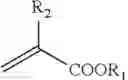
Preferably, the monomer comprises an acrylic monomer, which is specifically selected from a group consisting of acrylamide, acrylate, acrylic acid, vinyl acetate, N-vinyl pyrrolidone, acrylonitrile, methacrylic acid, methacrylate and an acrylate system as shown in the following structural formula I.
wherein, R1 is C1-C5, R2 is H or Cl.
More preferably, the monomer is one or two of acrylate and acrylamide; both are the acrylic monomer with a good hydrophilicity; copolymers formed by the two have good mechanical properties after water absorption, and is beneficial to dispersion of the thermochromic pigment.
Preferably, the initiator is selected from a group consisting of azobisisobutyronitrile (AIBN), cerium salts, persulfate, a persulfate-NaHSO3 system and a hydrogen peroxide-ascorbic acid system.
More preferably, the initiator is selected from persulfate; further, the dispersant is Na2S2O8; a decomposition product is Na2SO4, which exerts a lowest impact on the thermochromic water-absorbent resin, greatly speeds up the reaction and obtains the product.
Preferably, the dispersant is selected from a group consisting of Span 60, Tween 80, Tween 85 and nonylphenol polyoxyethylene ether-10 (OP-10). Selecting proper dispersant may allow uniform dispersion of the thermochromic pigment free of agglomeration and make discoloration of the product more obvious.
Preferably, the cross-linking agent is selected from a group consisting of ethylene glycol dimethacrylate, diethylene glycol dimethacrylate, allyl methacrylate, 1,1,1-trimethylolpropane acrylate, N,N′-methylene diacrylamide, triallylamine and tetraallyloxyethane.
Preferably, the diluent is mainly polyhydric alcohol;
More preferably, the diluent is selected from a group consisting of glycerol, pentaerythritol, trimethylol ethane, propylene glycol and diethylene glycol.
Preferably, the auxiliary is at least one of inorganic salts and organic compounds; the inorganic salts comprise one or more of sodium tripolyphosphate, zinc sulfate, potassium aluminum sulfate, sodium chloride and potassium chloride, and the organic compounds comprise at least one of polyethylene glycol (200-6000) and polyethylene glycol glyceride. The addition of the auxiliary effectively improves the ductility and hardness of the product.
Preferably, the thermochromic pigment is a water dispersion type reversible thermochromic microcapsule pigment/dye. The color classification of dye is as follows: blue, orange, red, green, carmine and black; a temperature for discoloration ranges between −15° C. and 70° C.; a common temperature is −5° C., 0° C., 5° C., 15° C., 31° C., 43° C. and 55° C. High, medium and low-temperature segmented discoloration of water-absorbent resin through mutual collocation or collocation with other background pigments can be realized. For example: two-segmented discoloration effect can be realized by mixing thermochromic dye with a temperature below 0° C. and thermochromic dye with a temperature above 50° C., while three-segmented discoloration effect can be realized by mixing thermochromic dye with a temperature below 0° C., thermochromic dye with a temperature above 31° C. and thermochromic dye with a temperature above 50° C.
In a second aspect, the present invention provides a preparation method of a super absorbent thermochromic resin, wherein the preparation method comprises following steps of: adding a thermochromic pigment, a dispersant, a cross-linking agent and a diluent to a monomer and mixing uniformly; adjusting a pH value, and adding an initiator; mixing uniformly to form a reaction system, controlling a reaction temperature to perform reaction, and obtaining the super absorbent thermochromic resin.
Preferably, the present invention preliminarily mixes and disperses the thermochromic pigment and the dispersant, and then transfers it into the monomer to uniformly mix them, effectively solving the phenomenon of internal agglomeration of pigment after the super absorbent thermochromic resin is produced.
Preferably, the mode of mixing uniformly includes stirring.
Preferably, the step of adjusting the pH value is specifically adding an alkali solution.
Preferably, the pH value after being adjusted is 5-9.
Further preferably, the pH value after being adjusted is 6-8. Due to the electrical properties of the thermochromic dye, a too high or too low pH value will cause the precipitation and agglomeration of the thermochromic pigment. By adjusting the pH value, the agglomeration of the thermochromic pigment can be avoided.
Preferably, the reaction temperature is controlled at 55-90° C.
Further preferably, the reaction temperature is controlled at 65-85° C. The microcapsule structure of the thermochromic pigment will be damaged due to a too high reaction temperature, so that the pigment fades or loses the discoloration effect. By adjusting the reaction temperature, the loss of discoloration caused by high temperature can be avoided. The temperature indication range of the polymer of this invention varies depending on the thermochromic pigment. The commonly adopted use temperature of the thermochromic water-absorbent resin is −15-70° C., preferably, the temperature indication range is −10-10° C., 30-35° C. and 50-55° C.; specifically: the temperature of below −5° C. easily causes frostbite, and the temperature of above 50° C. easily causes burns of a sensitive person, therefore, the temperatures within the range of −10-10° C. and 50-55° C. are reminder alerts.
Compared with the prior art, the present invention has the following beneficial effects:
1. In the present invention, by adding water dispersion type reversible thermochromic microcapsule pigment/dye to the original monomer and improving the addition proportion of each raw material in the original formula, a super absorbent thermochromic resin is obtained. Before and after water absorption, the resin has a significant color change, which preventing users from being burned at high temperatures or frostbite at low temperatures, and has a high water absorption function.
2. In the present invention, selecting a proper dispersant and adding thermochromic pigment and dispersant mixed in the experimental steps to the monomer effectively solves the problem that the thermochromic pigment is unstable and easy to agglomerate. As a result, the product, namely super absorbent thermochromic resin, is significant in thermochromism and achieves a good indication effect.
3. In the present invention, by changing the reaction temperature for production, it is possible to find a balance between the reaction temperature and the temperature affecting the thermochromic pigment, thereby effectively preventing thermochromic pigment from loss of thermochromism caused by high temperature and keeping the production normal.
4. In the present invention, by adding the initiator, it is possible to shorten the reaction time to only 6-10 min, and it is not necessary to fill with nitrogen, thereby overcoming such problems as low reaction rate and yield.
5. In the present invention, the added auxiliary can change the function of the polymerization bond in the polymerization of the monomer, and the temperature-sensitive phase transition microcapsules are stably present in the polymer, and the agglomerate structure of the polymer can be changed to increase the ductility and hardness of the product.
DETAILED DESCRIPTION OF THE PREFERRED EMBODIMENT
The present invention is described in detail as follows with reference to specific embodiments. The following embodiments will help provide further understanding of the present invention for those skilled in the art, and not in any way limit the present invention. It shall be noted that several variants and improvements can be made without departing from concept of the present invention for ordinary persons skilled in the art. All these fall within the protection scope of the present invention.
Embodiment 1
The embodiment provides a super absorbent thermochromic resin and a preparation method thereof, wherein components and contents involved are shown in Table 1; and the preparation method comprises the following steps of:
adding 30 g of acrylic acid to water; adjusting the solution with NaOH until pH=6.5; feeding nitrogen into a reactor; adding 0.4 g of Tween 60, 0.2 g of ethylene glycol dimethacrylate and 4 g of thermochromic dye (Guangdong New Prismatic Enterprise Co., Ltd., color changes from blue to colorless at −5° C. and the process is reversible upon temperature drop); stirring, keeping feeding nitrogen for 2 hours, and then adding 0.02 g of Na2S2O8 to a mixed liquor; performing heat preservation on an obtained reaction system (a total of 100 g) at 80° C. for 10 minutes to perform a polymerization reaction; cooling to room temperature, and then using a scraper for removing a gel from the reactor; drying the gel in an oven at 70° C.; and grinding the gel.
Embodiment 2
The embodiment provides a super absorbent thermochromic resin and a preparation method thereof, wherein components and contents involved are shown in Table 1; and the preparation method comprises the following steps of:
stirring and mixing 38 g of acrylic acid, 2 g of acrylonitrile, 0.5 g of OP-10 and 2 g of pentaerythritol with deionized water; adding 20 g of 9% NaOH for regulating the system pH to 5.5; adding 0.5 g of diethylene glycol dimethacrylate and 4 g of thermochromic dye (Guangzhou Kingcai Pigment Co., Ltd., color changes from yellow to colorless at 30° C. and the process is reversible upon temperature drop); stirring, feeding N2 for 2 hours, and then adding 0.03 g of AIBN to the mixture; stirring uniformly (the reaction system totals 100 g), and then using an industrial white oil with a temperature of 80° C. as a continuous phase and using the mixture as a dispersed phase for suspension polymerization; stirring for 15 minutes, and then filtering the white oil to obtain resin particles; using tetrahydrofuran to wash away the white oil on the surfaces of the resin particles; and drying in a vacuum drying oven at 80° C. to obtain water-absorbent resin microbeads.
Embodiment 3
The embodiment provides a super absorbent thermochromic resin and a preparation method thereof, wherein components and contents involved are shown in Table 1; and the preparation method comprises the following steps of:
adding 30.5 g of acrylic acid to 15 g of 9% NaOH solution to obtain a mixture a; adding 17 g of acrylamide, 2.5 g of N-vinyl pyrrolidone, 3 g of glycerol, 4 g of thermochromic pigment (Dongguan Biansefeng Industrial Investment Co., Ltd., color changes from green to yellow green at 45° C. and the process is reversible upon temperature drop), 0.7 g of triallylamine, 0.3 g of Tween 80, 0.4 g of OP-10 to deionized water to obtain a mixture b; mixing the mixture a and mixture b and stirring uniformly to obtain a mixture c; feeding N2 into the mixture c for 2 hours, and then adding 1 g of 2% (by mass) ceric ammonium nitrate solution; mixing uniformly (the reaction system totals 100 g), and then heating for 10 minutes in 80° C. water bath; after cooling, using a scraper for removing a gel from the reaction system; placing in an oven at 80° C. for 10 minutes, and then crushing to obtain the thermochromic water-absorbent resin powder.
Embodiment 4
The embodiment provides a super absorbent thermochromic resin and a preparation method thereof, wherein components and contents involved are shown in Table 1; and the preparation method comprises the following steps of:
adding 40 g of acrylic acid to 30 g of 5% NaOH solution, adjusting the solution until pH=4, and then adding 17 g of acrylamide, 3 g of vinyl acetate, 4 g of thermochromic pigment (Dongguan Biansefeng Industrial Investment Co., Ltd., color changes from red to colorless at 55° C. and the process is reversible upon temperature drop), 4 g of glycerol, 0.6 g of Tween 60, 0.6 g of OP-10 and 0.78 g of allyl methacrylate; continuously stirring and feeding N2; after 2 hours, adding 0.01 mL of 30% hydrogen peroxide and 0.01 g of L-ascorbic acid, and using an industrial white oil as a continuous phase and using the above-mentioned mixture (a total of 100 g) as a dispersed phase for performing suspension polymerization at 75° C.; filtering after 10 minutes, and washing the filtrate with petroleum ether, and drying at 75° C. to obtain the thermochromic water-absorbent resin (water contained in the NaOH solution).
Embodiment 5
The embodiment provides a super absorbent thermochromic resin and a preparation method thereof, wherein components and contents involved are shown in Table 1; and the preparation method comprises the following steps of:
adding 30 g of acrylic acid to 25 g of 5% NaOH solution, adjusting the solution until pH=6, and then adding 15 g of acrylamide, 4 g of thermochromic pigment (Taiwan New Prismatic Enterprise Co., Ltd., color changes from dark purple to light purple to red and then colorless at 0° C., 30° C. and 55° C.), 0.4 g of Span 60, 0.6 g of OP-10 and 2 g of polyethylene glycol and 0.5 g ethylene glycol dimethacrylate; continuously stirring and feeding N2; after 2 hours, adding 0.02 g of Na2S2O8 to, and using an industrial white oil as a continuous phase and using the above-mentioned mixture (a total of 100 g) as a dispersed phase for performing suspension polymerization at 75° C.; filtering after 10 minutes, and washing the filtrate with petroleum ether mixed with tetrahydrofuran (1:1), and drying at 75° C. to obtain the thermochromic water-absorbent resin (water contained in the NaOH solution).
Embodiment 6
The embodiment provides a super absorbent thermochromic resin and a preparation method thereof, wherein components and contents involved are shown in Table 1; and the preparation method comprises the following steps of:
mixing 4 g of thermochromic dye (Guangzhou Kingcai Pigment Co., Ltd., color changes from bright orange to orange red to red and then colorless at −5° C., 30° C. and 55° C.) with 0.3 g of Span first; mixing and stirring 35 g of acrylic acid, 0.4 g of Tween 85, 5 g of propylene glycol and deionized water, adding 22 g of 10% NaOH to adjust the system until pH=5.5, adding 1.3 g of polyethylene glycol glyceride, 0.9 g of N′N-methylenebisacrylamide and stirring them, feeding N2 for 2 hours, and then adding 0.01 g of potassium persulfate to the mixture; stirring uniformly (the reaction system totals 100 g), and then using an industrial white oil with a temperature of 80° C. as a continuous phase and using the mixture as a dispersed phase for suspension polymerization; stirring for 15 minutes, and then filtering the white oil to obtain resin particles; using tetrahydrofuran to wash away the white oil on the surfaces of the resin particles; and drying at 80° C. to obtain spherical water-absorbent resin.
Embodiment 7
Embodiment 7 provides a thermochromic water-absorbent resin composition and a preparation method thereof, wherein components and contents involved are shown in Table 1; and the preparation method is basically the same as that of Embodiment 2, with the difference being the addition of 0.8 g of zinc sulfate as the auxiliary.
Embodiment 8
Embodiment 8 provides a super absorbent thermochromic resin and a preparation method thereof, wherein components and contents involved are shown in Table 1; and the preparation method is basically the same as that of Embodiment 3, with the difference being the addition of 1.3 g of sodium chloride as the auxiliary and 4 g of thermochromic dye (Dongguan Biansefeng Industrial Investment Co., Ltd., color changes from purple to blue to red and then colorless at 0° C., 30° C. and 55° C.).
| TABLE 1 |
| Components and Contents Involved in Embodiments 1-8 |
| Embodiment | Embodiment | Embodiment | Embodiment | Embodiment | Embodiment | Embodiment | Embodiment | |
| 1 | 2 | 3 | 4 | 5 | 6 | 7 | 8 | |
| Monomer | 30% | 38% | 30.5% | 40% | 30% | 35% | 38% | 30.5% |
| acrylic acid | acrylic acid | acrylic acid | acrylic acid | acrylic acid | acrylic acid | acrylic acid | acrylic acid | |
| 2% | 17% | 17% | 15% | 2% | 17% | |||
| acrylonitrile | acrylamide | acrylamide | acrylamide | acrylonitrile | acrylamide | |||
| 2.5% N- | 3% vinyl | 2.5% N- | ||||||
| vinyl | acetate | vinyl | ||||||
| pyrrolidone | pyrrolidone | |||||||
| Initiator | 0.02% | 0.03% | 0.02% | 0.02% | 0.02% | 0.01% | 0.03% | 0.02% |
| Na2S2O8 | AIBN | ceric | hydrogen | Na2S2O8 | potassium | AIBN | ceric | |
| ammonium | peroxide- | persulfate | ammonium | |||||
| nitrate | ascorbic | nitrate | ||||||
| acid | ||||||||
| Diluent | 0 | 2% | 3% | 4% | 0 | 5% | 2% | 3% |
| pentaerythritol | propylene | glycerol | propylene | pentaerythritol | propylene | |||
| glycol | glycol | glycol | ||||||
| Dispersant | 0.4% | 0.5% | 0.3% | 0.6% | 0.6% | 0.3% | 0.5% | 0.3% |
| Tween 60 | OP-10 | Tween 80 | OP-10 | OP-10 | Span 60 | OP-10 | Tween 80 | |
| 0.4% | 0.6% | 0.4% | 0.4% | 0.4% | ||||
| OP-10 | Tween 60 | Span 60 | Tween 85 | OP-10 | ||||
| Cross- | 0.2% | 0.5% | 0.7% | 0.78% | 0.5% | 0.9% | 0.5% | 0.7% |
| linking | ethylene | diethylene | triallylamine | allyl | ethylene | N′N- | diethylene | triallylamine |
| agent | glycol | glycol | methacrylate | glycol | methylen | glycol | ||
| dimethacrylate | dimethacrylate | dimethacrylate | ebisacrylamide | dimethacrylate | ||||
| Auxiliary | 2% | 1.3% | 0.8% | 1.3% | ||||
| polyethylene | polyethylene | zinc | sodium | |||||
| glycol | glycol | sulfate | chloride | |||||
| glyceride | ||||||||
| Thermochromic | 4% | 4% | 4% | 4% | 4% | 4% | 4% | 4% |
| pigment | (Guangdong | (Guangzhou | (Dongguan | (Dongguan | (Taiwan | (Guangzhou | (Guangzhou | (Dongguan |
| New | Kingcai | Biansefeng | Biansefeng | New | Kingcai | Kingcai | Biansefeng | |
| Prismatic | Pigment | Industrial | Industrial | Prismatic | Pigment | Pigment | Industrial | |
| Enterprise | Co., Ltd., | Investment | Investment | Enterprise | Co., Ltd., | Co., Ltd., | Investment | |
| Co., Ltd., | color | Co., Ltd., | Co., Ltd., | Co., Ltd., | color | color | Co., Ltd., | |
| color | changes | color | color | color | changes | changes | color | |
| changes | from | changes | changes | changes | from | from | changes | |
| from | yellow to | from | from red | from | bright | yellow to | from | |
| blue to | colorless | green to | to | dark | orange to | colorless | purple to | |
| colorless | at 30° C. | yellow | colorless | purple to | orange | at 30° C.) | blue to | |
| at −5° C. | and the | green at | at 55° C. | light | red to | red and | ||
| and the | process is | 45° C. | and the | purple to | red and | then | ||
| process is | reversible | and the | process is | red and | then | colorless | ||
| reversible | upon | process is | reversible | then | colorless | at 0° C., | ||
| upon | temperature | reversible | upon | colorless | at −5° C., | 30° C. | ||
| temperature | drop) | upon | temperature | at 0° C., | 30° C. | and | ||
| drop) | temperature | drop | 30° C. | and | 55° C.) | |||
| drop) | and | 55° C.) | ||||||
| 55° C.) | ||||||||
| Deionized | Balance | Balance | Balance | Balance | Balance | Balance | Balance | Balance |
| water | ||||||||
| (distilled | ||||||||
| water) | ||||||||
See Table 2 for the performance test results of compositions in Embodiments 1-4:
| TABLE 2 |
| Performance Test of Compositions Obtained in Embodiments 1-4 |
| Embodiment | Embodiment | Embodiment | Embodiment | Embodiment | Embodiment | Embodiment | Embodiment | |
| 1 | 2 | 3 | 4 | 5 | 6 | 7 | 8 | |
| Color | Colorless | Yellow | Green | Red | Light | Orange | Yellow | Blue |
| uniformity | at 25° C. | at 25° C. | at 25° C. | at 25° C. | purple | red | at 25° C. | at 25° C. |
| after water | at 25° C. | at 25° C. | ||||||
| absorption | ||||||||
| of resin | ||||||||
| The | Blue | Yellow | Green | Red | Dark | Bright | Yellow | Purple |
| thermochromic | when the | when the | when the | when the | purple | orange | when the | when the |
| performance | ambient | ambient | ambient | ambient | when the | when the | ambient | ambient |
| after water | temperature | temperature | temperature | temperature | ambient | ambient | temperature | temperature |
| absorption | is | is below | is below | is below | temperature | temperature | is below | is below |
| of resin | below −5° C., | 30° C., | 45° C., | 55° C., | is below | is | 30° C., | 0° C., |
| colorless | colorless | yellow | colorless | 0° C., | below −5° C., | colorless | blue | |
| when the | when the | green | when the | light | orange | when the | when the | |
| ambient | ambient | when the | ambient | purple | red | ambient | ambient | |
| temperature | temperature | ambient | temperature | when the | when the | temperature | temperature | |
| is | is above | temperature | is above | ambient | ambient | is above | is above | |
| above −5° C. | 30° C. | is above | 55° C. | temperature | temperature | 30° C. | 0° C. and | |
| (not | (not | 45° C. | (not | is above | is | (not | below | |
| exceeding | exceeding | (not | exceeding | 0° C. and | above −5° C. | exceeding | 30° C., | |
| 90° C.) | 90° C.) | exceeding | 90° C.) | below | and below | 90° C.) | red | |
| 90° C.) | 30° C., | 30° C., | when the | |||||
| red | red | ambient | ||||||
| when the | when the | temperature | ||||||
| ambient | ambient | is above | ||||||
| temperature | temperature | 30° C. | ||||||
| is above | is above | and | ||||||
| 30° C. | 30° C. | below | ||||||
| and below | and below | 55° C. | ||||||
| 55° C. | 55° C. | and | ||||||
| and | and | colorless | ||||||
| colorless | colorless | when the | ||||||
| when the | when the | ambient | ||||||
| ambient | ambient | temperature | ||||||
| temperature | temperature | is above | ||||||
| is above | is above | 55° C. | ||||||
| 55° C. | 55° C. | (not | ||||||
| (not | (not | exceeding | ||||||
| exceeding | exceeding | 90° C.) | ||||||
| 90° C.) | 90° C.) | |||||||
| The | No | No | No | No | No | No | No | No |
| thermochromic | significant | significant | significant | significant | significant | significant | significant | significant |
| performance | changes | changes | changes | changes | changes | changes | changes | changes |
| after | in the | in the | in the | in the | in the | in the | in the | in the |
| naturally | thermochromic | thermochromic | thermochromic | thermochromic | thermochromic | thermochromic | thermochromic | thermochromic |
| aging | performance | performance | performance | performance | performance | performance | performance | performance |
| for 100 | ||||||||
| hours at | ||||||||
| 25° C. | ||||||||
| after water | ||||||||
| absorption | ||||||||
| of resin | ||||||||
| The | No | No | No | No | No | No | No | No |
| thermochromic | significant | significant | significant | significant | significant | significant | significant | significant |
| performance | changes | changes | changes | changes | changes | changes | changes | changes |
| after | in the | in the | in the | in the | in the | in the | in the | in the |
| naturally | thermochromic | thermochromic | thermochromic | thermochromic | thermochromic | thermochromic | thermochromic | thermochromic |
| aging | performance | performance | performance | performance | performance | performance | performance | performance |
| for 200 | ||||||||
| hours at | ||||||||
| 25° C. | ||||||||
| after | ||||||||
| water | ||||||||
| absorption | ||||||||
| of resin | ||||||||
| The | No | No | No | No | No | No | No | No |
| thermochromic | significant | significant | significant | significant | significant | significant | significant | significant |
| performance | changes | changes | changes | changes | changes | changes | changes | changes |
| after | in the | in the | in the | in the | in the | in the | in the | in the |
| naturally | thermochromic | thermochromic | thermochromic | thermochromic | thermochromic | thermochromic | thermochromic | thermochromic |
| aging | performance | performance | performance | performance | performance | performance | performance | performance |
| for 300 | ||||||||
| hours at | ||||||||
| 25° C. | ||||||||
| after water | ||||||||
| absorption | ||||||||
| of resin | ||||||||
| Compressive | 25N/particle, | 27N/particle, | 27N/particle, | 33N/particle, | 45N/particle, | 42N/particle, | 52N/particle, | 44N/particle, |
| strength | high in | high in | high in | high in | very | very | very | very |
| of the | strength | strength | strength | strength | high in | high in | high in | high in |
| product | and not | and not | and not | and not | strength | strength | strength | strength |
| (detection | easy to | easy to | easy to | easy to | and not | and not | and not | and not |
| by a | be crushed | be crushed | be crushed | be crushed | easy to | easy to | easy to | easy to |
| particle | be crushed | be crushed | be crushed | be crushed | ||||
| strength | ||||||||
| tester) | ||||||||
Comparative Examples 1-6
The comparative examples 1-6 belong to Embodiment 2, and the preparation method is same as Embodiment 2; see Table 3 for the comparison:
| TABLE 3 |
| Components and Contents Involved in the Comparative Examples 1-6 |
| Comparative | Comparative | Comparative | Comparative | Comparative | Comparative | |
| example 1 | example 2 | example 3 | example 4 | example 5 | example 6 | |
| Monomer | 18% | Same as | Same as | Same as | Same as | 10.5% |
| acrylic acid | Embodiment | Embodiment | Embodiment | Embodiment | acrylic acid | |
| 2% | 2 | 2 | 2 | 8 | 12.5% N- | |
| acrylonitrile | vinyl | |||||
| pyrrolidone | ||||||
| Initiator | Same as | 0.3% | Same as | Same as | Same as | 0.2% ceric |
| Embodiment | AIBN | Embodiment | Embodiment | Embodiment | ammonium | |
| 2 | 2 | 2 | 8 | nitrate | ||
| Diluent | Same as | Same as | Same as | Same as | 24% | Same as |
| Embodiment | Embodiment | Embodiment | Embodiment | glycerol | Embodiment | |
| 2 | 2 | 2 | 2 | 8 | ||
| Dispersant | Same as | 0.5% | Same as | 5% | Same as | Same as |
| Embodiment | OP-10 | Embodiment | OP-10 | Embodiment | Embodiment | |
| 2 | 2 | 8 | 8 | |||
| Cross- | Same as | Same as | 0.005% | 0% | 0.005% | Same as |
| linking | Embodiment | Embodiment | diethylene | allyl | Embodiment | |
| agent | 2 | 2 | glycol | methacrylate | 8 | |
| dimethacrylate | ||||||
| Auxiliary | Same as | Same as | ||||
| Embodiment | Embodiment | |||||
| 8 | 8 | |||||
| Thermochromic | Same as | Same as | 11% | Same as | Same as | Same as |
| pigment | Embodiment | Embodiment | (Guangzhou | Embodiment | Embodiment | Embodiment |
| 2 | 2 | Kingcai | 2 | 8 | 8 | |
| Pigment | ||||||
| Co., Ltd., | ||||||
| color | ||||||
| changes | ||||||
| from | ||||||
| yellow to | ||||||
| colorless | ||||||
| at 30° C. | ||||||
| and the | ||||||
| process is | ||||||
| reversible | ||||||
| upon | ||||||
| temperature | ||||||
| drop) | ||||||
| Deionized | Balance | Balance | Balance | Balance | Balance | Balance |
| water | ||||||
| (distilled | ||||||
| water) | ||||||
See Table 6 for the performance test results of compositions in the comparative examples 1-4:
| TABLE 4 |
| Performance Test Results of Compositions in the Comparative Examples 1-6 |
| Comparative | Comparative | Comparative | Comparative | Comparative | Comparative | |
| example 1 | example 2 | example 3 | example 4 | example 5 | example 6 | |
| Color | Uneven | Uniform | Uneven | Uneven | Uneven | Uneven |
| uniformity | color | color | color | color | color | color |
| after water | change | |||||
| absorption | ||||||
| of resin | ||||||
| The | Yellow | Yellow | Yellow | Yellow | Purple | Purple |
| thermochromic | when the | when the | when the | when the | when the | when the |
| performance | ambient | ambient | ambient | ambient | ambient | ambient |
| after water | temperature | temperature | temperature | temperature | temperature | temperature |
| absorption | is below | is below | is below | is below | is below | is below |
| of resin | 30° C., | 30° C., | 30° C., | 30° C., | 0° C., blue | 0° C., blue |
| colorless | colorless | colorless | colorless | when the | when the | |
| when the | when the | when the | when the | ambient | ambient | |
| ambient | ambient | ambient | ambient | temperature | temperature | |
| temperature | temperature | temperature | temperature | is above | is above | |
| is above | is above | is above | is above | 0° C. and | 0° C. and | |
| 30° C. (not | 30° C. (not | 30° C. (not | 30° C. (not | below | below | |
| exceeding | exceeding | exceeding | exceeding | 30° C., red | 30° C., red | |
| 90° C.) | 90° C.) | 90° C.) | 90° C.) | when the | when the | |
| ambient | ambient | |||||
| temperature | temperature | |||||
| is above | is above | |||||
| 30° C. and | 30° C. and | |||||
| below | below | |||||
| 55° C. and | 55° C. and | |||||
| colorless | colorless | |||||
| when the | when the | |||||
| ambient | ambient | |||||
| temperature | temperature | |||||
| is above | is above | |||||
| 55° C. (not | 55° C. (not | |||||
| exceeding | exceeding | |||||
| 90° C.) | 90° C.) | |||||
| The | No | No | No | No | No | No |
| thermochromic | significant | significant | significant | significant | significant | significant |
| performance | changes | changes | changes | changes | changes | changes |
| after | in the | in the | in the | in the | in the | in the |
| naturally | thermochromic | thermochromic | thermochromic | thermochromic | thermochromic | thermochromic |
| aging for | performance | performance | performance | performance | performance | performance |
| 100 hours | ||||||
| at 25° C. | ||||||
| after water | ||||||
| absorption | ||||||
| of resin | ||||||
| The | No | No | No | No | No | No |
| thermochromic | significant | significant | significant | significant | significant | significant |
| performance | changes | changes | changes | changes | changes | changes |
| after | in the | in the | in the | in the | in the | in the |
| naturally | thermochromic | thermochromic | thermochromic | thermochromic | thermochromic | thermochromic |
| aging for | performance | performance | performance | performance | performance | performance |
| 200 hours | ||||||
| at 25° C. | ||||||
| after water | ||||||
| absorption | ||||||
| of resin | ||||||
| The | No | No | No | No | No | No |
| thermochromic | significant | significant | significant | significant | significant | significant |
| performance | changes | changes | changes | changes | changes | changes |
| after | in the | in the | in the | in the | in the | in the |
| naturally | thermochromic | thermochromic | thermochromic | thermochromic | thermochromic | thermochromic |
| aging for | performance | performance | performance | performance | performance | performance |
| 300 hours | ||||||
| at 25° C. | ||||||
| after water | ||||||
| absorption | ||||||
| of resin | ||||||
| Change in | 15N/particle; | 13N/particle; | 27N/particle; | 11N/particle; | 7N/particle; | 8N/particle; |
| mechanical | compared | compared | compared | compared | compared | compared |
| properties | with the | with the | with the | with the | with the | with the |
| of the | embodiment, | embodiment, | embodiment, | embodiment, | embodiment, | embodiment, |
| product | the | the | no | the | the | the |
| (detection | compressive | mechanical | significant | mechanical | compressive | mechanical |
| by a | strength | properties | changes | properties | strength | properties |
| particle | of the | of product | in the | of product | of the | of product |
| strength | product is | are reduced, | mechanical | are reduced, | product is | are reduced, |
| tester) | lowered | and the | properties | and the | lowered | and the |
| product is | of the | product is | and the | product is | ||
| easily | product | pretty | product is | pretty | ||
| broken | easily | easily | easily | |||
| broken | broken. | broken | ||||
| with water | with water | |||||
| leakage | leakage | |||||
Comparative Examples 7-8
The comparative examples 7 and 8 belong to Embodiment 2; the components and contents are the same as Embodiment 2, except that the preparation method is different:
The difference between the comparative example 7 and Embodiment 2 lies in: the initiation temperature is set as 95° C.; the heat release of the system is increased, and the reaction rate is accelerated. The chromogenic performance of the formed gel is damaged, and the color change is not obvious.
The difference between the comparative example 8 and Embodiment 2 lies in: before using NaOH solution for regulating the system pH, the monomer, the stabilizer and thermochromic pigment are mixed. The chromogenic performance of the prepared gel is damaged, and the color distribution is uneven. There are agglomerates visible to the naked eye.
Specific embodiments of the present invention are described above. It shall be understood that the present invention is not limited to the above-mentioned specific embodiments, and those skilled in the art can make different variants and modifications within the scope of the claims, and it shall not affect the substance of the present invention.
Claims
1-12. (canceled)
13. A super absorbent thermochromic resin, comprising following components by weight percent:
| a monomer | 30-60%; | |
| an initiator | 0.01-0.5%; | |
| a dispersant | 0.01-4%; | |
| a cross-linking agent | 0.01-5%; | |
| a diluent | 0-20%; | |
| a thermochromic pigment | 0.1-10%; | |
and a balance of water.
14. The super absorbent thermochromic resin according to claim 13, wherein the thermochromic water-absorbent resin composition comprises the following components by weight percent:
| the monomer | 40-55%; | |
| the initiator | 0.05-0.3%; | |
| the dispersant | 0.4-3.5%; | |
| the cross-linking agent | 0.1-4.5%; | |
| the diluent | 0.4-15.8%; | |
| the thermochromic pigment | 4-7.5%; | |
and the balance of water.
15. The super absorbent thermochromic resin according to claim 13, wherein the thermochromic water-absorbent resin composition comprises the following components by weight percent:
| the monomer | 40-55%; | |
| the initiator | 0.05-0.3%; | |
| the dispersant | 0.4-3.5%; | |
| the cross-linking agent | 0.1-4.5%; | |
| the diluent | 0.4-15.8%; | |
| the thermochromic pigment | 4-7.5%; | |
| the auxiliary | 0.5-2%; | |
and the balance of water.
16. The super absorbent thermochromic resin according to claim 14, wherein the thermochromic water-absorbent resin composition comprises the following components by weight percent:
| the monomer | 40-55%; | |
| the initiator | 0.05-0.3%; | |
| the dispersant | 0.4-3.5%; | |
| the cross-linking agent | 0.1-4.5%; | |
| the diluent | 0.4-15.8%; | |
| the thermochromic pigment | 4-7.5%; | |
| the auxiliary | 0.5-2%; | |
and the balance of water.
17. The super absorbent thermochromic resin according to claim 13, wherein the monomer comprises an acrylic monomer; and the thermochromic pigment is a reversible thermochromic microcapsule pigment/dye of water dispersion type.
18. The super absorbent thermochromic resin according to claim 14, wherein the monomer comprises an acrylic monomer; and the thermochromic pigment is a reversible thermochromic microcapsule pigment/dye of water dispersion type.
19. The super absorbent thermochromic resin according to claim 13, wherein the initiator is selected from a group consisting of azobisisobutyronitrile, cerium salts, persulfate, a persulfate-NaHSO3 system and a hydrogen peroxide-ascorbic acid system.
20. The super absorbent thermochromic resin according to claim 14, wherein the initiator is selected from a group consisting of azobisisobutyronitrile, cerium salts, persulfate, a persulfate-NaHSO3 system and a hydrogen peroxide-ascorbic acid system.
21. The super absorbent thermochromic resin according to claim 13, wherein the dispersant is selected from a group consisting of Span 60, Tween 80, Tween 85 and OP-10 (nonylphenol polyoxyethylene ether-10).
22. The super absorbent thermochromic resin according to claim 14, wherein the dispersant is selected from a group consisting of Span 60, Tween 80, Tween 85 and OP-10.
23. The super absorbent thermochromic resin according to claim 13, wherein the cross-linking agent is selected from a group consisting of ethylene glycol dimethacrylate, diethylene glycol dimethacrylate, allyl methacrylate, 1,1,1-trimethylolpropane acrylate, triallylamine, N,N′-methylene diacrylamide and tetraallyloxyethane.
24. The super absorbent thermochromic resin according to claim 14, wherein the cross-linking agent is selected from a group consisting of ethylene glycol dimethacrylate, diethylene glycol dimethacrylate, allyl methacrylate, 1,1,1-trimethylolpropane acrylate, triallylamine, N,N′-methylene diacrylamide and tetraallyloxyethane.
25. The super absorbent thermochromic resin according to claim 13, wherein the diluent is a polyhydric alcohol.
26. The super absorbent thermochromic resin according to claim 14, wherein the diluent is a polyhydric alcohol.
27. The super absorbent thermochromic resin according to claim 13, wherein the auxiliary is at least one of inorganic salts and organic compounds; the inorganic salts comprise one or more of sodium tripolyphosphate, zinc sulfate, potassium aluminum sulfate, sodium chloride and potassium chloride, and the organic compounds comprise at least one of polyethylene glycol and polyethylene glycol glyceride.
28. A preparation method of a super absorbent thermochromic resin, wherein the preparation method comprises following steps of: adding a thermochromic pigment, a dispersant, a cross-linking agent, an auxiliary and a diluent to a monomer and mixing uniformly; adjusting a pH value, and adding an initiator; mixing uniformly to form a reaction system, controlling a reaction temperature, time and speed to perform reaction, and obtaining the super absorbent thermochromic resin.
29. The preparation method of the super absorbent thermochromic resin according to claim 28, wherein the reaction comprises solution polymerization or inverse suspension polymerization.
30. The preparation method of the super absorbent thermochromic resin according to claim 28, wherein the pH value after being adjusted is 5-8; the reaction temperature is controlled between 55-90° C.
Images & Drawings included:
Sources:
- United States Patent and Trademark Office - verify current appl. status at the USPTO↗
Recent applications in this class:
- » 20250235848 2025-07-24
WATER-ABSORBENT RESIN PARTICLES - » 20250229253 2025-07-17
METHOD FOR PRODUCING WATER-ABSORBING RESIN POWDER - » 20250222433 2025-07-10
METHOD FOR PRODUCING WATER-ABSORBING RESIN COMPOSITION - » 20250214060 2025-07-03
WATER-ABSORBING RESIN COMPOSITION, PRODUCTION METHOD THEREFOR, ABSORBER, AND ABSORBENT ARTICLE - » 20250205680 2025-06-26
FUNCTIONALIZED AND CROSSLINKED MATERIALS - » 20250205679 2025-06-26
Super Absorbent Polymer and Preparation Method Thereof - » 20250177953 2025-06-05
WATER ABSORBENT RESIN PARTICLES AND ABSORBENT ARTICLE - » 20250177952 2025-06-05
Preparation Method for Super Absorbent Polymer - » 20250170559 2025-05-29
METHOD OF MAKING SUPERABSORBENT POLYMER MATERIAL USING SOLUBLE POLYACRYLIC ACID POLYMERS HAVING DOUBLE BONDS - » 20250170558 2025-05-29
Super Absorbent Polymer