Method of production of CO2 using lime to limestone chemical reaction
US20180290892A1
2018-10-11
15/483,377
2017-04-10
✅ Patent granted
US 10,570,018 B2
2020-02-25
-
-
Sikarl A Witherspoon
2037-04-10
Abstract:
The production of lime (CaO; calcium oxide) from limestone (CaCO3) is one of the oldest natural chemical processes and it is used in construction.
In order to utilize the common knowledge chemical formula, per FIG. 3 (CaCO3→CaO+CO2 under 500° C. to 600° C. heat) first, lime needs to be exposed to moving air. Additionally, to speed up the carbon dioxide reaction with lime, lime is mixed with water. The lime and water mixture creates a lime slurry. The lime slurry is then poured into specially designed conveyor pans. Chains will be placed in to pans, prior to pouring the lime slurry. Chains, in this case, act as an enforcement for the lime panels and it will be possible to use magnetic holders to move the panels. After placing the lime slurry in conveyor pans, the slurry will harden. The hardened slurry panels then will be moved from conveyor to cable hangers. Moving cable hangers will provide fresh air contact with the hardened lime panels.
After lime panels react and saturate with CO2, the lime will be converted back to limestone (CaCO3; within 24 hours exposure to the air).
At this stage, limestone panels will be crushed, and after grinding, filled into the containers to accomplish the formula in FIG. 3, or the creation of lime and carbon dioxide from limestone.
After CO2 removal and storage, the process will be repeated continuously, using the same lime.
This method does not need a catalyst and does not create leftover byproducts.
Inventors:
- Hagop Misirian 1 🇺🇸 Santa Ana, CA, United States
- Hagop Jake Misirian 2 🇺🇸 Santa Ana, CA, United States
Applicant:
Interested in similar patents?
Get notified when new applications in this technology area are published.
Classification:
B01D2256/22 » CPC further
Main component in the product gas stream after treatment Carbon dioxide
C01B32/50 » CPC main
Carbon; Compounds thereof Carbon dioxide
B01D53/62 » CPC further
Separation of gases or vapours; Recovering vapours of volatile solvents from gases; Chemical or biological purification of waste gases, e.g. engine exhaust gases, smoke, fumes, flue gases, aerosols,; Chemical or biological purification of waste gases; Removing components of defined structure Carbon oxides
B01D53/82 » CPC further
Separation of gases or vapours; Recovering vapours of volatile solvents from gases; Chemical or biological purification of waste gases, e.g. engine exhaust gases, smoke, fumes, flue gases, aerosols,; Chemical or biological purification of waste gases; General processes for purification of waste gases; Apparatus or devices specially adapted therefor; Solid phase processes with stationary reactants
B01D53/83 » CPC further
Separation of gases or vapours; Recovering vapours of volatile solvents from gases; Chemical or biological purification of waste gases, e.g. engine exhaust gases, smoke, fumes, flue gases, aerosols,; Chemical or biological purification of waste gases; General processes for purification of waste gases; Apparatus or devices specially adapted therefor; Solid phase processes with moving reactants
B01D53/96 » CPC further
Separation of gases or vapours; Recovering vapours of volatile solvents from gases; Chemical or biological purification of waste gases, e.g. engine exhaust gases, smoke, fumes, flue gases, aerosols,; Chemical or biological purification of waste gases Regeneration, reactivation or recycling of reactants
B01J10/00 » CPC further
Chemical processes in general for reacting liquid with gaseous media other than in the presence of solid particles, or apparatus specially adapted therefor
B01J19/22 » CPC further
Chemical, physical or physico-chemical processes in general; Their relevant apparatus; Stationary reactors having moving elements inside in the form of endless belts
B01D2251/404 » CPC further
Reactants; Alkaline earth metal or magnesium compounds of calcium
B01D2251/604 » CPC further
Reactants; Inorganic bases or salts Hydroxides
B01D2251/606 » CPC further
Reactants; Inorganic bases or salts Carbonates
B01D2257/504 » CPC further
Components to be removed; Carbon oxides Carbon dioxide
B01D2258/06 » CPC further
Sources of waste gases Polluted air
B01D2259/128 » CPC further
Type of treatment; Methods and means for introducing reactants Solid reactants
C01B2210/0003 » CPC further
Purification or separation of specific gases; Separation or purification processing Chemical processing
C01B32/00 IPC
Carbon; Compounds thereof
B01D53/00 IPC
Separation of gases or vapours; Recovering vapours of volatile solvents from gases; Chemical or biological purification of waste gases, e.g. engine exhaust gases, smoke, fumes, flue gases, aerosols,
Description
1. INTRODUCTION
I, Hagop Misirian, citizen of the United State of America, residing in the city of Santa Ana, Calif., have invented a new and useful improvement in apparatus for the production of carbon dioxide (CO2), per one-line diagram (FIG. 1).
The main intent or use of this invention is a method of mass production of carbon dioxide (CO2); which by combined with hydrogen (H2), can be used in production of methanol. The produced methanol can be converted in to a hydrocarbon fuel that is equivalent to regular unleaded gasoline.
The method of creating methanol by combining CO2 and H2 with high pressure and high temperature was filed as a separate patent (application Ser. No. 15/488,844) by me (Hagop Misirian).
This document describes a method to produce a carbon dioxide (CO2) from ambient air utilizing a limestone to lime chemical reaction.
2. ABSTRACT
The production of lime (CaO; calcium oxide) from limestone (CaCO3) is one of the oldest natural chemical processes and it is used in construction.
In order to utilize the common knowledge chemical formula, per FIG. 4 (CaCO3→CaO+CO2 under 500° C. to 600° C. heat. This formula is reversible.) first, lime needs to be exposed to moving air. Additionally, to speed up the carbon dioxide reaction with lime, lime is mixed with water (FIG. 1 Item-1). The lime and water mixture creates a lime slurry. The lime slurry is then poured into specially designed conveyor pans (FIG. 1 Item-2). Chains will be placed in to the pans, prior to pouring the lime slurry. Chains, in this case, act as an enforcement for the lime panels and it will be possible to use magnetic holders to move the panels. After placing the lime slurry in conveyor pans, the slurry will harden. The hardened slurry panels then will be moved from conveyor to cable hangers (FIG. 1 Item-3). Moving cable hangers will provide fresh air contact with the hardened lime panels.
After lime panels react and saturate with the carbon dioxide (CO2), the lime will be converted back to a limestone (CaCO3; within 24 hours exposure to the air).
At this stage, limestone panels will be crushed, and after grinding (FIG. 1 Item-4), filled into the ovens (FIG. 1 Item-5; 12″ diameter−25′−0″ long stainless-steel pipe) to accomplish the formula in FIG. 4, or the creation of lime and carbon dioxide from limestone. After carbon dioxide (CO2) removal and storage, the process will be repeated continuously, using the same lime.
This method does not need a catalyst and does not create leftover byproducts.
3. CLAIMS
1. One-line diagram (FIG. 1) mass production method to create carbon dioxide (CO2).
2. Conveyor pans with a chain to help achieve one-line diagram (FIG. 3 Item-4).
4. DESCRIPTION
Due to the reason that common knowledge chemical formula, per FIG. 4 CaCO3→CaO+CO2 under 500° C. to 600° C. heat is reversible, it is possible to use same reversed formula to remove carbon dioxide (CO2) from the air, per one-line diagram (FIG. 1). To speed up the carbon dioxide (CO2) reaction, with the lime, first lime is mixed with a water, (32 to 39 gallons of water per 1 cubic yard of lime).
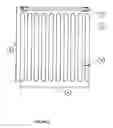
The lime and water mixture create a lime slurry. The lime slurry is then poured into specially designed conveyor pans (8 feet by 8 feet and 1 inch thick; FIG. 2, item-1). Chains will be placed (downwards direction about six inches on center) prior to pouring the lime slurry. Chains, in this case, act as an enforcement for the lime panels and it will be possible to use magnetic holders to move the panels from conveyor to the cable hangers (FIG. 2, item-2).
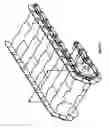
In FIG. 4: Illustrating a typical conveyer (eight feet three inches wide), option-1; where lime slurry pans can be put on top of the moving conveyer and remove. Option-2; where lime slurry pans are fixed and part of the conveyer.
After placing the lime slurry in conveyor pans, the slurry will harden within one hour. The hardened slurry panels then will be moved from the conveyor to cable hangers and hanged 12 feet on center. Moving cable hangers will provide fresh air contact with the hardened lime panels. This apparatus is illustrated in FIG. 2, Item-2 and FIG. 3; specifically, it is a steel structure with cover that will protect panels from the rain (FIG. 3). Optional enclosed environment with dust free and heated air (about 55 F) can be provided for this steel structure or cable hangers, which will prolong reusing the same lime. After when lime panels saturate with a carbon dioxide (CO2), the lime will turn back in to a limestone (about 24 hours exposure to the air).
At this stage, limestone panels will be crushed, and after grinding, filled into the electrically heated containers/ovens (12 inches diameter with 25 feet high stainless steel 40 schedule pipe; wrapped around with electrical heating coils and renewable electrical power source will be used in this case). Those ovens can be constructed per special orders, designed by an electric oven manufacturing companies. Containers will be equipped with the ability to provide powdered limestone to be dried first under 2000-300° C. heat and capture the water vapors. After all the air and water vapors are removed, the container will be covered and heating process will continue (about 500° C. to 600° C.). At this stage, limestone will start turning back to lime and carbon dioxide (CO2) as per formula in FIG. 4. After carbon dioxide (CO2) removal and storage the lime will be reused and process will be repeated continuously per FIG. 1.
5. SUMMARY OF THE INVENTION
This method does not need catalyst and does not create leftover byproducts.
In FIG. 2, item-4 and item-5 show about 1000′−0″×1000′−0″ or 25-acre lot can support 10 cable hanger loops (item-2) and each loop can support 1600 panels at 12 feet on center.
Assuming that one complete cycle can be accomplished in 24 hours (optimum duration of complete cycle will be determined later), which amounts to 6.4 million pounds of lime converted to limestone per day. For methanol production of 1.5 million gallon per day, about 5 million pounds of lime is needed to process each day.
LIST OF FIGURES AND BRIEF DESCRIPTION
FIG. 1: One-line diagram for production of carbon dioxide (CO2).
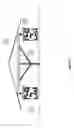
FIG. 2: Diagram detailing the conveyor for pans (dimensions: 8 feet by 8 feet and 1 inch thick) in which lime slurry will be poured and create lime panels. Then lime panels moved and hanged from cable hangers to encounter a moving fresh air.
-
- Item-1: Plan view of conveyor with 8 feet by 8 feet and 1 inch thick pans.
- Item-2: Depicts 10 cable hanger loops that lime panels will be hanged 12 feet on center
- Item-3: Details the overall distance (face to face) for each hanger loop (36 feet.)
- Item-4: Details the distance between the first and tenth loop (about 1000 feet).
- Item-5: Details the length of each hanger loop with conveyor loop (about 1000 feet).
FIG. 3: Diagram detailing the cable hanger apparatus structure/support, installed about 100 feet on center. It is a steel structure with cover that will protect panels from the rain.
-
- Item 1: Details the 8 feet by 8 feet and 1-inch thick lime panels, which hanged from moving cables
- Item 2: Depicts the structural support elements that support the moving cable hangers
- Item 3: Depicts the moving cable
- Item 4: Depicts the cover placed over the apparatus to protect the lime panels from rain or other falling hazards.
FIG. 4: Screenshot taken from www.scifun.org, detailing the specifics of the reaction from calcium carbonate to calcium oxide and carbon dioxide.
FIG. 5: Illustrating a typical conveyer (eight feet three inches wide), option-1 where lime slurry pans can be put on top of the moving conveyer and remove. Option-2 where lime slurry pans are fixed and part of the conveyer.
Claims
1. Mass production method of carbon dioxide (CO2) using reversed, limestone to lime chemical formula per FIG. 3 to remove carbon dioxide (CO2) from ambient air.
2. Lime slurry pans for a conveyor.
3. Use of chains, prior slurry placement in to the conveyor pans (chain will serve as a reinforcement for the lime panels and it will be possible to use magnetic holders to move hardened lime slurry/lime panels from conveyor to the cable hangers).
4. Method of moving cable hangers.
5. Method of limestone panels crushing, grounding, and placed in the electrically heated containers/ovens to accomplish limestone to lime chemical formula per FIG. 3. At this stage, limestone will start turning back to lime and CO2. Reusing lime continuously after CO2 removal and storage.
Images & Drawings included:


Sources:
- United States Patent and Trademark Office - verify current appl. status at the USPTO↗
Recent applications in this class:
- » 20250223176 2025-07-10
CARBON DIOXIDE SEQUESTRATION IN SALT MINIBASINS USING CARBONATED AQUEOUS FLUIDS - » 20250187927 2025-06-12
CARBON DIOXIDE RECOVERY SYSTEM - » 20250162879 2025-05-22
SELECTIVE ACETYLENE OXIDATION IN GAS MIXTURES - » 20250145472 2025-05-08
METHOD FOR GENERATING CARBON DIOXIDE - » 20250066207 2025-02-27
PRODUCING CARBON DIOXIDE WITH WASTE HEAT - » 20250066206 2025-02-27
METHOD OF SEPARATING MIXED MAGNESIUM AND LITHIUM SALTS - » 20250066205 2025-02-27
METHOD OF HYDROLYZING CALCIUM CHLORIDE BRINE - » 20250066204 2025-02-27
Reforming Process for Carbon Dioxide - » 20250033978 2025-01-30
VESSEL TO PROVIDE CARBON DIOXIDE FROM CALCIUM CARBONATE - » 20250002357 2025-01-02
TANDEM CIRCULATORY SYSTEM TO REDUCE THE RISK OF CARBON DIOXIDE LEAKAGE DURING CARBON DIOXIDE SEQUESTRATION IN SALINE DEEP-WATER AQUIFERS