Snow shaving auger
US20180305878A1
2018-10-25
15/947,828
2018-04-08
Abstract:
This invention is basically a snow blower auger the helical peripheries being bent at a constant angle in the direction of helical progression parallel with both their axis and outermost edges, of each auger helix, directing snow toward the ejection chute/impeller with nips of its periphery being removed to begin a new shave point thus shaving hard packed snow from the end of a driveway or such.
Inventors:
- Shawn Edward Nash 1 🇺🇸 Jackson, MI, United States
- Jonathan Edward Nash, JR. 1 🇺🇸 Jackson, MI, United States
Interested in similar patents?
Get notified when new applications in this technology area are published.
Classification:
E01H5/098 » CPC further
Removing snow or ice from roads or like surfaces; Grading or roughening snow or ice; Apparatus propelled by animal or engine power; Apparatus propelled by hand with driven dislodging or conveying elements, conveying pneumatically dislodging essentially by driven elements the elements being rotary or moving along a closed circular path, e.g. rotary cutter, digging wheels about horizontal or substantially horizontal axises perpendicular or substantially perpendicular to the direction of clearing
E01H5/045 » CPC further
Removing snow or ice from roads or like surfaces; Grading or roughening snow or ice; Apparatus propelled by animal or engine power; Apparatus propelled by hand with driven dislodging or conveying elements, conveying pneumatically Means for conveying or discharging the dislodged material, e.g. rotary impellers, discharge chutes
E01H5/12 » CPC main
Removing snow or ice from roads or like surfaces; Grading or roughening snow or ice Apparatus or implements specially adapted for breaking, disintegrating, or loosening layers of ice or hard snow with or without clearing or removing ; Roughening ice or hard snow by means of tools
E01H5/04 IPC
Removing snow or ice from roads or like surfaces; Grading or roughening snow or ice Apparatus propelled by animal or engine power; Apparatus propelled by hand with driven dislodging or conveying elements, conveying pneumatically
E01H5/09 IPC
Removing snow or ice from roads or like surfaces; Grading or roughening snow or ice; Apparatus propelled by animal or engine power; Apparatus propelled by hand with driven dislodging or conveying elements, conveying pneumatically dislodging essentially by driven elements the elements being rotary or moving along a closed circular path, e.g. rotary cutter, digging wheels
Description
CROSS REFERENCE TO RELATED APPLICATIONS (IF ANY)
Provisional application 62/488,936
Filing date: Apr. 24, 2017
STATEMENT OF FEDERALLY SPONSORED RESEARCH OR DEVELOPMENT
Not applicable.
THE NAMES OF THE PARTIES TO A JOINT RESEARCH AGREEMENT IF THE CLAIMED INVENTION WAS MADE AS A RESULT OF ACTIVITIES WITHIN THE SCOPE OF A JOINT RESEARCH AGREEMENT
Not applicable.
REFERENCE TO A “SEQUENCE LISTING, A TABLE, OR A COMPUTER PROGRAM LISTING COMPACT DISC APPENDIX
Not applicable.
STATEMENT REGARDING PRIOR DISCLOSURES BY AN INVENTOR OR JOINT INVENTOR
Not applicable.
BACKGROUND OF THE INVENTION
Field of Invention
Walk behind snow removal by way of blowing machines.
Patent classification definition: I believe E01H 1/042, E01H 1/056, E01H 5/045 and E01H 5/098.
Reference to Specific Documents
- www.amerisuninc.com snow throwers for sale section (jagged toothed snow gouging/clawing horizontal augers.) Possible assignee: PowerSmart inc.
Description of the Related Art
- Www.amerisuninc.com: the most recent art is of clawing or gouging augers. When those peripheral claws hit the cement curb or other very hard object those claws will probably get damaged and possibly startle the human operator. Over time the entire auger will need replacing which involves financial cost. It's true, www.amerisuninc.com's auger is more effective at removing hard packed snow but is too dangerous and costly to use. Older art just tried to shove snow from side to side.
BRIEF SUMMARY OF THE INVENTION
(According to MPEP 2163.07, author does not believe that author is adding “New Matter” that was not in the Provisional Application but rather elaborating, confirming, on what was already written in the Provisional Application and seen in the only drawing.
In regards to “an angle”, In other words, to rephrase, is to mean the periphery of each auger helix is bent to conform to the constraints of “any angle” which includes but is not limited to an acute angle, arc angle, obtuse angle, or a right angle. In author's opinion, pretty much any deviation from a flat or inclined plane might be considered an angle of some kind.
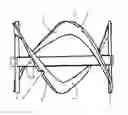
In regards to reference characters (2) and (5) of the only drawing, those parts of the drawing show a continuous bend running continuously parallel to the axis and outermost edges of each auger helix, which is what is intended to be patented. Author is not seeking a patent on clawing or gouging action by the auger helix (too dangerous and costly) but rather a smooth, safer shaving action put on hard packed snow at the end of a driveway or such.)
A horizontal snow auger with a plurality of helixes the peripheries of which are continuously bent parallel to their axis and outermost edges and at an angle in the direction of helical progression (as the unit is intended to rotate when put to service), with several nips being removed from its periphery facilitating the gentle and safe but effective shaving off and removing of hard packed snow instead of shoving hard packed snow from side to side (in old art) or clawing (in newer art), which is inefficient or Dangerous in the most recent art. The object of the invention is to more efficiently and safely remove hard packed snow from a path snowed on by bending/angling the periphery of each auger helix continuously parallel with its axis and outermost edges and in the direction of helical progression with nips from periphery being removed to begin a new shave point thus shaving hard packed snow gently and safely. The angle of bend is important. Too small of bend off helical plane (1 degree) may overtax the engine and blow the head gasket and/or break the shear bolt. Too great of bend off helical plane (91 degrees) may be less taxing on the engine and shear bolt but not get as much work done as could be done at another angle. The angle of bend in the direction of helical progression depends on the capabilities of the engine and shear bolts used in each subject snow blower machine. Author suggests peripheries of auger helixes can be bent anywhere between, but not including, 0 to 91 degrees creating physical angles between each helix and periphery of between, but not including, 180 degrees to 89 degrees.
BRIEF DESCRIPTION OF THE VIEW OF THE DRAWING
The only drawing depicts a perspective view of the general idea of the snow shaving auger with its helical periphery bent in the direction of helical progression to facilitate the shaving of snow and nips being removed from its periphery at several locations along the outer periphery of each auger helix to begin a new shaving point in hard packed snow. The continuous peripheral bend of each auger helix runs continuously parallel with the axis and outermost edges of each auger helix (as seen by drawing reference characters 2 and 5.)
DETAILED DESCRIPTION OF THE INVENTION
The accompanying description and drawing should in no way be considered the only formation of the snow blower auger possible but the inventor's primary example. All parts of the invention are of strong and durable material made for all weather use without breaking.
The elements of the invention in the drawing depict the main auger double helix (1 and 4), the periphery of the helixes being continuously bent parallel with their axis and outermost edges and at an angle in the direction of helical progression (2 and 5), nips being removed from the helical periphery to facilitate beginning a new slice into hard packed snow (3 and 6), flanked by and affixed to two reinforced flat bars (7 and 8) at each end of the double helix which are skewered through the center and affixed to by an auger axle pipe (9) through which an open ended hole (10) is put to facilitate placing a shear bolt through said auger axle pipe (9).
The auger axle pipe (9) should be long enough to just fit with room to spare between one side of a snow blower's auger transmission and inside of snow scoop. The internal diameter of auger axle pipe (9) should allow for the sliding over of the auger driveshaft with the reinforced flat bars (7 and 8) and entire auger double helix (1 and 4+2 and 5) diameter being just so the entire unit revolves freely within the snow scoop without touching the ground or the snow scoop.
Each auger manufactured can rotate horizontally clockwise or counterclockwise as long as (2 and 5) push, once shaved, snow in the direction of the snow blower's ejection chute/impeller. Each manufactured unit's auger axle pipe (9) is put in place over the auger driveshaft and the auger driveshaft assembly is replaced and secured within the snow scoop.
The machine that the manufactured augers are put in service in is called a “Snow blower”.
General assembly and use of Snow blower is as follows from rear to front:
Two long handle bars extending furthest rearward affixed to a motor mounted, traction wheeled chassis affixed to and driving the snow ejection impeller (with ejection chute) affixed to a snow scoop within which is driven an auger driveshaft transmission which Drives the horizontal augers by way of shear bolts. Usually a person walks behind the entire assembly directing its speed and movement clearing snow from intended path.
Claims
I claim:1. A snow blower auger comprising:
a main auger double helix (1 and 4), nips being removed from the helical periphery to facilitate beginning a new slice into hard packed snow (3 and 6), flanked by and affixed to two reinforced flat bars (7 and 8) at each end of the double helix which are skewered through the center and affixed to by an auger axle pipe (9) through which an open ended hole (10) is put to facilitate placing a shear bolt through said auger axle pipe (9), wherein the improvement is that the peripheries of the helixes are being continuously bent parallel with both their axis and outermost edges at a constant angle in the direction of helical progression (2 and 5).
Images & Drawings included:

Sources:
- United States Patent and Trademark Office - verify current appl. status at the USPTO↗
Recent applications in this class:
- » 20240026621 2024-01-25
ELECTRIC DEFROSTER - » 20230220641 2023-07-13
SNOWBANK DECONSTRUCTING SYSTEM - » 20230052967 2023-02-16
Snow Shovel Deicer Device - » 20210332544 2021-10-28
Ice-clearing shovel - » 20210254294 2021-08-19
Snowbank deconstructing system - » 20180080187 2018-03-22
Adjustment mechanism for deicing unit, deicing unit, deicing vehicle and deicing method - » 20160153159 2016-06-02
Device and process of snow removal - » 20150354159 2015-12-10
Ice chopper assembly - » 20150308063 2015-10-29
ICE PULVERIZING KNIFE AND ICE PULVERIZING DEVICE COMPRISING AN ICE PULVERIZING KNIFE - » 20150308062 2015-10-29
ICE-PULVERIZING KNIFE AND ICE-PULVERIZING DEVICE COMPRISING AN ICE-PULVERIZING KNIFE