Electronic call decoy technology
US20180325099A1
2018-11-15
15/980,369
2018-05-15
✅ Patent granted
US 11,076,591 B2
2021-08-03
-
-
Darren W Ark | William L Gmoser
Skinner and Associates | Joel D. Skinner, Jr.
2038-07-06
Abstract:
An electronic caller decoy that is used in hunting animals. The caller is particularly useful for attracting predator species such as coyotes, wolves, and the like. The decoy encourages predators to come towards the decoy within the range of a concealed hunter or hunters. The decoy simulates the sound and movement of wounded prey species such as rabbits, deer, and the like, to bring the predator within range. The decoy has a base including three or more legs, a body which is preferably rotatable on the base via a motor, an electronic sound generator and speaker, a microphone, a camera and a tail element. The motorized rotatable base is preferably remote controllable to orient sound broadcast in a specific direction, or plural directions.
Applicant:
Interested in similar patents?
Get notified when new applications in this technology area are published.
Classification:
A01M31/004 » CPC main
Hunting appliances Game callers
A01M31/002 » CPC further
Hunting appliances Detecting animals in a given area
H04N5/23299 » CPC further
Details of television systems; Studio circuitry; Studio devices; Studio equipment ; Cameras comprising an electronic image sensor, e.g. digital cameras, video cameras, TV cameras, video cameras, camcorders, webcams, camera modules for embedding in other devices, e.g. mobile phones, computers or vehicles; Television cameras ; Cameras comprising an electronic image sensor, e.g. digital cameras, video cameras, camcorders, webcams, camera modules specially adapted for being embedded in other devices, e.g. mobile phones, computers or vehicles; Devices for controlling television cameras, e.g. remote control ; Control of cameras comprising an electronic image sensor Controlling the position of the camera for changing the field of view, e.g. panning, tilting or tracking of objects
H04R1/345 » CPC further
Details of transducers, loudspeakers or microphones; Arrangements for obtaining desired frequency or directional characteristics for obtaining desired directional characteristic only by using a single transducer with sound reflecting, diffracting, directing or guiding means for loudspeakers
A01M31/00 IPC
Hunting appliances
H04N5/232 IPC
Details of television systems; Studio circuitry; Studio devices; Studio equipment ; Cameras comprising an electronic image sensor, e.g. digital cameras, video cameras, TV cameras, video cameras, camcorders, webcams, camera modules for embedding in other devices, e.g. mobile phones, computers or vehicles; Television cameras ; Cameras comprising an electronic image sensor, e.g. digital cameras, video cameras, camcorders, webcams, camera modules specially adapted for being embedded in other devices, e.g. mobile phones, computers or vehicles Devices for controlling television cameras, e.g. remote control ; Control of cameras comprising an electronic image sensor
H04R1/34 IPC
Details of transducers, loudspeakers or microphones; Arrangements for obtaining desired frequency or directional characteristics for obtaining desired directional characteristic only by using a single transducer with sound reflecting, diffracting, directing or guiding means
H02K7/14 » CPC further
Arrangements for handling mechanical energy structurally associated with dynamo-electric machines, e.g. structural association with mechanical driving motors or auxiliary dynamo-electric machines Structural association with mechanical loads, e.g. with hand-held machine tools or fans
H04R2201/025 » CPC further
Details of transducers, loudspeakers or microphones covered by but not provided for in any of its subgroups; Details casings, cabinets or mounting therein for transducers covered by but not provided for in any of its subgroups Transducer mountings or cabinet supports enabling variable orientation of transducer of cabinet
H04R1/30 » CPC further
Details of transducers, loudspeakers or microphones; Arrangements for obtaining desired frequency or directional characteristics for obtaining desired frequency characteristic only Combinations of transducers with horns, e.g. with mechanical matching means, i.e. front-loaded horns
A01M31/06 » CPC further
Hunting appliances Decoys
Description
CROSS-REFERENCE TO RELATED APPLICATIONS, IF ANY
This application claims the benefit under 35 U.S.C. § 119(e) of co-pending U.S. Provisional Patent Application Ser. No. 62/506,227, filed May 15, 2017, which is/are hereby incorporated by reference.
37 C.F.R. § 1.71(e) AUTHORIZATION
A portion of the disclosure of this patent document contains material which is subject to copyright protection. The copyright owner has no objection to the facsimile reproduction by anyone of the patent document or the patent disclosure, as it appears in the US Patent and Trademark Office patent file or records, but otherwise reserves all copyright rights whatsoever.
STATEMENT REGARDING FEDERALLY SPONSORED RESEARCH OR DEVELOPMENT
Not applicable.
REFERENCE TO A MICROFICHE APPENDIX, IF ANY
Not applicable.
BACKGROUND OF THE INVENTION
1. Field of the Invention
The present invention relates, generally, to decoy systems, apparatus and methods. Particularly, the invention relates to a decoy used in hunting, animal control, ranching or the like. Most particularly, the invention relates to a remote controllable electronic call type decoy for predators.
2. Background Information
Existing technology in this field is believed to have significant limitations and shortcomings. For this and other reasons, a need exists for the present invention.
All US patents and patent applications, and all other published documents mentioned anywhere in this application are incorporated by reference in their entirely.
BRIEF SUMMARY OF THE INVENTION
The invention provides a decoy apparatus, method of manufacture, and method of use which are practical, reliable, safe and efficient, and which are believed to fulfill the need and to constitute an improvement over the background technology.
In one aspect, the invention provides a predator decoy or caller that is used in hunting animals, particularly predator species such as coyotes, wolves, and the like. The decoy encourages predators to come towards the decoy within the range of a concealed hunter or hunters. The decoy simulates the sound and movement of wounded prey species such as rabbits, deer, and the like, to bring the predator within range. The decoy has a base including three or more legs, a body which is preferably rotatable on the base via a motor, an electric sound generator and speaker, a microphone, a camera and a tail element.
In another aspect, the invention provides an electronic caller decoy, comprising: a body including a housing, an electronic controller disposed within the housing, a power supply disposed within the housing and connected to the control circuit, and a motor disposed within the housing and connected to the power supply and to the electronic controller; a speaker connected to the body and to the electronic controller; and a base connected to the housing and to the motor; the base being for placement on an environmental surface for supporting the housing; the electronic controller generating sounds and sending them to the speaker for broadcast; and the electronic controller also instructing the motor to activate and turn the housing and speaker to broadcast the generated sounds in plural directions.
The aspects, features, advantages, benefits and objects of the invention will become clear to those skilled in the art by reference to the following description, claims and drawings.
BRIEF DESCRIPTION Of THE SEVERAL VIEWS OF THE DRAWING
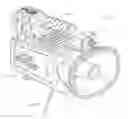
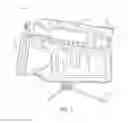
FIG. 1 is a perspective view of an embodiment of a predator decoy or electronic caller of the invention.
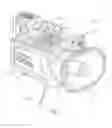
FIG. 2 is a front view thereof.
FIG. 3 is a back view thereof.
FIG. 4 is a side view thereof.
FIG. 5 is an opposite side view thereof.
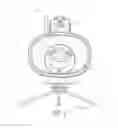
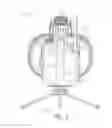
FIG. 6 is a top view thereof.
FIG. 7 is a bottom view thereof.
FIG. 8 is a perspective view of an alternative embodiment of the predator decoy of the invention.
FIG. 9 is an exploded view of an embodiment of the decoy of the invention.
FIG. 10 shows an embodiment of the decoy system of the invention including a decoy unit and a remote controller.
FIG. 11 shows a further embodiment of the caller.
FIG. 12 shows a further embodiment of the remote controller.
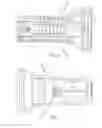
FIG. 13 shows a detailed view of the SD card slot and ports of the caller.
DETAILED DESCRIPTION
FIGS. 1-7 and 9, show an embodiment of the electronic caller or decoy 10 for predator of the present invention. The predator decoy 10 is useable in hunting animals, particularly predator species such as coyotes, wolves, and the like. The decoy 10 encourages predators to come towards the decoy within the range of a concealed hunter or hunters. The decoy 10 simulates the sound and movement of wounded prey species such as rabbits, deer, and the like, to bring the predator within range.
The decoy 10 includes a main body 12 with a speaker 14 disposed at one end. The body 12 is preferably generally rectangular, with radiused edges. The body 12 may comprise two (2) halves 12A and 12B. The main body 12 is supported by a base 16 on its bottom. The base 16 is preferably a tripod type arrangement. A camera 18 is preferably disposed on the top of the body 12, towards the speaker 14 end. The speaker 14 is preferably a horn-type speaker. It may also include a separate tweeter type speaker. The camera 18 preferably has still and video capability. A handle 20 is also disposed on the top of the body 12. A microphone 22 may be integrated with the camera 18. An electronic control panel 24 is disposed on one side of the body 12. An antenna 26, disposed on the top of the body 12 at a corner where the side featuring the control panel meets the back of the body 12. The antenna 26 is communicatively connected to electronic control circuitry contained in the housing 12 for remote control purposes. The control circuitry is also connected to the control panel 24.
FIG. 9 is an exploded view of a the decoy 10. The body 12 preferably is constructed of two halves 12A and 12B. Motor 30 is connected to the body 12 and the base 16. The motor is powered by a power source 32, preferably a battery. The electronic circuitry is shown to include a pair of PCB cards 34 and 36. The circuit 34/35 has sound control, motor control, camera/video control, and remote control transmission capabilities. A preferred remote control transmission is via RF.
In use, the motor connected to the body 12 which rotates the body 12 on the base 16. The motorized base system is preferably remote controlled. This system allows the hunter to rotate the unit left or right to broadcast the sound up to 360 degrees. Sound is directional so the direction the speaker is pointed is the direction the sound will travel—being able to rotate the speaker remotely allows the decoy 10 to have a greater efficacy because the decoy will be able to project the sound in all horizontal directions, potentially luring more game. The other benefit of rotating the unit is the sound is moving which will seem more natural to animals. Many times animals are making noise while traveling so moving the sound will sound like an animal moving around. The call permits the use of one speaker to broadcast sound 360 degrees, obviating the need tor plural speakers.
Although the decoy 10 is described above as having a single speaker, it is within the purview of the invention that it can have one or more additional speakers.
Although the decoy 10 is described above as having a camera, it is within the purview of the invention that it may not have a camera.
The decoy or electronic hunting call is particularly useful for predator hunting. However, it can also be used tor snow geese hunting. Snow geese are the only waterfowl with which electronic calls can be used presently. The call encourages animals to come towards the sound of the call.
FIG. 8 shows an alternative embodiment of the decoy 100 including a moving animal part element 102. Decoy 100 is constructed substantially similar to decoy 10 in FIGS. 1-7 and 9.
FIG. 10 shows another embodiment of a decoy system 200 of the invention comprising an electronic call 210 and a remote control unit 220. Decoy 200 also has substantially all of the elements of decoy 10 of FIGS. 1-7 and 9, except that is further has the remote controller 220.
FIGS. 11-13 show a still further embodiment of the decoy caller 300 of the invention. It also has substantially all of the features of decoy 10. The features of the caller 300 and remote controller are shown and described.
Referring to all of the decoy embodiments 10, 100, 200 and 300. The function of the system is described below.
Battery Installation: The decoy 10 uses ten AA batteries (not included). A battery holder is located on the bottom of the body 12. Remove the battery cover, disconnect the battery holder if necessary, and install the batteries. The remote control uses three AA batteries. Remove the battery cover on the back of the remote control 220 and install the batteries.
Antenna: The antenna 26 will either be in the box or stored in the handle of the call. Locate the antenna port on the back right corner of the body 12 and screw the antenna onto the caller.
Decoy: The moving animal part decoy 102 will either be in the box or stored in the handle of the call. Insert the decoy into the hole on the top of the handle. Make sure to align the groove on the decoy with the slot on the decoy joint located in the handle. A strong magnet holds the decoy in place.
Tripod Base: The tripod base 16 is installed on the bottom of the body 12. The tripod base allows the decoy 10 to rotate to broadcast sound and position the video camera 18. Make sure to align the groove on the bottom of the body 12 with the slot on the tripod stand 16. A strong magnet holds the tripod 16 to the body 12. The tripod base 16 can be disassembled to adapt to most standard camera tripods or any other base system that utilizes a ¼ 20 thread. This may be helpful if the user wishes to elevate the call depending an the hunting terrain.
Electronic Call Operation: Flip the power switch on the electronic call forward to the “on” position. A red LED light on the side of the call will illuminate when the power is on. Hold down the power button on the remote control. The remote will turn on. The remote screen will display “Finding Caller” “Waiting” while it searches for the caller. Once connected the main home screen for the caller screen will be displayed. On the bottom of the home screen it should say SD Link OK confirming the remote and caller are connected and in sync.
Remote Control Operation:
Sound Selection—Use the up/down arrows to highlight the folder you want to select. Press the play/pause button to select the folder. Use the up/down arrows to highlight the sound you want to play. Press the play/pause button to play the sound. Holding the up/down arrows down for 1 second will cycle through the folders/sounds faster.
Volume Selection—Use the vol− and vol+ buttons to lower or increase the volume level. The volume level ranges from 1 to 32. Holding the vol− or vol+ buttons for 1 second will raise or lower the volume level quickly.
Back Button—The back button is used to go from the sound list back to the folder list.
Recall Button—The recall button will play the previous sound.
Display Screen—The remote display screen includes information on the top 2 lines as well as the bottom line.
-
- Top Line (Left to Right):
- Stand timer which starts from zero when the remote is turned on
- Volume level from 1-32
- Remote control battery level indicator
- Second Line (Left to Right): Each icon will be highlighted when in use:
- AUX indicates if the auxiliary function is turned on
- REC indicates if the Video Camera is recording
- Camera indicates if a picture is being taken
- SD indicates if the SD card is installed and synced to the remote
- Signal indicates the strength of the signal between the remote and caller
- Speaker indicates if a sound is being played
- Bottom Line: States the previous function (i.e. video recording, photo, play/pause, etc.)
- Top Line (Left to Right):
Remote Control Distance: The decoy 10 utilizes industry leading remote technology which does not require a line of site between the remote and the caller up to at least 100 yards. Depending on conditions, remote distance may be significantly greater than 100 yards.
Decoy Operation:
“D” Button—Press the “D” button to turn the decoy on. The decoy will spin back and forth.
“S” Button—Press the button to control the speed of the decoy. There are 3 speed settings.
Scan Operation:
Top/Bottom Scan Buttons—Press either button to rotate the call left or right. Press the button again to stop the call.
Middle Scan Button—Press this button to cover 180 degrees. The call will rotate 90 degrees to the left, 180 degrees to the right, and back 90 degrees to the left, which will be the approximate starting position. If the user needs to stop the call while rotating, simply press the scan button again.
The scan buttons are preferably used to broadcast sound to a large area. The powerful 30 watt/30 amp speaker system is designed to extend sound long distances in one direction. Using the scan function will broadcast sound to a large area calling in predators from a greater distance than most calls.
Favorite Buttons: F1-F4 are designed to store four favorite sounds for quick access when hunting. Press the F1 through F4 button once to play the programmed sound at the predefined volume level.
Program F1 through F4—Simply highlight the sound the user wants to program as a favorite and adjust the volume to your preferred level. Hold down the corresponding F1 through F4 button. The highlighted sound will flash on the display screen confirming the programming is complete.
Gain Control: Unique to the device is a three stage gain control function. The gain on this caller has 3 settings (1-3). One being the lowest and 3 being the highest (loudest). Whenever the caller is turned on it is set to gain level of “2”. By adjusting the gain, the user is able to control the power running through the amp. One will notice a difference in the volume of the call between level 1 and level 3. Certain sound frequencies sound much better at a high gain where others sound better at a low gain. The user may add their own sounds to this caller, adjusting the gain may be useful depending on the sound being played since each sound recording is different. Adjusting the gain may also be useful depending on the hunting situation. For example, turning the gain to level 3 in strong wind conditions may be beneficial even if the sound quality is reduced (i.e. distortion).
Adjust Gain—Press the F5 key to cycle through the gain levels. The gain level will display on the display screen.
Auxiliary Function: The decoy 10 is designed with an auxiliary function which allows a separate decoy to be controlled remotely by connecting a compatible decoy (not included) to the back of the caller using a 3.5 mm cord (not included). Simply plug one end of the 3.5 mm cord into a compatible decoy and the other end into the auxiliary port on the back of the caller. Turn on the compatible decoy and the caller/remote. The auxiliary button “AUX” on the remote will now turn the compatible decoy on and off. The AUX icon on the top of the display screen will be highlighted when the auxiliary function is used.
HD Camera Operation: The decoy 10 is equipped with a wide angle high resolution video camera. The video camera also can take pictures. This video camera is a great feature allowing the user to capture video of his or her hunt. One can also use video or photos to remind the user of each stand, location, conditions, etc. where they were hunting. Before hunting, the user should ensure the SD card is installed in the camera slot.
Camera Button—Press the camera button to take a picture. The camera icon on the top of the display screen, will highlight and “Photo” will be stated on the bottom of the display screen.
Video Button—Press the RBC button to start video recording. Press the REC button again to stop recording. The REC icon on the top of the display screen will highlight and “Record Video On” will be stated on the bottom of the display screen. Press the REC button again to stop recording. The highlighting on the REC icon will disappear and “Record Video Off” will be stated on the bottom of the display screen. Sound is always recorded with the video. Use the scan buttons to rotate the caller and point the camera in the direction you want to capture.
To view photo and video on your computer, simply eject the SD card from the camera slot and insert into your computers SD card slot. Each individual video and image will be a separate file. Ensure your computer is utilizing windows media player to play the video.
Sound Management: The decoy 10 comes preloaded with 100 live animal sounds organized in 17 folders for quick access. The sounds are preferably professionally recorded. The 100 preloaded sounds have the extension .LD.
Add/Remove Sounds: The decoy 10 features an industry leading wireless 2 way communication system between the remote and caller. This makes syncing the caller to the remote extremely easy and quick.
-
- 1. Press the SD sound card in to eject the sound card and remove the SD sound card from the back of the caller
- 2. Add or remove the folders and sounds on the SD sound card using your computer. View the files just like you would view files on a standard camera SD card.
- 3. Reinstall the SD sound card into the caller (top side or label side of the SD card should face the left side of the caller when reinstalling)
- 4. Turn on the caller and remote and let them sync with each. Most syncs will lake 5-30 seconds. As stated in the “Electronic Call Operation” section, the remote screen, will display “Finding Caller” “Waiting” while it searches for the caller. Once connected the remove screen will display “Updating” and “Communication OK”. The main home screen for the caller screen will then display.
The maximum number of sounds are 2,000 and the maximum number of folders are 32. There can only be one level of folders. You cannot create a folder within a folder. The file names can be as long as you would like but the display screen will only show the first 20 characters.
The caller will play .LD, .mp3, .wav and .wma files. Errors between the remote and caller may occur when using .wav and .wma files due to their potential file size. Use of .LD and .mp3 files is recommend. If you do use .wav and/or .wma files and experience issues, simply remove the files from the SD card and resync the remote and caller.
Charging Port: The decoy 10 is equipped with a charging port.
Caller Buttons on Main Unit: The decoy 10 includes play/pause, volume and favorite buttons on the caller in case the remote is lost or the user wants to use the caller without the remote.
The embodiments above are chosen, described and illustrated so that persons skilled, in the art will be able to understand the invention and the manner and process of making and using it. The descriptions and the accompanying drawings should be interpreted in the illustrative and not the exhaustive or limited sense. The invention is not intended to be limited to the exact forms disclosed. While the application attempts to disclose all of the embodiments of the invention that are reasonably foreseeable, there may be unforeseeable insubstantial modifications that remain as equivalents. It should be understood by persons skilled in the art that there may be other embodiments than those disclosed which fall within the scope of the invention as defined by the claims. Where a claim, if any, is expressed as a means or step for performing a specified, function it is intended that such claim be construed to covet the corresponding structure, material, or acts described in the specification and equivalents thereof, including both structural equivalents and equivalent structures, material-based equivalents and equivalent materials, and act-based equivalents and equivalent acts.
Claims
What is claimed is:1. A decoy, comprising: a body including a housing, an electronic controller disposed within the housing, a power supply disposed within the housing and connected to the control circuit, and a motor connected to the power supply and to the electronic controller; a speaker connected to the body and to the electronic controller; and a base connected to the housing and to the motor; the base being for placement on an environmental surface for supporting the housing; the electronic controller generating sounds and sending them to the speaker for broadcast; and the electronic controller also instructing the motor to activate and turn the housing and speaker to broadcast the generated sounds in plural directions.
2. The decoy of claim 1, wherein the decoy is adapted to attract predator species such as coyotes, wolves, and the like.
3. The decoy of claim 1, wherein the body includes two body parts connected together and defining an internal cavity housing the electronic controller, the power supply and the motor.
4. The decoy of claim 1, wherein the housing has a handle disposed on a top surface adapted to permit, a user to carry the decoy.
5. The decoy of claim 1, wherein the electronic controller generates sound signals transmitted to the speaker and motion signals transmitted to the motor.
6. The decoy of claim 1, wherein the power supply comprises at least one battery.
7. The decoy of claim 1, wherein the speaker is a horn type speaker disposed on an end of the housing whereby the speaker broadcasts sound in one direction parallel to the ground.
8. The decoy of claim 1, wherein the base is disposed on a bottom surface of the housing and whereby the housing rotates around the base.
9. The decoy of claim 1, wherein the base is a tripod.
10. The decoy of claim 1, further comprising a remote controller, and wherein the electronic controller further includes a receiver for receiving control signals from the remote controller including sound control and motion control.
11. The decoy of claim 10, wherein the remote controller transmits and the electronic controller receives RF signals.
12. The decoy of claim 11, further comprising an antenna disposed on the housing and communicatively connected to the electronic controller, the antenna receiving RF signals from the remote controller.
13. The decoy of claim 1, further comprising a camera disposed on the housing oriented towards the speaker, and communicatively connected to the electronic controller, the video camera adapted to record at least one picture of an animal species being attracted to and approaching the decoy.
14. The decoy of claim 13, further comprising a microphone disposed on the housing-oriented towards the camera and the speaker, and communicatively connected to the electronic controller, the microphone adapted to record audio of an animal species being attracted to and approaching the decoy.
15. The decoy of claim 14, further comprising a handle connected to a top surface of the housing.
16. The decoy of claim 1, further comprising a motion decoy element disposed on the housing, the motion decoy element being communicatively connected to the motor, and wherein the electronic controller activates and terminates movement of the motion decoy element by the motor.
17. The decoy of claim 16, wherein the motion decoy element includes a shall extending upwardly from the housing and a fur element attached to an upward end of the shaft.
18. The decoy of claim 1, further comprising an electronic control panel disposed on the housing and communicatively connected to the electronic controller.
19. An electronic caller predator decoy, comprising:
a. a body including a housing, an electronic controller disposed within the housing, a battery power supply disposed within the housing and connected to the control circuit, and a motor disposed within the housing and connected to the power supply and to the electronic controller;
b. a speaker connected, to the body and to the electronic controller; and
c. a tripod base connected to the housing and to the motor;
d. a remote controller adapted to transmit motion and sound control signals to the electronic controller;
e. the tripod base being for placement on an environmental surface for supporting the housing;
f. the electronic controller generating sounds and sending them to the speaker for broadcast; and
g. the electronic controller also instructing the motor to activate and turn the housing and speaker to broadcast the generated sounds in plural
directions or a specific direction.
20. A rotatable electronic caller predator decoy, comprising:
a. a body including:
i. a housing,
ii. an electronic controller disposed within the housing,
iii. a power supply disposed within the housing and connected to the control circuit, and
iv. a motor disposed within the housing and connected to the power supply and to the electronic controller;
b. a horn type speaker connected to the body and to the electronic controller;
c. a tripod base connected to the housing and to the motor;
d. a remote controller adapted to transmit rotational motion and sound control signals to the electronic controller;
e. a camera disposed on the housing oriented towards the speaker, and communicatively connected to the electronic controller, the video camera adapted to record at least one picture of an animal species being attracted to and approaching the decoy;
f. a motion decoy element disposed on the housing, the motion decoy element being communicatively connected to the motor, and wherein the electronic controller activates and terminates movement of the motion decoy element by the motor;
g. the tripod base being for placement on an environmental surface for supporting the housing;
h. whereby the electronic controller generates sounds and sends them to the speaker for broadcast; and
i. whereby the electronic controller also instructs the motor to activate and rotationally turn the housing and speaker to broadcast the generated sounds in plural directions or a specific direction.
Images & Drawings included:




Sources:
- United States Patent and Trademark Office - verify current appl. status at the USPTO↗
Similar patent applications:
- » 20220071195
ELECTRONIC CALL DECOY TECHNOLOGY
Recent applications in this class:
- » 20250261630 2025-08-21
Multiple Game Calling Device - » 20250212870 2025-07-03
RAKING STICK GAME CALLING DEVICE - » 20250194582 2025-06-19
GAME CALL BARREL - » 20250064048 2025-02-27
GAME CALL APPARATUS FOR ATTRACTING ANIMALS TO AN AREA - » 20250008943 2025-01-09
COLLAPSIBLE BUGLE TUBE FOR GAME CALL - » 20240373837 2024-11-14
METHOD OF ATTRACTING WATERFOWL VIA WATER SOUNDS - » 20240341297 2024-10-17
SOUND SELECTABLE GAME CALLS - » 20240224988 2024-07-11
RETENTION SYSTEM FOR A SLATE CALL AND A STRIKER - » 20240081316 2024-03-14
External reed call - » 20240065260 2024-02-29
WILD GAME CALLING DEVICE