Foam exercising roller
US20180326254A1
2018-11-15
15/595,084
2017-05-15
✅ Patent granted
US 10,888,733 B2
2021-01-12
-
-
Garrett K Atkinson
Hanes & Bartels LLC
2037-12-08
Abstract:
An exercise foam roller having a plurality of elongated tube sectors where each sector has first and second longitudinal edges with at least a portion of the outer surface covered with foam and hinges interconnecting the tube sectors along their first longitudinal edges and fasteners detachably interconnecting the tube sectors along their second longitudinal edges.
Inventors:
- DeLovell Earls 1 🇺🇸 Hermosa Beach, CA, United States
- Andrew Smith 1 🇺🇸 Colorado Springs, CO, United States
- Charles Lewis 1 🇺🇸 Cambridge, MA, United States
Applicant:
Interested in similar patents?
Get notified when new applications in this technology area are published.
Classification:
A63B21/4039 » CPC main
Exercising apparatus for developing or strengthening the muscles or joints of the body by working against a counterforce, with or without measuring devices; Interfaces with the user related to strength training; Details thereof; Specific exercise interfaces contoured to fit to specific body parts, e.g. back, knee or neck support
A63B26/003 » CPC further
Exercising apparatus not covered by groups - for improving balance or equilibrium
A61H2015/0014 » CPC further
Massage by means of rollers, balls, e.g. inflatable, chains, or roller chains with balls or rollers rotating about their own axis cylinder-like, i.e. rollers
A63B21/00 IPC
Exercising apparatus for developing or strengthening the muscles or joints of the body by working against a counterforce, with or without measuring devices
A63B26/00 IPC
Exercising apparatus not covered by groups -
A63B22/16 » CPC further
Exercising apparatus specially adapted for conditioning the cardio-vascular system, for training agility or co-ordination of movements Platforms for rocking motion about a horizontal axis, e.g. axis through the middle of the platform ; Balancing drums; Balancing boards or the like
A61H2201/0161 » CPC further
Characteristics of apparatus not provided for in the preceding codes; Constructive details Size reducing arrangements when not in use, for stowing or transport
A61H2201/1261 » CPC further
Characteristics of apparatus not provided for in the preceding codes; Driving means driven by a human being, e.g. hand driven combined with active exercising of the patient
A61H2201/168 » CPC further
Characteristics of apparatus not provided for in the preceding codes; Physical interface with patient; Movement of interface, i.e. force application means not moving
A61H2201/169 » CPC further
Characteristics of apparatus not provided for in the preceding codes; Physical interface with patient; Surface of interface Physical characteristics of the surface, e.g. material, relief, texture or indicia
A61H2201/1623 » CPC further
Characteristics of apparatus not provided for in the preceding codes; Physical interface with patient kind of interface, e.g. head rest, knee support or lumbar support Back
A61H2201/1695 » CPC further
Characteristics of apparatus not provided for in the preceding codes; Physical interface with patient; Surface of interface; Physical characteristics of the surface, e.g. material, relief, texture or indicia Enhanced pressure effect, e.g. substantially sharp projections, needles or pyramids
A61H2203/0443 » CPC further
Additional characteristics concerning the patient; Position of the patient substantially horizontal
A61H2205/062 » CPC further
Devices for specific parts of the body; Arms Shoulders
A61H2205/081 » CPC further
Devices for specific parts of the body; Trunk Back
A63B23/00 IPC
Exercising apparatus specially adapted for particular parts of the body
A61H15/00 » CPC further
Massage by means of rollers, balls, e.g. inflatable, chains, or roller chains
A61H1/0292 » CPC further
Apparatus for passive exercising ; Vibrating apparatus ; Chiropractic devices, e.g. body impacting devices, external devices for briefly extending or aligning unbroken bones; Stretching or bending or torsioning apparatus for exercising for the spinal column
A61H2201/0157 » CPC further
Characteristics of apparatus not provided for in the preceding codes; Constructive details portable
A61H2205/086 » CPC further
Devices for specific parts of the body; Trunk Buttocks
A63B2023/006 » CPC further
Exercising apparatus specially adapted for particular parts of the body for stretching exercises
A61H1/02 IPC
Apparatus for passive exercising ; Vibrating apparatus ; Chiropractic devices, e.g. body impacting devices, external devices for briefly extending or aligning unbroken bones Stretching or bending or torsioning apparatus for exercising
Description
The present invention relates generally to a personal exercise and myofascial release device in the form of a foam covered roller.
BACKGROUND
Foam rollers have been growing in popularity in recent years. Using a foam roller is the best way to perform self-massage and myofascial release. Used before exercise foam rolling can increase blood flow and prepare the muscles for exercise. A foam roller can also help loosen tight muscles, reduce muscle adhesions and scar tissue formation and increase body flexibility.
The simplest form of such a roller is a round tube of foam that looks like a rolling pin. More advanced designs include, on the surface of the foam, flexible bumps for muscle penetration and treatment of trigger points along with variations of the density of the foam. From solid core rollers, the prior art includes hollow core tubes whose outside surface is covered with smooth or textured grid patterns. The interior of the hollow tube version has seen use as storage space with end caps on the tube to retain the stored contents.
The primary object of the present invention is to provide a foam roller construction that will provide easy access to the interior of the roller for storage of such items as exercise floor mats but will, at the same time allow the roller to be unfolded into two adjacent tube halves whose outside foam covered grid surfaces provide stationary support for a different kind of muscle therapy than that administered by a roller.
A second object of the invention is to provide a foam roller whose entire interior can be viewed and easily accessed for storage purposes by utilizing hinged tube halves to create the roller where the tube halves pivot around hinges to open the roller in the manner of a suitcase for ease of storage and retrieval.
Other further objects, features and advantages of the present invention will become apparent from the following description of the invention taken in conjunction with the accompanying drawings.
SUMMARY OF THE INVENTION
The roller of the present invention comprises two identical cylindrical tube halves that are interconnected with hinges along a first one of their longitudinal edges. A fastening mechanism is provided to selectively lock the second longitudinal edges together, thus forming a cylinder. The outside surface of the cylinder is covered with a foam material such as ethylene-vinyl acetate which may be smooth or grooved or textured with grid forming dimples, flexible bumps or tread on all or a portion of the outside surface of the roller. The interior of the formed cylinder may be used for storage of such items as an exercise floor mat and additional storage spaces in the form of compartments are also provided. An alternative embodiment of the roller may be shorter in length than a rolled exercise matt with the matt being retained between the closed roller halves. With these novel features the foam covered cylinder may be used as an exercise roller for performing self-massage and myofascial and trigger point release. Exercises can be performed with the cylinder opened with the longitudinal edges of the tube halves in contact with the floor. In that configuration the foam covered tube halves become stationary and useful as fixed pressure points for areas of the body such as the gluteus maximus or for core exercises such as sit-ups, using the stationary tube halves as a fulcrum. Following the roller exercise regimen, the roller is opened and the exercise mat may be conveniently secured within the roller.
DESCRIPTION OF THE DRAWINGS
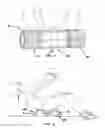
FIG. 1 is a perspective view of the preferred embodiment of the foam roller of the present invention showing an individual using the roller for back massage.
FIG. 2 is an end view of the roller in an open position with the longitudinal edges of the tube halves in contact with the floor and a person performing core exercises or sit-ups using the roller as a fulcrum.
FIG. 3 is a perspective view of the preferred embodiment of the foam roller of the present invention in an open position revealing the interior storage space.
FIG. 4 is a perspective view of the roller in an open position and showing a rolled up exercise mat contained within the interior storage space.
FIG. 5 is a perspective view of the roller with the tube halves closed.
FIG. 6 is a perspective view of an alternate embodiment of the present invention in an open position and with mat retaining clasps in a retracted position against the inside surface of the tube halves.
FIG. 7 is similar to FIG. 6 except the mat retaining clasps are in a raised position ready to receive and retain a rolled exercise mat.
FIG. 8 is a perspective view of the alternate embodiment with the tube halves is a partially closed position.
DETAILED DESCRIPTION OF THE INVENTION
The preferred form of the foam exercise roller 2 of the present invention is illustrated in FIGS. 1-5. The roller includes two identical tube halves 4 and 6, each having a longitudinal hinge edge 8 and 12 and each having a longitudinal closure edge 10 and 14. The tube halves 4 and 6 are pivotally interconnected along their longitudinal hinge edges 8 and 12 by hinges 16. The closure edges 10 and 14 of the tube halves are selectively interconnected by fastening bands 18. The roller 2, as seen in FIGS. 1 and 5, is formed when the tube halves are closed, that is, one or both halves are pivoted about hinges 16 until the closure edges 10 and 14 come into contact with each other. Closure of the tube halves is maintained by the circular bands around the roller whose ends are interlocked to secure the tube halves together in a cylindrical configuration. Conversely, the roller 2 is opened when the circular bands are disconnected and the tube halves are pivoted about the hinges 16 to the positions shown in FIGS. 2, 3 and 4.
The open position of the roller reveals the hollow interior of the tube halves 4 and 6 being utilized for storage space, generally indicated by reference numeral 20 in FIG. 3. The primary use for the storage space is to accommodate a rolled up exercise mat 22 secured in place by retaining straps 24 anchored to the tube half 6. The storage space can also include a removable compartment 26 in tube half 6 for keeping keys, credit cards and the like. A space in tube half 4 opposing the compartment 26 can be occupied by a number of other accessories such as an audio speaker 27. Each of the interior surfaces of the tube halves may be lined with netting to enclose various other items to be stored during use of the roller.
Semi-circular end caps 28 are disposed at the terminal ends of each tube half to complete the enclosure of the interior of the roller when the tube halves are closed. The end caps may be perforated with one or more apertures to allow for the passage of air through the interior of the roller.
The outer surface of each tube half is covered with one or more arrangements of foam. For most foam configurations ethylene-vinyl acetate is preferred. In the preferred embodiment there are multiple sections of foam covering, each of which may be covered with different kinds or densities of foam or different foam surface configurations to effect different kinds of muscle pressure. The center section 30 of the roller 2, that is, the combination of short sections on both sides of the circumferential groove 32 of the tube halves, is covered with a smooth surface variety of foam having broad grooves 34 angularly disposed to the longitudinal edges of the tube halves and traversing across the outer surface of the center section of foam, as shown in FIG. 5. The short sections are slightly spaced apart to accommodate the slight protrusion of portions of the human spine, as shown in FIG. 1.
The end portions 40 and 42 of each tube half are preferably covered with a higher density and roughly textured foam, including dimples, flexible bumps and narrow grooves adapted to apply the necessary local pressure to achieve the desired myofascial and trigger point release.
As illustrated in FIG. 2, a different kind of massage is achieved by planting the open sides of the tube halves 4 and 6 on a floor surface where they remain relatively stationary while the one exercising moves over or around the textured grid surface to stimulate a broader area muscle such as the gluteus maximus. The stationary tube halves also act as a fulcrum for sit-ups.
FIGS. 6 through 8 depict an alternative embodiment of the present invention where the roller 50 is shorter in length than that of the preferred form but still provides apparatus for storing an exercise mat. Tube halves 54 and 56 are pivotally attached along inside longitudinal edges 55 and 57 by hinges 58. The roller 50 is formed by pivoting the tube halves to a position where the outer longitudinal edges 62 and 64 come into contact with each other. The contact between the outer edges is maintained by a latch 66, magnets or other form of fastener.
Pivotally hinged to the respective inside longitudinal edges are arcuate grasping arms 72 and 74 which are provided to hold an exercise mat 80 in storage within the roller 50 when the roller is not in use or in transit. Each of the arms carries extensible pressure nubs 76 that engage the body of the rolled exercise mat 80 to retain the mat within the arms when the tube halves are closed, as shown in FIG. 8.
Each of the tube halves of the alternative embodiment are preferably covered with ethylene-vinyl acetate foam 82 that carries broad angular grooves 84 or some other desired texture or a grid pattern which produces the local pressures that the roller applies to muscles of the body.
Claims
We claim:1. An exercise foam roller, comprising,
a plurality of elongated tube sectors, each having,
first and second longitudinal edges,
an outer surface, and
foam covering at least a portion of the outer surface, means for interconnecting the tube sectors along their first longitudinal edges, means for detachably interconnecting the tube sectors along their second longitudinal edges.
2. The foam roller of claim 1 where the foam comprises ethylene-vinyl acetate.
3. The foam roller of claim 1 where the tube sectors comprise a pair of tube halves each having a longitudinal center section and first and second end portions and where the foam covering comprises,
a first surface covering at least a portion of the longitudinal center section of the tube half, and
a second surface covering the first and second end portions of the tube half.
4. The foam roller of claim 3 where the first surface comprises broad grooves angularly disposed to the longitudinal edges.
5. The foam roller of claim 3 where the second surface comprises ridges and narrow grooves
6. The foam roller of claim 3 and further comprising strap accommodating spaces between the center section foam and the foam over the first and second end portions.
7. The foam roller of claim 3 and further comprising a semi-circular groove along the longitudinal mid-line of the center section foam.
8. The foam roller of claim 3 and further including semi-circular end caps disposed at the terminal ends of each tube half.
9. The foam roller of claim 8 where each end cap includes a plurality of apertures.
10. The foam roller of claim 3 where each of the tube halves is sized and dimensioned to accommodate at least a portion of a rolled up exercise matt.
11. The foam roller of claim 8 where each of the tube halves is sized and dimensioned to accommodate the longitudinal length of a rolled up exercise matt between the end caps.
12. The foam roller of claim 10 and further including means for securing the exercise matt within the tube half.
13. The foam roller of claim 3 and further including at least one removable accessory compartment within the tube half.
14. The foam roller of claim 3 where the surfaces of the foam comprise at least one flattened area.
15. The foam roller of claim 12 where the means for securing the exercise matt within the tube half comprises,
at least one arcuate clasping arm,
a hinge interconnecting the at least one arm to a longitudinal edge of the tube half.
16. An exercise foam roller, comprising,
a pair of elongated tube halves, each having,
first and second longitudinal edges,
an outer surface, and
foam covering the outer surface,
at least one hinge interconnecting the tube halves along their first longitudinal edges,
means for detachably interconnecting the tube halves along their second longitudinal edges,
where each of the tube halves is sized and dimensioned to accommodate at least a portion of a rolled up exercise matt.
17. The exercise roller of claim 16 and further including,
at least one arcuate clasping arm,
a hinge interconnecting the at least one clasping arm to a longitudinal edge of the tube half, and
at least one nub carried by the at least one clasping arm.
18. An exercise foam roller, comprising,
a pair of elongated tube halves, each having,
first and second longitudinal edges,
an outer surface comprising first and second surface portions,
means for pivotally interconnecting the tube halves along their first longitudinal edges,
means for detachably interconnecting the tube halves along their second longitudinal edges,
foam covering the outer surface where the foam covering comprises,
a first surface covering at least the first portion of the tube half, and
a second surface covering the second portion of the tube half.
19. The exercise foam roller of claim 18 and including,
semi-circular end caps disposed at the terminal ends of each tube half, and where each of the tube halves is sized and dimensioned to accommodate the longitudinal length of a rolled up exercise matt between the end caps.
Images & Drawings included:



Sources:
- United States Patent and Trademark Office - verify current appl. status at the USPTO↗
Similar patent applications:
- » 15430476
Auxiliary foam roller exercise support apparatus - » 20110152035
FOAM ROLLER EXERCISE DEVICE - » 20250152456
Adjustable Myofascial Foam Roller Exercise Apparatus
Recent applications in this class:
- » 20250276209 2025-09-04
LEG EXTENSION MACHINE - » 20250242196 2025-07-31
AUTOMATIC BODY POSITIONING EXERCISE SUPPORT SYSTEM - » 20250186828 2025-06-12
EXERCISE DEVICE - » 20250170447 2025-05-29
KNEE JOINT PHYSICAL THERAPY DEVICE - » 20250099805 2025-03-27
CONCAVE ANGULATED POSITIONING DEVICE - » 20250050162 2025-02-13
ERGONOMIC HANDHELD WEIGHT UNIT AND METHOD OF USE - » 20250025742 2025-01-23
TORSO EXERCISE APPARATUS - » 20240374954 2024-11-14
YOGA BLOCK - » 20240269507 2024-08-15
Exercise device - » 20240189657 2024-06-13
EXERCISE DEVICE