Affixing device for pieces
US20190107135A1
2019-04-11
16/153,169
2018-10-05
✅ Patent granted
US 10,927,871 B2
2021-02-23
-
-
Victor D Batson | Amit Singh Dhillon
Thompson Hine LLP
2039-03-11
Abstract:
The affixing device for pieces includes an affixing element (1) that can be positioned through an opening (6) in each one of the pieces (7, 8) that are affixed to each other, that also comprises a first and second retaining elements (2, 3), which, when they are in their affixing positions, are in contact with the pieces (7, 8) that are affixed to each other, with the affixing device (1) passing through the first and second retaining elements (2, 3), and with the first retaining element (2) including an accommodation space for a tool. This configuration allows for faster and simpler assembly of the affixing device, also avoiding problems of misalignment.
Inventors:
- Francisco Criado del Pino 1 🇪🇸 Barcelona, Spain
- Jorge Gustavo Barcelo 1 🇪🇸 Barcelona, Spain
- Javier Arteta Unanua 1 🇪🇸 Barcelona, Spain
Assignee:
- Illinois Tool Works Inc. 5,396 🇺🇸 Glenview, IL, United States
Applicant:
Interested in similar patents?
Get notified when new applications in this technology area are published.
Classification:
B60R2019/1886 » CPC further
Wheel guards; Radiator guards, e.g. grilles ; Obstruction removers; Fittings damping bouncing force in collisions; Bumpers, i.e. impact receiving or absorbing members for protecting vehicles or fending off blows from other vehicles or objects; Means within the bumper to absorb impact characterised by the cross-section; Bumper fascias and fastening means therefor
F16B13/04 » CPC main
Dowels or other devices fastened in walls or the like by inserting them in holes made therein for that purpose with parts gripping in the hole or behind the reverse side of the wall after inserting from the front
F16B5/065 » CPC further
Joining sheets or plates, e.g. panels, to one another or to strips or bars parallel to them by means of clamps or clips joining sheets or plates to each other in parallel relationship the plates being one on top of the other and distanced from each other, e.g. by using protrusions to keep contact and distance
F16B13/124 » CPC further
Dowels or other devices fastened in walls or the like by inserting them in holes made therein for that purpose; Separate metal dowel sleeves fastened by inserting the screw, nail or the like fastened by inserting a threaded element, e.g. screw or bolt
F16B37/041 » CPC further
Nuts or like thread-engaging members; Devices for fastening nuts to surfaces, e.g. sheets, plates Releasable devices
F16B37/042 » CPC further
Nuts or like thread-engaging members; Devices for fastening nuts to surfaces, e.g. sheets, plates; Releasable devices locking by rotation
F16B5/02 IPC
Joining sheets or plates, e.g. panels, to one another or to strips or bars parallel to them by means of fastening members using screw-thread
F16B13/12 IPC
Dowels or other devices fastened in walls or the like by inserting them in holes made therein for that purpose Separate metal dowel sleeves fastened by inserting the screw, nail or the like
F16B37/04 IPC
Nuts or like thread-engaging members Devices for fastening nuts to surfaces, e.g. sheets, plates
F16B5/06 IPC
Joining sheets or plates, e.g. panels, to one another or to strips or bars parallel to them by means of clamps or clips
F16B13/10 IPC
Dowels or other devices fastened in walls or the like by inserting them in holes made therein for that purpose with parts gripping in the hole or behind the reverse side of the wall after inserting from the front with separate gripping parts moved into their final position in relation to the body of the device by a separate operation
B60R19/18 » CPC further
Wheel guards; Radiator guards, e.g. grilles ; Obstruction removers; Fittings damping bouncing force in collisions; Bumpers, i.e. impact receiving or absorbing members for protecting vehicles or fending off blows from other vehicles or objects Means within the bumper to absorb impact characterised by the cross-section;
F16B5/025 » CPC further
Joining sheets or plates, e.g. panels, to one another or to strips or bars parallel to them by means of fastening members using screw-thread specially designed to compensate for misalignement or to eliminate unwanted play
Description
TECHNICAL FIELD
The present invention relates to an affixing device for pieces, in particular, for the affixing of vehicle pieces, for example, to secure a bumper to a structure of the vehicle.
BACKGROUND
During the manufacture of a vehicle, many pieces must be assembled, using different affixing devices to affix different pieces together. To do this, the two pieces to be affixed normally comprise two openings, into which the affixing device is inserted and then tightened to secure the elements.
Normally, the positioning of the affixing device in is position of use is done manually, and a tool, a screwdriver for example, is then inserted to perform the tightening.
Obviously, this essentially manual assembly is prone to errors and imprecision, specifically in regard to the possibility of inserting the affixing device out of alignment in relation to the reference surface.
In addition, this type of assembly is laborious, because it requires two actions: manual positioning and tightening.
The aforementioned drawbacks can be especially delicate in the case of the assembly of some pieces, for example, the assembly of a bumper to a structure of a vehicle, because this requires a very robust, fast and secure assembly.
Therefore, one objective of the present invention is to provide an affixing device for pieces that is easily and quickly positioned and that avoids the problems of misalignment.
SUMMARY
The affixing device of the invention resolves the aforementioned drawbacks, presenting other advantages that are described below.
In one aspect, an affixing device, for affixing first and second pieces to each other, comprises an affixing element that can be positioned through a respective opening in each one of the first and second pieces that are affixed to each other, wherein the affixing device also comprises a first retaining element having an affixing position and a second retaining element having an affixing position, wherein, in the affixing position of the first retaining element, the first retaining element is in contact with the first piece and, in the affixing position of the second retaining element, the second retaining element is in contact with the second piece, with the affixing element passing through said first and second retaining elements, and with the first retaining element comprising an accommodation space for a tool.
In another aspect, an affixing device, for affixing first and second pieces to each other, comprises a threaded affixing element passing through and threadedly engaged with each of a first retaining element and a second retaining element, the affixing device configured to be positioned through a respective opening in each one of the first and second pieces that are affixed to each other and such that a portion of the first retaining element engages the first piece and a portion of the second retaining element engages the second piece in order to hold the first piece and the second piece together, wherein the first retaining element comprises an accommodation space for a tool and an engageable head of the affixing element is located within the accommodation space.
The affixing device for pieces, according to one aspect, comprises an affixing element that can be positioned through an opening in each one of the pieces that are affixed to each other, and is characterized in that it also comprises a first and second retaining elements, which, when they are in their affixing position, are in contact with the pieces, that are affixed to each other, with the affixing element passing through said first and second retaining elements, and with the first retaining element comprising an accommodation space for a tool.
This allows for faster and simpler assembly of the affixing device, also avoiding problems of misalignment, because the accommodation space of the first retaining element allows the positioning of a tool, for example, a screwdriver, to perform the assembly and then remove the tool.
According to a preferred embodiment, said accommodation space of the first retaining element is defined by at least one perimeter wall, or by a plurality of perimeter walls, with each wall preferably having a curved footprint.
To facilitate the coupling between the first retaining element and a tool, the at least one perimeter wall or each one of the plurality of perimeter walls comprises a distal lip.
Advantageously, said first retaining element comprises a circular base, which, in its assembly position, is in contact with one of the pieces that are affixed to each other, and preferably, said at least one wall extends substantially perpendicular with respect to said circular base.
According to a preferred embodiment, said second retaining element comprises a plurality of feet.
In addition, the affixing device according to the present invention may also comprises a seal positioned between the first and second retaining elements.
BRIEF DESCRIPTION OF THE DRAWINGS
To provide a better understanding of the description, a series of drawings are included that schematically, and solely as an example and not for the purposes of limitation, represent a practical embodiment of the invention.
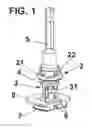
FIGS. 1 to 3 are perspective views of the affixing device according to the present invention during its assembly process; in particular, FIG. 1 shows the moment of the positioning of the device, FIG. 2 shows the moment of the tightening, and FIG. 3 shows the moment of the removal of the tool.
DETAILED DESCRIPTION
As shown in the figures, the affixing device according to the present invention comprises the following components: an affixing element 1, a first retaining element 2 and a second retaining element 3.
The affixing element 1 may be a conventional threaded element, for example, a screw, bolt, or similar element, which preferably comprises a head 11 equipped with a complementary opening with a tool 5, that allows the tightening of said affixing element 1. Each retaining element 2, 3 may include a threaded through opening, with the affixing element passing through and threadedly engaging each of the through openings such that relative rotation between the affixing element and the retaining elements will cause movement of the retaining elements toward each other.
Said tool 5 is shaped such that it allows its insertion into the first retaining element 2 before it is positioned in the openings 6. In addition, once the pieces 7, 8 have been firmly joined by means of rotation of the affixing element 1, the tool 5 allows its release from the first retaining element 2 with a small external force.
This affixing element 1 passes through the two openings 6 of the pieces 7, 8 that are to be joined together. For example, the pieces may be a structure 7 and a bumper 8, or any other similar pieces.
The first retaining element 2, in its assembly position (FIGS. 2 and 3) is in contact with said pieces 8, and comprises an accommodation space for the positioning of the tool 5, for example, a screwdriver, to facilitate the tightening of the affixing element 1.
According to the embodiment shown, the first retaining element comprises circular base 21, from which a plurality of perimeter walls 22, which advantageously have a curved footprint, extend in a substantially perpendicular manner.
To facilitate the retention of the tool, each one of said perimeter walls 22 comprises a distal lip 23, which preferably couples in the interior of a slot 51 of the tool 5, as shown in FIG. 2.
It should be noted, however, that the accommodation space of the first retaining element 2 may be defined by only one perimeter wall 21, although in this case, the material of said perimeter wall 21 must be sufficiently elastic to allow the accommodation space and removal of the tool 5. Occasionally, the slot 51 may be placed in the piece 2 and the lip 23 in the tool 5.
The second retaining element 3, in its assembly position shown in FIGS. 2 and 3, is in contact with the other piece 7, and according to the embodiment shown, comprises a plurality of feet 31.
The affixing device according to the present invention also advantageously comprises a seal 4, which in its assembly position is positioned between the first 2 and second 3 retaining elements.
The affixing device according to the present invention functions as follow:
First, with the affixing element threadedly engaged with each of the retaining elements 2 and 3, and with the tool 5 positioned in the accommodation space of the first retaining element 2 and coupled with the affixing element 1 through its head 21, the affixing device is placed in its position of use, by passing the affixing device through the openings 6 of the pieces 7, 8, for example a structure of a vehicle and a bumper (FIG. 1). When the affixing device is moved into the openings 6 of the pieces 7, 8, the wall 21 of retaining element 2 will engage the upper surface of piece 8 to limit further passage of the affixing device.
To facilitate the positioning, the tool 5 is held in inside the accommodation space thanks to the presence of the lip 23 on the perimeter walls 22 of the first retaining element 2, which fit into a slot 51 of said tool 5.
When the affixing device is positioned in this manner, its alignment with respect to the pieces 7, 8 is guaranteed. To do this, it is also possible for the feet 31 of the second retaining element 3 to form a polygon, whose shape coincides with the shape of the openings 6, so that only the feet 31 will be inserted into said openings 6 if the insertion is carried out in a substantially perpendicular manner.
Once the affixing device has been put into position (FIG. 2), the affixing element 1 will be tightened, such that the first and second retaining elements 2, 3 come into contact with both pieces 7, 8, with a sufficient degree of tightness to guarantee correct affixing. That is, when the affixing element 1 is rotated the retaining elements 2, 3 are pulled together, toward each other, so that some part of retaining element 3 (e.g., feet 31) will engage with a lower surface of the piece 7, while wall 21 engages the upper surface of piece 8, to hold the pieces 7 and 8 tightly together. This tightening is done by turning the affixing element 1 in the proper direction. This turning will cause the displacement of the affixing element inside both retaining elements 2, 3. Upon conclusion of the tightening, the seal 4 will be in its sealing position, which is between the lower surface of piece 8 and the upper surface of piece 7 and engaged with both such surfaces.
Once the tightening has been carried out, the tool 5 is removed, with this able to be done easily thanks to the elastic nature of the perimeter walls 22 that form the accommodation space of the first retaining element 2.
Although reference has been made to a specific embodiment of the invention, it is clear for a person skilled in the art that numerous variations and modifications may be made to the affixing device described, and that all of the details mentioned may be substituted with other technically equivalent details, without falling outside the scope of protection defined by the attached claims.
Claims
What is claimed is:1. An affixing device for affixing first and second pieces to each other, the affixing device comprising an affixing element that can be positioned through a respective opening in each one of the first and second pieces that are affixed to each other, wherein the affixing device also comprises a first retaining element having an affixing position and a second retaining element having an affixing position, wherein, in the affixing position of the first retaining element, the first retaining element is in contact with the first piece and, in the affixing position of the second retaining element, the second retaining element is in contact with the second piece, with the affixing element passing through said first and second retaining elements, and with the first retaining element comprising an accommodation space for a tool.
2. The affixing device for pieces according to claim 1, in which said accommodation space of the first retaining element is defined by at least one perimeter wall.
3. The affixing device for pieces according to claim 2, in which said accommodation space of the first retaining element comprises a circular base.
4. The affixing device for pieces according to claim 3, in which said at least one perimeter wall extends substantially perpendicular with respect to the circular base.
5. The affixing device for pieces according to claim 1, in which said second retaining element comprises a plurality of feet.
6. The affixing device for pieces according to claim 1, in which the affixing device also comprises a seal positioned between the first and second retaining elements.
7. The affixing device for pieces according to claim 2, in which the accommodation space of the first retaining element is defined by a plurality of perimeter walls, with each wall having a curved footprint.
8. The affixing device for pieces according to claim 7, in which the at least one perimeter wall or each one of the plurality of perimeter walls comprises a distal lip.
9. An affixing device for affixing first and second pieces to each other, the affixing device comprising a threaded affixing element passing through and threadedly engaged with each of a first retaining element and a second retaining element, the affixing device configured to be positioned through a respective opening in each one of the first and second pieces that are affixed to each other and such that a portion of the first retaining element engages the first piece and a portion of the second retaining element engages the second piece in order to hold the first piece and the second piece together, wherein the first retaining element comprises an accommodation space for a tool and an engageable head of the affixing element is located within the accommodation space.
10. The affixing device according to claim 9 wherein said accommodation space of the first retaining element is defined by at least one perimeter wall.
11. The affixing device according to claim 10, wherein said accommodation space of the first retaining element comprises a circular base that engages the first piece.
12. The affixing device according to claim 11, wherein said at least one perimeter wall extends substantially perpendicularly to and away from the circular base to define an open end of the accommodation space.
13. The affixing device according to claim 9, wherein said second retaining element comprises a plurality of feet that engage the second piece.
14. The affixing device according to claim 9, wherein the affixing device also comprises a seal positioned between the first and second retaining elements.
Images & Drawings included:



Sources:
- United States Patent and Trademark Office - verify current appl. status at the USPTO↗
Similar patent applications:
Recent applications in this class:
- » 20250290532 2025-09-18
HOLLOW STRUCTURE ANCHOR - » 20250146518 2025-05-08
SNAP-ON FURNITURE SYSTEM - » 20240418194 2024-12-19
Hollow Wall Mounting Device - » 20230392633 2023-12-07
Blind fastener - » 20210088066 2021-03-25
Swing arm for recessed lighting fixtures - » 20210040972 2021-02-11
Expansion screw structure - » 20200332817 2020-10-22
Dowel with directional expanding portion and wall system including directional dowel - » 20200025233 2020-01-23
Snap connector - » 20180216647 2018-08-02
Metal channel anchor with enhanced holding strength - » 20170191517 2017-07-06
Mounting System Employing an X-Shaped Adapter for Mounting Devices to a Square Receiver
Recent applications for this Assignee:
- » 20250292708 2025-09-18
HYBRID HEAT TRANSFER LABEL ASSEMBLIES - » 20250289021 2025-09-18
NOZZLE ARRANGEMENT FOR APPLYING FLUIDS, SYSTEM HAVING SUCH A NOZZLE ARRANGEMENT, AND METHOD FOR APPLYING FLUIDS - » 20250288181 2025-09-18
DOOR LOCK DEVICE AND ELECTRICAL APPLIANCE - » 20250282967 2025-09-11
RESIN FORMULATION CONTAINING DYE AND USE THEREOF AS A HIGH PURITY MARKER PEN - » 20250252872 2025-08-07
HYBRID HEAT TRANSFER LABEL ASSEMBLIES - » 20250250041 2025-08-07
CONTAINER CARRIER - » 20250242944 2025-07-31
A GROUND SUPPORT EQUIPMENT - » 20250230340 2025-07-17
FILM FORMING FORMULATION AND COMPOSITION THEREOF - » 20250218006 2025-07-03
AUTOMATED PRODUCT TRACKING - » 20250204744 2025-06-26
DOOR LOCK DEVICE, ELECTRICAL APPLIANCE AND CONTROL METHOD