Fan Blade Noise Reducer
US20190136873A1
2019-05-09
15/943,927
2018-04-03
Abstract:
The leading edge method improves fan blade aerodynamics, which reduces energy lost into the airflow as acoustic noise. This results in a quieter fan, with no significant change to air moving capability. This is accomplished by increasing the radius of the fan blade leading edge, and by ensuring that any laminar boundary layer existing over the fan blade is tripped into a more energetic, and less likely to separate, turbulent boundary layer. Most fan blades are not fabricated with aerodynamic (airfoil) cross sections. Typically, they are either stamped from sheet stock, or molded out of thin material, in both cases with “sharp” leading edges with small leading-edge radius compared to fan blade chord length. Airfoils designed to operate at the Reynolds-numbers applicable to fan blades eschew sharp leading edges for large, rounded leading edges to control the surface pressure distributions and permit operation over a wide angle of attack range without boundary layer separation. The leading edge treatment in this patent application serves the purpose of increasing the fan leading edge radius without scrapping the entire fan blade and replacing it with a proper low Reynolds-numbers airfoil shape.
Interested in similar patents?
Get notified when new applications in this technology area are published.
Classification:
F04D29/667 » CPC main
Details, component parts, or accessories; Combating cavitation, whirls, noise, vibration or the like ; Balancing especially adapted for elastic fluid pumps by influencing the flow pattern, e.g. suppression of turbulence
F04D29/388 » CPC further
Details, component parts, or accessories; Rotors specially for elastic fluids for axial flow pumps; Blades characterised by construction
F04D29/384 » CPC further
Details, component parts, or accessories; Rotors specially for elastic fluids for axial flow pumps; Blades characterised by form
F04D29/66 IPC
Details, component parts, or accessories Combating cavitation, whirls, noise, vibration or the like ; Balancing
F04D29/38 IPC
Details, component parts, or accessories; Rotors specially for elastic fluids for axial flow pumps Blades
Description
BACKGROUND
To reduce fan size it is necessary to increase fan rpm to maintain the same airflow on such items as shop fans, ac fans, computer fans, etc.. In doing so the fan creates unwanted noise due to leading edge aerodynamic deficiencies. This is a simple fix to this unwanted noise.
BRIEF SUMMARY
Reduce fan noise by altering fan blade leading edge radius shape and size. Applicable as an aftermarket fix to fan blades, an additional step during blade production, or can be formed directly into the blade.
DESCRIPTION OF DRAWING
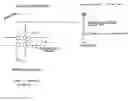
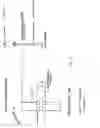
FIG. 1 Front view and end view looking at tubing attached on fan blade leading edge.
DETAILED DESCRIPTION
The leading edge method prototype setup used a commercial 4-blade stamped sheet metal shop fan. Fan noise was a major issue during use.
Fan Blades: 4
Blade Span: 12.75″
Chord: 6″
Blade Thickness: 0.70″
Leading edge method applied: 0.25 OD, 0.125 ID round rubber tubing, full span of each blade. Results: Noise level drop 6%./RPM drop 0.018%/CFM drop 6%.
The flow rate drop was not significant for fan's intended application. Noise level drop was significant and greater than could be associated with RPM drop alone.
In this example, increasing the leading edge radius to 0.25″ from 0.70″ (28%) where 0.25″ is defined as Leading Edge Radius/Blade Chord Length achieved these results. Apply method along leading edge of fan. Tip region is more critical than root region but best results occur with full span treatment. Circular/tubular shape of method is simple but not required as long as leading edge radius is increased to all blades.
Claims
I claim:1. Altering the geometric shape and size with various materials or by production methods of the leading edge of a fan blade will change the aerodynamics and harmonics of the fan thus significantly reducing fan noise with insignificant loss of cfm or rpm.
2. The process in claim 1 wherein a piece of 0.250D/0.125 ID round rubber tubing is split on one side and attached to the leading edge of all fan blades of a fan to achieve said results.
3. The process in claims 1 and 2 wherein various materials shaped so they increase the leading edge radius can be substituted to achieve said results.
4. The process in claim 1 wherein the fan blade manufacture can alter the fan blade to achieve said results.
Images & Drawings included:
Sources:
- United States Patent and Trademark Office - verify current appl. status at the USPTO↗
Similar patent applications:
Recent applications in this class:
- » 20250163937 2025-05-22
DIFFUSER TUBE RESONATOR FOR REFRIGERANT COMPRESSORS - » 20250137466 2025-05-01
BLOWER - » 20250101993 2025-03-27
AIR GUIDE COVER, OUTDOOR UNIT OF HVAC APPARATUS, AND HVAC APPARATUS - » 20240392808 2024-11-28
DIAGONAL FAN - » 20240392807 2024-11-28
DIAGONAL FAN - » 20240328434 2024-10-03
Blower - » 20240309888 2024-09-19
Silent Fan - » 20240018976 2024-01-18
Systems and methods for integrally geared centrifugal compressor to maintain rotor concentricity with differing pinion gear tooth counts - » 20230417258 2023-12-28
Centrifugal fan - » 20230407885 2023-12-21
Operation panel for machine tool