Cooling and heating plate
US20190223637A1
2019-07-25
16/332,299
2017-09-13
✅ Patent granted
US 12,303,048 B2
2025-05-20
WO; PCT/AT2017/060227; 20170913
WO; WO2018/049452; 20180322
Jenna M Maroney
Andrew Wilford
2037-09-13
Abstract:
A cooling and heating plate, in particular for serving food and beverages, is connected to a cooling unit and an electrical heating device, preferably a silicone panel heater, is also provided on the under side of the plate. The plate is a multilayered plate having an upper plate, preferably of chrome nickel steel, and an aluminum plate situated thereunder. At least one steel pipe, which is preferably seamless with serpentine curves, having a compressive strength of at least 50 bar is integrally cast in the aluminum plate. As a result, carbon dioxide can also be used as a coolant. Fastening elements can also be integrally cast in the aluminum plate.
Inventors:
- Josef HÖLLER 2 🇦🇹 Neufurth, Austria
- Joachim HÖLLER 2 🇦🇹 Zeillern, Austria
- Josef Höller 1 🇦🇹 Neufurth, Austria
- Joachim Höller 1 🇦🇹 Zeillern, Austria
Assignee:
- JOSEF HOELLER GMBH 1 🇦🇹 Amstetten, Austria
Applicant:
Interested in similar patents?
Get notified when new applications in this technology area are published.
Classification:
F28D2021/0042 » CPC further
Heat-exchange apparatus not covered by any of the groups - ; Other heat exchangers for particular applications; Heat exchange systems not otherwise provided for for foodstuffs
F25D31/005 » CPC further
Other cooling or freezing apparatus Combined cooling and heating devices
A47G19/02 IPC
Table service Plates, dishes or the like
F28D1/047 IPC
Heat-exchange apparatus having stationary conduit assemblies for one heat-exchange medium only, the media being in contact with different sides of the conduit wall, in which the other heat-exchange medium is a large body of fluid, e.g. domestic or motor car radiators with heat-exchange conduits immersed in the body of fluid with tubular conduits the conduits being bent, e.g. in a serpentine or zig-zag
F25D31/00 IPC
Other cooling or freezing apparatus
A47G19/027 » CPC main
Table service; Plates, dishes or the like with means for keeping food cool or hot
A47F3/001 » CPC further
Show cases or show cabinets Devices for lighting, humidifying, heating, ventilation
A47F3/0491 » CPC further
Show cases or show cabinets air-conditioned, refrigerated; Details common to both closed and open types for charging, displaying or discharging the articles Cooled shelves
F25B39/02 » CPC further
Evaporators; Condensers Evaporators
F28F1/22 » CPC further
Tubular elements; Assemblies of tubular elements; Tubular elements and assemblies thereof with means for increasing heat-transfer area, e.g. with fins, with projections, with recesses the means being only outside the tubular element and extending longitudinally the means having portions engaging further tubular elements
F28F3/12 » CPC further
Plate-like or laminated elements; Assemblies of plate-like or laminated elements Elements constructed in the shape of a hollow panel, e.g. with channels
F25B9/008 » CPC further
Compression machines, plants or systems, in which the refrigerant is air or other gas of low boiling point characterised by the refrigerant the refrigerant being carbon dioxide
F25B2309/061 » CPC further
Gas cycle refrigeration machines; Compression machines, plants or systems characterised by the refrigerant being carbon dioxide with cycle highest pressure above the supercritical pressure
F28F2255/146 » CPC further
Heat exchanger elements made of materials having special features or resulting from particular manufacturing processes molded overmolded
A47F3/00 IPC
Show cases or show cabinets
A47F3/04 IPC
Show cases or show cabinets air-conditioned, refrigerated
F25B9/00 IPC
Compression machines, plants or systems, in which the refrigerant is air or other gas of low boiling point
F28D21/00 IPC
Heat-exchange apparatus not covered by any of the groups -
A47B31/02 » CPC further
Service or tea tables, trolleys, or wagons with heating, cooling or ventilating means
F28D1/0477 » CPC further
Heat-exchange apparatus having stationary conduit assemblies for one heat-exchange medium only, the media being in contact with different sides of the conduit wall, in which the other heat-exchange medium is a large body of fluid, e.g. domestic or motor car radiators with heat-exchange conduits immersed in the body of fluid with tubular conduits the conduits being bent, e.g. in a serpentine or zig-zag the conduits being bent in a serpentine or zig-zag
Description
TECHNICAL FIELD
The present invention relates to a cooling and heating plate, in particular for the presentation of food and beverages, in which the plate is connected to a cooling unit and has an electrical heating device on its lower side, wherein the plate is designed as a multilayered plate having an upper plate, preferably consisting of chromium-nickel steel, and, situated therebelow, an aluminum plate having coolant ducts.
PRIOR ART
Such a cooling and heating plate is known from patcit0001:WO WO 2015/161332--. According to this document, the cooling and heating plate consists of three layers: an upper plate consisting of chromium steel having a thickness of about 1.5 mm, a central plate consisting of aluminum having a thickness of about 5 mm, and a lower plate likewise consisting of chromium steel having a thickness of about 1.5 mm. Coolant ducts are incorporated into the central plate. The connection between the central plate and the upper and the lower plate is achieved according to this document by rolling.
Arranged on the lower side of the lower plate is a heating mat which is covered by a thermal and electrical insulation and tightly closed by a covering shell.
Two things are disadvantageous with this plate: firstly, the coolant ducts withstand only relatively low pressures, and secondly, by virtue of the high pressure upon rolling, the coolant ducts have the effect that the upper plate is not completely planar, with the result that the coolant ducts are noticeable upon corresponding light incidence.
The most future-oriented refrigerant is currently carbon dioxide since it has no influence on the ozone layer and, compared with other refrigerants, has barely any influence on the greenhouse effect. However, carbon dioxide requires high pressures, even on the low-pressure side (that is to say downstream of the evaporator). The known cooling and heating plate cannot cope with these pressures.
SUMMARY OF THE INVENTION
It is an object of the present invention to overcome these disadvantages and to provide a cooling and heating plate whose coolant ducts also withstand high pressures and in which the upper plate is planar.
This object is achieved according to the invention by a cooling and heating plate of the type stated at the outset in that at least one steel pipe having a compressive strength of at least 50 bar is integrally cast in the aluminum plate to form the coolant ducts.
According to the invention, the coolant ducts are thus not produced by milling out the aluminum plate, but by a steel pipe which is integrally cast during the production of the aluminum plate. As a result, the heat transfer between the steel pipe and the aluminum is optimal, and the compressive strength is provided by virtue of the steel pipe. Overall, the heat transfer from the refrigerant to the aluminum plate is not substantially poorer than in the known solution described at the outset.
If the steel pipe is bent in a meandering shape, it is also possible to manage with a single steel pipe in the case of large cooling and heating plates.
Since, according to the invention, each aluminum plate is produced by casting, the possibility arises of also integrally casting fastening elements in the aluminum plate, with the result that no additional machining operations are necessary for mounting the fastening elements (for example screw bolts).
In order for the steel pipe to withstand high pressures and for pipe breakages to be improbable, it is preferable for the steel pipe to be seamless.
For reasons of the manufacturing outlay and of the weight of the cooling and heating plate, the aluminum plate should be thin, but, on the other hand, it should be ensured that the steel pipe, even in the case of slight deviations from the planned central position, is sufficiently covered. According to a further preferred feature, there is therefore provision that the aluminum plate has a thickness which is approximately twice as large as the outside diameter of the steel pipe.
The electrical heating device is preferably a silicone panel heater which is fitted on the lower side of the aluminum plate. Such silicone panel heaters are flat, emit uniform heat and can generate high temperatures. They are therefore well suited for the cooling and heating plates according to the invention.
BRIEF DESCRIPTION OF THE DRAWINGS
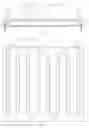
The present invention will be explained in more detail with reference to the appended drawing, in which FIG. 1 shows a vertical section through a cooling and heating plate according to the invention; and
FIG. 2 shows a horizontal section through the same cooling and heating plate.
BEST WAY OF IMPLEMENTING THE INVENTION
The cooling and heating plate is a multilayered plate 11 consisting of an aluminum plate 13 and an upper plate 12. The upper plate 12 bears the beverages to be heated or to be cooled and must therefore, on the one hand, consist of a food-safe material and, on the other hand, must have a sound appearance over years. A preferred material for the upper plate 12 is chromium-nickel steel.
A steel pipe 14 bent in a meandering shape is integrally cast in the aluminum plate 13. This steel pipe 14 has a compressive strength of at least 50 bar and can therefore also withstand the pressures which are necessary for refrigerating machines having carbon dioxide as refrigerant. Since the steel pipe 14 is integrally cast in the aluminum, the heat transfer resistance between the steel pipe 14 and the aluminum plate 13 is low. Between the refrigerant (e.g. carbon dioxide) and the aluminum plate 13 there is, of course, additionally the heat resistance of the steel pipe 14, which should therefore be as thin as possible. If use is made of a seamless steel pipe 14, it is possible to manage with wall thicknesses of at most 1 mm without compromising the necessary compressive strength.
Fastening elements 15 are also integrally cast in the aluminum plate 13. An electrical silicone panel heater 16 is mounted on the lower side of the aluminum plate 13. For heating, this silicone panel heater is switched on, in which case the cooling unit is, of course, switched off. The coolant can remain in the steel pipe 14. Although carbon dioxide then exceeds the critical temperature, the steel pipe 14 withstands the resultant pressures.
For temperature measurement (both during heating and during cooling), a Pt100 temperature sensor can be provided in a conventional manner, and a suitable controller is, for example, the controller ST121-KD1TA.03FS from STÖRK-TRONIC.
This cooling and heating plate makes it possible, during cooling, to achieve an optimum temperature transfer down to −30° C. The temperature of −30° C. serves for the production of ice cream, directly before the eyes of the consumer. During heating, a temperature of up to 140° C. can be achieved, with the result that food can be kept sufficiently warm. The bottom of the cooling and heating plate is insulated to suit the requirements
The cooling and heating plate can be operated with carbon dioxide, with the result that the otherwise customary greenhouse gases can be avoided. Of course, however, it can also be operated with all conventional refrigerants, thus also being suitable as a replacement part for existing systems. Isobutane as refrigerant is best suited for a cooling unit which is mounted directly in the cooling and heating plate and which has to be correspondingly compact.
The upper plate 12 and the aluminum plate 13 are preferably adhesively bonded to one another with an adhesive having good heat conductivity. If they are connected to one another by rolling, there is the risk that the steel pipe 14 is deformed in the process, resulting in cross-sectional narrowings.
Claims
1. A cooling and heating plate, in particular for the presentation of food and beverages, in which the plate is connected to a cooling unit and has an electrical heating device on its lower side, wherein the plate is designed as a multilayered plate having an upper plate, preferably consisting of chromium-nickel steel, and, situated therebelow, an aluminum plate having coolant ducts, wherein at least one steel pipe having a compressive strength of at least 50 bar is integrally cast in the aluminum plate to form the coolant ducts.
2. The cooling and heating plate according to claim 1, wherein the steel pipe is bent in a meandering shape.
3. The cooling and heating plate according to claim 1, wherein fastening elements are also integrally cast in the aluminum plate.
4. The cooling and heating plate according to claim 1, wherein the steel pipe is seamless.
5. The cooling and heating plate according to claim 1, wherein the aluminum plate has a thickness which is approximately twice as large as the outside diameter of the steel pipe.
6. The cooling and heating plate according to claim 1, wherein the electrical heating device is a silicone panel heater which is fitted on the lower side of the aluminum plate.
Images & Drawings included:

Sources:
- United States Patent and Trademark Office - verify current appl. status at the USPTO↗
Similar patent applications:
- » 20100219175
Rotatable heating-cooling plate and element in proximity thereto - » 20070068920
Bake unit, method for cooling heating plate used in the bake unit, apparatus and method for treating substrates with the bake unit - » 20100101771
Heated cooling plate for E-chucks and pedestals - » 20250065691
Direct Cooling Plate, Heat Exchanger, Power Battery Pack and Vehicle - » 10412754
Tube-in-plate cooling or heating plate - » 20250040079
LIQUID COOLING HEAT DISSIPATION PLATE AND LIQUID COOLING ELECTRONIC DEVICE - » 20210210403
HEAT SPREADING PLATE HAVING ATLEAST ONE COOLING FIN METHOD FOR PRODUCING A HEAT SPREADING PLATE HAVING ATLEAST ONE COOLING FIN ELECTRONIC MODULE - » 20240230245
LOW PRESSURE DROP AUTOMOTIVE LIQUID-COOLING HEAT DISSIPATION PLATE AND ENCLOSED AUTOMOTIVE LIQUID-COOLING COOLER HAVING THE SAME - » 20240133639
LOW PRESSURE DROP AUTOMOTIVE LIQUID-COOLING HEAT DISSIPATION PLATE AND ENCLOSED AUTOMOTIVE LIQUID-COOLING COOLER HAVING THE SAME - » 20240224464
Liquid-cooling heat dissipation plate with unequal height pin-fins and enclosed liquid-cooling cooler having the same
Recent applications in this class:
- » 20250160550 2025-05-22
WIRELESS HEATED OR COOLED DISHWARE, DRINKWARE, OR SERVERWARE WITH SAFETY SYSTEM - » 20240298825 2024-09-12
CROCKERY COMPRISING MICROWAVE-ACTIVATABLE PHASE-CHANGE MATERIAL - » 20240260771 2024-08-08
Plate and Bowl Insulator Ring and Method of use - » 20230320502 2023-10-12
ORNAMENTAL FOOD-CHILLING BOWL - » 20230146911 2023-05-11
TEMPERATURE-CONSERVING CONTAINERS - » 20210068565 2021-03-11
THERMALLY INSULATED BOWL - » 20200146477 2020-05-14
PLATEWARE WITH ACTIVE TEMPERATURE CONTROL - » 20200093299 2020-03-26
Thermal baby food tray - » 20190223636 2019-07-25
POUCH FILLED WITH PHASE-CHANGE MATERIAL AND METHOD FOR MANUFACTURE THEREOF - » 20190223635 2019-07-25
Portable cooler container with active temperature control