Therapeutic exercise contour support
US20190262659A1
2019-08-29
15/907,400
2018-02-28
✅ Patent granted
US 10,857,417 B2
2020-12-08
-
-
Joshua T Kennedy
Ingerium Patents LLC | Peter R Kramer
2038-08-09
Abstract:
Disclosed is a therapeutic exercise contour support (TECS), made of high density flexible foam, which can either be used on traditional bench press equipment or as a stand-alone. The TECS provides support for the neck, upper body and lower back when performing bench press exercise. The TECS has a distinctive contoured surface that elevates the spine and allows the user to have a natural scapula-humeral rhythm when performing the bench press at inclined, horizontal and declined inclinations. An adjustable ergonomic neck foam support can be attached to the main contour support to maintain proper cervical curvature. The TECS can also be used for therapy by placing it on a horizontal surface and then lying on it in a supine position. This helps the scapulae to retract as they should, which may assist in alleviating pain in the upper back due to poor posture and muscle imbalance.
Applicant:
Interested in similar patents?
Get notified when new applications in this technology area are published.
Classification:
A63B23/02 IPC
Exercising apparatus specially adapted for particular parts of the body for the abdomen, the spinal column or the torso muscles related to shoulders (e.g. chest muscles)
A63B21/4039 » CPC main
Exercising apparatus for developing or strengthening the muscles or joints of the body by working against a counterforce, with or without measuring devices; Interfaces with the user related to strength training; Details thereof; Specific exercise interfaces contoured to fit to specific body parts, e.g. back, knee or neck support
A47G9/1081 » CPC further
Bed-covers; Counterpanes; Travelling rugs; Sleeping rugs; Sleeping bags; Pillows; Pillows comprising a neck support, e.g. a neck roll
A47G2009/1018 » CPC further
Bed-covers; Counterpanes; Travelling rugs; Sleeping rugs; Sleeping bags; Pillows; Pillows Foam pillows
A63B21/00 IPC
Exercising apparatus for developing or strengthening the muscles or joints of the body by working against a counterforce, with or without measuring devices
A47G9/10 IPC
Bed-covers; Counterpanes; Travelling rugs; Sleeping rugs; Sleeping bags; Pillows Pillows
Description
SUMMARY OF INVENTION
The present invention relates to a distinctive ergonomic upper body contoured foam support surface and removable neck support which can be mounted to traditional bench press equipment for improving performance of the barbell/dumbbell bench press exercise as well as other upper-body exercises. The TECS can also be used for therapeutic purposes by lying supine on the contoured support.
BACKGROUND OF INVENTION
In our modern society, people are becoming more aware of the health benefits of weight training. Many go to commercial gyms to weight train. However, it is very difficult for many others to find time to workout at commercial gyms and therefore, they train at home. With a pair of dumbbells, many weight training exercises can be performed for training the muscles of the legs, back, shoulders and arms. Push-ups can be done for training the pectoral muscles, however, strength and hypertrophy soon stalls as the muscles adapt to the stimulus (load). It then becomes necessary to acquire a bench or elevated surface to perform weighted dumbbell bench presses/flys to increase the load for inducing muscle hypertrophy and upper body strength.
Of all free weight exercises, the dumbbell/barbell bench press, when performed on a flat bench surface, restricts scapulae movement and is a major cause of shoulder pain and injury. Most benches sold in residential and commercial markets are designed with a flat surface. Many users are unaware of the shoulder injuries that can be incurred when performing the bench press on such surface. Secondly, the lordotic curve of the lower-back and the cervical curve of the neck are not supported when performing the bench press on a flat bench surface.
Poor posture, weak rotator cuff muscles and over-powering muscles of the chest and shoulders can prevent the scapulae from proper articulation of the upper body. The inner border of the scapula flares out (scapula-winging) and can cause severe pain.
Lying supine on a contoured surface that elevates the spine and helps the scapulae to retract can aid in alleviating pain and restore range of motion.
DETAILED DESCRIPTION OF INVENTION
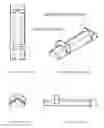
The upper body ergonomic contour foam support member 1 and the neck support member 2 fulfil several functions as illustrated in FIGS. 1d and 3d. The removable neck support member 2 depicted in FIG. 2d can be adjusted for varying heights of users. The middle circular contour foam support, which is approximately 100 mm in diameter, of member 1 elevates the spine, thereby creating space between the contoured surface and the scapula. This produces natural scapula-humeral rhythm and allows the scapula to retract and protract naturally when the bench press is performed with either dumbbells or barbells. The middle portion of the contour support by itself is too narrow and can introduce lateral instability when pressing. For this reason two circular foam supports, approximately 60 mm in diameter are placed adjacent to the middle contour support on both sides. These smaller circular cross-sections are large enough to prevent lateral instability and small enough to not impede scapula-humeral rhythm. Shoulder injury can be prevented when the bench press is performed on the upper body ergonomic contour support member 1. The specific shape of member 1 can be foam moulded and upholstered to improve aesthetics and longevity. The cervical neck support member 2 can be attached to member 1 using straps. The upper body contour support can then be strapped to any traditional bench press machine or be built into the bench surface thereby making the surface more suitable for bench pressing. It is light weight and can be easily carried around for any time of use.
When lying supine on a flat surface the head tilts backwards and increases the cervical curvature. In this tilted position the muscles of the neck are not relaxed. Cervical spinal discs and connective ligaments are put under undue strain. The removable neck support member 2 has its top surface elevated at approximately 85 mm higher than the middle circular contour foam support. The neck support member 2 maintains the cervical curvature of the neck and can provide therapeutic comfort by relieving stress in the neck and trapezius muscles. With the neck supported, the user is able to focus on performing the bench press to effectively maximize recruitment of the pectoralis major muscle.
When the TECS is being used solely for therapeutic purposes, the upper body ergonomic contour support 1 and cervical neck support 2 can be placed on a bench or horizontal surface/floor. The user can then simply lie supine on the arranged contour support. This arrangement can assist in relieving undue stress in the shoulders, upper and lower back and neck.
BRIEF DESCRIPTION OF DRAWINGS
FIGS. 1a, 1b, 1c, and 1d illustrate the top, front, side and isometric views of the Therapeutic Exercise Contour Support.
FIGS. 2a, 2b, 2c, and 2d illustrate the top, front, side and isometric views of the upper body ergonomic contour support.
FIGS. 3a, 3b, 3c, and 3d illustrate the top, front, side and isometric views of the cervical neck support.
Claims
I claim:1. An ergonomic upper body contour support member 1 which comprises three functional parts of
a.) a larger middle circular contour foam support and
b.) two smaller circular contour foam supports fixed longitudinally on both sides of the higher elevated mid foam support and
c.) a circular foam support aligned perpendicular to the longitudinal axis.
2. A removable neck support member 2 which can be placed on the ergonomic upper body contour support of claim 1 and can be adjusted along the longitudinal axis of the mid circular contour support for varying heights of users.
Images & Drawings included:



Sources:
- United States Patent and Trademark Office - verify current appl. status at the USPTO↗
Recent applications in this class:
- » 20250276209 2025-09-04
LEG EXTENSION MACHINE - » 20250242196 2025-07-31
AUTOMATIC BODY POSITIONING EXERCISE SUPPORT SYSTEM - » 20250186828 2025-06-12
EXERCISE DEVICE - » 20250170447 2025-05-29
KNEE JOINT PHYSICAL THERAPY DEVICE - » 20250099805 2025-03-27
CONCAVE ANGULATED POSITIONING DEVICE - » 20250050162 2025-02-13
ERGONOMIC HANDHELD WEIGHT UNIT AND METHOD OF USE - » 20250025742 2025-01-23
TORSO EXERCISE APPARATUS - » 20240374954 2024-11-14
YOGA BLOCK - » 20240269507 2024-08-15
Exercise device - » 20240189657 2024-06-13
EXERCISE DEVICE