Polished talc microbeads
US20190307660A1
2019-10-10
16/339,814
2016-10-14
✅ Patent granted
US 11,304,883 B2
2022-04-19
WO; PCT/EP2016/074729; 20161014
WO; WO2018/068865; 20180419
Craig D Ricci
Kacvinsky Daisak Bluni PLLC
2036-10-14
Abstract:
Polished talc microbeads, i.e. polished talc particles with a largest average diameter of less than 500 μm and methods for the preparation thereof, which microbeads are especially suitable to be use as an alternative for plastic microbeads used in cosmetics and personal hygiene products. Body scrubs, tooth pastes and soaps comprising the present polished talc microbeads. The use of polished talc microbeads with a talc content of more than 70% (w/w) and a largest diameter of less than 500 μm as a substitute for plastic microbeads in cosmetics and personal hygiene products.
Inventors:
- Jose Manuel DE BARROS SANCHES 1 🇳🇱 Zaandam, Netherlands
- Tomasz WASILEWSKI 1 🇵🇱 Radom, Poland
- Anna Maria Kanios-Zakrzewska 1 🇳🇱 Amsterdam, Netherlands
Assignee:
- MONDO MINERALS B.V. 2 🇳🇱 Amsterdam, Netherlands
Applicant:
Interested in similar patents?
Get notified when new applications in this technology area are published.
Classification:
A61K8/46 IPC
Cosmetics or similar toilet preparations characterised by the composition containing organic compounds containing sulfur
A61K8/442 » CPC further
Cosmetics or similar toilet preparations characterised by the composition containing organic compounds containing nitrogen; Aminocarboxylic acids or derivatives thereof, e.g. aminocarboxylic acids containing sulfur; Salts; Esters or N-acylated derivatives thereof substituted by amido group(s)
A61K8/466 » CPC further
Cosmetics or similar toilet preparations characterised by the composition containing organic compounds containing sulfur containing sulfonic acid derivatives; Salts
A61Q19/10 » CPC further
Preparations for care of the skin Washing or bathing preparations
A61K2800/28 » CPC further
Properties of cosmetic compositions or active ingredients thereof or formulation aids used therein and process related aspects; Chemical, physico-chemical or functional or structural properties of the composition as a whole Rubbing or scrubbing compositions; Peeling or abrasive compositions; Containing exfoliants
A61K2800/41 » CPC further
Properties of cosmetic compositions or active ingredients thereof or formulation aids used therein and process related aspects; Chemical, physico-chemical or functional or structural properties of particular ingredients Particular ingredients further characterized by their size
C01P2004/02 » CPC further
Particle morphology depicted by an image obtained by optical microscopy
C01P2004/60 » CPC further
Particle morphology Particles characterised by their size
A61K8/25 » CPC main
Cosmetics or similar toilet preparations characterised by the composition containing inorganic ingredients Silicon; Compounds thereof
A61K8/0241 » CPC further
Cosmetics or similar toilet preparations characterised by special physical form Containing particulates characterized by their shape and/or structure
C01B33/22 » CPC further
Silicon; Compounds thereof; Silicates Magnesium silicates
A61K8/44 IPC
Cosmetics or similar toilet preparations characterised by the composition containing organic compounds containing nitrogen Aminocarboxylic acids or derivatives thereof, e.g. aminocarboxylic acids containing sulfur; Salts; Esters or N-acylated derivatives thereof
A61K8/02 IPC
Cosmetics or similar toilet preparations characterised by special physical form
A61K2800/412 » CPC further
Properties of cosmetic compositions or active ingredients thereof or formulation aids used therein and process related aspects; Chemical, physico-chemical or functional or structural properties of particular ingredients; Particular ingredients further characterized by their size Microsized, i.e. having sizes between 0.1 and 100 microns
A61K8/447 » CPC further
Cosmetics or similar toilet preparations characterised by the composition containing organic compounds containing nitrogen; Aminocarboxylic acids or derivatives thereof, e.g. aminocarboxylic acids containing sulfur; Salts; Esters or N-acylated derivatives thereof containing sulfur
Description
The present invention relates to polished talc microbeads, i.e. polished talc particles with a largest average diameter of less than 500 μm and to methods for the preparation thereof. The present polished talc microbeads are especially suitable to be use as an alternative for plastic microbeads, such as polyethylene microbeads, used in cosmetics and personal hygiene products. Accordingly, the present invention additionally relates to body scrubs, tooth pastes and soaps comprising the present polished talc microbeads.
Presently, microbeads are solid plastic particles of less than 0.5 millimetres in their largest dimension. They are generally made of polyethylene but can be of other plastics such as polypropylene and polystyrene. Microbeads have been used in personal care products, cosmetics and toothpastes as well as in biomedical and health science research. Sphericity and particle size uniformity create a ball-bearing effect in creams and lotions, resulting in a silky texture and spreadability. Smoothness and roundness provide lubrication.
Microbeads, after use, are generally washed down the drain and can pass unfiltered through the sewage treatment plants ultimately making their way into rivers and canals, resulting in plastic particle water pollution. The beads can absorb and concentrate pollutants like pesticides and polycyclic hydrocarbons. Microbeads have been found to pollute the Great Lakes in high concentrations, particularly Lake Erie. A study from the State University of New York, found anywhere from 1500 to 1 million microbeads per square mile on the surface of the Great Lakes.
Due to the increase in bans of microbeads in many countries such as the USA and in Europe, many cosmetic companies are phasing out microbeads from their production lines for exfoliates, cleansers and shower gels.
Considering the above, there is a clear need in the art for alternatives of plastic microbeads being readily applicable in cosmetics and personal hygiene products and being environmental friendly.
It is an object of the present invention, amongst other objects, to meet the above need in the art.
This object of the present invention, amongst other objects is met as outlined in the appended claims.
Specifically, this object of the present invention, amongst other objects, is met, according to a first aspect, by the use of polished talc microbeads with a talc content of more than 70% (w/w) such as 80%, 90%, 91%, 92%, 93%, 94%, 95% as 96%, 97%, 98%, 99% and substantially 100%, and a largest diameter of less than 500 μm as substitute for plastic microbeads in cosmetics and personal hygiene products.
The present inventors have surprisingly found that relatively small talc particles, i.e. less than 500 μm, of sufficient purity, i.e. >75% (w/w) can provide a suitable alternative for plastic microbeads. However, such talc particles can only provide an alternative if sufficiently spherical and smooth, or formulated differently, sufficiently polished. According to the invention, such polishing can be readily obtained by adding sieved talc particles of less than 500 μm into a revolving drum and allowing the talc particles to tumble, i.e. to roll over. Although a specific time frame depends on process conditions, suitable time frames to be contemplated are 5 minutes to 2 hours.
Considering the above, the present invention, according to a second aspect, relates to a method for providing polished talc microbeads, the method comprises the steps of:
-
- a) providing course talc with a talc content of at least 70, preferably at least 95% and an average largest diameter of between 1 cm to 10 cm;
- b) crushing the course talc particles;
- c) sieving the crushed talc particles through a sieve thereby obtaining talc particles with an average largest diameter of less than 500 μm;
- d) subjecting the sieved talc particles to tumbling thereby obtaining polished talc microbeads.
According to the present invention, polished talc microbeads with a largest diameter between 500 μm and 250 μm can be used in a body scrub; polished talc microbeads with a largest diameter between 250 μm and 125 μm can be used in a facial scrub; and polished talc microbeads with a largest diameter is between 125 μm and 0.5 μm such as 90 μm can be used in tooth paste, creams and soaps.
According to the present invention, polished talc particles can also be used in a liquid, i.e. water based, soap in an amount of 1% to 5% (w/w) in combination with one or more surfactants in an amount of 1% to 15% (w/w).
According to the present invention, the present polished talc particles can also be used in a dry soap comprising more than 50% (w/w/) of the present polished talc microbeads in combination with one or more surfactants.
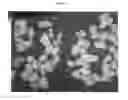
The present invention will be further detailed in the following examples of preferred embodiments of the present invention. In the examples, reference is made to a FIG. 1 wherein:
FIG. 1: shows a 30× magnification of the present polished talc microbeads after tumbling (right) and before tumbling (left).
EXAMPLES
Example 1: General Preparation of the Polished Talc Microbeads
Coarse talc (hydrated magnesium silicate) of less than 10 cm diameter was subjected to crushing and subsequently sieved to obtain a fractions with 1) an average largest diameter of 500 to 250 μm; 2) an average largest diameter of 250 to 125 μm; 3) an average largest diameter of 125 to 90 μm and 4) an average largest diameter of less than 90 μm. Subsequently, the fractions were added into a rotating drum and allowed to tumble at 60 rpm for 20 minutes in order to polish the talc particles. A representative example of the 500 to 250 μm fraction before (left) and after (right) tumbling is shown in FIG. 1. As can be seen in FIG. 1, tumbling provides smoothness and roundness to the talc particles and, additionally, provides a more spherical shape.
Example 2: Powdered Soap (Dry Soap)
Three formulations of a powdered (dry) soap were prepared by mixing the constituting ingredients in any given order:
| Fomulation 1 |
| Amount in | ||
| Compound | percentage (w/w) | Function |
| Sodium lauryl sulfoacetate | 26 | Surfactant |
| Polished talc | ad 100 | fraction less than 250 μm |
| Sorbitol | 5 | Humectant |
| Citric acid monohydrate | 0.3 | Buffer |
| Formulation 2 |
| Amount in | ||
| Compound | percentage (w/w) | Function |
| Sodium lauryl sarcosinate | 24.7 | Surfactant |
| Polished talc | ad 100 | fraction less than 250 μm |
| Citric acid | 0.3 | Buffer |
| Sodium methyl cocoyl | 5.2 | Surfactant |
| taurate | ||
| Formulation 3 |
| Amount in | ||
| Compound | percentage (w/w) | Function |
| Sodium lauryl sulfoacetate | 23.0 | Surfactant |
| Polished talc | ad 100 | fraction less than 250 μm |
| Citric acid | 0.3 | Buffer |
| Sodium methyl cocoyl | 5.7 | Surfactant |
| taurate | ||
| Sorbitol | 5.0 | Humectant |
| Allantoin | 0.2 | Skin soothing and |
| protection | ||
| Urea | 0.3 | Skin conditioning |
Example 3: Liquid Soap
| Formulation liquid soap |
| Amount in | ||
| Compound | percentage (w/w) | Function |
| Aqua | Ad 100 | Solvent |
| Acrylates/C10-30 Alkyl | 0.8 | Viscosity modifier |
| Acrylate Crosspolymer | ||
| Sodium Lauroyl | 5.13 | Surfactant |
| Sarcosinate | ||
| Sodium Laureth Sulfate | 2.7 | Surfactant |
| Cocamidopropyl Betaine | 0.9 | Surfactant |
| Triethanolamine | q.s. | buffer |
| Polished talc | 2.5 | fraction less than 250 μm |
Manufacturing Procedure:
Heat water of phase A up to 40° C. Add Acrylates/C10-30 Alkyl Acrylate Crosspolymer while stirring and homogenize for 1 to 2 min. to ensure complete hydration. Mix the remained of the ingredients and adjust the pH with triethanolamine to 6.8. Stir with moderate speed until a homogenous gel is obtained.
Appearance: milky homogenous gel
pH-Value: 6.8
Viscosity (Brookfield RVDVI, spindle 3, speed 10 rpm) mPa·s: 4500-7000
Stability: more than 3 months.
Claims
1. A cosmetics or personal hygiene product including polished talc microbeads with a talc content of more than 70% (w/w) and a largest diameter of less than 500 μm.
2. The cosmetics or personal hygiene product according to claim 1, wherein the largest diameter is between 500 μm and 250 μm and the personal hygiene product is a body scrub.
3. The cosmetics or personal hygiene product according to claim 1, wherein the largest diameter is between 250 μm and 125 μm and the personal hygiene product is a facial scrub.
4. The cosmetics or personal hygiene product according to claim 1, wherein the largest diameter is between 125 μm and 0.5 μm and the personal hygiene product is a tooth paste, cream or soap.
5. The cosmetics or personal hygiene product according to claim 1, wherein the personal hygiene product is a liquid soap comprising 1% to 5% (w/w) polished talc microbeads, 1% to 15% (w/w) of one or more surfactants and water up to 100% (w/w).
6. The cosmetics or personal hygiene product according to claim 1, wherein the personal hygiene product is a dry soap comprised of at least 50% (w/w) polished talc microbeads and at least 15% (w/w) of one or more surfactants.
7. The cosmetics or personal hygiene product according to claim 1, wherein the cosmetics or personal hygiene product comprises a body scrub comprising polished talc microbeads with a talc content of more than 70% (w/w) with a largest diameter between 500 μm and 250 μm.
8. The cosmetics or personal hygiene product according to claim 1, wherein the cosmetics or personal hygiene product comprises a facial scrub comprising polished talc microbeads with a talc content of more than 75% (w/w) with a largest diameter between 250 μm and 125 μm.
9. The cosmetics or personal hygiene product according to claim 1, wherein the cosmetics or personal hygiene product comprises a tooth paste, a cream or a soap comprising polished talc microbeads with a talc content of more than 75% (w/w) with a largest diameter is between 125 μm and 0.5 μm.
10. A soap comprising:
a liquid soap comprising 1% to 5% (w/w) polished talc microbeads, 1% to 15% (w/w) of one or more surfactants and water up to 100% (w/w); or
a dry soap comprised of at least 50% (w/w) polished talc microbeads and at least 15% (w/w) of one or more surfactants.
11. (canceled)
12. A method for providing polished talc microbeads, the method comprising:
a) providing course talc with a talc content of at least 70% and an average largest diameter of between 1 cm to 10 cm;
b) crushing the course talc particles;
c) sieving the crushed talc particles through a sieve to obtain talc particles with an average largest diameter of less than 500 μm;
d) tumbling the sieved talc particles in a tumbler to obtain polished talc microbeads.
13. The method according to claim 12, wherein said course talc in step a) has a talc content of at least one of: at least 80%, at least 90%, at least 95%, at least 96%, at least 97% at least 98%, at least 99%, or substantially 100%.
14. The method according to claim 12, wherein step c) talc particles are obtained with an average largest diameter of less than 250 μm or less than 125 μm.
15. (canceled)
Images & Drawings included:
Sources:
- United States Patent and Trademark Office - verify current appl. status at the USPTO↗
Recent applications in this class:
- » 20250281376 2025-09-11
Hair Care Composition - » 20250275899 2025-09-04
SILICA PARTICLE AND PREPARATION METHOD THEREOF, AND ORAL CLEANING AND CARE COMPOSITION - » 20250255790 2025-08-14
METHOD FOR PRODUCTION OF A NAIL COATING HAVING GLASS MICROSPHERES - » 20250221899 2025-07-10
COSMETIC - » 20250186316 2025-06-12
Coated Glass Particulate-UV Gel Composition and Method for Use - » 20250186315 2025-06-12
AMORPHOUS SILICA PARTICLE, PREPARATION METHOD AND USE THEREOF - » 20250177261 2025-06-05
CLEANSING AGENT - » 20250161176 2025-05-22
SOLID COMPOSITION FOR DYEING KERATIN - » 20250152484 2025-05-15
OIL-IN-WATER EMULSION SKIN PREPARATION FOR EXTERNAL USE - » 20250134786 2025-05-01
Composition Comprising Silicas for the Cosmetic Treatment of Keratinous Fibers
Recent applications for this Assignee:
- » 20100135886 2010-06-03
Treatment of talc in a solvent