System and method for a closed loop control in an artificial pancreas
US20190307958A1
2019-10-10
16/471,569
2016-12-30
✅ Patent granted
US 11,534,548 B2
2022-12-27
WO; PCT/CN2016/113690; 20161230
WO; WO2018/120104; 20180705
Laura A Bouchelle
JCIP Global Inc.
2037-08-01
Abstract:
The present invention provides a closed loop control method in an artificial pancreas and a system using the method, comprising sensing an activity level of a patient by at least one motion sensor and providing signals to at least one processer; then adjusting a series of related algorithms depending partly on the signals by the processer to provide more accurate and reliable data that is the basis of desirable treatment plans, and sending corresponding instructions by the processer for automatic operations of the artificial pancreas to realize a closed loop control.
Assignee:
- MEDTRUM TECHNOLOGIES INC. 124 🇨🇳 Shanghai, China
Applicant:
Interested in similar patents?
Get notified when new applications in this technology area are published.
Classification:
A61M5/1723 » CPC main
Devices for bringing media into the body in a subcutaneous, intra-vascular or intramuscular way; Accessories therefor, e.g. filling or cleaning devices, arm-rests; Infusion devices, e.g. infusing by gravity; Blood infusion; Accessories therefor; Means for controlling media flow to the body or for metering media to the body, e.g. drip meters, counters ; Monitoring media flow to the body electrical or electronic using feedback of body parameters, e.g. blood-sugar, pressure
A61M5/14248 » CPC further
Devices for bringing media into the body in a subcutaneous, intra-vascular or intramuscular way; Accessories therefor, e.g. filling or cleaning devices, arm-rests; Infusion devices, e.g. infusing by gravity; Blood infusion; Accessories therefor; Pressure infusion, e.g. using pumps adapted to be carried by the patient, e.g. portable on the body of the skin patch type
A61M2205/18 » CPC further
General characteristics of the apparatus with alarm
A61M2205/50 » CPC further
General characteristics of the apparatus with microprocessors or computers
A61M2230/201 » CPC further
Measuring parameters of the user; Blood composition characteristics Glucose concentration
A61M2230/63 » CPC further
Measuring parameters of the user Motion, e.g. physical activity
A61B5/14532 » CPC further
Measuring for diagnostic purposes ; Identification of persons; Measuring characteristics of blood , e.g. gas concentration, pH value; Measuring characteristics of body fluids or tissues, e.g. interstitial fluid, cerebral tissue for measuring glucose, e.g. by tissue impedance measurement
A61B5/0004 » CPC further
Measuring for diagnostic purposes ; Identification of persons; Remote monitoring of patients using telemetry, e.g. transmission of vital signals via a communication network characterised by the type of physiological signal transmitted
A61B5/11 IPC
Measuring for diagnostic purposes ; Identification of persons; Detecting, measuring or recording devices for testing the shape, pattern, colour, size or movement of the body or parts thereof, for diagnostic purposes Measuring movement of the entire body or parts thereof, e.g. head or hand tremor, mobility of a limb
A61B5/1118 » CPC further
Measuring for diagnostic purposes ; Identification of persons; Detecting, measuring or recording devices for testing the shape, pattern, colour, size or movement of the body or parts thereof, for diagnostic purposes; Measuring movement of the entire body or parts thereof, e.g. head or hand tremor, mobility of a limb Determining activity level
A61B5/4839 » CPC further
Measuring for diagnostic purposes ; Identification of persons; Other medical applications; Diagnosis combined with treatment in closed-loop systems or methods combined with drug delivery
A61M5/14244 » CPC further
Devices for bringing media into the body in a subcutaneous, intra-vascular or intramuscular way; Accessories therefor, e.g. filling or cleaning devices, arm-rests; Infusion devices, e.g. infusing by gravity; Blood infusion; Accessories therefor; Pressure infusion, e.g. using pumps adapted to be carried by the patient, e.g. portable on the body
A61M5/142 IPC
Devices for bringing media into the body in a subcutaneous, intra-vascular or intramuscular way; Accessories therefor, e.g. filling or cleaning devices, arm-rests; Infusion devices, e.g. infusing by gravity; Blood infusion; Accessories therefor Pressure infusion, e.g. using pumps
A61B5/0024 » CPC further
Measuring for diagnostic purposes ; Identification of persons; Remote monitoring of patients using telemetry, e.g. transmission of vital signals via a communication network characterised by features of the telemetry system for multiple sensor units attached to the patient, e.g. using a body or personal area network
A61B2560/0214 » CPC further
Constructional details of operational features of apparatus; Accessories for medical measuring apparatus; Operational features of power management of power generation or supply
A61B2560/0462 » CPC further
Constructional details of operational features of apparatus; Accessories for medical measuring apparatus; Constructional details of apparatus Apparatus with built-in sensors
A61B5/145 IPC
Measuring for diagnostic purposes ; Identification of persons Measuring characteristics of blood , e.g. gas concentration, pH value; Measuring characteristics of body fluids or tissues, e.g. interstitial fluid, cerebral tissue
A61M2005/1726 » CPC further
Devices for bringing media into the body in a subcutaneous, intra-vascular or intramuscular way; Accessories therefor, e.g. filling or cleaning devices, arm-rests; Infusion devices, e.g. infusing by gravity; Blood infusion; Accessories therefor; Means for controlling media flow to the body or for metering media to the body, e.g. drip meters, counters ; Monitoring media flow to the body electrical or electronic using feedback of body parameters, e.g. blood-sugar, pressure the body parameters being measured at, or proximate to, the infusion site
A61M2205/3303 » CPC further
General characteristics of the apparatus; Controlling, regulating or measuring Using a biosensor
A61M5/172 IPC
Devices for bringing media into the body in a subcutaneous, intra-vascular or intramuscular way; Accessories therefor, e.g. filling or cleaning devices, arm-rests; Infusion devices, e.g. infusing by gravity; Blood infusion; Accessories therefor; Means for controlling media flow to the body or for metering media to the body, e.g. drip meters, counters ; Monitoring media flow to the body electrical or electronic
G16H40/63 » CPC further
ICT specially adapted for the management or administration of healthcare resources or facilities; ICT specially adapted for the management or operation of medical equipment or devices for the operation of medical equipment or devices for local operation
A61B5/00 IPC
Measuring for diagnostic purposes ; Identification of persons
A61B5/0205 » CPC further
Measuring for diagnostic purposes ; Identification of persons; Detecting, measuring or recording pulse, heart rate, blood pressure or blood flow; Combined pulse/heart-rate/blood pressure determination; Evaluating a cardiovascular condition not otherwise provided for, e.g. using combinations of techniques provided for in this group with electrocardiography or electroauscultation; Heart catheters for measuring blood pressure Simultaneously evaluating both cardiovascular conditions and different types of body conditions, e.g. heart and respiratory condition
A61B5/6833 » CPC further
Measuring for diagnostic purposes ; Identification of persons; Arrangements of detecting, measuring or recording means, e.g. sensors, in relation to patient specially adapted to be attached to or worn on the body surface; Means for maintaining contact with the body using adhesives Adhesive patches
A61M2205/3569 » CPC further
General characteristics of the apparatus; Communication; Range sublocal, e.g. between console and disposable
Description
TECHNICAL FIELD
This invention generally relates to medical appliance, and more specifically to a system and method for adjustment of blood glucose related algorithm in a close loop artificial pancreas.
BACKGROUND
For a normal healthy person, the pancreas produces and releases insulin into the blood stream in response to elevated blood glucose levels. β-cells, which reside in the pancreas, produce and secrete the insulin into the blood stream, as it is needed. If β-cells become incapacitated or die, a condition known as Type I diabetes mellitus, or in some cases if β-cells produce insufficient quantities of insulin, Type II diabetes, then insulin must be provided to the body of the patient from another source.
Traditionally, since insulin cannot be taken orally, insulin has been injected with a syringe. More recently, use of infusion pump therapy has been increasing, especially for delivering insulin for diabetics. For example, external infusion pumps are worn on a belt, in a pocket, or patched to the body of the patient directly, and deliver insulin into the body via an infusion tube with a percutaneous needle or a cannula placed in the subcutaneous tissue. The medicine that is delivered by the infusion pump device can depend on the condition of the patient and the desired treatment plan. However, current insulin pumps and other diabetes treatment instruments are limited in switching between different treatment plans based on different conditions of the patient.
Desired treatment plans using a closed loop algorithm depend on accurate determination of the physical conditions of the patient, especially for the continuously glucose monitoring in tissue fluid whose concentration is easily influenced by the actions of the patient. If a patient is in sleep, due to less activity taking place in the muscle and organs than the normal state, whether she or he needs a low suspend or predictive low suspend requires to be recalculated by adjusted algorithms. Furthermore, some low-priority alerts should be muted to prevent disturbing the patient from sleep. Similarly, if a patient is doing physical exercise, her or his interstitial glucose value sensed by the glucose sensor may fluctuate sharply because of the frequent changes in the tissue fluid, but her or his glucose level should not be determined as abnormal. To realize the closed loop algorithm in an artificial pancreas, the combination of sensing the activity level of the patient and adjusting related algorithms is crucial.
SUMMARY OF THE INVENTION
To overcome the deficiencies of the prior art, one purpose of the present invention is to provide a method to realize a closed loop control in an artificial pancreas, comprising,
sensing an activity level of a patient and providing signals indicative of the activity level by at least one motion sensor to at least one processer;
determining the physical state of the patient according to the activity level and adjusting a plurality of algorithms via the processer depending partly on the signals from the motion sensor, and sending corresponding instructions via the processer based on the adjusted algorithms for automatic operations to realize the closed loop control.
Alternatively, the motion sensor comprises one or more from an accelerometer, a gyroscope and an attitude sensor.
Alternatively, the method further comprises adjusting the algorithms according to different exercise intensities when the patient is in a physical exercise state.
Alternatively, the blood glucose related algorithms comprise a low-suspend algorithm, a predictive low-suspend algorithm, and an alert threshold algorithm.
Alternatively, the method further comprises automatically switching the closed loop artificial pancreas between different operation modes based at least partly on the adjusted algorithms.
Alternatively, the method further comprises automatically adjusting the insulin delivery of a basal rate mode of the closed loop artificial pancreas based at least partly on the adjusted algorithms.
Alternatively, the method further comprises automatically switching the closed loop artificial pancreas to an audio-off mode for low-priority alerts that do not require immediate action according to the adjusted algorithms.
The other purpose of the present invention is to provide a closed loop artificial pancreas using the method identified above, comprising,
a patch pump and a continuous glucose monitoring (CGM) system;
at least one motion sensor set in any component of artificial pancreas, configured to sense the activity levels of a patient and provide corresponding signals;
at least one processer set in any component of artificial pancreas, configured to determine the physical states of the patient, adjust related algorithms and send corresponding instructions based partly on the signals.
Alternatively, the closed loop artificial pancreas further comprises a handset;
at least one motion sensor is set in the patch pump, the CGM system or the handset, configured to sense the activity levels of a patient and provide corresponding signals;
at least one processer is set in the patch pump, the CGM system or the handset, configured to determine the physical states of the patient, adjust related algorithms and send corresponding instructions based partly on the signals.
Alternatively, the patch pump and the CGM system are separated from each other; at least one motion sensor is set in the patch pump or the CGM system, and two processers are set in the patch pump and the CGM system respectively.
Alternatively, the patch pump and the CGM system are integrated in a single-needle-integrated artificial pancreas in which both a motion sensor and a processer are set.
The present invention has advantages in the following ways: Firstly, applying the motion sensors in the close loop artificial pancreas enables a comprehensive grasp of the patient's activity levels for a more rational treatment by distinguishing sleep and physical exercise states from the normal state; secondly, adjusting blood glucose related algorithms according to different activity levels and exercise intensities of the patient provides more applicable data and enables automatic operations of the artificial pancreas, such as suspending the delivery under low glucose condition, switching between different operation modes and adjusting insulin delivery of specific operation mode, which reflect the advantages of the closed loop control of artificial pancreas in an all-round way; thirdly, muting some low-priority alerts when sensing the patient in the state of sleep or physical exercise can reduce unnecessary disturbance to the patient making the system more pleasant to use. To sum up, the application of motion sensors in the close loop artificial pancreas enables algorithm adjustments based on different physical states and exercise intensities of the patient to provide more accurate and reliable blood glucose related data that is the basis of desirable treatment plans, and a closed loop artificial pancreas using this method satisfies the requirements of the patient on safety and intelligence of a diabetes treatment system in a more sophisticated way.
BRIEF DESCRIPTION OF THE DRAWINGS
FIG. 1-3 are schematic diagrams of a patient wearing an artificial pancreas in the present invention
FIG. 4-9 are schematic diagrams of representative method in the embodiments of the present invention
DETAILED DESCRIPTION
To make the above-mentioned objects, features and advantages of the present invention more obvious and understandable, the embodiments of the present invention are described in the following through specific embodiments.
Referring to FIG. 1, an embodiment of the system using the closed loop control in the present invention is provided. FIG. 1 illustrates a patient wearing a CGM system 1 configured to monitor the blood glucose changes in real time and a patch pump 2 configured to deliver insulin to the patient, both equipped with a processor, which communicates with each other via a processor set in a portable handset 3 configured to receive signals, process and display data, and send instructions. At least one motion sensor is set in any one, or two, or all three of the CGM system 1, the patch pump 2 and the handset 3, which will be described in following paragraphs.
Referring to FIG. 2, an embodiment of the system using the closed loop control in the present invention is provided. FIG. 2 illustrates a patient wearing an artificial pancreas comprising two separate components: a CGM system 1 and a patch pump 2, which communicate with each other via their respective processers. At least one motion sensor is set in the CGM system 1 and/or the patch pump 2, which will be described in following paragraphs.
Referring to FIG. 3, an embodiment of the system using the closed loop control in the present invention is provided. FIG. 3 illustrates a patient wearing a single-needle-integrated artificial pancreas integrated by a patch pump 2 and a built-in CGM system 1. A processer is set in the single-needle-integrated artificial pancreas to perform all the functions including receiving signals, processing data, and sending instructions. A motion sensor is also set in the single-needle-integrated artificial pancreas.
Referring to FIG. 1 and FIG. 4, an embodiment of the present invention is provided. As shown in FIG. 4, a motion sensor 101 is set in the CGM system 1, configured to sense activity levels of the patient and send corresponding signals. A processer 102 in the CGM system 1 receives signals from the motion sensor 101 and adjusts related algorithms depending partly on the signals, and the data processed using the adjusted algorithms is sent to a processer 302 in a handset 3. Through further processing, the processer 302 determines whether an operation of the patch pump 2 is needed. If so, the processer 302 sends an instruction to the processer 202 of the patch pump 2 to perform the corresponding operation automatically.
In this embodiment, the motion sensor 101 is a three-axis accelerometer 101.
When the patient is in physical exercise, the start and end of the exercise, as well as the intensity of the exercise can be determined by the equation:
ACCpower=√{square root over (ACCX2+ACCY2+ACCZ2)}
Where,
ACCpower is the acceleration amplitude of all three axes;
ACCX: is the acceleration data of the X axis;
ACCY is the acceleration data of the Y axis;
ACCZ is the acceleration data of the Z axis.
The attitudes of the patient, whether she or he is standing, sitting, lying, or changing from one of these attitudes to another, can be sensed by the three-axis accelerometer 101. In other words, the attitude changes of the patient can be tracked by the three-axis accelerometer 101 in real time. When the patient goes to sleep, the state can be determined by the equation:
ACCvar=(ACCX−ACCX|PRE)2+(ACCY−ACCY|PRE)2+(ACCZ−ACCZ|PRE)2
Where,
ACCvar is the acceleration variation of all three axes;
ACCX is the acceleration data of the X axis;
ACCY is the acceleration data of the Y axis;
ACCZ is the acceleration data of the Z axis;
ACCX|PRE is the acceleration data of the X axis at a previous time;
ACCY|PRE is the acceleration data of the Y axis at a previous time;
ACCZ|PRE is the acceleration data of the Z axis at a previous time.
The algorithms adjusted by the processer 102 comprise but not limited to a low-suspend algorithm, a predictive low-suspend algorithm; and an alert threshold algorithm. As shown in FIG. 4, data processed according to the adjusted algorithms is sent to the handset 3, and the processer 302 in the handset 3 determines whether an operation should be performed automatically by the patch pump 2. If so, the processer 302 sends an instruction to the processer 202 of the patch pump 2. The operations comprise but not limited to a delivery suspend according to the low-suspend algorithm or the predictive low-suspend algorithm, a change of operation modes, an adjustment of the insulin delivery amount of a basal rate mode, and switching the CGM system 1 and the patch pump 2 into an audio-off mode for low priority alerts according to the adjusted algorithm when the patient is determined in a state of sleep or physical exercise.
Referring to FIG. 1 and FIG. 5, an embodiment of the present invention is provided. As shown in FIG. 5, a motion sensor 101 is set in the CGM system 1, and the signals provided by the motion sensor 101 are sent to and processed by a processer 302 set in the handset 3 via a transmitting module 1021 set in the CGM system 1. The processer 302 in the handset 3 adjusts related algorithms depending partly on the signals, and determines whether an operation of the patch pump 2 is needed. If so, the processer 302 sends an instruction to the processer 202 of the patch pump 2 to perform the corresponding operation automatically.
Referring to FIG. 1 and FIG. 6, an embodiment of the present invention is provided. As shown in FIG. 6, a motion sensor 301 is set in a portable handset 3 to sense the activity levels of the patient when the patient is carrying the handset 3, and the signals provided by the motion sensor 301 are sent to and processed by a processer 302 set in the handset 3. The processer 302 in the handset 3 adjusts related algorithms depending partly on the signals, and processes the glucose data provided by a processer 102 of the CGM system 1 accordingly. The processer 302 in the handset 3 further determines whether an operation of the patch pump 2 is needed. If so, the processer 302 of the handset 3 sends an instruction to the processer 202 of the patch pump 2 to perform the corresponding operation automatically.
Referring to FIG. 2 and FIG. 7, an embodiment of the present invention is provided. As shown in FIG. 7, a motion sensor 101 is set in the CGM system 1, and the signals provided by the motion sensor 101 are sent to and processed by a processer 102 which is also set in the CGM system 1. The processer 102 adjusts related algorithms depending partly on the signals, and the data processed using the adjusted algorithm is sent to a processer 202 in a patch pump 2 directly. Through further processing, the processer 202 determines whether an operation of the patch pump 2 is needed. If so, an instruction is generated from the processer 202 for the patch pump 2 to perform the corresponding operation automatically.
Referring to FIG. 2 and FIG. 8, an embodiment of the present invention is provided. As shown in FIG. 8, a motion sensor 201 is set in the patch pump 2, and the signals provided by the motion sensor 201 are sent to the processer 202 which is also set in the patch pump 2. The processer 202 determines the physical state of the patient, in specific, whether the patient is in sleep or doing physical exercise, then switches the patch pump 2 to an appropriate operation mode according to the state of the patient automatically. At the same time, the processer 202 sends a signal comprising the physical state and exercise intensity of the patient to the processer 102 of the CGM system to adjust related algorithms, calculating the blood glucose values based on the adjusted algorithms which reflect the actual state of the patient.
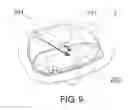
Referring to FIG. 3 and FIG. 9, an embodiment of the present invention is provided. As shown in FIG. 9, a single-needle-integrated artificial pancreas comprises a patch pump 2 and a built-in glucose sensor 111 in FIG. 9. A motion sensor 201 is set in the single-needle-integrated artificial pancreas, and a processer 202 configured to perform all the functions of receiving signals, processing data, and sending instructions is also set in the single-needle-integrated artificial pancreas. The motion sensor 201 senses activity levels of the patient and send corresponding signals to the processer 202. The processer 202 receives signals from the motion sensor 201 and adjusts related algorithms depending partly on the signals to process the glucose data received from the built-in glucose sensor 111, and determines whether an operation of the single-needle-integrated artificial pancreas is needed. If so, an instruction is generated from the processer 202 for the patch pump 2 to perform the corresponding operation automatically, realizing the closed loop control in the single-needle-integrated artificial pancreas.
The above descriptions of the detailed embodiments are only to illustrate the principle and the effect of the present invention, and it is not to limit the scope of the present invention. Those skilled in the art can modify or change the embodiments without departing from the spirit and scope of the present invention. Accordingly, all equivalent modifications and variations completed by persons of ordinary skill in the art, without departing from the spirit and technical idea of the present invention, should fall within the scope of the present disclosure defined by the appended claims.
Claims
1. A method to realize a closed loop control in an artificial pancreas, comprising:
sensing an activity level of a patient by at least one motion sensor set in an artificial pancreas;
providing signals indicative of the activity level of the patient by the motion sensor to at least one processer of the artificial pancreas;
determining the physical state of the patient according to the activity level via the processer;
adjusting a plurality of algorithms via the processer depending partly on the signals from the motion sensor; and
sending corresponding instructions based on the adjusted algorithms via the processer for automatic operations of the artificial pancreas.
2. The method according to claim 1, wherein the motion sensor comprises one or more from an accelerometer, a gyroscope and an attitude sensor.
3. The method according to claim 1, wherein the algorithms comprise a low-suspend algorithm.
4. The method according to claim 1, wherein the algorithms comprise a predicted low-suspend algorithm.
5. The method according to claim 1, wherein the algorithms comprise an alert threshold algorithm.
6. The method according to claim 1, wherein the method further comprises automatically switching the artificial pancreas between different operation modes based at least partly on the adjusted algorithms.
7. The method according to claim 1, wherein the method further comprises automatically adjusting the insulin delivery of a basal rate mode of the artificial pancreas based at least partly on the adjusted algorithms.
8. The method according to claim 1, wherein the method further comprises automatically switching the artificial pancreas to an audio-off mode for low-priority alerts that do not require immediate action according to the adjusted algorithms.
9. A closed loop artificial pancreas using the method according to claim 1, comprising,
a patch pump and a continuous glucose monitoring (CGM) system;
at least one motion sensor set in any component of artificial pancreas, configured to sense the activity levels of a patient and provide corresponding signals; and
at least one processer set in any component of artificial pancreas, configured to determine the physical states of the patient, adjust related algorithms and send corresponding instructions based partly on the signals.
10. The closed loop artificial pancreas according to claim 9, wherein the closed loop artificial pancreas further comprises:
a handset;
at least one motion sensor is set in the patch pump, the CGM system or the handset, configured to sense the activity levels of a patient and provide corresponding signals; and
at least one processer is set in the patch pump, the CGM system or the handset, configured to determine the physical states of the patient, adjust related algorithms and send corresponding instructions based partly on the signals.
11. The closed loop artificial pancreas according to claim 10, wherein
the patch pump and the CGM system are separated from each other;
at least one motion sensor is set in the patch pump or the CGM system; and
two processers are set in the patch pump and the CGM system respectively.
12. The closed loop artificial pancreas according to claim 10, wherein
the patch pump and the CGM system are integrated in a single-needle-integrated artificial pancreas; and
both a motion sensor and a processer are set in the single-needle-integrated artificial pancreas.
13. The method according to claim 1, wherein the method further comprises adjusting the algorithms according to different exercise intensities when the patient is in a physical exercise state.
Images & Drawings included:



Sources:
- United States Patent and Trademark Office - verify current appl. status at the USPTO↗
Similar patent applications:
- » 20140276554
Method and system for closed-loop control of an artificial pancreas - » 20140276555
Method and system for closed-loop control of an artificial pancreas - » 20180043095
METHOD AND SYSTEM FOR CLOSED-LOOP CONTROL OF AN ARTIFICIAL PANCREAS - » 20140163517
Method and system for tuning a closed-loop controller for an artificial pancreas - » 20150100038
Method and system for controlling a tuning factor due to sensor replacement for closed-loop controller in an artificial pancreas
Recent applications in this class:
- » 20250288741 2025-09-18
INCREASED PARAMETER TITRATION FREQUENCY VIA ANALYTE HISTORY ADJUSTMENT - » 20250288740 2025-09-18
SYSTEM AND METHODS TO CUSTOMIZE MODES INTO ACTIONABLE PUMP SETTINGS - » 20250281694 2025-09-11
SYSTEM AND METHOD FOR SWITCHING BETWEEN CLOSED LOOP AND OPEN LOOP CONTROL OF AN AMBULATORY INFUSION PUMP - » 20250276127 2025-09-04
THERAPEUTIC METHODS AND DEVICES - » 20250269113 2025-08-28
INFUSION DEVICES AND RELATED RESCUE DETECTION METHODS - » 20250269112 2025-08-28
Methods and Systems to Validate Physiologic Waveform Reliability and Uses Thereof - » 20250262381 2025-08-21
ADJUSTING INSULIN DELIVERY RATES - » 20250262380 2025-08-21
URINE OUTPUT SENSING WITHOUT USE OF AN INDWELLING CATHETER, AND ASSOCIATED SYSTEMS, DEVICES, AND METHODS - » 20250262379 2025-08-21
AUTOMATIC MEDICAMENT DELIVERY DEVICE UTILIZING LIMITED OR NO USER INPUT - » 20250256027 2025-08-14
SYSTEM AND METHOD FOR ADJUSTING INSULIN DELIVERY
Recent applications for this Assignee:
- » 20250235614 2025-07-24
CLOSED-LOOP ARTIFICIAL PANCREAS INSULIN INFUSION CONTROL SYSTEM - » 20250235609 2025-07-24
CLOSED-LOOP ARTIFICIAL PANCREAS INSULIN INFUSION CONTROL SYSTEM - » 20250235606 2025-07-24
CLOSED-LOOP ARTIFICIAL PANCREAS INSULIN INFUSION CONTROL SYSTEM - » 20250229023 2025-07-17
CLOSED-LOOP ARTIFICIAL PANCREAS INSULIN INFUSION CONTROL SYSTEM - » 20250229018 2025-07-17
DRUG INFUSION DEVICE WITH INTEGRATED POWER SUPPLY AND ARTIFICIAL PANCREAS - » 20250221644 2025-07-10
CALIBRATION FREE ANALYTE DETECTION DEVICE - » 20250221640 2025-07-10
COMMUNICATION SYSTEM OF ANALYTE DETECTION DEVICE - » 20250221638 2025-07-10
ENERGY-EFFICIENT ANALYTE DETECTION SYSTEM - » 20250195759 2025-06-19
HIGHLY INTEGRATED DRUG INFUSION DEVICE - » 20250169719 2025-05-29
INSTALLATION UNIT OF ANALYTE DETECTION DEVICE