Method and device for signalizing a walking or running speed to a runner or walker
US20190328286A1
2019-10-31
16/467,324
2016-12-09
✅ Patent granted
US 10,791,967 B2
2020-10-06
WO; PCT/EP2016/002082; 20161209
WO; WO2018/103812; 20180614
Ahn V La
Lucas & Mercanti, LLP | Klaus P. Stoffel
2036-12-09
Abstract:
A method and a device for signalizing a walking or running speed to a runner or walker during walking or running, wherein the runner or walker wears a garment. To conveniently inform the walker or runner about his or her actual walking or running speed, the method includes: a) Determining the actual speed by a speedometer which is worn or carried by the runner or walker; b) Transferring of the actual speed into a light signal, wherein the light signal corresponds to the speed; c) Displaying the light signal by a light emitting element which is attached to the or integrated into the garment.
Assignee:
- PUMA SE 115 🇩🇪 Herzogenaurach, Germany
Applicant:
Interested in similar patents?
Get notified when new applications in this technology area are published.
Classification:
G08B1/08 IPC
Systems for signalling characterised solely by the form of transmission of the signal using electric transmission ; transformation of alarm signals to electrical signals from a different medium, e.g. transmission of an electric alarm signal upon detection of an audible alarm signal
A61B5/6804 » CPC further
Measuring for diagnostic purposes ; Identification of persons; Arrangements of detecting, measuring or recording means, e.g. sensors, in relation to patient specially adapted to be attached to or worn on the body surface; Sensor mounted on worn items Garments; Clothes
A61B5/742 » CPC further
Measuring for diagnostic purposes ; Identification of persons; Details of notification to user or communication with user or patient ; user input means using visual displays
G08B5/36 » CPC further
Visible signalling systems, e.g. personal calling systems, remote indication of seats occupied using electric transmission; using electromagnetic transmission using visible light sources
H04M1/725 IPC
Substation equipment, e.g. for use by subscribers; Mobile telephones; Cordless telephones, i.e. devices for establishing wireless links to base stations without route selection Cordless telephones
A61B5/00 IPC
Measuring for diagnostic purposes ; Identification of persons
G01S19/52 » CPC further
Satellite radio beacon positioning systems; Determining position, velocity or attitude using signals transmitted by such systems; Determining a navigation solution using signals transmitted by a satellite radio beacon positioning system the satellite radio beacon positioning system transmitting time-stamped messages, e.g. GPS [Global Positioning System], GLONASS [Global Orbiting Navigation Satellite System] or GALILEO Determining velocity
H04W4/029 » CPC further
Services specially adapted for wireless communication networks; Facilities therefor; Services making use of location information Location-based management or tracking services
A61B5/11 IPC
Measuring for diagnostic purposes ; Identification of persons; Detecting, measuring or recording devices for testing the shape, pattern, colour, size or movement of the body or parts thereof, for diagnostic purposes Measuring movement of the entire body or parts thereof, e.g. head or hand tremor, mobility of a limb
A61B5/1118 » CPC main
Measuring for diagnostic purposes ; Identification of persons; Detecting, measuring or recording devices for testing the shape, pattern, colour, size or movement of the body or parts thereof, for diagnostic purposes; Measuring movement of the entire body or parts thereof, e.g. head or hand tremor, mobility of a limb Determining activity level
Description
The invention relates to a method for signalizing a walking or running speed to a runner or walker during walking or running, wherein the runner or walker wears a garment. Furthermore, the invention relates to a device for a runner or walker for signalizing a walking or running speed.
Especially during sport activities it is often of interest for a runner or walker to know the actual walking or running speed. Speedometers are well known in the art, for example designed like a watch. In many cases it disturbs the sport activity when the walker or runner must read the display of the speedometer to get the desired information concerning his or her actual speed.
Thus, it is an object of the invention to propose a method and a device by which it is possible to transfer the information concerning the actual speed of a walker or runner to the same in a convenient manner so that walking or running is not disturbed or hindered.
The solution of this object according to the invention is characterized in that the method comprises:
-
- a) Determining the actual speed by a speedometer which is worn or carried by the runner or walker;
- b) Transferring of the actual speed into a light signal, wherein the light signal corresponds to the speed;
- c) Displaying the light signal by means of a light emitting element which is attached to the or integrated into the garment.
A slightly modified concept is characterized in that the method comprises:
-
- a) Determining the actual speed by a speedometer which is worn or carried by the runner or walker;
- b) Calculating the difference speed between the actual speed and a predetermined reference speed;
- c) Transferring of the difference speed into a light signal, wherein the light signal corresponds to the difference speed;
- d) Displaying the light signal by means of a light emitting element which is attached to the or integrated into the garment.
That is, according to the invention the actual speed of the walker or runner or the difference speed to a set (predetermined) given value is communicated by means of a light emitting element which is connected with the garment. Preferably a glass fiber and optical fiber respectively (also an electroluminescent element can be taken into consideration here) is used as the light emitting element which preferably runs down the arm sleeves of the garment—if the garment is a jacket or the like—so that the walker or runner can have an easy view to the light emitting element. It is not necessary to read a display of a speedometer to get the information about the actual speed of the walker or runner. It becomes specifically easy to monitor in a convenient manner if a desired set speed of the walker or runner is kept.
While a jacket, especially a running jacket, or the like is preferred it is however also possible to apply the concept according to the present idea to other garments like for example a running trouser or the like.
Preferably, the speedometer comprises or is an electronic device with a GPS module, wherein the actual speed is determined by means of a change in the position detected by the GPS module and the time elapsed during the position change.
Thereby, preferably a GPS module is used which is part of a mobile phone (the term “smart phone” is used herein equivalently).
The speed determination can be carried out by an app (software application) in the mobile phone. Also, the transferring of the actual speed or of the difference speed into the light signal can be carried out by an app in the mobile phone.
To signalize the actual speed or difference speed to a set speed different possibilities are recommended:
In above step b) according to the first mentioned method or in above step c) according to the second mentioned method the transfer can take place by defining an intensity of the light signal in dependency on the actual speed or difference speed (more or less light intensity dependent of the deviation from a set speed).
Alternatively, the transfer can take place by defining periodical interruption phases for the light signal in dependency on the actual speed or difference speed. The frequency of the interruption can increase with the magnitude of the absolute value of the deviation from the set speed.
A specifically preferred embodiment of the method proposes that the transfer takes place by defining at least one predetermined color of the light signal in dependency on the actual speed or difference speed. Thus, the walker or runner can easily get the information about his or her actual speed by simply watching the actual color of the light emitting element.
In this case a special embodiment exhibits that the difference speed between the actual speed and a given set value of the speed is signalized in such a manner that a first color is displayed if the actual speed is below a first predetermined percentage of the reference speed and that a second color, which is different from the first color, is displayed if the actual speed is above a second predetermined percentage of the reference speed. The first predetermined percentage and/or the second predetermined percentage is preferably between 1% and 10%.
In addition no light signal can be displayed if the actual speed is above the first predetermined percentage of the reference speed and below the second predetermined percentage of the reference speed. This has to be understood in such a manner that no signal is displayed if the actual speed is within a tolerance which is defined by the first percentage of the reference speed below the same as the lower limit and the second percentage of the reference speed above the same as the upper limit. Becoming slower than the lower limit will result in the display of the first color, becoming faster than the upper limit will result in the display of the second color.
That is, as long the walker or runner keeps a speed which is within a defined limit of tolerance no light signal is given via the light emitting element. If the speed of the walker or runner is reduced below the mentioned first percentage a first color (preferably: red) is displayed by the light emitting element (preferably by the glass fiber or optical fiber); the message to the walker or runner is: too slow. If the speed of the walker or runner is increased above the mentioned second percentage a second color (preferably: blue) is displayed by the light emitting element (preferably by the glass fiber or optical fiber); the message to the walker or runner is: too fast or fast enough.
As an alternative to displaying no light signal in the mentioned case it can also be taken into consideration that a third color, which is different from the first color and from the second color, is displayed if the actual speed is above the first predetermined percentage of the reference speed and below the second predetermined percentage of the reference speed.
That is, for example a red light signal is given in the case “too slow” and a blue light signal can be given in the case “faster than the upper tolerance limit”. If the speed is within the tolerance a green light signal can be given, saying “speed within the set range”.
So the walker or runner can easily keep a desired speed without reading any display of a speedometer.
The device for a runner or walker for signalizing a walking or running speed to the runner or walker during walking or running, is characterized in that it comprises:
-
- a garment worn by the runner or walker during running or walking,
- at least one light emitting element which is attached to the or integrated into the garment,
- a receiving chamber or holding device for receiving or holding of a mobile phone which comprises a GPS module,
- a control element for controlling the activation of the at least one light emitting element in accordance with a signal emitted by the mobile phone and
- connection means for connecting the control element with the mobile phone, wherein the mobile phone or the control element comprises a speedometer for measuring the actual speed of the runner or walker.
The communication between the mobile phone and the control element which controls the light emitting elements occurs preferably wireless. The connection means comprise preferably elements for establishing a Blue Tooth connection which needs not to be described in detail here as it is well known in the art.
The receiving chamber is preferably a pocket in the inner side of the garment.
Alternatively, another holding device can be used to keep the mobile phone in place.
The at least one light emitting element is preferably an optical fiber which is fixed to the garment, especially to arm sleeves of the garment.
Each one single light emitting element can be arranged in the left and in the right region of the garment.
The garment has preferably two arm sleeves which reach down at least to the elbow of the runner or walker.
This method steps are preferably repeated and carried out periodically to show a permanent signal to the walker or runner concerning his or her actual speed.
The garment is preferably a runner's jacket. However, the concept according to the present idea can of course be also applied to other garments like for example a running trouser.
Thus, the invention is basing on the idea that a smart phone with its GPS navigation function is used to deliver an effective tool for a runner or walker to get information concerning his or her actual speed. The information is communicated by means of optical signals.
Thus, it is an important aspect of the concept of the present invention that a smart phone is used, especially to assist during physical training (running). Beneficially, two distinct optical elements (optical fibers/glass fibers/electroluminescent element) are anchored in a garment on the sleeves of the same to make the speed information visible in an easy manner.
The optical elements (optical fibers/glass fibers) are connected with a Blue Tooth device which communicates with the smart phone which is worn during the physical training.
According to the situation and controlled by the smart phone light is emitted into the distinct optical fibers by a control element which gets its information via Blue Tooth from the smart phone. So, an actual speed and specifically the difference between an actual speed and a set (predetermined) speed can be displayed in the mentioned manner.
While the present invention is here referred to a walker or runner who is wearing the garment in question it is of course also applicable and claimed for all athletes who carry out a sports with a certain speed or velocity like a skier or cyclist.
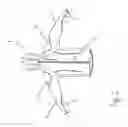
In the drawings an embodiment of the invention is shown.
FIG. 1 shows the front view of a sports garment being a running jacket and
FIG. 2 shows schematically a part of the sports garment according to the invention.
In FIG. 1 a garment 1 being a runner's jacket is shown which has two (long) arm sleeves 9 and 10. In the inner of the garment 1 a receiving chamber 6 (see FIG. 2) is arranged in which a mobile phone 5 is inserted. A light emitting element 3 being an optical fiber is arranged in the garment 1 (or two separate light emitting elements 3) which extend in the sleeve region of the garment 1.
In FIG. 2 details of the arrangement are shown schematically. The receiving chamber 6 in the garment 1 is shown in which the smart phone 5 is inserted. The smart phone 5 has a OPS module 4, as known in the art, i. e. the exact position of the wearer of the smart phone 5 can be detected. The GPS module 4 is connected with a speedometer 2 (the speedometer 2 can be a part of the smart phone 5, as depicted, or can be a part of the control element 7, see below). The speedometer 2 receives permanently the change of the location of the smart phone 5 by means of the GPS module 4 and can calculate by means of an internal clock the actual speed (v=Δs/Δt, with Δs being the difference in location in m and Δt being the time difference in s which elapsed while the difference of location took place).
The smart phone 5 can communicate via connection means 8 (being a Blue Tooth connection in the present case) with a control element 7 which is mounted in the garment 1.
For displaying the actual speed v to the walker or runner or the actual difference between the actual speed and a set predetermined speed (which can be calculated in the smart phone 5 or in the control element 7) the signal is communicated via the connection means 8 to the control element 7. The control element 7 has a light emitting diode (LED) 11 which can be switched or influenced by the control element 7. The LED 11 is connected with the light emitting element 3. The LED 11 is specifically designed to emit light of different colors according to the control signal for the LED.
Consequently, according to the actual speed v of the walker or runner a light signal can be output to the walker or runner via the light emitting element 3.
As a preferred embodiment of the invention the light emitting element 3 is designed as a glass fiber/optical fiber which is integrated or anchored into the sleeves 9, 10 of the garment 1.
As said, the control element 7 can be designed to influence the color of the light emitting diode 11. Thus, a signal being a color or color change can be given to the user of the system which correlates with the actual speed v of the user or a difference speed between the actual speed and a set speed value.
REFERENCE NUMERALS
- 1 Garment
- 2 Speedometer
- 3 Light emitting element
- 4 GPS module
- 5 Mobile phone/smart phone
- 6 Receiving chamber
- 7 Control element
- 8 Connection means
- 9 Arm sleeve
- 10 Arm sleeve
- 11 Light Emitting Diode
- v Actual running/walking speed
- v0 Reference speed
- Δv Difference speed (v−v0)
Claims
1-22. (canceled)
23. A method for signalizing a walking or running speed to a runner or walker during walking or running, wherein the runner or walker wears a garment, wherein the method comprises:
a) Determining the actual speed by a speedometer which is worn or carried by the runner or walker;
b) Calculating the difference speed between the actual speed (v) and a predetermined reference speed;
c) Transferring of the difference speed into a light signal, wherein the light signal corresponds to the difference speed;
d) Displaying the light signal by means of a light emitting element,
wherein in step c) the transfer takes place by defining at least one predetermined color of the light signal in dependency on the difference speed,
wherein a first color is displayed if the actual speed is below a first predetermined percentage of the reference speed and
wherein a second color, which is different from the first color, is displayed if the actual speed is above a second predetermined percentage of the reference speed,
wherein no light signal or a third color, which is different from the first color and from the second color, is displayed if the actual speed is above the first predetermined percentage of the reference speed and below the second predetermined percentage of the reference speed,
wherein the speedometer comprises or is an electronic device with a GPS module, wherein the actual speed is determined by means of a change in the position detected by the GPS module and the time elapsed during the position change, wherein a GPS module is used which is part of a mobile phone, wherein
displaying the light signal according to step d) takes place by a light emitting element in the form of a glass fiber or an optical fiber, which is attached to the or integrated into the garment.
24. The method according to claim 23, wherein the speed determination is carried out by an app in the mobile phone.
25. The method according to claim 23, wherein the transferring of the difference speed into the light signal is carried out by an app in the mobile phone.
26. The method according to claim 23, wherein the first predetermined percentage and/or the second predetermined percentage is between 1% and 10%.
27. The method according to claim 23, wherein the first color is red.
28. The method according to claim 23, wherein the second color is blue.
29. The method according to claim 23, wherein the third color is green.
Images & Drawings included:


Sources:
- United States Patent and Trademark Office - verify current appl. status at the USPTO↗
Recent applications in this class:
- » 20250261878 2025-08-21
Electronics Module and Method - » 20250213140 2025-07-03
SYSTEM FOR OBTAINING BIOMETRIC PARAMETERS BY MEANS OF A COLLAR-MASK DEVICE - » 20250185944 2025-06-12
REMOTE CONTROLLED PHYSICAL ACTIVITY MONITORING - » 20250176858 2025-06-05
METHOD FOR ASSESSING PAIN EXPERIENCED BY A PATIENT - » 20250090046 2025-03-20
PERFORMANCE FORECASTING FOR ACTIVITIES - » 20250082229 2025-03-13
A Machine Learning Pipeline for Highly-Sensitive Assessment of Rotator Cuff Function - » 20250072787 2025-03-06
AUTOMATIC SEGMENTATION OF INERTIAL SENSOR DATA - » 20250064344 2025-02-27
HEARING DEVICE WITH HEALTH CHARACTERIZATION AND/OR MONITORING AND RELATED METHODS - » 20250057446 2025-02-20
Body Noise-Based Health Monitoring - » 20250000388 2025-01-02
DETECTION SYSTEM, DETECTION METHOD, AND A NON-TRANSITORY COMPUTER-READABLE STORAGE MEDIUM
Recent applications for this Assignee:
- » 20240373976 2024-11-14
ARTICLES OF FOOTWEAR WITH SUPPORT STRUCTURES - » 20240277116 2024-08-22
Outsole pattern for an article of footwear - » 20240251908 2024-08-01
Article of footwear having a sole plate - » 20240074542 2024-03-07
Outsole pattern for an article of footwear - » 20240065382 2024-02-29
Rotary closure with tensioning element - » 20240057722 2024-02-22
SYSTEMS AND METHODS FOR FASTENING A SHOE - » 20240041155 2024-02-08
Article of footwear having a display system - » 20240032642 2024-02-01
ARTICLE OF FOOTWEAR HAVING A DISPLAY SYSTEM - » 20240008585 2024-01-11
Article of footwear having a textile display system - » 20230413945 2023-12-28
Article of footwear having a sole plate