HANDGUN HOLSTER
US20190331455A1
2019-10-31
16/383,599
2019-04-13
Abstract:
The handgun holster is provided with a holster body which defines a cavity which is sized to receive a handgun which is inserted in the cavity through a cavity opening. The holster body has an inner side surface to be positioned adjacent the wearers body and an outer side surface facing away from the wearers body. The holster also has a forward edge region extending between the inner side and outer side surfaces. The holster body is provided with a transverse ridge or recess which is positioned below at least a portion of the upper opening at a distance. The transverse ridge or recess enables a wearers hand to grasp the transverse rib or recess with the wearers fingers of one hand while retaining the weapon in the holster with the thumb and palm of the same hand.
Interested in similar patents?
Get notified when new applications in this technology area are published.
Classification:
F41C33/0263 » CPC main
Means for wearing or carrying smallarms; Holsters, i.e. cases for pistols having means for being carried or worn, e.g. at the belt or under the arm having a locking system for preventing unauthorized or accidental removal of the small arm from the holster
F41C33/02 IPC
Means for wearing or carrying smallarms Holsters, i.e. cases for pistols having means for being carried or worn, e.g. at the belt or under the arm
Description
CROSS-REFERENCE TO RELATED APPLICATIONS
This application claims the benefit of U.S. provisional application Ser. No. 62/662,527 filed Apr. 25, 2018, the disclosure of which is hereby incorporated in its entirety by reference herein.
TECHNICAL FIELD
This application relates to handgun holsters designed to prevent the unintended withdrawal of the weapon by someone other than the holster wearer.
BACKGROUND
There is a need to configure handgun holsters in a matter to prevent someone other than the holster wearer from removing the handgun from the holster. This objective is typically achieved by a pivoting U-shaped hood which is held in place by a one or two stage locking mechanism or a single or multi locking system with or without a hood. Even with a weapon retention hood, there is a need to prevent an aggressor from removing a wearers weapon. This frequently requires the use of two hands making it difficult to subdue the aggressor. An object of the present invention is to enable a wearer of a handgun holster to retain the weapon in the holster with one hand even if an aggressor has managed to grab the handgun grip and release the retention hood or unlock the locking system. This frees the wearers other hand to subdue the aggressor.
SUMMARY
The handgun holster is provided with a holster body which defines a cavity which is sized to receive a handgun which is inserted in the cavity through a cavity opening. The holster body has an inner side surface to be positioned adjacent the wearers body and an outer side surface facing away from the wearers body. The holster also has a forward edge region extending between the inner side and outer side surfaces. The holster body is provided with a transverse ridge or recess which is positioned below at least a portion of the upper opening at a distance. The transverse ridge or recess enables a wearers hand to grasp the transverse rib or recess with the wearers fingers of one hand while retaining the weapon in the holster with the thumb and palm of the same hand. The transverse ridge or recess can be positioned on the outer facing side surface of the holster or on the forward edge of the holster.
BRIEF DESCRIPTION OF THE DRAWINGS
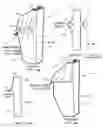
FIG. 1A is a preferred embodiment of a handgun holster having a raised ridge in the holster outside surface.
FIG. 1B is a front view of the holster of FIG. 1A.
FIG. 2A is an alternative handgun holster embodiment having a transverse recess of the holster's outside surface.
FIG. 2B is a front view of the holster of FIG. 2A.
FIG. 3A is an exploded fragmentary front view illustrating a user's finger tips wrapped under the raised ridge on the holster body.
FIG. 3B is a front view of the holster shown in the FIG. 3A detail.
FIGS. 4, 5 and 6 further illustrate the ridge design for a handgun holster shown in FIGS. 1A, 1B, 3A and 3B.
FIGS. 7 and 8 illustrate an aggressor grabbing the weapon in FIG. 7 and the wearer using the raised ridge to retain the weapon with one hand in FIG. 8.
FIG. 9A, 9B and 9C is an alternative holster design with a raised ridge as a form on the front edge of the holster enabling the weapon to be squeezed between the wearers index finger and thumb.
DETAILED DESCRIPTION
As required, detailed embodiments of the present invention are disclosed herein; however, it is to be understood that the disclosed embodiments are merely exemplary of the invention that may be embodied in various and alternative forms. The figures are not necessarily to scale; some features may be exaggerated or minimized to show details of particular components. Therefore, specific structural and functional details disclosed herein are not to be interpreted as limiting, but merely as a representative basis for teaching one skilled in the art to variously employ the present invention.
The handgun holster 10 is provided with a holster body 12 which defines a cavity 14 which is sized to receive a handgun 16 which is inserted in the cavity through a cavity opening 18. The holster body 12 has an inner side surface 20 to be positioned adjacent the wearers body 22 and an outer side surface 24 facing away from the wearers body. The holster 10 also has a forward edge region 26 extending between the inner side 20 and outer side surface 24. The holster body is provided with a transverse ridge 28 or recess 30 which is positioned a distance below at least a portion of the upper edge 32 of cavity opening 18. The transverse ridge 28 or recess 30 enables a wearers hand 34 to grasp the transverse rib 28 or recess 30 with the wearers fingers of one hand while retaining the weapon in the holster with the thumb and palm of the same hand. The transverse ridge 28 or recess 30 can be positioned on the outer facing side surface 24 of the holster or on the forward edge 36 of the holster.
The transverse retention ridge 28 may be used in accordance with a conventional hood design (locking or snapping style) and/or a locking mechanism and/or lever release style. The retention ridge may be used alone or along with any threat level retention system.
-
- Level 1 Retention—A passive retention device which utilized a hood and/or tension screw
- Level 2 Retention—An active retention device
- Level 3 Retention—A hood, tension screw, active retention device
Various embodiments of the claimed handgun holster design are shown in the drawings. In use the holsters will also be equipped with a weapon retention hood and an attachment for a belt or harness. Holsters can be fabricated from leather, plastic or fiber reinforced composites.
A first example of the handgun holster 10 is shown in FIGS. 1A and 1B. The holster has a body defining an internal cavity 12 having a cavity opening 18 in the upper region thereof. The holster has an inside surface 20 to be positioned against the wearers body and an outside surface 24 positioned away from the wearers body. The outside surface 24 in FIG. 1A is provided with a transverse raised ridge 28 which is 0.2-0.8 inches high extending substantially 0.75-3.0 inches along the transverse width of the holster positioned below the upper region edge 32 of the holster opening. The rim of the ridge is positioned 1-4 inches from the upper most region 36 of the holster or 2-5 inches from the top of the hand gun the holster is sized to receive. This location enables the user to grip the ridge with the user's fingertips 38 while using the palm and thumb of the same hand to retain the weapon in the holster.
FIGS. 2A and 2B illustrate an alternative holster embodiment 10′ having a transverse recess 30 sized to receive the user's fingertips.
A front view of the weapon 16 is shown in FIGS. 3A and 3B retained in the holster. The ridge 30 is placed a distance below the upper most portion of the opening 18 to enable the weapon to be grasped with the users thumb and palm while the user's fingertips are wrapped under the ridge to secure the weapon.
FIGS. 4-6 illustrate an alternative holster embodiment 10″, with the ridge formed as a hood 38 which helps prevent the forward or rearward edge of the ridge from catching on objects such as clothing or seatbelts. Hood 38 define a ridge 30 that the wear's fingers can grip under as shown in FIG. 5. This enables the wearer to apply tension on the weapon to retain the weapon in the holster. The hood 38 may be added to the holster as an aftermarket accessory or incorporated in the holster when originally manufactures.
FIG. 7 illustrates a gun grabbed by an aggressor 40, where an aggressor has freed the weapon retention hood and/or locking system and grasped the handgun grip.
FIG. 8 illustrates the wearer with one hand 34 grasping the ridge with the wearers fingertips while securely holding the weapon in the holster using the palm and thumb of one hand leaving the wearers other hand free to subdue the aggressor.
FIG. 9A, 9B and 9C illustrates an alternative embodiment 10′″ of the holster or the raised ridge 42 or recess which is located on the front edge 26 of the holster as opposed to the outer side surface 24. This embodiment and the users index finger can be hooked under the ridge or recess while the users palm and thumb can squeeze the weapon into the holster to securely retain it. Preferably, the ridge can withstand at least 100 lbs. of grip force and preferably over 150 lbs. of grip force.
While exemplary embodiments are described above, it is not intended that these embodiments describe all possible forms of the invention. Rather, the words used in the specification are words of description rather than limitation, and it is understood that various changes may be made without departing from the spirit and scope of the invention. Additionally, the features of various implementing embodiments may be combined to form further embodiments of the invention.
Claims
What is claimed is:1. A handgun holster comprising:
a holster body defining a cavity sized to receive a handgun inserted into the cavity through an upper opening,
the holster body having an inner side surface to be positioned adjacent a wearer's body and an outward side surface facing away from the wearer's body;
wherein the outward side surface is provided with a transvers rib or recess positioned below at least a portion the upper opening a distance which enables a wearer's hand to grasp the transvers rib or recess with the fingertips of one hand while retained the handgun in the holster with the thumb and palm portion of the same hand leaving other wearer's other hand free.
2. The holster of claim 1, wherein the transvers rib or recess is between 1-4 inches below the upper opening in the holster body.
3. The holster of claim 1, wherein the transvers rib or recess is raised 0.25-0.75 inches from the outward side surface of the holster body facing away from the wearer's body.
4. The holster of claim 1, wherein the transvers rib or recess is recessed 0.25-0.75 inches from the outward side surface of the holster body facing away from the wearer's body.
5. The holster of claim 1, wherein the transvers rib or recess is 2-4 inches long.
6. A handgun holster comprising:
a holster body defining a cavity sized to receive a handgun inserted into the cavity through an upper opening,
the holster body having an inner side surface to be positioned adjacent a wearer's body, a outward side surface facing away from the wearer's body and a forward side edge;
wherein the forward side edge is provided with a transvers rib or recess positioned below the upper opening a distance which enables a wearer's hand to grasp the transvers rib or recess with the fingers of one hand while retained the handgun in the holster with the thumb and palm portion of the same hand leaving other wearer's other hand free.
7. The holster of claim 6, wherein the transvers rib or recess is raised 0.25-0.75 inches from the outward side surface of the holster body facing away from the wearer's body.
8. The holster of claim 6, wherein the transvers rib or recess is recessed 0.25-0.75 inches from the outward side surface of the holster body facing away from the wearer's body.
9. The holster of claim 1, wherein the transvers rib or recess is 0.75-3.0 inches long.
Images & Drawings included:



Sources:
- United States Patent and Trademark Office - verify current appl. status at the USPTO↗
Similar patent applications:
- » 20230039305
Holster belt for carrying a handgun holster - » 20180274882
Holster support with collapsible stability bar for providing bed-side or chair-side support of a handgun holster for rapid and safe access to a handgun - » 20140042196
Handgun holster having a safety lock for engagement with the spent casing ejection port of the handgun - » 20200408488
Handgun holster having a thumb-operated safety lock on the spent casing ejection port of the handgun - » 20100282792
Handgun holster - » 20100270349
Concealable handgun holster with deceptive attachment clip - » 20110233243
Abdominal handgun holster - » 20100108728
Handgun holster - » 20070175935
Holster handgun locator and lock - » 20110168748
Handgun holster
Recent applications in this class:
- » 20250155221 2025-05-15
Improved Safety Holsters - » 20250085084 2025-03-13
FIREARM HOLSTER - » 20250060192 2025-02-20
Holster - » 20240401910 2024-12-05
HOLSTER HAVING A REMOVABLE LOCKOUT ELEMENT - » 20240401909 2024-12-05
HOLSTER - » 20240247909 2024-07-25
HANDGUN HOLSTER WITH RETENTION MECHANISM - » 20240159495 2024-05-16
Firearm holster - » 20240142197 2024-05-02
Customizable locking and quick release mechanism and kit for handgun holsters - » 20240068771 2024-02-29
PORTABLE FIREARM SAFETY SYSTEM - » 20240068770 2024-02-29
SYSTEMS AND METHODS OF HANDGUN AND HOLSTER SAFETY AND SECURITY