Weighted Sweat Band
US20190336809A1
2019-11-07
15/787,034
2017-10-18
Abstract:
The weighted sweat band described is a useful wearable sporting accessory for tennis players. It's manufactured with common manufacturing processes and uses relatively common materials.
Interested in similar patents?
Get notified when new applications in this technology area are published.
Classification:
A63B2102/02 » CPC further
Application of clubs, bats, rackets or the like to the sporting activity ; particular sports involving the use of balls and clubs, bats, rackets, or the like Tennis
A63B21/065 » CPC main
Exercising apparatus for developing or strengthening the muscles or joints of the body by working against a counterforce, with or without measuring devices; User-manipulated weights worn on user's body
A41D20/00 » CPC further
Wristbands or headbands, e.g. for absorbing sweat
Description
CROSS REFERENCE
N/A
STATEMENT OF FEDERALLY SPONSORED RESEARCH
N/A
INVENTOR
David Rials
BACKGROUND
This invention was created during a tennis practice session of the inventor
BRIEF SUMMARY
Weighted sweat band to be worn while playing tennis.
BRIEF DISCRIPION OF VIEWS
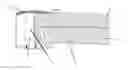
- item 1: is the cuff
- item 2: mass pocket
- item 3: mass
- item 4: elastic strap
- item 5: hook strip
- item 6: hook strip
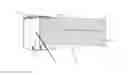
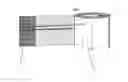
- Item 1: hook strip
- Item 2: mass pocket
- Item 3: hook strip
- Item 4: cuff
- Item 5: mass
DETAILED DISCRIPTION
The sweat band uses ASTM 304 stainless steel weights (although other passivated metals could be used) to supply the mass. This mass is located on FIG. 1 item 2 (the pocket for the weight) and FIG. 1 item 3 (the weight itself). This mass is critical as it needs to be sufficient enough in weight to provide usable energy and at the same time small enough to not disturb the player or slow the players swing down. It uses an absorbent material for the ring of fabric that slips on the wrist. FIG. 1 item 4 shows the elastic band. The band has an elastic hook and loop strap that cinches down the band to the user's wrist. This strap also functions as a sweat cloth. FIG. 1 item 5 and item 6 show the hook strip for the hook and loop system. The hook needs to be at least 1.5″ long to provide enough surface area for the hook and loop to stay closed during play. The physical principal that this devices exploits is the law of conservation of angular momentum. FIG. 2 shows a separate view of the invention with the items called out.
Claims
1. The weighted band provides more available potential energy and henceforth more kinetic energy to the racquet during the forehand and serve of the tennis player. To do this the wearer has to wear on the opposite wrist of the dominate racquet hand. This is non-obvious as the mass quantity and attachment to the wrist require detail understanding of the physical properties of metals, fabric materials, and physical inertial properties of masses for the creation of the invention.
Images & Drawings included:
Sources:
- United States Patent and Trademark Office - verify current appl. status at the USPTO↗
Recent applications in this class:
- » 20250152992 2025-05-15
WEIGHTED VEST - » 20250121245 2025-04-17
WEIGHTED APPAREL SYSTEMS AND METHODS FOR USE IN PERSONAL FITNESS - » 20250121244 2025-04-17
WEIGHTED VEST - » 20250114656 2025-04-10
WEIGHTED VEST - » 20250108246 2025-04-03
WEIGHTED ARTICLE OF APPAREL WITH ADJUSTABLE FIT AND METHOD OF MANUFACTURING THE SAME - » 20250099800 2025-03-27
WEIGHT-BEARING BRACELET - » 20250065178 2025-02-27
Exercise Device Targeting Anterior Tibialis Muscles & Method Of Use - » 20250041649 2025-02-06
FOOT DUMBBELL EXERCISER - » 20250041648 2025-02-06
Weight exercise system and apparatus - » 20240390724 2024-11-28
WEIGHTED COMPRESSION SLEEVES