RING MADE OF EXPANDED POLYSTYRENE FOR A CUP
US20190352079A1
2019-11-21
16/331,289
2017-09-08
Abstract:
The present invention solves a number of practical problems relating to the use of disposable plastic and paper cups (1) by mass caterers and fast food entities for serving beverages such as coffee, tea, juices, refreshments, beers, etc., to their customers but also desserts such as yoghurt, ice cream, fruit salads etc. The ring (2) has a truncated cone shape to fit externally onto existing disposable cups, plastic or paper and is made of expanded polystyrene. The additional ring covers over 80% of the total surface, of the beaker in order to heat-insulate and maintain the desirable beverage temperature for longer.
Interested in similar patents?
Get notified when new applications in this technology area are published.
Classification:
B65D81/3879 » CPC main
Containers, packaging elements, or packages, for contents presenting particular transport or storage problems, or adapted to be used for non-packaging purposes after removal of contents with thermal insulation insulating sleeves or jackets for cans, bottles, barrels, etc. formed of foam material
B65D23/0842 » CPC further
Details of bottles or jars not otherwise provided for; Coverings or external coatings Sheets or tubes applied around the bottle with or without subsequent folding operations
A47G23/0216 » CPC further
Other table equipment; Glass or bottle holders for drinking-glasses, plastic cups, or the like for one glass or cup
B65D81/38 IPC
Containers, packaging elements, or packages, for contents presenting particular transport or storage problems, or adapted to be used for non-packaging purposes after removal of contents with thermal insulation
A47G23/02 IPC
Other table equipment Glass or bottle holders
B65D23/08 IPC
Details of bottles or jars not otherwise provided for Coverings or external coatings
Description
A) GENERAL—OVERVIEW OF THE COGNITIVE FIELD
The present invention relates to the addition of a ring made of expanded polystyrene to a disposable (plastic or paper) cup. This ring is applied to the outer surface of the cup covering over 80% of its total surface, with a view to insulating and maintaining the desirable temperature of the beverage for a longer period (FIG. 1).
Disposable cups are used by mass caterers and fast food entities for serving beverages such as coffee, tea, juices, soft drinks, granites, beers, etc, to their customers as well as desserts such as yoghurt, ice cream, fruit salads, etc. In many cases, customer service is carried out by distribution. Most of these cups do not have any thermal insulation and so the temperature of the contents changes very quickly. Disposable rings to date are mainly paper-made and are available in different shapes, either flat or corrugated ones and with different closure methods, as there are also double-walled paper cups, but the cost of producing all of these and their heat-insulating behaviour is not satisfactory. Depending on their type, beverages are distinguished in hot and cold ones. Hot beverages have a high temperature as most are prepared at temperatures slightly above 90° C. and are served at temperatures of 45-50° C. Cold beverages are served at temperatures below 10° C. Given that the indoor temperature of a typical building wherein these beverages and foods are served ranges from 20° C. (winter) to 26° C. (summer) and disposable cups are made of plastic or paper material with a small wall thickness ranging from 1 to 1.5 millimetres, beverages and foods exchange their heat content very quickly with the environment, resulting in their temperature reaching very quickly at a level very close to ambient temperature. Thus, the offered beverage or food loses very quickly a basic quality characteristic thereof, i.e. the desirable consumption temperature. The additional ring (2) of the present invention has a truncated cone shape to be applied externally to the existing disposable, plastic or paper cups (1) (FIG. 2) put on the market and is made of expanded polystyrene.
Maintaining the desirable temperature of the individual beverage or food can be achieved by adding the heat insulating ring to the cup. This is achieved as the coefficient of thermal conductivity of polystyrene is λEPS=0.035 W/mK and is lower than both the paper coefficient that is λpaper=0.13 W/mK and the polyethylene one λPET=0.20 W/mK. Therefore, the addition of the polystyrene ring will reduce the rate of heat transfer to the environment as the thermal transmittance coefficient by the addition of the thermal insulation ring will be reduced by 5 to 8 times. Below is an illustrative example of calculating the thermal transmittance coefficient U for case (a) where we have a plastic cup of polyethylene without the addition of the ring and (b) where we have a plastic cup of polyethylene with the addition of the thermal insulation ring.
| Case (a) |
| Coefficient of | |||
| Layer | thermal | Thermal | |
| thickness d | conductivity λ | resistance d/λ | |
| Element layers | (mm) | (W/mK) | (m2 * K/W) |
| Polyethylene | 1 | 0.2 | 0.005 |
| Total: | 0.29 | 0.005 | |
From the foregoing, the thermal transmittance coefficient is calculated:
U a = 1 ∑ j = 1 1 d j λ j = 1 0 .005 = 200 W / ( m 2 K )
| Case (b) |
| Coefficient of | |||
| Layer | thermal | Thermal | |
| thickness d | conductivity λ | resistance d/λ | |
| Element layers | (mm) | (W/mK) | (m2 * K/W) |
| Polyethylene | 1 | 0.2 | 0.005 |
| Expanded | 1 | 0.035 | 0.029 |
| polystyrene | |||
| Total: | 0.29 | 0.034 | |
From the foregoing, the thermal transmittance coefficient is calculated:
U β = 1 ∑ j = 1 2 d j λ j = 1 0.034 = 29.41 W / ( m 2 K )
B) DESCRIPTION OF ADVANTAGES OF THE PRESENT INVENTION
The present invention provides a solution to several practical problems relating to the use of disposable plastic cups by mass caterers and fast food entities for the needs of serving beverages such as coffee, tea, juices, soft drinks, beers to their customers, but also desserts like yoghurt, ice cream, fruit salads etc.
The advantages of this invention are in detail the following:
-
- 1. Maintain the desirable hot or cold beverage and cold meal temperature for a long time. Maintaining the desirable temperature of the hot or cold beverage and cold meal is achieved by using the heat insulating ring for a long time, thus the user receiving a qualitatively superior product.
- 2. Easy stacking, as due to the truncated cone shape the rings can be stacked easily in one another (FIG. 3) and thus easily stored.
- 3. In the case of cold drinks, condensation of water vapour on the outside of the cup wall (shell) is avoided. This avoids the unpleasant effect of wetting of the user's hands and the table on which the cup is placed and, sometimes, dropping of water drops on the user.
- 4. In the case of a hot drink, it protects the user from the high temperature of the beverage as the outside wall temperature coming into contact with the user is very low and can not cause any burn sensation or burning.
- 5. It is applied to all existing disposable plastic and paper cups available on the market. On the large base of the truncated cone there are small notches (3), FIG. 1 (b), to achieve a perfect fit in a cup with embossed surfaces.
- 6. It does not prevent the simultaneous use of existing bases and carrying bags for plastic and paper cups.
- 7. It covers up to 80% of the conical surface of the disposable cups and thus helps maintain the desirable content temperature for a long time.
- 8. It does not need to be assembled, it has no clasp and it is ready for use by placing it under the disposable cup.
- 9. It is possible to print a logo on the outer surface of the ring.
C) DESCRIPTION OF DRAWINGS
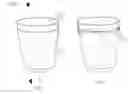
FIGS. 1 (a)-(b) show a three-dimensional beverage cup illustration with the insulating material in two different types, without and with notches.
FIGS. 2 (a)-(c) illustrate how to place the insulating ring to the disposable cup.
FIG. 3 shows how the thermal insulation ring is stacked.
Claims
1. An additional ring of expanded polystyrene for a disposable cup, characterized in that it is in the foam of a truncated cone, fits to the cup (1) and covers at least 80% of its surface.
2. An additional ring of expanded polystyrene for a disposable cup according to claim 1, characterized in that on the large base of the ring (2) there are notches (3) for its fitting to a cup (1) with embossed surfaces.
Images & Drawings included:



Sources:
- United States Patent and Trademark Office - verify current appl. status at the USPTO↗
Recent applications in this class:
- » 20200255208 2020-08-13
Insulated container - » 20200039726 2020-02-06
BEVERAGE CASE WITH WALLS HAVING DETACHABLE INSULATION DEVICES - » 20190300267 2019-10-03
INSULATING HOLDER FOR BEVERAGE CONTAINER - » 20190283954 2019-09-19
Insulated sleeve for a container - » 20190002184 2019-01-03
INSULATIVE SLEEVE FOR BEVERAGE CUP - » 20180257845 2018-09-13
ADJUSTABLE INSULATED RECEPTACLE FOR BEVERAGE CONTAINERS - » 20170334629 2017-11-23
Insulated sleeve for a container - » 20160264341 2016-09-15
MASON JAR INSULATOR - » 20160236851 2016-08-18
Insulative container - » 20140048551 2014-02-20
FOAM CAN INSULATOR WITH COUNTER