COMPOUND AND ORGANIC ELECTRONIC DEVICE USING THE SAME
US20190372016A1
2019-12-05
16/429,594
2019-06-03
Abstract:
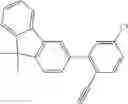
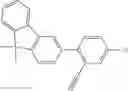
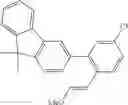
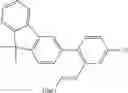
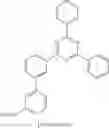
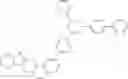
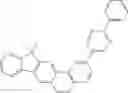
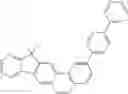
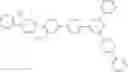
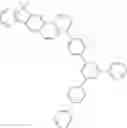
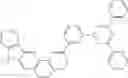
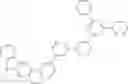
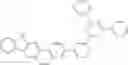
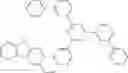
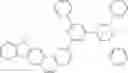
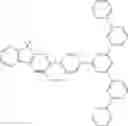
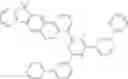
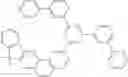
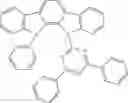
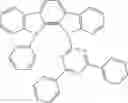
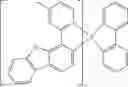
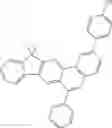
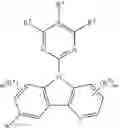
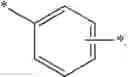
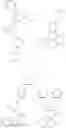
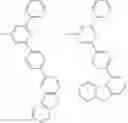
Provided are a novel compound and an organic electronic device using the same. The novel compound is represented by the following Formula (I):
-
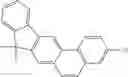
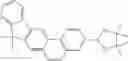
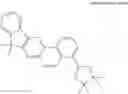
- wherein A1 and A2 each represent a carbon atom; *1 is bonded to one of A1 and A2, and *2 is bonded to the other of A1 and A2; a is an integer from 1 to 4; b is an integer from 0 to 3.
Interested in similar patents?
Get notified when new applications in this technology area are published.
Classification:
H01L51/0067 » CPC main
Solid state devices using organic materials as the active part, or using a combination of organic materials with other materials as the active part; Processes or apparatus specially adapted for the manufacture or treatment of such devices, or of parts thereof; Selection of organic semiconducting materials, e.g. organic light sensitive or organic light emitting materials; Macromolecular systems with low molecular weight, e.g. cyanine dyes, coumarine dyes, tetrathiafulvalene aromatic compounds comprising a hetero atom, e.g.: N,P,S comprising only nitrogen as heteroatom
H01L51/5012 » CPC further
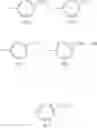
Solid state devices using organic materials as the active part, or using a combination of organic materials with other materials as the active part; Processes or apparatus specially adapted for the manufacture or treatment of such devices, or of parts thereof specially adapted for light emission, e.g. organic light emitting diodes [OLED] or polymer light emitting devices [PLED] Electroluminescent [EL] layer
H01L51/0073 » CPC further
Solid state devices using organic materials as the active part, or using a combination of organic materials with other materials as the active part; Processes or apparatus specially adapted for the manufacture or treatment of such devices, or of parts thereof; Selection of organic semiconducting materials, e.g. organic light sensitive or organic light emitting materials; Macromolecular systems with low molecular weight, e.g. cyanine dyes, coumarine dyes, tetrathiafulvalene aromatic compounds comprising a hetero atom, e.g.: N,P,S; Polycyclic condensed heteroaromatic hydrocarbons comprising only oxygen in the heteroaromatic polycondensed ringsystem, e.g. cumarine dyes
H01L51/00 IPC
Solid state devices using organic materials as the active part, or using a combination of organic materials with other materials as the active part; Processes or apparatus specially adapted for the manufacture or treatment of such devices, or of parts thereof
C07D401/10 » CPC further
Heterocyclic compounds containing two or more hetero rings, having nitrogen atoms as the only ring hetero atoms, at least one ring being a six-membered ring with only one nitrogen atom containing two hetero rings linked by a carbon chain containing aromatic rings
C07D239/26 » CPC further
Heterocyclic compounds containing 1,3-diazine or hydrogenated 1,3-diazine rings not condensed with other rings having three or more double bonds between ring members or between ring members and non-ring members with only hydrogen atoms, hydrocarbon or substituted hydrocarbon radicals, directly attached to ring carbon atoms
C07D213/22 » CPC further
Heterocyclic compounds containing six-membered rings, not condensed with other rings, with one nitrogen atom as the only ring hetero atom and three or more double bonds between ring members or between ring members and non-ring members having three double bonds between ring members or between ring members and non-ring members having no bond between the ring nitrogen atom and a non-ring member or having only hydrogen or carbon atoms directly attached to the ring nitrogen atom containing only hydrogen and carbon atoms in addition to the ring nitrogen atom containing two or more pyridine rings directly linked together, e.g. bipyridyl
C07D251/24 » CPC further
Heterocyclic compounds containing 1,3,5-triazine rings not condensed with other rings having three double bonds between ring members or between ring members and non-ring members with hydrogen or carbon atoms directly attached to at least one ring carbon atom to three ring carbon atoms
C07D405/10 » CPC further
Heterocyclic compounds containing both one or more hetero rings having oxygen atoms as the only ring hetero atoms, and one or more rings having nitrogen as the only ring hetero atom containing two hetero rings linked by a carbon chain containing aromatic rings
Description
CROSS-REFERENCE TO RELATED APPLICATION
Pursuant to 35 U.S.C. § 119(e), this application claims the benefit of the priority to U.S. Provisional Patent Application No. 62/680,625, filed Jun. 5, 2018. The content of the prior application is incorporated herein by its entirety.
BACKGROUND OF THE INVENTION
1. Field of the Invention
The present invention relates to a novel compound and an organic electronic device using the same, more particularly to a novel compound as an electron transport material for an electron transport layer and an organic electronic device using the same.
2. Description of the Prior Arts
With the advance of technology, various organic electronic devices that make use of organic materials have been energetically developed. Examples of organic electronic devices include organic light emitting devices (OLEDs), organic phototransistors, organic photovoltaic cells, and organic photodetectors.
OLED was initially invented and proposed by Eastman Kodak Company through a vacuum evaporation method. Dr. Ching M. Tang and Steven Van Slyke of Kodak Company deposited an electron transport material such as tris(8-hydroxyquinoline)aluminum(III) (abbreviated as Alq3) on a transparent indium tin oxide glass (abbreviated as ITO glass) formed with a hole transport layer of organic aromatic diamine thereon, and subsequently deposited a metal electrode onto an electron transport layer to complete the fabrication of the OLED. OLEDs have attracted lots of attention due to their numerous advantages, such as fast response speed, light weight, compactness, wide viewing angle, high brightness, higher contrast ratio, no need of backlight, and low power consumption. However, the OLEDs still have the problems such as short lifespan.
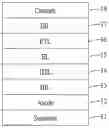
One of the approaches in prior art is to interpose some interlayers between the cathode and the anode. With reference to FIG. 1, a modified OLED 1 may have a structure of a substrate 11, an anode 12, a hole injection layer 13 (abbreviated as HIL), a hole transport layer 14 (abbreviated as HTL), an emission layer 15 (abbreviated as EL), an electron transport layer 16 (abbreviated as ETL), an electron injection layer 17 (abbreviated as EIL), and a cathode 18 stacked in sequence. When a voltage is applied between the anode 12 and the cathode 18, the holes injected from the anode 12 move to the EL via HIL and HTL and the electrons injected from the cathode 18 move to the EL via EIL and ETL. Recombination of the electrons and the holes occurs in the EL to generate excitons, thereby emitting a light when the excitons decay from excited state to ground state.
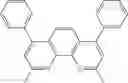
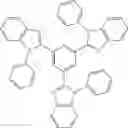
Another approach is to modify the materials of ETL for OLEDs to render the electron transport materials to exhibit hole-blocking ability. Examples of conventional electron transport materials include 2,9-dimethyl-4,7-diphenyl-1,10-phenanthroline (BCP), 3,3′-[5′-[3-(3-pyridinyl)phenyl][1,1′: 3′,1″-terphenyl]-3,3″-diyl]bispyridine (TmPyPb), 1,3,5-tris(1-phenyl-1H-benzimidazol-2-yl)benzene (TPBi), tris(2,4,6-trimethyl-3-(pyridin-3-yl)phenyl)borane (3TPYMB), 1,3-bis(3,5-dipyrid-3-yl-phenyl)benzene (BmPyPb), and 9,10-bis(3-(pyridin-3-yl)phenyl)anthracene (DPyPA).
However, even using the foresaid electron transport materials, the lifespan of OLEDs still needs to be improved. Therefore, the present invention provides a novel compound to mitigate or obviate the problems in the prior art.
SUMMARY OF THE INVENTION
An objective of the present invention is to provide a novel compound useful for an organic electronic device.
Another objective of the present invention is to provide an organic electronic device using the novel compound, so as to prolong the lifespan of the organic electronic device.
To achieve the foresaid objectives, the present invention provides a novel compound represented by the following Formula (I):
In Formula (I), A1 and A2 each represent a carbon atom; *1 is bonded to one of A1 and A2, and *2 is bonded to the other of A1 and A2.
In Formula (I), a is an integer from 1 to 4.
In Formula (I), b is an integer from 0 to 3.
In Formula (I), L is an arylene group having 6 to 60 carbon atoms.
In Formula (I), G is selected from the group consisting of: a heteroaryl group having 3 to 60 ring carbon atoms, an alkyl group having 1 to 40 carbon atoms and substituted with at least one functional group, an alkenyl group having 2 to 40 carbon atoms and substituted with at least one functional group, an alkynyl group having 2 to 40 carbon atoms and substituted with at least one functional group, a cycloalkyl group having 3 to 60 ring carbon atoms and substituted with at least one functional group, a heterocycloalkyl group having 3 to 60 ring carbon atoms and substituted with at least one functional group, an alkoxy group having 1 to 40 carbon atoms and substituted with at least one functional group, an aryl group having 6 to 60 ring carbon atoms and substituted with at least one functional group, an aryloxy group having 6 to 60 ring carbon atoms and substituted with at least one functional group, an alkylsilyl group having 1 to 40 carbon atoms and substituted with at least one functional group, an arylsilyl group having 6 to 60 ring carbon atoms and substituted with at least one functional group, an alkylboron group having 1 to 40 carbon atoms and substituted with at least one functional group, an arylboron group having 6 to 60 ring carbon atoms and substituted with at least one functional group, a phosphine group having 1 to 40 carbon atoms and substituted with at least one functional group, and a phosphine oxide group having 1 to 40 carbon atoms and substituted with at least one functional group, any isomeric groups thereof, and any deuterated analogs thereof, wherein the functional group is selected from the group consisting of: a cyano group, a nitro group, a trifluoromethyl group, a fluoro group, and a chloro group.
In Formula (I), c is an integer from 0 to 4.
In Formula (I), Y is selected from the group consisting of: a deuterium atom, an unsubstituted aryl group having 6 to 60 ring carbon atoms, an unsubstituted alkyl group having 1 to 12 carbon atoms, an unsubstituted alkenyl group having 2 to 12 carbon atoms, and an unsubstituted alkynyl group having 2 to 12 carbon atoms.
In Formula (I), Z1 and Z2 are each independently selected from the group consisting of: an alkyl group having 1 to 6 carbon atoms, and an aryl group having 6 to 12 ring carbon atoms, and Z1 and Z2 are the same or different.
The compound attached with at least one specific group [(L)b-G] is suitable as an electron transport material for OLEDs of any color, and allows the OLEDs using the same to have extended lifespan.
When a in Formula (I) is an integer from 2 to 4, each group of [(L)b-G] may be the same or different. For example, when a is the integer 2, two groups of [(L)b-G] may be represented by [(L1)b1-G1] and [(L2)b2-G2]. Herein, b1 and b2 are each independently an integer from 0 to 3, and b1 and b2 are the same or different; L1 and L2 are each independently selected from the group for L as stated above, and L1 and L2 are the same or different; G1 and G2 are each independently selected from the group for G as stated above, and G1 and G2 are the same or different.
Likely, when c is an integer from 2 to 4, (Y)s are the same or different. Preferably, only one group of [(L)b-G] is attached on the main skeletal structure. That is, in one embodiment, a is the integer 1.
In the case that *1 is bonded to A1 and *2 is bonded to A2, the compound may be represented by
More specifically, the compound represented by Formula (I-I) is represented by any one of the following formulae:
In the case that *1 is bonded to A2 and *2 is bonded to A1, the compound may be represented by
More specifically, the compound represented by Formula (I-II) is represented by any one of the following formulae:
Preferably, the heteroaryl group having 3 to 60 ring carbon atoms represented by G in Formulae (I), (I-I-I) to (I-I-IV), and (I-II-I) to (I-II-IV) is selected from the group consisting of: a furyl group, a pyrrolyl group, a thiophenyl group, an imidazolyl group, a pyrazolyl group, a triazolyl group, a tetrazolyl group, an oxazolyl group, an isoxazolyl group, a thiazolyl group, an isothiazolyl group, an oxadiazolyl group, a thiadiazolyl group; a pyridyl group, a pyridazinyl group, a pyrimidinyl group, a pyrazinyl group, a triazinyl group; an indolyl group, an isoindolyl group, a benzofuranyl group, an isobenzofuranyl group, a benzothiophenyl group, an isobenzothiophenyl group, an indolizinyl group, a quinolizinyl group, a quinolyl group, an isoquinolyl group, a cinnolyl group, a phthalazinyl group, a quinazolinyl group, a quinoxalinyl group, a benzimidazolyl group, a benzoxazolyl group, a benzothiazolyl group, an indazolyl group, a benzisoxazolyl group, a benzisothiazolyl group; a dibenzofuranyl group, a dibenzothiophenyl group, a carbazolyl group, a biscarbazolyl group, a coumarinyl group, a chromenyl group, a phenanthridinyl group, an acridinyl group, a phenanthrolinyl group, a phenazinyl group, a phenothiazinyl group, a phenoxazinyl group, an azatriphenylenyl group, a diazatriphenylenyl group, a xanthenyl group, an azacarbazolyl group, an azadibenzofuranyl group, an azadibenzothiophenyl group, a benzofuranobenzothiophenyl group, a benzothienobenzothiophenyl group, a dibenzofuranonaphthyl group, a dibenzothienonaphthyl group, a dinaphthothienothiophenyl group, a dinaphtho carbazolyl group, a dibenzo[b,f]azepin group, a tribenzo[b,d,f]azepin group, a dibenzo[b,f]oxepin group, a tribenzo[b,d,f]oxepin group, any isomeric groups thereof, and any deuterated analogs thereof.
More specifically, the heteroaryl group having 3 to 60 ring carbon atoms, represented by G in Formula (I) and especially in Formula (I-I-I), is selected from the group consisting of: a furyl group, an imidazolyl group, a pyrazolyl group, a triazolyl group, a tetrazolyl group, an isoxazolyl group, a thiazolyl group, an isothiazolyl group, a thiadiazolyl group, a pyridazinyl group, a pyrimidinyl group, a triazinyl group, an isoindolyl group, an isobenzofuranyl group, an isobenzothiophenyl group, an indolizinyl group, a quinolizinyl group, a cinnolyl group, a phthalazinyl group, a quinazolinyl group, a quinoxalinyl group, a benzimidazolyl group, a benzoxazolyl group, a benzothiazolyl group, an indazolyl group, a benzisoxazolyl group, a benzisothiazolyl group, a biscarbazolyl group, a coumarinyl group, a chromenyl group, a phenanthridinyl group, an azatriphenylenyl group, a diazatriphenylenyl group, a xanthenyl group, an azacarbazolyl group, an azadibenzofuranyl group, an azadibenzothiophenyl group, a benzofuranobenzothiophenyl group, a benzothienobenzothiophenyl group, a dibenzofuranonaphthyl group, a dibenzothienonaphthyl group, a dinaphthothienothiophenyl group, a dinaphtho carbazolyl group, a dibenzo[b,f]azepin group, a tribenzo[b,d,f]azepin group, a dibenzo[b,f]oxepin group, a tribenzo[b,d,f]oxepin group, any isomeric groups thereof, and any deuterated analogs thereof.
Specifically, the heteroaryl group having 3 to 60 ring carbon atoms represented by G in Formulae (I), (I-I-I) to (I-I-IV), and (I-II-I) to (I-II-IV) is selected from the group consisting of:
wherein o is an integer from 0 to 2; m is an integer from 0 to 3; n is an integer from 0 to 4; p is an integer from 0 to 5;
wherein R1 to R5 are each independently selected from the group consisting of: a deuterium atom, a halogen group, a cyano group, a nitro group, a trifluoromethyl group, an alkyl group having 1 to 12 carbon atoms, an alkenyl group having 2 to 12 carbon atoms, an alkynyl group having 2 to 12 carbon atoms, a cycloalkyl group having 3 to 30 ring carbon atoms, a heterocycloalkyl group having 3 to 30 ring carbon atoms, an aryl group having 6 to 30 ring carbon atoms, a heteroaryl group having 3 to 30 ring carbon atoms, an alkoxy group having 1 to 40 carbon atoms, an aryloxy group having 6 to 30 ring carbon atoms, an alkylsilyl group having 1 to 40 carbon atoms, an arylsilyl group having 6 to 30 ring carbon atoms, an alkylboron group having 1 to 30 carbon atoms, an arylboron group having 6 to 30 ring carbon atoms, a phosphine group having 1 to 30 carbon atoms, and a phosphine oxide group having 1 to 30 carbon atoms.
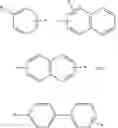
Preferably, the group [(L)b-G] is selected from the group consisting of:
Preferably, the aryl group having 6 to 60 ring carbon atoms and substituted with at least one functional group represented by G in Formulae (I), (I-I-I) to (I-I-IV), and (I-II-I) to (I-II-IV) is selected from the group consisting of: a phenyl group substituted with the at least one functional group, a biphenylyl group substituted with the at least one functional group, a terphenyl group substituted with the at least one functional group, a naphthyl group substituted with the at least one functional group, a phenanthryl group substituted with the at least one functional group, an anthracenyl group substituted with the at least one functional group, a benzanthryl group substituted with the at least one functional group, a fluorenyl group substituted with the at least one functional group, a chrysenyl group substituted with the at least one functional group, a fluoranthenyl group substituted with the at least one functional group, and any deuterated analogs thereof.
More preferably, the aryl group having 6 to 60 ring carbon atoms and substituted with at least one functional group represented by G in Formulae (I), (I-I-I) to (I-I-IV), and (I-II-I) to (I-II-IV) is selected from the group consisting of: a phenyl group substituted with the at least one functional group and a biphenyl group substituted with the at least one functional group.
Specifically, the aryl group having 6 to 60 ring carbon atoms and substituted with the at least one functional group represented by G in Formulae (I), (I-I-I) to (I-I-IV), and (I-II-I) to (I-II-IV) is selected from the group consisting of:
wherein r is an integer from 1 to 5; s is an integer from 0 to 4; the total of r and s is not more than 5;
wherein R1 is selected from the group consisting of: a deuterium atom, an alkyl group having 1 to 12 carbon atoms, an alkenyl group having 2 to 12 carbon atoms, an alkynyl group having 2 to 12 carbon atoms, a cycloalkyl group having 3 to 30 ring carbon atoms, a heterocycloalkyl group having 3 to 30 ring carbon atoms, an aryl group having 6 to 30 ring carbon atoms, a heteroaryl group having 3 to 30 ring carbon atoms, an alkoxy group having 1 to 12 carbon atoms, an aryloxy group having 6 to 30 ring carbon atoms, an alkylsilyl group having 1 to 12 carbon atoms, an arylsilyl group having 6 to 30 ring carbon atoms, an alkylboron group having 1 to 12 carbon atoms, and an arylboron group having 6 to 30 ring carbon atoms.
Preferably, Y in Formulae (I), (I-I-I) to (I-I-IV), and (I-II-I) to (I-II-IV) is selected from the group consisting of: a deuterium atom, a phenyl group, a biphenyl group, a terphenyl group, a naphthyl group, a phenanthryl group, an anthracenyl group, a benzanthryl group, a fluorenyl group, a chrysenyl group, a fluoranthenyl group, a deuterated phenyl group, a deuterated biphenyl group, a deuterated terphenyl group, a deuterated naphthyl group, a deuterated phenanthryl group, a deuterated anthracenyl group, a deuterated benzanthryl group, a deuterated fluorenyl group, a deuterated chrysenyl group, and a deuterated fluoranthenyl group.
Preferably, b in Formula (I) is 0. That is, each G is directly attached on the main skeletal structure.
In the case that b in Formulae (I), (I-I-I) to (I-I-IV), and (I-II-I) to (I-II-IV) is an integer from 1 to 3, L is selected from the group consisting of:
Preferably, L is selected from the group consisting of:
More specifically, L is
In this specification, said “arylene group having 6 to 60 ring carbon atoms” denoted by L may be an unsubstituted arylene group having 6 to 60 ring carbon atoms or an arylene group having 6 to 60 ring carbon atoms substituted with at least one substituent. The substituent may be selected from the group consisting of: a deuterium atom, a halogen group, a cyano group, a nitro group, a trifluoromethyl group, an alkyl group having 1 to 12 carbon atoms, an alkenyl group having 2 to 12 carbon atoms, an alkynyl group having 2 to 12 carbon atoms, a cycloalkyl group having 3 to 30 ring carbon atoms, a heterocycloalkyl group having 3 to 30 ring carbon atoms, an alkoxy group having 1 to 40 carbon atoms, an aryloxy group having 6 to 30 ring carbon atoms, an alkylsilyl group having 1 to 40 carbon atoms, an arylsilyl group having 6 to 30 ring carbon atoms, an alkylboron group having 1 to 30 carbon atoms, an arylboron group having 6 to 30 ring carbon atoms, a phosphine group having 1 to 30 carbon atoms, and a phosphine oxide group having 1 to 30 carbon atoms.
In this specification, said “heteroaryl group” denoted by G may be an unsubstituted heteroaryl group or a heteroaryl group substituted with at least one substituent. The substituent on the heteroaryl group may be similar to any one of R1 to R5 as stated above.
In this specification, said “unsubstituted aryl group having 6 to 60 carbon atoms” denoted by Y means an aryl ring structure without any substituents which replace one or more hydrogen atoms on the aryl ring structure. Likely, said “unsubstituted alkyl group having 1 to 12 carbon atoms”, said “unsubstituted alkenyl group having 2 to 12 carbon atoms”, or said “unsubstituted alkynyl group having 2 to 12 carbon atoms” denoted by Y means an hydrocarbon skeletal structure without any hetero atoms.
In this specification, said “alkyl group” denoted by Z1 and Z2 may be an unsubstituted alkyl group or an alkyl group substituted with at least one substituent. The substituent on the alkyl group, alkenyl group, or alkynyl group may be, for example, but not limited to a deuterium atom.
In this specification, said “aryl group” denoted by Z1 and Z2 may be an unsubstituted aryl group or an aryl group substituted with at least one substituent. The substituent on the aryl group may be, for example, but not limited to a deuterium atom.
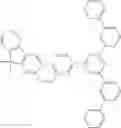
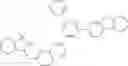
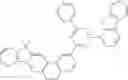
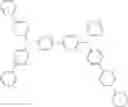
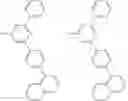
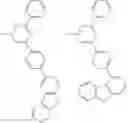
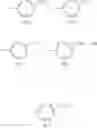
For example, the compound may be selected from the group consisting of:
The present invention also provides an organic electronic device, comprising a first electrode, a second electrode, and an organic layer disposed between the first electrode and the second electrode. The organic layer comprises the novel compound as described above.
Preferably, the organic electronic device is an organic light emitting device (OLED).
Specifically, the organic light emitting device may comprise:
a hole injection layer formed on the first electrode;
a hole transport layer formed on the hole injection layer;
an emission layer formed on the hole transport layer;
an electron transport layer formed on the emission layer;
an electron injection layer formed between the electron transport layer and the second electrode.
In one embodiment, the organic layer may be the electron transport layer, i.e., the electron transport layer comprises an electron transport material which is the novel compound as stated above.
For example, the electron transport layer may be a single-layered configuration or a multi-layered configuration disposed between the emission layer and the electron injection layer. When the electron transport layer is the multi-layered configuration, e.g., the electron transport layer comprises a first electron transport layer and a second electron transport layer, the first electron transport material of the first electron transport layer may be made of a single novel compound and the second electron transport material of the second electron transport layer may be made of another single novel compound or any single conventional compound. Or, the first electron transport material of the first electron transport layer may be made of a novel compound in combination with another single novel compound or any single conventional compound, and so as the second electron transport material.
Said first and/or second electron transport layer comprises the novel compound such as Compounds 1 to 264. The OLEDs using the novel compound as the electron transport material can have an extended the lifespan compared to commercial OLEDs using known electron transport materials of ETL, such as 2,9-dimethyl-4,7-diphenyl-1,10-phenanthroline (BCP), 3,3′[5′[3-(3-pyridinyl)phenyl][1,1′:3′,1″-terphenyl]-3,3″-diyl]bispyridine (TmPyPb), 1,3,5-tris(1-phenyl-1H-benzimidazol-2-yl)benzene (TPBi), tris(2,4,6-trimethyl-3-(pyridin-3-yl)phenyl)borane (3 TPYMB), 1,3-bis(3,5-dipyrid-3-yl-phenyl)benzene (BmPyPb), and 9,10-bis(3-(pyridin-3-yl)phenyl)anthracene (DPyPA).
Preferably, the OLED comprises a hole blocking layer (HBL) formed between the electron transport layer and the emission layer, to block holes overflow from the emission layer to the electron transport layer.
In another embodiment, the organic layer may be the hole blocking layer, i.e., the hole blocking layer comprises a hole blocking material which is the novel compound as stated above. More specifically, said hole blocking layer comprises the novel compound such as Compounds 1 to 264. The OLEDs using the novel compound as the hole blocking material can have an extended lifespan compared to commercial OLEDs using known hole blocking materials of HBL, such as 2,9-dimethyl-4,7-diphenyl-1,10-phenanthroline (BCP) and 2,3,5,6-tetramethyl-phenyl-1,4-(bis-phthalimide) (TMPP).
Preferably, the hole injection layer may be a two-layered structure, i.e., the OLED comprises a first hole injection layer and a second hole injection layer disposed between the first electrode and the hole transport layer.
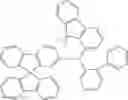
Said first and second hole injection layers may be made of, for example, but not limited to: polyaniline, polyethylenedioxythiophene, 4,4′,4″-Tris[(3-methylphenyl)phenylamino]triphenylamine (m-MTDATA), or N1,N1′-(biphenyl-4,4′-diyl)bis(N1-(naphthalen-1-yl)-N4,N4′-diphenylbenzene-1,4-diamine).
Preferably, the hole transport layer may be a two-layered structure, i.e., the OLED comprises a first hole transport layer and a second hole transport layer disposed between the two-layered hole injection layer and the emission layer.
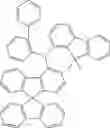
Said first and second hole transport layers may be made of, for example, but not limited to: 1,1-bis[(di-4-tolylamino)phenylcyclohexane](TAPC), a carbazole derivative such as N-phenyl carbazole, and N4,N4′-di(naphthalen-1-yl)-N4,N4′-diphenylbiphenyl-4,4′-diamine (NPB).
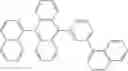
Preferably, the emission layer can be made of an emission material including a host and a dopant. The host of the emission material is, for example, but not limited to, 9-(4-(naphthalen-1-yl)phenyl)-10-(naphthalen-2-yl) anthracene.
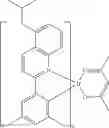
For red OLEDs, the dopant of the emission material is, for example, but not limited to: organometallic compounds of iridium (II) having quinoline derivative ligands or isoquinoline derivative ligands; an osmium complex; or a platinum complex. For green OLEDs, the dopant of the emission material is, for example, but not limited to: diaminofluorenes; diaminoanthracenes; or organometallic compounds of iridium (II) having phenylpyridine ligands. For blue OLEDs, the dopant of the emission material is, for example, but not limited to: an aminoperylene derivative; a diaminochrysene; diaminopyrenes; or organicmetallic compounds of iridium (II) having pyridinato picolinate ligands. With various host materials of the emission layer, the OLED can emit lights in red, green or blue.
Preferably, the OLED comprises an electron blocking layer formed between the hole transport layer and the emission layer, to block electrons overflow from the emission layer to the hole transport layer. Said electron blocking layer may be made of 9,9′-[1,1′-biphenyl]-4,4′-diylbis-9H-carbazole (CBP) or 4,4′,4″-tri(N-carbazolyl)-triphenylamine (TCTA), but it is not limited thereto.
In the presence of such a hole blocking layer and/or an electron blocking layer in an OLED, the OLED has a higher luminous efficiency compared to a typical OLED.
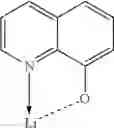
Said electron injection layer may be made of an electron injection material, for example, but not limited to (8-oxidonaphthalen-1-yl)lithium(II).
Said first electrode is, for example, but not limited to, an indium-doped tin oxide electrode.
Said second electrode has a work function lower than that of the first electrode. The second electrode is, for example, but not limited to, an aluminum electrode, an indium electrode, or a magnesium electrode.
Other objectives, advantages and novel features of the invention will become more apparent from the following detailed description when taken in conjunction with the accompanying drawings.
BRIEF DESCRIPTION OF THE DRAWINGS
FIG. 1 illustrates a schematic cross-sectional view of an OLED;
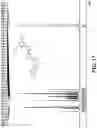
FIGS. 2 to 19 respectively are 1H nuclear magnetic resonance (NMR) spectra of compounds 1 to 18.
DETAILED DESCRIPTION OF THE PREFERRED EMBODIMENT
Hereinafter, one skilled in the arts can easily realize the advantages and effects of a novel compound and an organic light emitting device using the same in accordance with the present invention from the following examples. It should be understood that the descriptions proposed herein are just preferable examples only for the purpose of illustrations, not intended to limit the scope of the invention. Various modifications and variations could be made in order to practice or apply the present invention without departing from the spirit and scope of the invention.
Pathway 1: Synthesis of Intermediate An
Intermediate An used for preparing a novel compound was synthesized by the following steps. The synthesis pathway of Intermediate An was summarized in Scheme A1.
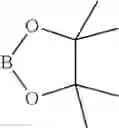
Where in B′ is B(OH)2 group or
group.
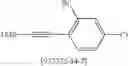
Synthesis of Intermediate A1
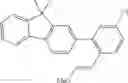
Taking Intermediate A1 as an example of Intermediate An which is synthesized by Scheme A1, the synthesis pathway of Intermediate A1 was summarized in Scheme A1-1.
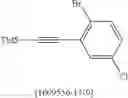
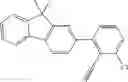
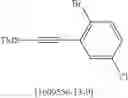
Step 1: Synthesis of Intermediate A1-1
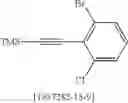
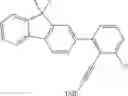
9,9-Dimethylfluorene-2-boronic acid (CAS No. 333432-28-3) as Reactant R.1 (1.2eq), Reactant 131 (1.0eq), palladium(11) acetate [Pd(OAc)2] (0.015eq), triphenylphosphine (PPh3) (0.06eq), and potassium carbonate (K2CO3) (3.0M, 1.5eq) were mixed in 200 ml of toluene, and the reaction mixture was heated to about 80° C. and stirred. After completion of the reaction, the reaction mixture was cooled to room temperature, and the crude product was extracted with saturated aqueous solution of sodium chloride and ethyl acetate (EA) and collected by the organic layer. The organic layer was dried over magnesium sulfate (MgSO4), separated by filtration with silica gel and concentrated under reduced pressure. A resulting residue was suspended in hexane, and the suspension was then filtered again and washed with hexane to obtain Intermediate A1-1. Intermediate A1-1 could be directly used in step 2 without further purification.
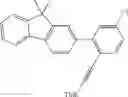
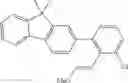
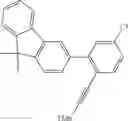
Step 2: Synthesis of Intermediate A1-2
Intermediate A1-1 (1.0eq) and tetra-n-butylammonium fluoride (TBAF) (1.5eq) were dissolved in tetrahydrofuran (THF) (0.3M) and stirred at room temperature for 1 hour. The solvent was then removed under reduced pressure, and the residue was purified with column chromatography to get a white solid product. The yield of step 2 was 79%.
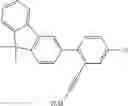
The white solid product was identified as Intermediate A1-2 by a field desorption mass spectroscopy (FD-MS) analysis. The chemical structure was listed in Table 1.
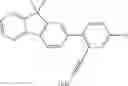
Step 3: Synthesis of Intermediate A1-3
Cesium hydroxide hydrate (CsOH*H2O)(0.3 eq) were dissolved in N-methyl-2-pyrrolidone (NMP)(0.3M) and stirred at room temperature for 10 minutes. The solution was then added Maki (1.7 eq) and intermediate A1-2, and the mixture were stirred and heated at 110° C. for 6 hrs. The solvent was then removed under reduced pressure, and the residue was purified with column chromatography by using Toluene/Hexane (2/1) to get oil type product. The yield of step 3 was 85%.
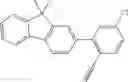
Step 4: Synthesis of Intermediate A1
Intermediate A1-3 (1 eq) was dissolved in dichloromethane (CH2Cl2)(0.3 M) and cooled to 0° C. Then the solution was added CF3SO3H (0.2 eq) slowly drop by drop and stirred for 2 hrs at 0° C. After completion of the reaction, the solvent was quenched by NaHCO3(aq), then removed the water layer. The solvent contained in the organic layer was removed under reduced pressure, and the residue was purified with column chromatography to obtain a white solid product. The yield of step 4 was 85%.
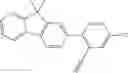
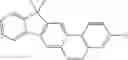
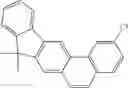
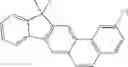
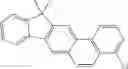
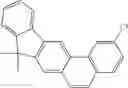
The white solid product was identified as Intermediate A1 by a FD-MS analysis. FD-MS analysis: C23H17Cl: theoretical value 328.83 and observed value 328.83. The chemical structure was listed in Table 1.
Syntheses of Intermediates A2 and A3
Intermediates A2 and A3, which also can be used for preparing a novel compound, were respectively synthesized in a similar manner as Intermediate A1 through steps 1 to 4, except that the starting material Reactant B1 was replaced with Reactants B2 and B3, respectively. All intermediates were analyzed as described above, and the results were listed in Table 1.
| TABLE 1 |
| Reactants An and Bn used for preparing Intermediates An, chemical |
| structures of Intermediates An-1, An-2, An-3, and An, yields of Intermediates |
| An-2, An-3, and An, formulae, and mass analyzed by FD-MS of Intermediates |
| A1 to A3 |
| Reactant | |
| An No. | Reactant A1 |
| Chemical Structure/ CAS No. of Reactant Bn | Reac- tant B1 | Reac- tant B2 | ||
| Chemical Structure of Intermediate An-1 | Inter- mediate A1-1 | Inter- mediate A2-1 | ||
| Chemical Structure of Intermediate An-2 | Inter- mediate A1-2 | Inter- mediate A2-2 | ||
| Yield(%) | 79 | 81 | ||
| Chemical Structure of Intermediate An-3 | Inter- mediate A1-3 | Inter- mediate A2-3 | ||
| Yield(%) | 85 | 82 | ||
| Chemical Structure of Intermediate An | Inter- mediate A1 | Inter- mediate A2 | ||
| Yield(%) | 85 | 83 | ||
| Formula/ | C23H17Cl/ | C23H17Cl/ | ||
| Mass (M+) | 328.83 | 328.83 | ||
| Reactant | |||
| An No. | Reactant A1 | ||
| Chemical Structure/ CAS No. of Reactant Bn | Reac- tant B3 | |||
| Chemical Structure of Intermediate An-1 | Inter- mediate A3-1 | |||
| Chemical Structure of Intermediate An-2 | Inter- mediate A3-2 | |||
| Yield(%) | 66 | |||
| Chemical Structure of Intermediate An-3 | Inter- mediate A3-3 | |||
| Yield(%) | 73 | |||
| Chemical Structure of Intermediate An | Inter- mediate A3 | |||
| Yield(%) | 82 | |||
| Formula/ | C23H17Cl/ | |||
| Mass (M+) | 328.83 | |||
Modifications of Intermediates A1 to A3
In addition to Intermediates A1 to A3, one person skilled in the art can adopt other applicable starting materials and successfully synthesize other desired intermediates through a reaction mechanism similar to Scheme A1-1.
Pathway 2: Synthesis of Intermediate A4 and A5
Intermediate An used for preparing a novel compound can also be synthesized by the following steps. The synthesis pathway of Intermediate An was summarized in Scheme A2.
Wherein B′ is B(OH)2 group or
group.
Synthesis of Intermediate A4
Taking Intermediate A4 as an example of Intermediate An which is synthesized by Scheme A2, the synthesis pathway of Intermediate A4 was summarized in Scheme A2-1.
Step 1: Synthesis of Intermediate A4-1
9,9-Dimethylfluorene-3-borortic acid pinacol ester (CAS No. 1346007-02-0) as Reactant R2 (1.2eq), Reactant B1 (1.0eq), Pd(OAc)2 (0.015eq), PP113 (0.06eq), and K2CO3 (3.0M, 1.5eq) were mixed in 200 ml of toluene, and the reaction mixture was heated to about 80° C. and stirred. After completion of the reaction, the reaction mixture was cooled to room temperature, and the crude product was extracted with saturated aqueous solution of sodium chloride and ethyl acetate and collected by the organic layer The organic layer was dried over MgSO4, separated by filtration with silica gel and concentrated under reduced pressure. A resulting residue was suspended in hexane, the suspension was then filtered again and washed with hexane to obtain Intermediate A4-1. Intermediate A4-1 could be directly used in step 2 without further purification.
Step 2: Synthesis of Intermediate A4-2
Intermediate A4-2 was synthesized in a similar manner as Intermediate A1-2 through step 2, except that the starting material Intermediate A1-1 was replaced by intermediate A4-1. The yield of step 2 was 70%. The chemical structure was listed in Table 2.
Step 3: Synthesis of Intermediate A4-3
Intermediate A4-3 was synthesized in a similar manner that Intermediate A1-3 was obtained through foresaid step 3, except that the starting material Intermediate A1-2 was replaced by Intermediate A4-2. The yield of step 3 was 83%.
Step 4: Synthesis of Intermediate A4
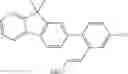
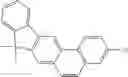
Intermediate A4 was synthesized in a similar manner as Intermediate A1 through step 4, except that the starting material Intermediate A1-3 was replaced by Intermediate A4-3. The yield of step 4 was 63%. Intermediate A4 was identified by a FD-MS analysis. FD-MS analysis: C23H17Cl: theoretical value 328.83 and observed value 328.83. The chemical structure was listed in Table 2.
Syntheses of Intermediate A5
Intermediate A5, which also can be used for preparing a novel compound, was respectively synthesized in a similar manner as Intermediate A4 through steps 1 to 4, except that the starting material Reactant B1 was replaced with Reactants B2. All intermediates were analyzed as described above, and the results were listed in Table 2.
| TABLE 2 |
| Reactants An and Bn used for preparing Intermediates An, chemical |
| structures of Intermediates An-1, An-2 and An, yields of Intermediates An-2 |
| and An, formulae, and mass analyzed by FD-MS of Intermediates A4 and A5 |
| Reactant An No. | Reactant An |
| Chemical Structure/ CAS No. of Reactant Bn | Reac- tant B1 | Reac- tant B2 | ||
| Chemical Structure of Intermediate An-1 | Inter- mediate A4-1 | Inter- mediate A5-1 | ||
| Chemical Structure of Intermediate An-2 | Inter- mediate A4-2 | Inter- mediate A5-2 | ||
| Yield(%) | 75 | 84 | ||
| Chemical Structure of Intermediate An-3 | Inter- mediate A4-3 | Inter- mediate A5-3 | ||
| Yield(%) | 83 | 78 | ||
| Chemical Structure of Intermediate An-3 | Inter- mediate A4 | Inter- mediate A5 | ||
| Yield(%) | 63 | 67 | ||
| Formula/ | C23H17Cl/ | C23H17Cl/ | ||
| Mass (M+) | 328.83 | 328.83 | ||
Modifications of Intermediates A4 and A5
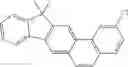
In addition to Intermediates A4 and A5, one person skilled in the art can adopt other applicable starting materials and successfully synthesize other desired intermediates through a reaction mechanism similar to Scheme A2-1. Applicable modifications of Intermediate A4 and A5 may be, for example, but not limited to, Intermediate A6 as follows.
Synthesis of Intermediate An-B
The general synthesis pathway of Intermediate An-B was summarized in Scheme A3.
Synthesis of Intermediate A1-B
Taking Intermediate A1-B as an example of Intermediate An-B, the synthesis pathway of Intermediate A1-B was summarized in Scheme A3-1.
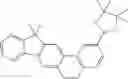
A mixture of Intermediate A1 (1.0 eq), bis(pinacolato)diboron (1.20 eq), tris(dibenzylideneacetone)dipalladium(0)[Pd2(dba)3)] (0.015 eqdicyclohexyl(2′,6′-dimethoxy-[1,1′-biphenyl]-2-yl)phosphine(0.03 eq, SPhos) and potassium acetate (KOAc) (1.5 eq) in anhydrous 1,4-dioxane (0.5 M) was stirred at 110° C. for 8 hours under nitrogen atmosphere. After cooling to room temperature, the solvent was then removed under reduced pressure, and the residue was purified with column chromatography to obtain a pale yellow solid product. The yield of step 5 was 89%.
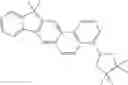
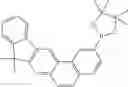
The pale yellow solid product was identified as Intermediate A1-B by a FD-MS analysis. The chemical structure, yield, formula, and mass analyzed by FD-MS of Intermediate A1-B were listed in Table 3.
Syntheses of Intermediates A2-B to A5-B
Intermediates A2-B to A5-B, which also can be used for preparing a novel compound, were respectively synthesized in a similar manner as Intermediate A1-B through step 4, except that the starting material Intermediate A1 was replaced with Intermediate A2 to A5, respectively. All intermediates were analyzed as described above, and the results were listed in Table 3.
| TABLE 3 |
| Intermediates An used for preparing Intermediates An-B, chemical |
| structures of Intermediates An and An-B, yields of Intermediates An-B, |
| formulae, and mass analyzed by FD-MS of Intermediates An-B |
| Intermediate An-B |
| For- | |||
| mula/ | |||
| Intermediate An | Yield | Mass | |
| Chemical Structure | Chemical Structure | (%) | (M+) |
| In- ter- me- di- ate A1 | In- ter- me- di- ate A1- B | 89 | C29H29 BO2/ 420.35 | ||
| In- ter- me- di- ate A2 | In- ter- me- di- ate A2- B | 95 | C29H29 BO2/ 420.35 | ||
| In- ter- me- di- ate A3 | In- ter- me- di- ate A3- B | 70 | C29H29 BO2/ 420.35 | ||
| In- ter- me- di- ate A4 | In- ter- me- di- ate A4- B | 96 | C29H29 BO2/ 420.35 | ||
| In- ter- me- di- ate A5 | In- ter- me- di- ate A5- B | 83 | C29H29 BO2/ 420.35 | ||
Modifications of Intermediates A1-B to A5-B
In addition to Intermediates A1-B to A5-B, one person skilled in the art can adopt other starting materials and successfully synthesize other desired intermediates through a reaction mechanism similar to Scheme A3-1.
Applicable modifications of Intermediates A1-B to A5-B may be, for example, but is not limited to, Intermediate A6-B as follows.
Preparation of Reactants Dn
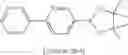
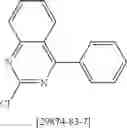
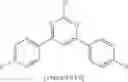
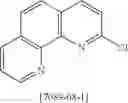
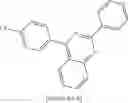
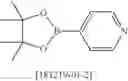
Reactants Dn used for preparing a novel compound were listed in Table 4. Reactants D1, D3 to D23 were purchased from Sigma-Aldrich.
| TABLE 4 |
| chemical structures and the CAS No. of the Reactants D1 to D23 |
| Reactant D1 |
| Reactant D2 |
| Reactant D3 |
| Reactant D4 |
| Reactant D5 |
| Reactant D6 |
| Reactant D7 |
| Reactant D8 |
| Reactant D9 |
| Reactant D10 |
| Reactant D11 |
| Reactant D12 |
| Reactant D13 |
| Reactant D14 |
| Reactant D15 |
| Reactant D16 |
| Reactant D17 |
| Reactant D18 |
| Reactant D19 |
| Reactant D20 |
| Reactant D21 |
| Reactant D22 |
| Reactant D23 |
Synthesis of Reactant D2
The synthesis pathway of the Reactant D2 was summarized in Scheme D2.
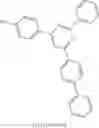
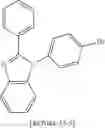
4-bromobenzaldehyde (CAS No. 1122-91-4) (1.0 eq) and 1-[4-(3-Pyridinyl)phenyl]ethanone (CAS No. 90395-45-2) (1.0 eq) dissolved in absolute ethanol (0.5 M) were stirred, and an aqueous solution of potassium hydroxide (KOH) (3.0 eq, 2.5 M) was added dropwise at 0° C., and then the reaction mixture was stirred at room temperature for 12 hours. After that, 4-bromobenzamidine.HCl (CAS No. 1670-14-0) (1.0 eq) was added to the foresaid reaction mixture and heated at reflux temperature for another 6 hours. After completion of the reaction, the solvent was then removed under reduced pressure, and the residue was purified with column chromatography to get a white solid product in a yield of 34%. The white solid product was identified as Reactant D2 by a FD-MS analysis. FD-MS analysis: C27H18BrN3: theoretical value 464.36 and observed value 464.36. The chemical structure was listed in Table 4.
Synthesis of Novel Compounds
Each of the foresaid Intermediates, e.g., Intermediates An and An-B could be reacted with various Reactants Dn to synthesize various claimed novel compounds. The general synthesis pathway of the claimed novel compound was summarized in Scheme I. In the following Scheme I, “Intermediate A” may be any one of the foresaid Intermediates An and An-B as listed in Tables 1 to 3 or the like, and “Reactant Dn” may be any one of Reactants D1 to D23 as listed in Table 4. The compounds were each synthesized by the following method I or method II, and the results were listed in Table 5.
Intermediate A (1.0eq), Reactant Dn (1.2eq), Pd(OAc)2 (0.01eq), and 2-(dicyclohexylphosphino)biphenyl [P(Cy)2(2-biPh)] (0.04eq) were stirred in a mixed solution of toluene/ethanol(0.5M, v/v=10/1), and 3.0M of K2CO3 aqueous solution. The reaction mixture was heated to about 100° C. and stirred for 12 hours under nitrogen atmosphere. After completion of the reaction, water and toluene were added to the reaction mixture. Subsequently, the organic layer was recovered by solvent extraction operation and dried over sodium sulfate. The solvent was then removed from the organic layer under reduced pressure, and the resulting residue was purified by silica gel column chromatography. The obtained residue was recrystallized with toluene to obtain a white solid product as the claimed novel compound.
Intermediate A (1.0 eq), Reactant Dn (1.2 eq), Tris(dibenzylitteneacetone)dipalladium(0) (Pd2(dba)3 (0.015eq), and Tricyclohexylphosphinte tetrafiuoroborate [P(Cy)3(HB F4)](0.06eq) were stirred in a mixed solution of DME (0.5 M, v/v=10/1), and 3.0 M of K2CO3 aqueous solution. The reaction mixture was heated to about 90° C. and stirred for 12 hours under nitrogen atmosphere. After completion of the reaction, water and toluene were added to the reaction mixture. Subsequently, the organic layer was recovered by solvent extraction operation and dried over sodium sulfate. The solvent was then removed from the organic layer under reduced pressure, and the resulting residue was purified by silica gel column chromatography. The obtained residue was recrystallized with toluene to obtain a white solid product as the claimed novel compound.
Intermediates A and Reactants Dn adopted to synthesize Compounds 1 to 18 were listed in Tables 5-1 and 5-2.
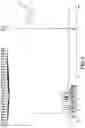
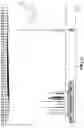
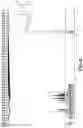
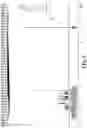
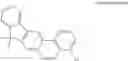
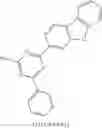
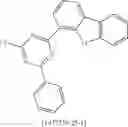
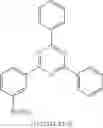
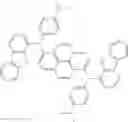
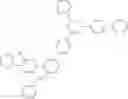
Compounds 1 to 18 were identified by 1H-NMR and FD-MS, and the chemical structure, yield, formula and mass of each of Compounds 1 to 12 were also listed in Table 5-1 and 5-2. According to FIGS. 2 to 19 and the results of 1H-NMR, the chemical structures of Compounds 1 to 18 were identified as follows.
| TABLE 5-1 |
| Intermediates A and Reactant Dn adopted to prepare novel |
| compound by method I and their yields, formulae, and FD-MS data |
| Claimed Compound |
| Intermediate | Reactant | Chemical Structure of | Yield | Formula/ |
| A | Dn | Claimed Compound | (%) | Mass (M+) |
| A1-B | D2 | Compound 1 | 90 | C50H35N3/ 677.83 | |
| A1 | D7 | Compound 3 | 65 | C33H24N2/ 448.56 | |
| A1 | D9 | Compound 4 | 61 | C33H24N2/ 448.56 | |
| A2-B | D2 | Compound 6 | 82 | C50H35N3/ 677.83 | |
| A3-B | D2 | Compound 8 | 74 | C50H35N3/ 677.83 | |
| A4-B | D2 | Compound 10 | 77 | C50H35N3/ 677.83 | |
| A2 | D23 | Compound 13 | 85 | C50H35N3/ 677.83 | |
| A1 | D22 | Compound 14 | 88 | C44H31N3/ 601.74 | |
| A1 | D23 | Compound 15 | 84 | C50H35N3/ 677.83 | |
| A2 | D22 | Compound 16 | 88 | C44H31N3/ 601.74 | |
| TABLE 5-2 |
| Intermediates A and Reactant Dn adopted to prepare novel |
| compound by method II and their yields, formulae, and FD-MS data |
| Claimed Compound |
| Intermediate | Reactant | Chemical Structure of | Yield | Formula/ |
| A | Dn | Claimed Compound | (%) | Mass (M+) |
| A1-B | D1 | Compound 2 | 76 | C50H35N3/ 677.83 | |
| A1-B | D6 | Compound 5 | 77 | C50H35N3/ 677.83 | |
| A2-B | D1 | Compound 7 | 87 | C50H35N3/ 677.83 | |
| A3-B | D1 | Compound 9 | 76 | C50H35N3/ 677.83 | |
| A4-B | D1 | Compound 11 | 80 | C50H35N3/ 677.83 | |
| A5-B | D1 | Compound 12 | 83 | C50H35N3/ 677.83 | |
| A1-B | D20 | Compound 17 | 75 | C44H29N3O/ 615.72 | |
| A1-B | D21 | Compound 18 | 78 | C44H29N3O/ 615.72 | |
Modifications of Compounds 1 to 18
In addition to the Compounds 1 to 18, one person skilled in the art can react any Intermediates A with any Reactants Dn through a reaction mechanism similar to Scheme I and Scheme II to synthesize other desired claimed novel compounds.
Preparation of OLED Devices
A glass substrate coated with ITO layer (abbreviated in ITO substrate) in a thickness of 1500 Å was placed in distilled water containing a detergent dissolved therein, and was ultrasonically washed. The detergent was a product manufactured by Fischer Co., and the distilled water was distilled water filtered twice through a filter (Millipore Co.). After the ITO layer had been washed for 30 minutes, it was ultrasonically washed twice with distilled water for 10 minutes. After the completion of washing, the glass substrate was ultrasonically washed with isopropyl alcohol, acetone and methanol solvents and then dried, after which it was transported to a plasma cleaner. Then the substrate was cleaned with oxygen plasma for 5 minutes, and then transferred to a vacuum evaporator.
After that, various organic materials and metal materials were sequentially deposited on the ITO substrate to obtain the OLED device of Examples and Comparative Examples as stated above. The vacuum degree during the deposition was maintained at 1×10⁻⁶ to 3×10⁻⁷ torr. Herein, the ITO substrate was deposited with a first hole injection layer (HIL-1), a second hole injection layer (HIL-2), a first hole transporting layer (HTL-1), a second hole transporting layer (HTL-2), a blue/green/red emission layer (BEL/GEL/REL), an electron transporting layer (ETL), an electron injection layer (EIL), and a cathode (Cthd).
Herein, HAT was a material for forming HIL-1 and HIL-2; HI-2 was a material for forming HIL-2; HT-1 and HT-2 were respectively materials for forming HTL-1 and HTL-2; novel compounds of the present invention and commercial ET (BCP) were materials for forming ETL; Liq was a material for forming ETL and EIL. RH/GH/BH were each a host material for forming REL/GEL/BEL, and RD/GD/BD were each a dopant for forming REL/GEL/BEL. The main difference of the OLEDs between the Examples and Comparative Examples was that the ETL of OLED in the following comparative examples were made of BCP, TPBi, or other Comparative Compounds but the ETL of OLED in the following examples was made of the novel compounds of the present invention listed in Tables 5-1 and 5-2. The detailed chemical structures of foresaid commercial materials and other Comparative Compounds used in the OLED devices were listed in Table 6.
| TABLE 6 |
| chemical structures of commercial materials for OLED devices. |
| HAT |
| HI-2 |
| Liq |
| HT-1 |
| HT-2 |
| BCP |
| (commercial ET) |
| RH |
| GH |
| BH |
| RD |
| GD |
| BD |
| TPBi |
| (commercial ET) |
| Comparative |
| Compound 1 |
| Comparative |
| Compound 2 |
Preparation of Blue OLED Devices
To prepare the blue OLED device, multiple organic layers were respectively deposited on the ITO substrate according to the sequence as listed in Table 7, and the materials and the thicknesses of the organic layers in blue OLED devices were also listed in Table 7.
| TABLE 7 |
| coating sequence, materials and thickness of |
| the layers in blue OLED device |
| Coating | |||
| Sequence | Layer | Material | Thickness |
| 1 | HIL-1 | HAT | 100 Å |
| 2 | HIL-2 | HI-2 doped with 5.0 wt % of HAT | 750 Å |
| 3 | HTL-1 | HT-1 | 100 Å |
| 4 | HTL-2 | HT-2 | 100 Å |
| 5 | BEL | BH doped with 3.5 wt % of BD | 250 Å |
| 6 | ETL | Commercial ET/Comparative | 250 Å |
| Compound/Novel compounds doped | |||
| with 35.0 wt % of Liq | |||
| 7 | EIL | Liq | 15 Å |
| 8 | Cthd | Al | 1500 Å |
Preparation of Green OLED Devices
To prepare the green OLED device, multiple organic layers were respectively deposited on the ITO substrate according to the sequence as listed in Table 8, and the materials and the thicknesses of the organic layers in green OLED devices were also listed in Table 8.
| TABLE 8 |
| coating sequence, materials and thickness of |
| the layers in green OLED device |
| Coating | |||
| Sequence | Layer | Material | Thickness |
| 1 | HIL-1 | HAT | 100 Å |
| 2 | HIL-2 | HI-2 doped with 5.0 wt % of HAT | 1300 Å |
| 3 | HTL-1 | HT-1 | 100 Å |
| 4 | HTL-2 | HT-2 | 100 Å |
| 5 | GEL | GH doped with 10.0 wt % of GD | 400 Å |
| 6 | ETL | Commercial ET/Comparative | 350 Å |
| Compound/Novel compounds doped | |||
| with 35.0 wt % of Liq | |||
| 7 | EIL | Liq | 15 Å |
| 8 | Cthd | Al | 1500 Å |
Preparation of Red OLED Devices
To prepare the red OLED device, multiple organic layers were respectively deposited on the ITO substrate according to the sequence as listed in Table 9, and the materials and the thicknesses of the organic layers in red OLED devices were also listed in Table 9.
| TABLE 9 |
| coating sequence, materials and thickness of |
| the organic layers in red OLED device |
| Coating | |||
| Sequence | Layer | Material | Thickness |
| 1 | HIL-1 | HAT | 100 Å |
| 2 | HIL-2 | HI-2 doped with 5.0 wt % of HAT | 2100 Å |
| 3 | HTL-1 | HT-1 | 100 Å |
| 4 | HTL-2 | HT-2 | 100 Å |
| 5 | REL | RH doped with 3.5 wt % of RD | 300 Å |
| 6 | ETL | Commercial ET/Comparative | 350 Å |
| Compound/Novel compounds doped | |||
| with 35.0 wt % of Liq | |||
| 7 | EIL | Liq | 15 Å |
| 8 | Cthd | Al | 1500 Å |
Performance of OLED Device
To evaluate the performance of OLED devices, red, green, and blue OLED devices were measured by PR650 as photometer and Keithley 2400 as power supply. Color coordinates (x,y) were determined according to the CIE chromaticity scale (Commission Internationale de L'Eclairage, 1931). The results were shown in Tables 10 to 12. For the blue and red OLED devices, the data of Color coordinates (x,y) were collected at 1000 nits. For the green OLED devices, the data of Color coordinates (x,y) were collected at 3000 nits. For blue OLEDs, the evaluation of lifespan (T85) was defined as a period taken for luminance reduction to 85% of the initial luminance at 2000 nits. The results of blue OLEDs were shown in Table 10.
For green OLEDs, the evaluation of lifespan (T95) was defined as a period taken for luminance reduction to 95% of the initial luminance at 7000 nits. The results of green OLEDs were shown in Table 11.
For red OLEDs, the evaluation of lifespan (T90) was defined as a period taken for luminance reduction to 90% of the initial luminance at 6000 nits. The results of red OLEDs were shown in Table 12.
| TABLE 10 |
| materials of ETL, colors, CIE(x), CIE(y), lifespan (T85) |
| of blue OLED devices of Examples 1 to 18 (El to E18) |
| and Comparative Examples 1 to 3 (C1 to C3) |
| Example | |||||
| No. | Material of ET | CIE(x) | CIE(y) | T85 (hrs) | |
| E1 | Compound 1 | 0.129 | 0.16 | 108.70 | |
| E2 | Compound 2 | 0.129 | 0.162 | 214.11 | |
| E3 | Compound 3 | 0.128 | 0.158 | 98.04 | |
| E4 | Compound 4 | 0.128 | 0.161 | 74.63 | |
| E5 | Compound 5 | 0.127 | 0.163 | 147.06 | |
| E6 | Compound 6 | 0.129 | 0.163 | 116.28 | |
| E7 | Compound 7 | 0.129 | 0.162 | 142.86 | |
| E8 | Compound 8 | 0.129 | 0.158 | 151.52 | |
| E9 | Compound 9 | 0.128 | 0.158 | 125.00 | |
| E10 | Compound 10 | 0.128 | 0.165 | 147.06 | |
| E11 | Compound 11 | 0.129 | 0.157 | 250.00 | |
| E12 | Compound 12 | 0.128 | 0.163 | 238.10 | |
| E13 | Compound 13 | 0.133 | 0.156 | 157.46 | |
| E14 | Compound 14 | 0.133 | 0.154 | 173.98 | |
| E15 | Compound 15 | 0.131 | 0.157 | 155.32 | |
| E16 | Compound 16 | 0.13 | 0.155 | 189.84 | |
| E17 | Compound 17 | 0.13 | 0.169 | 209.84 | |
| E18 | Compound 18 | 0.129 | 0.163 | 211.25 | |
| C1 | BCP | 0.129 | 0.154 | 18.90 | |
| C2 | TPBi | 0.129 | 0.154 | 25.60 | |
| C3 | Comparative | 0.129 | 0.158 | 65.79 | |
| Compound 1 | |||||
As shown in Table 10, the lifespans of blue OLEDs of E1 to E18 are all longer than those of C1 to C3, especially for C3. It demonstrated that adopting the novel compounds of the present invention as the electron transport material can effectively prolong the lifespan of the blue OLED.
| TABLE 11 |
| materials of ETL, colors, CIE(x), CIE(y), lifespan (T95) of |
| green OLED devices of Examples 19 to 27 (E19 to E27) |
| and Comparative Examples 4 to 7 (C4 to C7) |
| Example | ||||
| No. | Material of ET | CIE(x) | CIE(y) | T95 (hrs) |
| E19 | Compound 1 | 0.312 | 0.64 | 157.23 |
| E20 | Compound 2 | 0.313 | 0.64 | 131.58 |
| E21 | Compound 5 | 0.314 | 0.639 | 161.29 |
| E22 | Compound 7 | 0.311 | 0.641 | 135.14 |
| E23 | Compound 8 | 0.31 | 0.641 | 138.50 |
| E24 | Compound 9 | 0.317 | 0.638 | 185.19 |
| E25 | Compound 10 | 0.31 | 0.64 | 151.52 |
| E26 | Compound 11 | 0.312 | 0.639 | 185.19 |
| E27 | Compound 12 | 0.311 | 0.641 | 156.25 |
| C4 | BCP | 0.308 | 0.643 | 29.00 |
| C5 | TPBi | 0.31 | 0.641 | 38.00 |
| C6 | Comparative | 0.313 | 0.64 | 119.90 |
| Compound 1 | ||||
| C7 | Comparative | 0.309 | 0.641 | 107.30 |
| Compound 2 | ||||
As shown in Table 11, the lifespans of green OLEDs of E19 to E27 are all longer than those of C4 to C7, especially for C6 and C7. It demonstrated that adopting the novel compounds of the present invention as the electron transport material also can effectively prolong the lifespan of the green OLED.
| TABLE 12 |
| materials of ETL, colors, CIE(x), CIE(y), lifespan (T90) |
| of red OLED devices of Examples 28 to 34 (E28 to |
| E34) and Comparative Examples 8 to 11 (C8 to C11) |
| Example | |||||
| No. | Material of ET | CIE(x) | CIE(y) | T90 (hrs) | |
| E28 | Compound 2 | 0.66 | 0.338 | 228.21 | |
| E29 | Compound 3 | 0.658 | 0.339 | 140.43 | |
| E30 | Compound 5 | 0.66 | 0.338 | 234.43 | |
| E31 | Compound 7 | 0.659 | 0.339 | 212.36 | |
| E32 | Compound 9 | 0.66 | 0.338 | 248.69 | |
| E33 | Compound 11 | 0.658 | 0.34 | 260.97 | |
| E34 | Compound 12 | 0.658 | 0.339 | 260.97 | |
| C8 | BCP | 659 | 0.339 | 35.9 | |
| C9 | TPBi | 0.658 | 0.338 | 47.8 | |
| C10 | Comparative | 0.661 | 0.338 | 108.39 | |
| Compound 1 | |||||
| C11 | Comparative | 0.66 | 0.337 | 156.99 | |
| Compound 2 | |||||
As shown in Table 12, the lifespans of red OLEDs of E28 to E34 are all longer than those of C8 to C11, especially for C10 and C11. It demonstrated that adopting the novel compounds of the present invention as the electron transport material also can effectively prolong the lifespan of the red OLED, like the blue and green OLEDs.
Based on the results shown in Tables 10 to 12, the novel compounds of the present invention can be act as the suitable electron transport material and has the effect of prolonging the lifespan of the red, green, and blue OLEDs.
Even though numerous characteristics and advantages of the present invention have been set forth in the foregoing description, together with details of the structure and features of the invention, the disclosure is illustrative only. Changes may be made in the details, especially in matters of shape, size, and arrangement of parts within the principles of the invention to the full extent indicated by the broad general meaning of the terms in which the appended claims are expressed.
Claims
What is claimed is:1. A compound represented by the following Formula (I):
wherein A1 and A2 each represent a carbon atom; *1 is bonded to one of A1 and A2, and *2 is bonded to the other of A1 and A2;
a is an integer from 1 to 4;
b is an integer from 0 to 3;
L is an arylene group having 6 to 60 carbon atoms;
G is selected from the group consisting of: a heteroaryl group having 3 to 60 ring carbon atoms, an alkyl group having 1 to 40 carbon atoms and substituted with at least one functional group, an alkenyl group having 2 to 40 carbon atoms and substituted with at least one functional group, an alkynyl group having 2 to 40 carbon atoms and substituted with at least one functional group, a cycloalkyl group having 3 to 60 ring carbon atoms and substituted with at least one functional group, a heterocycloalkyl group having 3 to 60 ring carbon atoms and substituted with at least one functional group, an alkoxy group having 1 to 40 carbon atoms and substituted with at least one functional group, an aryl group having 6 to 60 ring carbon atoms and substituted with at least one functional group, an aryloxy group having 6 to 60 ring carbon atoms and substituted with at least one functional group, an alkylsilyl group having 1 to 40 carbon atoms and substituted with at least one functional group, an arylsilyl group having 6 to 60 ring carbon atoms and substituted with at least one functional group, an alkylboron group having 1 to 40 carbon atoms and substituted with at least one functional group, an arylboron group having 6 to 60 ring carbon atoms and substituted with at least one functional group, a phosphine group having 1 to 40 carbon atoms and substituted with at least one functional group, and a phosphine oxide group having 1 to 40 carbon atoms and substituted with at least one functional group, any isomeric groups thereof, and any deuterated analogs thereof, wherein the functional group is selected from the group consisting of: a cyano group, a nitro group, a trifluoromethyl group, a fluoro group, and a chloro group;
c is an integer from 0 to 4;
Y is selected from the group consisting of: a deuterium atom, an unsubstituted aryl group having 6 to 60 ring carbon atoms, an unsubstituted alkyl group having 1 to 12 carbon atoms, an unsubstituted alkenyl group having 2 to 12 carbon atoms, and an unsubstituted alkynyl group having 2 to 12 carbon atoms; and
Z1 and Z2 are each independently an alkyl group having 1 to 6 carbon atoms, or an aryl group having 6 to 12 ring carbon atoms, and Z1 and Z2 are the same or different.
2. The compound as claimed in claim 1, wherein a in Formula (I) is the integer 1.
3. The compound as claimed in claim 1, wherein the compound is represented by any one of the following formulae:
4. The compound as claimed in claim 1, wherein the heteroaryl group having 3 to 60 ring carbon atoms represented by G in Formula (I) is selected from the group consisting of: a furyl group, a pyrrolyl group, a thiophenyl group, an imidazolyl group, a pyrazolyl group, a triazolyl group, a tetrazolyl group, an oxazolyl group, an isoxazolyl group, a thiazolyl group, an isothiazolyl group, an oxadiazolyl group, a thiadiazolyl group; a pyridyl group, a pyridazinyl group, a pyrimidinyl group, a pyrazinyl group, a triazinyl group; an indolyl group, an isoindolyl group, a benzofuranyl group, an isobenzofuranyl group, a benzothiophenyl group, an isobenzothiophenyl group, an indolizinyl group, a quinolizinyl group, a quinolyl group, an isoquinolyl group, a cinnolyl group, a phthalazinyl group, a quinazolinyl group, a quinoxalinyl group, a benzimidazolyl group, a benzoxazolyl group, a benzothiazolyl group, an indazolyl group, a benzisoxazolyl group, a benzisothiazolyl group; a dibenzofuranyl group, a dibenzothiophenyl group, a carbazolyl group, a biscarbazolyl group, a coumarinyl group, a chromenyl group, a phenanthridinyl group, an acridinyl group, a phenanthrolinyl group, a phenazinyl group, a phenothiazinyl group, a phenoxazinyl group, an azatriphenylenyl group, a diazatriphenylenyl group, a xanthenyl group, an azacarbazolyl group, an azadibenzofuranyl group, an azadibenzothiophenyl group, a benzofuranobenzothiophenyl group, a benzothienobenzothiophenyl group, a dibenzofuranonaphthyl group, a dibenzothienonaphthyl group, a dinaphthothienothiophenyl group, a dinaphtho carbazolyl group, a dibenzo[b,f]azepin group, a tribenzo[b,d,f]azepin group, a dibenzo[b,f]oxepin group, a tribenzo[b,d,f]oxepin group, any isomeric groups thereof, and any deuterated analogs thereof.
5. The compound as claimed in claim 4, wherein the heteroaryl group having 3 to 60 ring carbon atoms represented by G in Formula (I) is selected from the group consisting of: a furyl group, an imidazolyl group, a pyrazolyl group, a triazolyl group, a tetrazolyl group, an isoxazolyl group, a thiazolyl group, an isothiazolyl group, a thiadiazolyl group, a pyridazinyl group, a pyrimidinyl group, a triazinyl group, an isoindolyl group, an isobenzofuranyl group, an isobenzothiophenyl group, an indolizinyl group, a quinolizinyl group, a cinnolyl group, a phthalazinyl group, a quinazolinyl group, a quinoxalinyl group, a benzimidazolyl group, a benzoxazolyl group, a benzothiazolyl group, an indazolyl group, a benzisoxazolyl group, a benzisothiazolyl group, a biscarbazolyl group, a coumarinyl group, a chromenyl group, a phenanthridinyl group, an azatriphenylenyl group, a diazatriphenylenyl group, a xanthenyl group, an azacarbazolyl group, an azadibenzofuranyl group, an azadibenzothiophenyl group, a benzofuranobenzothiophenyl group, a benzothienobenzothiophenyl group, a dibenzofuranonaphthyl group, a dibenzothienonaphthyl group, a dinaphthothienothiophenyl group, a dinaphtho carbazolyl group, a dibenzo[b,f]azepin group, a tribenzo[b,d,f]azepin group, a dibenzo[b,f]oxepin group, a tribenzo[b,d,f]oxepin group, any isomeric groups thereof, and any deuterated analogs thereof.
6. The compound as claimed in claim 1, wherein G in Formula (I) is selected from the group consisting of:
wherein o is an integer from 0 to 2; m is an integer from 0 to 3; n is an integer from 0 to 4; and p is an integer from 0 to 5;
wherein R1 to R5 are each independently selected from the group consisting of: a deuterium atom, a halogen group, a cyano group, a nitro group, a trifluoromethyl group, an alkyl group having 1 to 12 carbon atoms, an alkenyl group having 2 to 12 carbon atoms, an alkynyl group having 2 to 12 carbon atoms, a cycloalkyl group having 3 to 30 carbon atoms, a heterocycloalkyl group having 3 to 30 carbon atoms, an aryl group having 6 to 30 carbon atoms, a heteroaryl group having 3 to 30 carbon atoms, an alkoxy group having 1 to 40 carbon atoms, an aryloxy group having 6 to 30 carbon atoms, an alkylsilyl group having 1 to 40 carbon atoms, an arylsilyl group having 6 to 30 carbon atoms, an alkylboron group having 1 to 30 carbon atoms, an arylboron group having 6 to 30 carbon atoms, a phosphine group having 1 to 30 carbon atoms, and a phosphine oxide group having 1 to 30 carbon atoms.
7. The compound as claimed in claim 6, wherein G in Formula (I) is selected from the group consisting of:
8. The compound as claimed in claim 1, wherein the aryl group having 6 to 60 ring carbon atoms and substituted with at least one functional group represented by G in Formula (I) is selected from the group consisting of: a phenyl group substituted with the at least one functional group, a biphenyl group substituted with the at least one functional group, a terphenyl group substituted with the at least one functional group, a naphthyl group substituted with the at least one functional group, a phenanthryl group substituted with the at least one functional group, an anthracenyl group substituted with the at least one functional group, a benzanthryl group substituted with the at least one functional group, a fluorenyl group substituted with the at least one functional group, a chrysenyl group substituted with the at least one functional group, a fluoranthenyl group substituted with the at least one functional group, and any deuterated analogs thereof.
9. The compound as claimed in claim 1, wherein the aryl group having 6 to 60 ring carbon atoms and substituted with at least one functional group represented by G in Formula (I) is selected from the group consisting of:
wherein r is an integer from 1 to 5; s is an integer from 0 to 4; and the sum of r and s is not more than 5;
wherein R1 is selected from the group consisting of: a deuterium atom, an alkyl group having 1 to 12 carbon atoms, an alkenyl group having 2 to 12 carbon atoms, an alkynyl group having 2 to 12 carbon atoms, a cycloalkyl group having 3 to 30 ring carbon atoms, a heterocycloalkyl group having 3 to 30 ring carbon atoms, an aryl group having 6 to 30 ring carbon atoms, a heteroaryl group having 3 to 30 ring carbon atoms, an alkoxy group having 1 to 12 carbon atoms, an aryloxy group having 6 to 30 ring carbon atoms, an alkylsilyl group having 1 to 12 carbon atoms, an arylsilyl group having 6 to 30 ring carbon atoms, an alkylboron group having 1 to 12 carbon atoms and an arylboron group having 6 to 30 ring carbon atoms.
10. The compound as claimed in claim 1, wherein Y is selected from the group consisting of: a deuterium atom, a phenyl group, a biphenyl group, a terphenyl group, a naphthyl group, a phenanthryl group, an anthracenyl group, a benzanthryl group, a fluorenyl group, a chrysenyl group, a fluoranthenyl group, a deuterated phenyl group, a deuterated biphenyl group, a deuterated terphenyl group, a deuterated naphthyl group, a deuterated phenanthryl group, a deuterated anthracenyl group, a deuterated benzanthryl group, a deuterated fluorenyl group, a deuterated chrysenyl group, and a deuterated fluoranthenyl group.
11. The compound as claimed in claim 1, wherein b is the integer 0.
12. The compound as claimed in claim 1, wherein b is an integer of 1 to 3, and L is selected from the group consisting of:
13. The compound as claimed in claim 1, wherein the group [(L)b-G] is selected from the group consisting of:
14. The compound as claimed in claim 12, wherein L is
15. The compound as claimed in claim 1, wherein the compound is selected from the group consisting of:
16. An organic electronic device, comprising a first electrode, a second electrode, and an organic layer disposed between the first electrode and the second electrode, wherein the organic layer comprises the compound as claimed in claim 1.
17. The organic electronic device as claimed in claim 16, wherein the organic electronic device is an organic light emitting device.
18. The organic electronic device as claimed in claim 17, wherein the organic light emitting device comprises:
a hole injection layer formed on the first electrode;
a hole transport layer formed on the hole injection layer;
an emission layer formed on the hole transport layer;
an electron transport layer formed on the emission layer, wherein the organic layer is the electron transport layer; and
an electron injection layer formed between the electron transport layer and the second electrode.
19. The organic electronic device as claimed in claim 17, wherein the organic light emitting device comprises:
a hole injection layer formed on the first electrode;
a hole transport layer formed on the hole injection layer;
an emission layer formed on the hole transport layer;
a hole blocking layer formed on the emission layer, wherein the organic layer is the hole blocking layer;
an electron transport layer formed on the hole blocking layer; and
an electron injection layer formed between the electron transport layer and the second electrode.
20. The organic electronic device as claimed in claim 16, wherein the compound is selected from the group consisting of:
Images & Drawings included:
































































































































































Sources:
- United States Patent and Trademark Office - verify current appl. status at the USPTO↗
Similar patent applications:
- » 20100240910
Polyheterocyclic compound, organic electronic device using polyheterocyclic compound, and electronic apparatus including organic electronic device - » 20120217492
Organic compound, organic electronic device using same, and terminal for same - » 20240196732
ORGANIC ELECTRONIC DEVICE, DISPLAY DEVICE COMPRISING THE ORGANIC ELECTRONIC DEVICE AS WELL AS COMPOUNDS FOR USE IN ORGANIC ELECTRONIC DEVICES - » 20220407017
Organic Electronic Device and Display Device Comprising the Organic Electronic Device as well as Organic Compounds for Use in Organic Electronic Devices - » 20230097962
Organic Electronic Device Comprising a Compound of Formula (I), Display Device Comprising the Organic Electronic Device as Well as Compounds of Formula (I) for Use in Organic Electronic Devices - » 20230232711
Organic Electronic Device Comprising a Compound of Formula (I), Display Device Comprising the Organic Electronic Device as Well as Compounds of Formula (I) for Use in Organic Electronic Devices - » 20230240132
Organic Electronic Device Comprising a Compound of Formula (1), Display Device Comprising the Organic Electronic Device as Well as Compounds of Formula (1) for Use in Organic Electronic Devices - » 20230006155
Organic Electronic Device Comprising a Compound of Formula (I), Display Device Comprising the Organic Electronic Device as Well as Compounds of Formula (I) for Use in Organic Electronic Devices - » 20230056322
Organic Electronic Device Comprising a Compound of Formula (I), Display Device Comprising the Organic Electronic Device as Well as Compounds of Formula (I) for Use in Organic Electronic Devices - » 20230056395
Organic Electronic Device Comprising a Compound of Formula (I), Display Device Comprising the Organic Electronic Device as Well as Compounds of Formula (I) for Use in Organic Electronic Devices
Recent applications in this class:
- » 20230301182 2023-09-21
Organic compound, and electronic element and electronic device using same - » 20230292600 2023-09-14
COMPOUND FOR ORGANIC OPTOELECTRONIC DEVICE, COMPOSITION FOR ORGANIC OPTOELECTRONIC DEVICE, ORGANIC OPTOELECTRONIC DEVICE, AND DISPLAY DEVICE - » 20230232709 2023-07-20
LIGHT-EMITTING DEVICE AND ELECTRONIC APPARATUS INCLUDING THE LIGHT-EMITTING DEVICE - » 20230217816 2023-07-06
LIGHT EMITTING DEVICE AND LIGHT EMITTING DISPLAY DEVICE INCLUDING THE SAME - » 20230217815 2023-07-06
LIGHT EMITTING DEVICE AND LIGHT EMITTING DISPLAY INCLUDING THE SAME - » 20230217814 2023-07-06
ORGANIC COMPOUND AND ORGANIC LIGHT EMITTING DEVICE INCLUDING THE SAME - » 20230200228 2023-06-22
ORGANIC LIGHT EMITTING DIODE AND ORGANIC LIGHT EMITTING DEVICE INCLUDING THEREOF - » 20230200227 2023-06-22
ORGANIC ELECTROLUMINESCENT DEVICE - » 20230189640 2023-06-15
ORGANIC LIGHT EMITTING DIODE AND ORGANIC LIGHT EMITTING DEVICE INCLUDING THE SAME - » 20230172062 2023-06-01
ORGANIC ELECTROLUMINESCENT APPARATUS