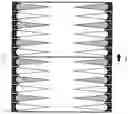
Backgammon board with the assigned number for each position on the board for each player
US20190388775A1
2019-12-26
16/017,071
2018-06-25
Abstract:
An improved Backgammon playing board that helps players move their stone to correct position (location) easily and swiftly by assigning a number from zero to 23 to each location on face of stoner holder with 2 different color for each player.
Interested in similar patents?
Get notified when new applications in this technology area are published.
Classification:
A63F3/00151 » CPC main
Board games; Raffle games; Types of board games Backgammon
A63F2003/00498 » CPC further
Board games; Raffle games; Characteristics of game boards, alone or in relation to supporting structures or playing piece; Details of game boards, e.g. rotatable, slidable or replaceable parts, modular game boards, vertical game boards; Details of the rim or side edge; Information on the rim by colours
A63F2003/00501 » CPC further
Board games; Raffle games; Characteristics of game boards, alone or in relation to supporting structures or playing piece; Details of game boards, e.g. rotatable, slidable or replaceable parts, modular game boards, vertical game boards; Details of the rim or side edge; Information on the rim by numbers or letters
A63F3/00261 » CPC further
Board games; Raffle games; Characteristics of game boards, alone or in relation to supporting structures or playing piece Details of game boards, e.g. rotatable, slidable or replaceable parts, modular game boards, vertical game boards
A63F3/00 IPC
Board games; Raffle games
Description
BACKGROUND OF INVENTION
Field of Invention
Invention relates to game boards specifically boards used for playing the game of backgammon.
Background of Invention
Backgammon, a board game has traditionally been played by two persons. The backgammon playing board used for ancient game is arranged with 24 positions over which the players alternatively move their respective 15 stones according to roll of dice. The board itself is divided into four quadrants or “tables”, with two tables per side and six triangular points per table. The basic object of the game is to be the first player to remove all of his stones from table. The Stones of two players are moved in opposite directions around the board. Initially each player has eight stones on his home side or home table and seven stones on opposite side or outside table.
BRIEF DESCRIPTION OF DRAWINGS
FIG. 1: Is Plan view of backgammon board in accordance with invention.
FIG. 2: Two black stones on position 3 and 6.
FIG. 3: black stone moved 11 steps from position 3 to 14
FIG. 4: black stone moved 11 steps from position 6 to 17
DETAILED SPECIFICATIONS OF INVENTION
In FIG. 1, Black arrow shows direction of movement for player with black stone (marked #2), white arrow shows direction of movement for player with white stones Marked #1) Player with black stone sees stone holder numbered from zero to “23” in black color on the direction which he needs to move his stones, white player sees stone holder marked from zero to 23 in white on the direction he need to move his stones. Each time player rolls a dice simply he could add numbers on the dice to current position of his stone and move it to new position.
For example let's say black player has two of his stones on position marked number “3” and “6” in black color (FIG. 2) and roll of dice is 5 and 6 he could easily move his stone on position “3” to position marked “14” FIG. 3 (5 plus 6 equal eleven plus his current position which is three) without worrying about counting positions one by one which is very time consuming and prone to error and many cases humiliating for beginners.
In our example naturally player could add eleven to “6” and move his stone from position 6 to position “17” in black number (FIG. 4). (or any combination he want to move his stones)
Claims
What is claimed is:1. Improved backgammon board with assigned number for each location (position) of board for each player (see FIG. 1), Player with black stone will see stone holder numbered from zero to “23” in black color on the direction which he needs to move his stones, white player will see stone holder marked from zero to 23 in white on the direction he need to move his stones. Each time player roll a dice simply he could add numbers on the dice to current position of his stone and move it to new position. For example let's say black player has two of his two stones on position marked number “3” and “7” in black color and roll of dice is 5 and 6 he could easily move his stone on position “3” to position marked “14” in black on stone holder (5 plus 6 equal eleven plus his current position which is three) without worrying about counting positions one by one which is very time consuming and prone to error and many cases humiliating for beginners.
In our example naturally player could add eleven to “7” and move his stone from position 7 to position marked by “18” in black number, (or any combination he want to move his stones).
Images & Drawings included:



Sources:
- United States Patent and Trademark Office - verify current appl. status at the USPTO↗
Recent applications in this class:
- » 20240149144 2024-05-09
METHOD OF REDUCING EFFECT OF SKILL LEVEL IN A BACKGAMMON GAME - » 20220023749 2022-01-27
MULTI-PLAYER BOARD GAME - » 20200316454 2020-10-08
GAME BOARD FOR ENHANCED ENJOYMENT OF ACEY-DEUCY HAVING A SERIES OF RECTANGULAR SPACES ENABLING STRAIGHT LINEAR PLAY - » 20140197597 2014-07-17
GAMMON GAME AND METHOD OF PLAY