PAPER CUP
US20200087017A1
2020-03-19
16/546,950
2019-08-21
Abstract:
The disposable paper cup has a body formed of a cylindrical wall with a recess at the top. The portions of the body wall adjacent either side of the recess are aligned into a flap. The flap is folded over and secured to the exterior surface of the body wall to entirely enclose the cup body, except for an integral spout formed by the recess.
Interested in similar patents?
Get notified when new applications in this technology area are published.
Classification:
A47G19/2205 » CPC further
Table service; Drinking vessels or saucers used for table service Drinking glasses or vessels
B65D3/06 » CPC main
Rigid or semi-rigid containers having bodies or peripheral walls of curved or partially-curved cross-section made by winding or bending paper without folding along defined lines characterised by shape essentially conical or frusto-conical
A47G19/22 IPC
Table service Drinking vessels or saucers used for table service
Description
CROSS-REFERENCE TO RELATED APPLICATIONS
Priority is claimed on Provisional Patent Application Ser. No. 62/732,557, filed Sep. 17, 2018, which is incorporated herein in its entirety by reference.
STATEMENT REGARDING FEDERALLY SPONSORED RESEARCH OR DEVELOPMENT
Not Applicable
REFERENCE TO A “SEQUENCE LISTING”, A TABLE, OR A COMPUTER PROGRAM LISTING APPENDIX SUBMITTED ON COMPACT DISC
Not Applicable
BACKGROUND OF THE INVENTION
1. Field of the Invention
The present invention relates to a paper cup and more particularly, to a paper cup with a wall which is folded to form a spout and needs no lid.
2. Description of Prior Art Including Information Disclosed Under 37 CFR 1.97 and 1.98
Conventional paper cups for hot or cold beverages have a large open top and require a separate lid to close the cup. The lid adds another element to the production, delivery and storage cost.
Aside from the cost, closing the cup with a separate lid can create problems. If the user squeezes the cup, the internal pressure can cause the lid to pop up, allowing the liquid in the cup to spill.
Separate lids for paper cups are not good for the environment. The lids are often made of plastic which is not biodegradable. The lids add to the waste which must be disposed of and accumulate in garbage dumps.
Accordingly, there is a need for a low cost, safe, environmentally friendly and elegant paper cup for hot and cold drinks which can be used for personal and commercial use, which has an integral spout and does not require a separate lid.
Moreover, in certain situations, such as where the liquid in the cup is to be consumed which the user is in motion or has only one hand available to hold the cup, it may be difficult for the user to obtain the liquid from the cup without spilling a portion of the liquid.
There is, therefore, also a need to have a cup which can be used by one hand and has an integral spout through which liquid can easily flow into the mouth of the user, without having to remove a lid or use a straw.
BRIEF SUMMARY OF THE INVENTION
In accordance with one aspect of the present invention, a disposable paper cup is provided having an entirely enclosed body except for an integral spout.
In accordance with another aspect of the present invention, a disposable paper cup is provided. The cup has a body formed of a generally cylindrical wall. A recess is created at the top of the body. The portions of the wall adjacent the recess are folded over to entirely enclose the body, and define the spout formed by the recess.
The wall portions are aligned in side-by-side relation prior to being folded. The folded portions are sealed to the body after being folded.
An insulating sleeve may be provided surrounding the cup body.
In accordance with another aspect of the invention, a method of forming a disposable paper cup body is provided. The cup body is formed of a generally rectangular paper sheet part having a top edge and opposite sides. The method comprises the steps of: creating a recess in the sheet part adjacent the top thereof; sealing the sides of the part to form a generally cylindrical body; aligning the portions of the body on either side of the recess; moving the aligned portions of the body together into side-by-side relation; folding the aligned portions to a position adjacent the exterior surface of the cup body such that the recess forms a spout; and sealing the aligned portions to the exterior of the cup body.
The method further includes the steps of: creating a generally cylindrical sleeve of heat insulating material; and inserting the cup body into the sleeve.
BRIEF DESCRIPTION OF THE SEVERAL VIEWS OF DRAWINGS
To these and to such other objects that may hereinafter appears, the present invention relates to a paper cup as described in detail in the following specification and recited in the annexed claims, taken together with the accompanying drawings, in which like numerals refer to like parts and in which:
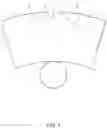
FIG. 1 is an elevation view of a paper sheet which has been cut to create paper portions which will form the bottom and side wall of the paper cup;
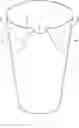
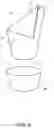
FIG. 2 is a perspective view of the paper cup after side wall has been formed and the bottom attached;
FIG. 3 is a side elevation view of the paper cup showing the portions to be folded aligned and in side-by-side relation;
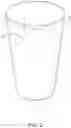
FIG. 4 is a side elevation view of the paper cup with the aligned portions folded;
FIG. 5 is a side elevation view of the cup of FIG. 4 with the optional insulating sleeve exploded;
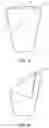
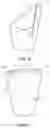
FIG. 6 is a side elevation view of the cup of FIG. 4 showing the location at which the folded portions are sealed to the exterior surface of the cup wall; and
FIG. 7 is a side elevation view of the cup of FIG. 3 showing the sealing points.
DETAILED DESCRIPTION OF THE INVENTION
As seen in the Figures, the present invention is a disposable paper cup which has an entirely enclosed body, except for an integral spout. The body is formed of a generally cylindrical wall with a top portion having a recess. The portions of the body wall adjacent the recess are folded over to entirely enclose the body, other than the spout formed by the recess.
The body wall portions are aligned in side-by-side relation prior to being folded. The folded portions are sealed to the body after being folded. The cup may further include an insulating sleeve.
The cup is formed from a sheet of paper. As seen in FIG. 1, the paper sheet is cut into a generally rectangular part, which will form the wall of the body of the cup and a circular part, which will form the bottom of the cup.
In the preferred embodiment of FIG. 1, the generally rectangular part actually has somewhat arcuate top and bottom edges such that when the body of the cup is formed, as seen in FIG. 2, it is not exactly cylindrical but instead is generally cylindrical, being somewhat larger at the top than at the bottom. Thus, the resulting cup body is technically a truncated cone, which is a common shape for drinking cups and glasses.
For purposes of this disclosure, the term “generally rectangular” is intended to include rectangular shapes, and shapes which are approximately rectangular such as the shape of the part depicted in FIG. 1. Similarly, the term “generally cylindrical” is intended to include shapes which are cylindrical, and shapes which are approximately cylindrical such as the shape of the cup body as seen in FIG. 2.
FIG. 1 shows that the generally rectangular body part includes an upper left-hand portion 1 defined by a fold line 2. Fold line 2 extends from the left side of the part to the top edge of the part and partially defines the top edge of a central portion 3. A recess 4 is situated at the top of central portion 3 and has a semi-circular shape with corners at each side.
The left corner of recess 4 is aligned with fold line 2. A second fold line 5 extends from the right side of the part to the other corner of recess 4 and defines the upper right-hand portion 6 of the part. In the preferred embodiment, fold lines 2 and 5 would form an angle of about 90 degrees, if extended.
When the left side of the part and the right side of the part are sealed together to form the body of the cup, and the circular part 7 is sealed to the bottom of the cup body, the partially formed cup appears as seen in FIG. 2.
As seen in FIG. 3, when portions 1 and 6 of the partially formed cup on either side of recess 4 are aligned and moved into side-by-side relation to form a flap, the partially formed cup appears as illustrated in FIG. 3. The flap formed of portions 1 and 6 is then folded along fold line 2 such that it is adjacent the exterior of the surface of the cup body, and the partially formed cup appears as seen in FIG. 4. In that state, the spout is defined by recess 4 and the entire body of the cup, with the exception of the integral spout, is enclosed, eliminating the necessity for a separate lid.
FIG. 5 shows a separate insulating sleeve 9 into which the body of the cup of the present invention may be received. Sleeve 9 may also be formed of paper. The use of sleeve 9 is optional and primarily employed when the cup contains hot beverages. However, in certain instances, the sleeve may be sized for used to secure the flat to the exterior of the cup body, eliminating the need for sealant or other securing means. In addition, an elastic band may be substituted for the paper sleeve by placing the band around the folded flap and the cup body.
FIG. 6 illustrates the place 10 where the folded flap formed by portions 1 and 6 may be secured to the exterior surface of the cup body. Adhesive, hook and loop tape or other sealing means (including the sleeve 9 or elastic band referred to above) may be used for sealing the flap to the cup body. FIG. 7 illustrates the places 11 and 12 on the exterior surface of the cup body and portion 1, respectively, which may be secured together.
In some situations, the flap formed by portions 1 and 6 can be held in place adjacent the exterior surface of the cup body by the hand of the user, eliminating the necessity of sealing or otherwise securing the flap to the cup body by adhesive, a sleeve or an elastic band.
While only a single preferred embodiment of the present invention has been disclosed for purposes of illustration, it is obvious that many modifications and variations could be made thereto, including, for example, the size and shape of the cup body. It is intended to cover all of those modifications and variations which fall within the scope of the present invention, as defined by the following claims:
Claims
I claim:1. A disposable paper cup comprising an entirely enclosed body except for an integral spout.
2. A disposable paper cup comprising a body formed of a generally cylindrical wall with a top portion having a recess, wherein the portions of said wall adjacent said recess are folded over to entirely enclose the body, other than a spout formed by said recess.
3. The cup of claim 2 wherein said wall portions are aligned and moved into side-by-side relation prior to being folded.
4. The cup of claim 3 wherein said folded portions are sealed to said body after being folded.
5. The cup of claim 2 wherein said folded portions are secured to said body.
6. The cup of claim 2 further comprising an insulating sleeve.
7. A method of forming a disposable paper cup body from a generally rectangular paper sheet part having a top edge and opposite sides, the method comprising the steps of:
(a) creating a recess in the sheet part adjacent the top edge;
(b) sealing the sides of the sheet part to form a generally cylindrical body;
(c) aligning the portions of the body on either side of the recess;
(d) moving the aligned portions of the body together into side-by-side relation; and
(e) folding the aligned portions to a position adjacent the exterior of the cup body such that the recess forms a spout.
8. The method of claim 7 further comprising the step of:
(f) securing the aligned portions to the exterior of the cup body.
9. The method of claim 7 further comprising the steps of:
(g) creating a generally cylindrical sleeve of heat insulating material; and
(h) inserting the cup body into the sleeve.
10. The method of claim 7 further comprising forming a bottom for the cup body and sealing the bottom to the cup body.
11. The method of claim 9 wherein said method results in a cup body which is entirely enclosed, except for an integral spout.
12. The method of claim 7 further comprising the steps of:
(i) creating a sleeve; and
(j) inserting the cup body in the sleeve.
Images & Drawings included:
Sources:
- United States Patent and Trademark Office - verify current appl. status at the USPTO↗
Similar patent applications:
- » 20180070750
Paper cup, a blank for a paper cup, and use of a paper cup - » 20190039357
Paper cup, paper cup for acidic food - » 20130193198
Method of forming side paper of a foldable paper cup, and foldable paper cup - » 20100155461
Paper cup, and method and device for making a paper cup - » 20240247141
Upcycling Post-Consumed Single Used Paper Cups to Loose Fibre Insulation and Paper-Plastic Composite Material - » 20080176015
PAPER CUP COMPRISING A SHEET OF POLYLACTIC ACID LAMINATED PAPER - » 20130001286
Cup of paper material and method for the fabrication of a cup of paper material - » 20090261117
Disposable teacup shape paper cup holder - » 20050269390
Disposable paper cups, method of making, and handling of such cups - » 20100154983
Device for the application of adhesive and machine and method for manufacturing paper cups
Recent applications in this class:
- » 20240400250 2024-12-05
Cup With Parts: Apparatus & Method - » 20240246715 2024-07-25
CONTAINER WITH A ONE-PIECE CONTAINER BODY COMPRISING FIBERS AND A CLOSURE THEREFOR, METHOD FOR MANUFACTURING A CONTAINER BODY, DEVICE AND METHOD FOR CLOSING A CONTAINER BODY BY MEANS OF A CLOSURE - » 20230249868 2023-08-10
FOOD CONTAINER - » 20220297872 2022-09-22
Container for articles, relative blank and method of making - » 20220135275 2022-05-05
COATED PAPERBOARD CONTAINER, METHOD OF MANUFACTURING A COATED PAPERBOARD CONTAINER, AND CUP BOTTOM FORMING APPARATUS - » 20220111995 2022-04-14
Method of forming a paper container and related materials - » 20210130032 2021-05-06
FRESH-KEEPING PAPER BOX - » 20200231326 2020-07-23
Biodegradable Drinking Cup Assembly - » 20190329928 2019-10-31
Coated paperboard container, method of manufacturing a coated paperboard container, and cup bottom forming apparatus - » 20190127106 2019-05-02
Drinking cup