Sacrificial active material of a positive electrode for a lithium-ion electrochemical element
US20200136140A1
2020-04-30
16/624,632
2018-05-22
✅ Patent granted
US 11,563,212 B2
2023-01-24
WO; PCT/EP2018/063373; 20180522
WO; WO2018/233963; 20181227
Brittany L Raymond
Sughrue Mion, PLLC
2039-07-19
Abstract:
A sacrificial positive active material for a lithium-ion electrochemical element which is a compound of formula (Li2O)x (MnO2)y(MnO)z(MOa)t in which: x+y+z+t=1; 1−x−y≥0; 0.97≥x≥0.6; y≤0.45; x −0.17; y≥0; y+z>0; t≥0; 1≤a<3. M is selected from the group consisting of Fe, Co, Ni, B, Al, Ti, Si, V, Mo, Zr and a mixture thereof.
Inventors:
- Valérie PRALONG 5 🇫🇷 Caen, France
- Christian JORDY 14 🇫🇷 St. Louis De Montferrand, France
- Melanie FREIRE 1 🇫🇷 GAGNY, France
Assignee:
- CENTRE NATIONAL DE LA RECHERCHE SCIENTIFIQUE 3,102 🇫🇷 PARIS, France
- CENTRE NATIONAL DE LA RECHERCHE SCIENTIFIQUE (C.N.R.S.) 166 🇫🇷 Paris Cedex 16, France
- SAFT 69 🇫🇷 Levallois-Perret, France
- ENSICAEN 1 🇫🇷 CAEN CEDEX 4, France
- UNICAEN 1 🇫🇷 CAEN CEDEX 05, France
- ENSICAEN 2 🇫🇷 Caen, France
- UNICAEN 1 🇫🇷 Caen, France
Applicant:
Interested in similar patents?
Get notified when new applications in this technology area are published.
Classification:
C01G45/1278 » CPC further
Compounds of manganese; Manganates manganites or permanganates; Manganates or manganites with a manganese oxidation state of Mn(III), Mn(IV) or mixtures thereof of the type [Mn2O7]n-, e.g. (Sr2-xNdx)Mn2O7, Tl2Mn2O7
C01G45/1285 » CPC further
Compounds of manganese; Manganates manganites or permanganates; Manganates or manganites with a manganese oxidation state of Mn(III), Mn(IV) or mixtures thereof of the type [Mn2O5]n-
H01M4/364 » CPC further
Electrodes; Electrodes composed of, or comprising, active material; Selection of substances as active materials, active masses, active liquids; Composites as mixtures
H01M4/5825 » CPC further
Electrodes; Electrodes composed of, or comprising, active material; Selection of substances as active materials, active masses, active liquids of inorganic compounds other than oxides or hydroxides, e.g. sulfides, selenides, tellurides, halogenides or LiCoF; of polyanionic structures, e.g. phosphates, silicates or borates Oxygenated metallic salts or polyanionic structures, e.g. borates, phosphates, silicates, olivines
C01P2006/40 » CPC further
Physical properties of inorganic compounds Electric properties
H01M4/505 » CPC main
Electrodes; Electrodes composed of, or comprising, active material; Selection of substances as active materials, active masses, active liquids of inorganic oxides or hydroxides of manganese of mixed oxides or hydroxides containing manganese for inserting or intercalating light metals, e.g. LiMnO or LiMnOxFy
C01G45/12 IPC
Compounds of manganese Manganates manganites or permanganates
H01M4/525 » CPC further
Electrodes; Electrodes composed of, or comprising, active material; Selection of substances as active materials, active masses, active liquids of inorganic oxides or hydroxides of nickel, cobalt or iron of mixed oxides or hydroxides containing iron, cobalt or nickel for inserting or intercalating light metals, e.g. LiNiO, LiCoO or LiCoOxFy
H01M4/58 IPC
Electrodes; Electrodes composed of, or comprising, active material; Selection of substances as active materials, active masses, active liquids of inorganic compounds other than oxides or hydroxides, e.g. sulfides, selenides, tellurides, halogenides or LiCoF; of polyanionic structures, e.g. phosphates, silicates or borates
H01M4/36 IPC
Electrodes; Electrodes composed of, or comprising, active material Selection of substances as active materials, active masses, active liquids
H01M10/0525 » CPC further
Secondary cells; Manufacture thereof; Accumulators with non-aqueous electrolyte; Li-accumulators Rocking-chair batteries, i.e. batteries with lithium insertion or intercalation in both electrodes; Lithium-ion batteries
C01P2002/72 » CPC further
Crystal-structural characteristics defined by measured X-ray, neutron or electron diffraction data by d-values or two theta-values, e.g. as X-ray diagram
H01M4/587 » CPC further
Electrodes; Electrodes composed of, or comprising, active material; Selection of substances as active materials, active masses, active liquids of inorganic compounds other than oxides or hydroxides, e.g. sulfides, selenides, tellurides, halogenides or LiCoF; of polyanionic structures, e.g. phosphates, silicates or borates; Carbonaceous material, e.g. graphite-intercalation compounds or CFx for inserting or intercalating light metals
C01G45/1221 » CPC further
Compounds of manganese; Manganates manganites or permanganates Manganates or manganites with a manganese oxidation state of Mn(III), Mn(IV) or mixtures thereof
Description
FIELD OF THE INVENTION
The technical field of the invention is that of electrochemically active materials intended for use in the positive electrode (or cathode) of a rechargeable electrochemical cell (or battery) of the lithium-ion type.
PRIOR ART
The operation of a lithium-ion electrochemical cell is based on the principle of reversible insertion of lithium into a host structure of an electrochemically active material. When the cell is charged, the electrochemically active material of the positive electrode oxidizes and extracts lithium from its structure while the electrochemically active material of the negative electrode reduces and lithium is inserted into its structure. Conversely, when the cell is discharged, the electrochemically active material of the positive electrode reduces and inserts lithium into its structure, while the electrochemically active material of the negative electrode oxidizes and lithium extracts from its structure.
Graphite is commonly used as an electrochemically active material in the negative electrode of a lithium-ion cell. When the cell is first charged, a passivation layer on the surface of the negative electrode is formed by decomposition of the electrolyte contained in the cell. Its formation is necessary because it avoids the exfoliation of graphite, leading to a high irreversible capacity, by preventing the co-intercalation of solvent. This passivation layer consumes lithium which will no longer be used to insert and extract and will therefore not participate in subsequent discharges. It is the cause of an irreversible capacity of the negative electrode.
At the positive electrode, during the discharge of the electrochemical cell, a fraction of the lithium does not re-enter the structure of the electrochemically positive active material. This unused fraction constitutes the irreversible capacity of the positive electrode.
Some lithium-ion electrochemical cells are characterized by an irreversible capacity of the negative electrode greater than that of the positive electrode. Examples include:
electrochemical cells comprising a graphite-based negative electrode and a positive electrode based on LiCoO2, or based on a lithium nickel manganese cobalt oxide (NMC), or based on a lithium nickel cobalt aluminium oxide (NCA), or based on LiFePO4 or
electrochemical cells the negative electrode of which is based on silicon, have an irreversible capacity which can reach up to 30 to 40%.
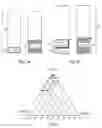
One of the consequences of the existence of this difference in these irreversible capacities is the non-use of part of the capacity of the electrode with the lowest irreversible capacity. The energy density of the electrochemical cell is then lower than that of a cell the irreversible capacities of which would be identical for both electrodes. This problem is illustrated in FIG. 1a. The left rectangle represents the capacity of the positive electrode. The right rectangle represents that of the negative electrode. The unhatched part of each rectangle represents the reversible capacity while the hatched part represents the irreversible capacity. It can be seen that the positive electrode and the negative electrode have the same total capacity but have different irreversible capacities. The positive electrode has a lower irreversible capacity than the negative electrode. Since the discharge of the electrochemical cell is limited by the electrode with the lowest reversible capacity, the discharge of the cell will stop when the reversible capacity of the negative electrode will have been fully used. Therefore, there is a fraction of electrochemically active material in the positive electrode that will not be used during the discharge of the electrochemical cell. This unused fraction corresponds to the difference in the area of the two hatched surfaces. This fraction of unused positive active material represents a certain mass and volume of the positive electrode. It therefore penalizes the mass capacity and volume capacity of the electrochemical cell.
Different ways have been sought to reduce the difference between the irreversible capacity of the positive electrode and the irreversible capacity of the negative electrode. Irreversible capacities can be artificially equalized either by pre-charging the negative electrode, for example by adding lithium metal, or by adding an active material of high irreversible capacity, also called sacrificial positive material, to the positive electrode. In the latter case, the use of an active material with a high irreversible capacity makes it possible to lighten the positive electrode since, compared to an active material with a low irreversible capacity, it is sufficient to use a smaller mass of active material for a given irreversible capacity.
Different sacrificial positive active materials are known. Examples include:
-
- Li2NiO2, which has a total capacity of 350 mAh/g. This active material is described in Chem. Mater. 2010, 22, 1263-1270.
- LisFeO4, which has a capacity of 700 mAh/g. This active material is described in Electrochemica Acta 108, 2013, 591-595.
Document WO 2015/011883 describes a sacrificial positive active material of the formula Li6MnO4, or (Li2O)0.75(MnO)0.25. The disadvantage of this active material is that it must be charged to a high potential, i.e. higher than 4.4V compared with lithium metal. The charging potential indicated in FIG. 8 of document WO 2015/011883 is indeed 4.5 V. Such a potential is detrimental to the life of the electrochemical cell. On the other hand, this figure shows that for a charging voltage of 4.4V, the charged capacity is less than 450 mAh/g. For a charging voltage of 4V, the charged capacity is less than 100 mAh/g, which is very low. What is sought, therefore, is a sacrificial positive active material with a higher charged capacity and for a charge potential with respect to lithium not exceeding 4.4V.
SUMMARY OF THE INVENTION
The invention proposes novel compounds that can be used as sacrificial positive active materials. These compounds have a high irreversible capacity, preferably from 630 mAh/g to about 1200 mAh/g.
A first object of the invention is a compound of the formula
(Li2O)x(MnO2)y(MnO)z(MOa)t
wherein
x+y+z+t=1
1−x−y≥0
0.97≥x≥0.6
y≤0.45·x−0.17
y≥0
y+z>0
t≥0
1≤a<3
M is selected from the group consisting of Fe, Co, Ni, B, Al, Ti, Si, V, Mo, Zr and a mixture thereof.
This compound can crystallize in the cubic system.
It can present an X-ray diffraction pattern, in which the width at mid-height of the line at a 2-theta angle between 40° and 45° is greater than 1°, the wavelength used being the Kalpha wavelength of copper.
According to an embodiment, x≥0.7, preferably x≥0.8, preferably still x≥0.9.
According to an embodiment, y=z+/−0.05.
According to an embodiment, y≤0.2, preferably y≤0.1.
According to an embodiment, z≤0.4, preferably z≤0.3, preferably still z≤0.2, preferably still z≤0.1.
According to an embodiment, t=0.
A second object of the invention is a composite material comprising the compound as described above and a Li2O crystalline phase.
This composite material can contain from 1 to 10% by mass of carbon.
A third object of the invention is an electrode comprising a first sacrificial electrochemically active material which is the compound as described above and at least one second electrochemically active material.
According to an embodiment, the second electrochemically active material is chosen from the group consisting of:
-
- compound i) of formula LixMn1−y−zM′yM″zPO4 (LMP), where M′ and M″ are different from each other and are selected from the group consisting of B, Mg, Al, Si, Ca, Ti, V, Cr, Fe, Co, Ni, Cu, Zn, Y, Zr, Nb and Mo, with 0.8≤x≤1.2; 0≤y≤0.6; 0≤z≤0.2;
- compound ii) of formula LixM2−x−y−z−wM′yM″zM′″wO2 (LMO2), where M, M′, M″ and M′″ are selected from the group consisting of B, Mg, Al, Si, Ca, Ti, V, Cr, Mn, Fe, Co, Ni, Cu, Zn, Y, Zr, Nb and Mo, provided that M or M′ or M″ or M′″ is selected from Mn, Co, Ni or Fe;
- M, M′, M″ and M′″ being different from each other; with 0.8≤x≤1.4; 0≤y≤0.5; 0≤z≤0.5; 0≤w≤0.2 and x+y+z+w<2;
- compound iii) of formula LixMn2−y−zM′yM″zO4 (LMO), where M′ and M″ are selected from the group consisting of B, Mg, Al, Si, Ca, Ti, V, Cr, Fe, Co, Ni, Cu, Zn, Y, Zr, Nb and Mo; M′ and M″ being different from each other, and 1≤x≤1.4; 0≤y≤0.6; 0≤z≤0.2;
- compound iv) of formula LixFe1−yMyPO4, where M is selected from the group consisting of B, Mg, Al, Si, Ca, Ti, V, Cr, Mn, Co, Ni, Cu, Zn, Y, Zr, Nb and Mo; and 0.8≤x≤1.2; 0≤y≤0.6;
- compound v) of formula xLi2MnO3; (1−x)LiMO2 where M is selected from Ni, Co and Mn and x≤1;
- and a mixture of one or more of the compounds i) to v).
According to an embodiment, the electrode comprises the compound ii) and
M is Ni;
M′ is Mn;
M″ is Co and
M′″ is selected from the group consisting of B, Mg, Al, Si, Ca, Ti, V, Cr, Mn, Fe, Co, Ni, Cu, Zn, Y, Zr, Nb and Mo;
with 0.8≤x≤1.4; 0<y≤0.5; 0<z≤0.5; 0≤w≤0.2 and x+y+z+w<2.
According to an embodiment, the electrode comprises the compound ii) and
M is Ni;
M′ is Co;
M″ is Al; and
1≤x≤1.15;
y>0;
z>0;
w=0.
According to an embodiment, the electrode comprises the compound ii) and x=1; 0.6≤2−x−y−z≤0.85; 0.10≤y≤0.25; 0.05≤z≤0.15.
According to an embodiment, the electrode comprises the compound ii) of formula LiCoO2.
According to an embodiment, the electrode comprises compound iv). Preferably, compound iv) has the formula LiFePO4.
According to an embodiment, the electrode comprises the compound iii) with x=1; 0≤y≤0.1; z=0 and M′ is Al. The compound iii) may have the formula LiMn2O4.
According to an embodiment, the mass percentage of the compound as described above is less than or equal to 5% of the total mass of all electrochemically active materials, preferably less than or equal to 2%.
A fourth object of the invention is an electrochemical cell of the lithium-ion type comprising a positive electrode as described above.
According to an embodiment, the electrochemical cell comprises:
-
- at least one negative electrode comprising a graphite-based active material,
- at least one positive electrode comprising at least one of the compounds i) to v) described above, or a mixture thereof.
According to an embodiment, the electrochemical cell comprises:
-
- at least one negative electrode comprising an active material selected from the group consisting of tin, silicon, carbon and silicon-based compounds, carbon and tin-based compounds, carbon, tin and silicon-based compounds; lithium titanium oxide compounds, such as lithium titanate Li4Ti5O12
- at least one positive electrode comprising the compound according to the invention.
Finally, a fifth object of the invention is a process for manufacturing the compound as described above, said process comprising the steps of:
a) provision of a mixture of Li2O, MnO, MnO2 and optionally MO;
b) grinding the mixture in an inert atmosphere;
c) heating the mixture in an inert atmosphere at a temperature between 800 and 1000° C.;
d) cooling of the mixture to room temperature;
e) grinding the mixture in an inert atmosphere;
f) possibly adding carbon to the mixture;
g) possibly grinding the mixture in an inert atmosphere.
BRIEF DESCRIPTION OF THE FIGURES
FIG. 1a schematically shows the capacities of the positive electrode and the negative electrode of a lithium-ion electrochemical cell according to the prior art in which the irreversible capacity of the negative electrode is greater than that of the positive electrode.
FIG. 1b schematically represents the capacities of the positive electrode and the negative electrode of a lithium-ion electrochemical cell according to the invention in which the difference between the irreversible capacity of the positive electrode and the irreversible capacity of the negative electrode has been reduced compared with the situation illustrated in FIG. 1a.
FIG. 2 is a ternary diagram (Li2O, MnO, MnO2) showing the compositional domain to which the compound according to the invention belongs and the position in that domain of the compounds in the examples in Table 1 below.
FIG. 3 is an X-ray diffraction pattern of a powder of the compound from example 1 Li9MnO6 according to the invention.
FIG. 4 is an X-ray diffraction pattern of a powder of the compound from example 7 Li10Mn2O7 according to the invention.
FIG. 5 shows the galvanostatic cycling curve of the compound of example 1 in a half cell of the Swagelok® type versus lithium.
FIG. 6 shows the galvanostatic cycling curve of the compound in example 7 in a half cell of the Swagelok® type versus lithium.
FIG. 7 is a ternary diagram (Li2O, MnO, MnO2) showing the position of the compounds in Table 3 below as counter-examples.
FIG. 8a shows the cycling curve of a reference electrode A and an electrode B including the compound from example 1. The abscissa axis is graduated in mAh/cm2.
FIG. 8b shows the cycling curve of a reference electrode A and an electrode B including the compound from example 1 under the same conditions as those in FIG. 8a. The abscissa axis is graduated in mAh/g.
DESCRIPTION OF DETAILED EMBODIMENTS
The compound according to the invention has the formula
(Li2O)x(MnO2)y(MnO)z(MOa)t
wherein
x+y+z+t=1
1−x−y≥0
0.97≥x≥0.6
y≤0.45·x−0.17
y≥0
y+z>0
t≥0
1≤a<3
M is selected from the group consisting of Fe, Co, Ni, B, Al, Ti, Si, V, Mo, Zr and a mixture thereof.
This formula defines a composition range. This composition range can be represented in a ternary diagram. Assuming that cell M is absent from the compound, the formula of the compound according to the invention can be rewritten:
(Li2O)x (MnO2)y (MnO)z. The three pure components Li2O, MnO2 and MnO are the three vertices of this ternary diagram.
Five criteria are imposed on parameters x, y and z. They define the composition range of the compound according to the invention in the ternary diagram. These criteria are as follows:
Criterion 1: x≥0.6
Criterion 2: y≤0.45·x−0.17
Criterion 3: x≤0.97
Criterion 4: y+z>0
Criterion 5: 1−x−y≥0
FIG. 2 shows the composition domain in the ternary diagram. This domain is delimited by a thick line. The points included in this domain meet the five criteria above.
The applicant found that the theoretical capacity of the compound according to the invention increased with the Li2O content. Therefore, x is preferably greater than or equal to 0.7, preferably still x is greater than or equal to 0.8, preferably still x is greater than or equal to 0.9.
The applicant also found that when the quantity of MnO is close to that of MnO2, a high capacity was obtained. “Close to” means y=z±0.05. In the ternary diagram in FIG. 2, this condition is met for the points on the vertical bisector of the triangle passing through the Li2O vertex.
According to a preferred embodiment, the compound according to the invention is devoid of the cell M, i.e. t=0.
The compound according to the invention is generally nanostructured. The size of the crystallites is typically less than 50 nm, preferably less than or equal to 10 nm, preferably even less than or equal to 5 nm. This nanostructure can be demonstrated by using the X-ray diffraction technique. The X-ray diffraction pattern on a powder of the compound has a peak at a 2-theta angle between 40° and 45°, the width at mid-height of which is greater than 1°. The wavelength used for the measurement is the Kalpha wavelength of copper. The width at mid-height can be greater than or equal to 2°, greater than or equal to 3°. It has been observed that the width at mid-height of the peak increases as the size of the crystallites decreases. Typically, a width at mid-height peak of about 2° corresponds to a crystallite size of about 5 nm.
The compound according to the invention generally crystallizes in the cubic system. The cubic system can be demonstrated by using the Rietveld refinement method which uses the X-ray diffraction technique.
A second Li2O phase is usually present with the compound of the invention. The X-ray diffraction pattern characteristic of the presence of the Li2O phase has peaks at the following 2-theta angles: 34°, 39°, 56°, 71° and 84°±1°, the angle being obtained using the Kalpha wavelength of copper.
The compound according to the invention is generally used in mixture with at least one second electrochemically active material. This second electrochemically active material can be selected from the group consisting of:
-
- compound i) of formula LixMn1−y−zM′yM″zPO4 (LMP), where M′ and M″ are different from each other and are selected from the group consisting of B, Mg, Al, Si, Ca, Ti, V, Cr, Fe, Co, Ni, Cu, Zn, Y, Zr, Nb and Mo, with 0.8≤x≤1.2; 0≤y≤0.6; 0≤z≤0.2;
- compound ii) of formula LixM2-x-y-z-wM′yM″zM′″wO2 (LMO2), where M, M′, M″ and M′″ are selected from the group consisting of B, Mg, Al, Si, Ca, Ti, V, Cr, Mn, Fe, Co, Ni, Cu, Zn, Y, Zr, Nb and Mo, provided that M or M′ or M or M′″ is selected from Mn, Co, Ni or Fe;
- M, M′, M″ and M′″ being different from each other; with 0.8≤x≤1.4; 0≤y≤0.5; 0≤z≤0.5; 0≤w≤0.2 and x+y+z+w<2;
- compound iii) of formula LixMn2−y−zM′yM″zO4 (LMO), where M′ and M″ are selected from the group consisting of B, Mg, Al, Si, Ca, Ti, V, Cr, Fe, Co, Ni, Cu, Zn, Y, Zr, Nb and Mo; M′ and M″ being different from each other, and 1≤x≤1.4; 0≤y≤0.6; 0≤z≤0.2;
- compound iv) of formula LixFe1−yMyPO4, where M is selected from the group consisting of B, Mg, Al, Si, Ca, Ti, V, Cr, Mn, Co, Ni, Cu, Zn, Y, Zr, Nb and Mo; and 0.8≤x≤1.2; 0≤y≤0.6;
- compound v) of formula xLi2MnO3; (1−x)LiMO2 where M is selected from Ni, Co and Mn and x≤1
or a mixture of compounds i) to v).
The compound according to the invention may be used in combination with one or more electrochemically active materials which may or may not be part of compounds i) to v).
In an embodiment, the lithium-ion electrochemical cell comprises:
-
- at least one negative graphite-based electrode,
- at least one positive electrode comprising the compound according to the invention in admixture with one or more of the compounds i) to v).
In a preferred embodiment, the electrochemical cell comprises: - at least one negative graphite-based electrode,
- at least one positive electrode comprising the compound according to the invention in admixture with a compound iv) as described above. The compound iv) is advantageously LiFePO4. The use of a compound according to the invention in an electrochemical cell comprising a positive electrode comprising a type iv) compound allows to increase the energy density of the cell by about 8 to 9%.
In an embodiment, the electrochemical cell comprises: - at least one negative silicon-based electrode,
- at least one positive electrode comprising the compound according to the invention in admixture with another electrochemically positive active material.
Generally, carbon is mixed with the compound according to the invention and any other electrochemically active material present in the positive electrode. The mass proportion of carbon used generally represents 3 to 10% of the sum of the masses of the positive active materials.
The process used to obtain the compound according to the invention is a mechanical alloying process. Mechanical alloying refers to all material techniques in which the energy for activating the chemical reaction between precursors is provided by mechanical means. The manufacturing process includes the steps of:
a) provision of a mixture of Li2O, MnO, MnO2 and optionally MO;
b) grinding the mixture in an inert atmosphere;
c) heating the mixture in an inert atmosphere at a temperature between 800 and 1000° C.;
d) cooling of the mixture to room temperature;
e) grinding the mixture in an inert atmosphere;
f) possibly adding carbon to the mixture;
g) optionally grinding the mixture in an inert atmosphere if carbon has been added in step f).
According to an embodiment, step c) of heating is carried out for a period of 3 to 5 hours.
Preferably, step c) of heating the mixture is carried out at a temperature ranging from 850 to 950° C., preferably 900° C., for a period ranging from 3.5 h to 4.5 h, preferably 4 h. The temperature rise to the desired temperature is carried out gradually over a period of 4 to 6 hours, preferably 5 hours.
Preferably, step d) of cooling to room temperature is carried out gradually over a period of 4 to 6 hours, preferably 5 hours.
According to an embodiment, step e) of grinding the mixture is carried out for a period of 13 to 17 hours.
Preferably, step e) of grinding the mixture is carried out over a period of about 15 hours.
According to an embodiment, step g) of grinding the mixture is carried out for a period of 4 to 6 hours.
The process according to the invention makes it possible to obtain a stabilization of the cubic phase as well as a nanostructuring of the compound.
EXAMPLES
Thirteen examples of compounds according to the invention have been synthesized. Their composition is shown in Table 1 below. The procedure used to synthesize them is as follows:
First, the precursors Li2O, MnO, MnO2 and MO, if applicable, were ground in a mortar in stoichiometric proportions in a glove box under argon atmosphere (total mass of precursors: 5 g). Then, a heat treatment in a sealed tube was carried out for 4 hours at 900° C. The temperature rise to 900° C. occurred in 5 hours, as did the temperature drop to 25° C.
The resulting material was then ground for 15 hours under argon atmosphere, in 10 mL WC tungsten carbide bowls with 4 WC balls 10 mm in diameter, using a FRITSCH™ planetary mill. The grinding speed is 700 rpm. After 5 hours, 10 hours and 15 hours, the grinding was stopped and the walls of the bowl were scraped in the glove box to homogenize the powder which is compacted on the walls. In order to avoid heating during the 5 consecutive hours of grinding, ten 30-minute cycles with a 5-minute break were carried out, alternating the direction of rotation of the grinding bowls.
Carbon was added to the material already ground for 15 hours at a rate of 5% by mass with respect to the mass of the material already ground for 15 hours. Then, the mixture containing the carbon was ground again for a further 5 hours, under the same conditions as before (10 cycles of 30 minutes at a speed of 700 rpm, alternating the direction of rotation of the grinding).
| TABLE 1 |
| Compounds according to the invention |
| Degree of | Theoretical | ||||||||
| Example | oxidation | capacity* | |||||||
| number | Formula | xLi2O | yMnO2 | zMnO | tMOa | M | a | of Mn | (mAh/g) |
| 1 | Li9MnO6 | 0.818 | 0.091 | 0.091 | 0.000 | — | — | 3 | 1130 |
| 2 | Li19MnO11 | 0.905 | 0.048 | 0.048 | 0.000 | — | — | 3 | 1403 |
| 3 | Li18Mn2O13 | 0.818 | 0.182 | 0.000 | 0.000 | — | — | 2 | 1089 |
| 4 | Li38Mn2O23 | 0.905 | 0.095 | 0.000 | 0.000 | — | — | 2 | 1373 |
| 5 | Li60MnO32 | 0.968 | 0.032 | 0.000 | 0.000 | — | — | 2 | 1635 |
| 6 | Li6Mn2O5 | 0.600 | 0.000 | 0.400 | 0.000 | — | — | 4 | 694 |
| 7 | Li10Mn2O7 | 0.714 | 0.000 | 0.286 | 0.000 | — | — | 4 | 920 |
| 8 | Li18Mn2O11 | 0.818 | 0.000 | 0.182 | 0.000 | — | — | 4 | 1174 |
| 9 | Li38Mn2O21 | 0.905 | 0.000 | 0.095 | 0.000 | — | — | 4 | 1435 |
| 10 | Li12Mn4O11 | 0.600 | 0.100 | 0.300 | 0.000 | — | — | 3.5 | 671 |
| 11 | Li9Mn0.5Al0.5O6 | 0.818 | 0.045 | 0.045 | 0.091 | Al | 1.5 | 3 | 1209 |
| 12 | Li9Mn0.5V0.5O6 | 0.818 | 0.000 | 0.091 | 0.091 | V | 2.0 | 4 | 1141 |
| 13 | Li9Mn0.5Ti0.5O6 | 0.818 | 0.000 | 0.091 | 0.091 | Ti | 2.0 | 4 | 1149 |
| *theoretical capacity (mAh/g) equal to the number of lithium atoms in the formula of the compound under consideration × 26800/molecular weight of the compound |
The position of compounds 1-10 in a ternary diagram is shown in FIG. 2. A fourteenth example of a compound that is part of the invention but not synthesized is Li190Mn5O102.5 which has a theoretical mass capacity of 1500 mAh/g.
The compound of example 1 of formula Li9MnO6 was studied for its crystallographic structure. An X-ray diffraction pattern was performed on a powder of this compound. It is shown in FIG. 3, which shows a peak at a 2-theta angle of 43.5°. This peak has a mid-height width of about 3°, indicating that the compound is nanostructured. In addition, the Rietveld refinement of the pattern indicates that this compound crystallizes in the cubic system. It also indicates the presence of a secondary phase Li2O.
The compound of example 7 of formula Li10Mn2O7 was also studied for its crystallographic structure. An X-ray diffraction pattern was performed on a powder of this compound. It is shown in FIG. 4, which shows a peak at a 2-theta angle of 41.5°. This peak has a width at mid-height of about 3°. This indicates that the compound is nanostructured.
For comparison, the compound Li6MnO4 described in document WO 2015/011883, cited in the discussion of prior art, is not nanostructured. Indeed, referring to FIG. 14 of document WO2015/011883, it can be noted that the peak at a 2-theta angle between 40 and 45° has a half-height width of less than 0.3°, which means that the size of the crystallites is greater than 50 nm.
Electrical Tests:
The electrical tests were performed using Swagelok®-type laboratory electrochemical cells. The positive electrode has a surface area of 1.14 cm2 and consists of from 20 to 30 mg of a mixture comprising 72% by mass of electrochemically active material and 28% by mass of carbon. The mixture was previously mixed with the FRITSCH™ planetary mill for 30 minutes at 450 rpm. The negative electrode consists of a lithium disc in large excess of capacity compared with the positive electrode. The thickness of the lithium disc is 500 μm. The two electrodes are electrically isolated by two layers of borosilicate glass fibre (Whatman™) separators. The electrolyte used is composed of 1 M LiPF6 dissolved in a mixture of ethylene carbonate and methyl ethyl carbonate EC:MEC in a mass ratio of 3:7.
The charge currents were calculated to extract one Li atom per compound formula in 20 hours.
The cut-off voltage of the first charge is 4.4V and 1.2V for the discharge.
The cut-off voltage of the second charge is 4.6V and 1.2V for the discharge.
The cut-off voltage for the third charge is 4.8V and 1.2V for the discharge.
The results of the electrical tests are summarized in Table 2 below
| TABLE 2 |
| Electrical test results for compounds according to the invention |
| Total | |||||||||
| charged | |||||||||
| Theoretical | capacity | ||||||||
| Example | capacity | at 4.4 V | |||||||
| number | Formula | xLi2O | yMnO2 | zMnO | tMOa | M | a | (mAh/g) | (mAh/g) |
| 1 | Li9MnO6 | 0.818 | 0.091 | 0.091 | 0.000 | — | — | 1130 | 1125 |
| 2 | Li19MnO11 | 0.905 | 0.048 | 0.048 | 0.000 | — | — | 1403 | 813 |
| 3 | Li18Mn2O13 | 0.818 | 0.182 | 0.000 | 0.000 | — | — | 1089 | 641 |
| 4 | Li38Mn2O23 | 0.905 | 0.095 | 0.000 | 0.000 | — | — | 1373 | 676 |
| 5 | Li60MnO32 | 0.968 | 0.032 | 0.000 | 0.000 | — | — | 1635 | 640 |
| 6 | Li6Mn2O5 | 0.600 | 0.000 | 0.400 | 0.000 | — | — | 694 | 630 |
| 7 | Li10Mn2O7 | 0.714 | 0.000 | 0.286 | 0.000 | — | — | 920 | 797 |
| 8 | Li18Mn2O11 | 0.818 | 0.000 | 0.182 | 0.000 | — | — | 1174 | 633 |
| 9 | Li38Mn2O21 | 0.905 | 0.000 | 0.095 | 0.000 | — | — | 1435 | 796 |
| 10 | Li12Mn4O11 | 0.600 | 0.100 | 0.300 | 0.000 | — | — | 671 | 781 |
| 11 | Li9Mn0.5Al0.5O6 | 0.818 | 0.045 | 0.045 | 0.091 | Al | 1.5 | 1209 | 691 |
| 12 | Li9Mn0.5V0.5O6 | 0.818 | 0.000 | 0.091 | 0.091 | V | 2.0 | 1141 | 931 |
| 13 | Li9Mn0.5Ti0.5O6 | 0.818 | 0.000 | 0.091 | 0.091 | Ti | 2.0 | 1149 | 954 |
| Criterion | ||||||||
| Total | 2: 0.45x- | |||||||
| charged | Crierion | 0.17- | Criterion | Criterion | ||||
| capacity | 1: | y ≥ 0 | 3: 0.97- | Criterion | 5: | |||
| Example | at 4.8 V | x-0.6 ≥ 0 | 0.45x- | x ≥ 0 | 4: y + z > 0 | 1-x-y ≥ 0 | All | |
| number | (mAh/g) | x-0.6 | 0.17-y | 0.97-x | y + z | 1-x-y | criteria | |
| 1 | 1124 | 0.218 | 0.107 | 0.152 | 0.182 | 0.091 | YES | |
| 2 | 893 | 0.305 | 0.190 | 0.065 | 0.095 | 0.048 | YES | |
| 3 | 641 | 0.218 | 0.016 | 0.152 | 0.182 | 0.000 | YES | |
| 4 | 676 | 0.305 | 0.142 | 0.065 | 0.095 | 0.000 | YES | |
| 5 | 769 | 0.368 | 0.233 | 0.002 | 0.032 | 0.000 | YES | |
| 6 | 643 | 0.000 | 0.100 | 0.370 | 0.400 | 0.400 | YES | |
| 7 | 829 | 0.114 | 0.151 | 0.256 | 0.286 | 0.286 | YES | |
| 8 | 633 | 0.218 | 0.198 | 0.152 | 0.182 | 0.182 | YES | |
| 9 | 876 | 0.305 | 0.237 | 0.065 | 0.095 | 0.095 | YES | |
| 10 | 819 | 0.000 | 0.000 | 0.370 | 0.400 | 0.300 | YES | |
| 11 | 925 | 0.218 | 0.153 | 0.152 | 0.091 | 0.136 | YES | |
| 12 | 910 | 0.218 | 0.198 | 0.152 | 0.091 | 0.182 | YES | |
| 13 | 957 | 0.218 | 0.198 | 0.152 | 0.091 | 0.182 | YES | |
Table 2 shows that the compounds according to the invention have, for a charging voltage of 4.4V, a total charged capacity of at least 630 mAh/g, up to 1200 mAh/g.
The galvanostatic cycling of the compound in example 1 of formula Li9MnO6, in half-cell versus lithium (Swagelok® type) was performed. The resulting cycling curve is shown in FIG. 5, which shows that at a charge rate corresponding to the extraction of a lithium atom in 20 hours per compound formula, nearly 9 lithium atoms per compound formula are extracted from the structure (1125 mAh/g) at the first charge and 1.64 lithium atoms are reinserted during the first discharge (206 mAh/g). This result shows the strong irreversible capacity of this material since out of the 9 lithium atoms per compound formula extracted during charging, only 1.64 atoms per compound formula are able to reinsert into the compound structure during the discharge following this first charge. It can be seen that the experimental capacity under charge is very close to the theoretical capacity despite the presence of a significant amount of Li2O. This result means that the nanostructured composite composed of cubic phase and Li2O makes it possible to electrochemically activate the oxidation of Li2O. Finally, one can note that the charged capacity of 1125 mAh/g at 4.4V of the compound in example 1 is much higher than the charged capacity of compound Li6MnO4 described in document WO 2015/011883, cited in the discussion of the prior art, which is indeed less than 450 mAh/g.
The galvanostatic cycling curve of the compound in example 7 of formula Li10Mn2O6, in half-cell versus lithium (Swagelok® type) is shown in FIG. 6. This figure shows that at a charging rate corresponding to the extraction of a lithium atom in 20 hours per compound formula, nearly 8.6 lithium atoms per compound formula are extracted from the structure (797 mAh/g) at the first charge and 2.8 lithium atoms per compound formula are re-inserted at the 1st discharge (260 mAh/g).
Compounds not part of the invention were synthesized and their capacity were measured. The position of these compounds in a ternary diagram is shown in FIG. 7. These compounds are outside the compositional domain materialized by a thick line. Table 3 shows the formulas of these compounds as well as the measured charged capacities.
| TABLE 3 |
| Electrical test results for counter-examples |
| Total | ||||||||||
| Degree | charged | |||||||||
| Counter | of | Theoretical | capacity | |||||||
| example | oxidation | capacity | at 4.4 V | |||||||
| number | Formula | xLi2O | yMnO2 | zMnO | tMOa | M | a | of Mn | (mAh/g) | (mAh/g) |
| 1 | Li3MnO3 | 0.600 | 0.200 | 0.200 | 0.000 | — | — | 3 | 676 | 370 |
| 2 | Li2MnO3 | 0.500 | 0.500 | 0.000 | 0.000 | — | — | 2 | 589 | 335 |
| 3 | Li6Mn2O7 | 0.600 | 0.400 | 0.000 | 0.000 | — | — | 2 | 758 | 620 |
| 4 | Li10Mn2O9 | 0.714 | 0.286 | 0.000 | 0.000 | — | — | 2 | 985 | 489 |
| 5 | Li10Mn5O14 | 0.500 | 0.400 | 0.100 | 0.000 | — | — | 2.4 | 557 | 277 |
| 6 | Li6Mn4O7 | 0.429 | 0.000 | 0.571 | 0.000 | — | — | 4 | 367 | 272 |
| 7 | Li2MnO2 | 0.500 | 0.000 | 0.500 | 0.000 | — | — | 4 | 458 | 326 |
| 8 | Li10Mn7O13 | 0.417 | 0.083 | 0.500 | 0.000 | — | — | 3.71 | 366 | 360 |
| 9 | Li10Mn5O11 | 0.500 | 0.100 | 0.400 | 0.000 | — | — | 3.6 | 479 | 362 |
| 10 | Li9TiO6 | 0.818 | 0.000 | 0.000 | 0.182 | Ti | 2 | — | 1122 | 304 |
| 11 | Li2O | 1.000 | 0.000 | 0.000 | 0.000 | — | — | — | 1787 | 200 |
| Criterion | ||||||||
| 2: | ||||||||
| Total | 0.45x- | Criterion | ||||||
| charged | Criterion | 0.17- | 3: | Criterion | ||||
| Counter | capacity | 1: | y ≥ 0 | 0.97- | Criterion | 5: | ||
| example | at 4.8 V | x-0.6 ≥ 0 | 0.45x- | x ≥ 0 | 4: y + z > 0 | 1-x-y ≥ 0 | all | |
| number | (mAh/g) | x-0.6 | 0.17-y | 0.97-x | y + z | 1-x-y | criteria | |
| 1 | 416 | 0.000 | −0.100 | 0.370 | 0.400 | 0.200 | NO | |
| 2 | 331 | −0.100 | −0.445 | 0.470 | 0.500 | 0.000 | NO | |
| 3 | 620 | 0.000 | −0.300 | 0.370 | 0.400 | 0.000 | NO | |
| 4 | 621 | 0.114 | −0.134 | 0.256 | 0.286 | 0.000 | NO | |
| 5 | 360 | −0.100 | −0.345 | 0.470 | 0.500 | 0.100 | NO | |
| 6 | 358 | −0.171 | 0.023 | 0.541 | 0.571 | 0.571 | NO | |
| 7 | 350 | −0.100 | 0.055 | 0.470 | 0.500 | 0.500 | NO | |
| 8 | 420 | −0.183 | −0.066 | 0.553 | 0.583 | 0.500 | NO | |
| 9 | 433 | −0.100 | −0.045 | 0.470 | 0.500 | 0.400 | NO | |
| 10 | 443 | 0.218 | 0.198 | 0.152 | 0.000 | 0.182 | NO | |
| 11 | 250 | 0.400 | 0.280 | −0.030 | 0.000 | 0.000 | NO | |
Table 3 shows that the counter-examples have, for a charging voltage of 4.4V, a total charging capacity not exceeding 620 mAh/g. None of these compounds meet all five criteria.
Validation in Mixture with a Cathode Active Material with Low Irreversible Capacity LiFePO4:
The validation of the invention was carried out by comparing two positive electrodes, one based on LiFePO4 (electrode A) and the other by replacing 2% of this compound with the Li9MnO6 compound of 1125 mAh/g capacity (electrode B). This substitution creates an irreversible capacity of about 20 mAh/g of positive active material.
The reference electrode A was manufactured with the following mass composition: 77% LiFePO4/23% carbon.
The electrode B according to the invention was manufactured with the following mass composition: 75.5% LiFePO4/1.5% Li9MnO6/23% carbon. The mass of Li9MnO6 represents about 2% of the sum of the masses of positive active materials.
The mixture of active material(s) and carbon is deposited on a current collector of the positive electrode at a rate of 12.65 mg/cm2.
The electrical tests performed on both electrodes are as follows:
1: Charging at a rate allowing to extract a Li atom by compound formula in 20 hours, up to 4V.
2: Constant voltage charging supplement (4V) with an end of charge current corresponding to C/1300
3: Discharge up to 2V at a C/10 rate
The charge-discharge curves for each of these electrodes have been plotted. They are shown in FIGS. 8a and 8b. FIG. 8a shows that:
-
- during the first charge, the charged capacity of electrode A is 1.85 mAh/cm2 and the charged capacity of electrode B is 2.15 mAh/cm2, i.e. an additional capacity of about 0.3 mAh/cm2 for electrode B containing the compound according to the invention.
- the capacity discharged after the first charge is the same for electrode A and electrode B. It is about 1.85 mAh/cm2.
FIG. 8b shows the cycling curve of electrodes A and B under the same conditions as those in FIG. 8a, with the difference that the abscissa axis is graduated in mAh/g and the starting points of the discharge curves of electrodes A and B are not overlapped.
The total charged capacity during the first charge for electrode A is 165 mAh/g and that of electrode B is 185 mAh/g. The capacity measured during the first discharge is the same for both electrodes, which means that the irreversible capacity has been increased by 20 mAh/g as expected.
The increase in the mass capacity of an electrochemical cell of the lithium-ion type by the use of a compound according to the invention in the positive electrode can be verified by calculation. The assumptions used are as follows:
A reference electrochemical cell R comprises:
-
- a positive reference electrode A containing an active material consisting of 100% LiFePO4.
- a negative electrode containing an active material consisting 100% of a C/Si composite.
An electrochemical cell I according to the invention comprises: - a positive electrode B containing an active material consisting of 98% LiFePO4 and 2% Li9MnO6, which is a compound according to the invention.
- a negative electrode containing an active material consisting 100% of a C/Si composite.
LiFePO4 used in the two cells R and I described above has a total mass capacity of 165 mAh/g, of which 9% is the irreversible mass capacity, or 15 mAh of irreversible capacity.
The C/Si composite used in the two cells R and I described above has a total mass capacity of 1266 mAh/g, of which 21% is the irreversible mass capacity, or 266 mAh/g of irreversible capacity.
The Li9MnO6 compound has a total mass capacity of 1125 mAh/g.
On the basis of the numerical values of the capacities described above and the assumption that the total capacity of the negative electrode is equal to the total capacity of the positive electrode, the mass capacity of the cells R and I expressed per gram of positive and negative material can be calculated. The results of this calculation are shown in Tables 4a and 4b below:
| TABLE 4a | ||
| Active material /+/ | Active material /−/ |
| irreversible | Irreversible | Total | ||||
| mass | total mass | mass | mass | |||
| capacity | capacity | capacity | capacity | |||
| description | (mAh/g) | (mAh/g) | description | (mAh/g) | (mAh/g) | |
| Cell R | A | 100% LiFePO4 | 15 | 165 | C/Si composite | 266 | 1266 |
| Cell I | B | 98% LiFePO4 + 2% Li9MnO6 | 35 | 185 | C/Si composite | 266 | 1266 |
| TABLE 4b | |
| Cell containing 1 gram of positive active material and equal capacities of the positive and negative electrodes |
| Cell | |||||||||||
| Cell total | Cell | mass | |||||||||
| total | capacity | irreversible | capacity | ||||||||
| /+/ | mass of | /−/ electrode | /+/ electrode | (mAh) | capacity | Cell | (mAh per | gain | |||
| material | /−/ | active | irreversible | irreversible | (=total /−/ | (=max | reversible | g active | cell R | ||
| mass | material | materials | capacity | capacity | electrode | (irrev/−/; | capacity | material | vs. cell | ||
| description | (g) | mass (g) | /+/ and /−/ | (mAh) | (mAh) | capacity) | irrev/+/)) | (mAh) | /+/ and /−/) | I (%) | |
| Cell | A | 100% | 1 | 0.13 | 1.13 | 35 | 15 | 165 | 35 | 130 | 115 | |
| R | LiFePO4 | |||||||||||
| Cell I | B | 98% | 1 | 0.15 | 1.15 | 39 | 35 | 185 | 39 | 146 | 128 | 10% |
| LiFePO4 + | ||||||||||||
| 2% Li9MnO6 | ||||||||||||
Table 4b shows that the capacity of cell I is 128 mAh per gram of positive and negative active materials while that of cell R is only 115 mAh/g, representing a mass capacity gain of about 10%.
The capacities of the positive and negative electrodes of the reference cell R are shown schematically in FIG. 1a. The positive electrode containing 1 gram of positive material has a total capacity of 165 mAh and an irreversible capacity of 15 mAh (left rectangle). The negative electrode has an identical total capacity of 165 mAh and an irreversible capacity of 35 mAh (right rectangle).
The capacities of the positive and negative electrodes of cell I according to the invention are shown schematically in FIG. 1b. In the positive electrode of cell I, 2% LiFePO4 was substituted by Li9MnO6. The irreversible capacity provided by LiFePO4 is 14.7 mAh, that provided by Li9MnO6 is 20.3 mAh, i.e. a total irreversible capacity of 35 mAh. The total capacity of the positive electrode is increased to 185 mAh due to the increase in capacity provided by Li9MnO6 (left rectangle). The irreversible capacity of the negative electrode has increased from 35 mAh to 39 mAh, due to the increase in the total capacity of the positive electrode and the assumption that the total capacity of the negative electrode is maintained at the same value as that of the positive electrode. The capacity of the negative electrode is shown in the right-hand rectangle in FIG. 1b.
The comparison of FIG. 1b with FIG. 1a shows that the addition of only 2% of Li9MnO6 compound has significantly reduced the difference between the irreversible capacity of the positive electrode and the irreversible capacity of the negative electrode. Table 4b above shows that this reduction in difference is accompanied by an increase in the reversible mass capacity of the cell (expressed per gram of positive and negative active materials) since the reversible mass capacity of cell I has increased by 10% compared with that of cell R. Therefore, the principle of the invention is well verified.
Claims
1. Compound of formula (Li2O)x (MnO2)y (MnO)z (MOa)t
wherein
x+y+z+t=1
1−x−y≥0
0.97≥x≥0.6
y≤0.45·x−0.17
y≥0
y+z>0
t≥0
1≤a<3
M is selected from the group consisting of Fe, Co, Ni, B, Al, Ti, Si, V, Mo, Zr and a mixture thereof.
2. Compound according to claim 1, crystallizing in the cubic system.
3. Compound according to claim 2, having an X-ray diffraction pattern, wherein the width at mid-height of the line at a 2-theta angle between 40° and 45° is greater than 1°, the wavelength used being the Kalpha wavelength of copper.
4. Compound according to claim 1, wherein x≥0.7, preferably x≥0.8, preferably still x≥0.9.
5. Compound according to claim 1, wherein y=z+/−0.05.
6. Compound according to claim 1, wherein y≤0.2, preferably y≤0.1.
7. Compound according to claim 1, wherein z≤0.4, preferably z≤0.3, preferably still z≤0.2, preferably still z≤0.1.
8. Compound according to claim 1, wherein t=0.
9. Composite material comprising the compound according to claim 1 and at least one crystalline phase Li2O.
10. Composite material comprising the compound according to claim 1 and containing from 1 to 10% by mass of carbon.
11. Electrode comprising a first electrochemically active material which is the compound according to claim 1 and at least one second electrochemically active material.
12. Electrode according to claim 11, wherein the second electrochemically active material is selected from the group consisting of:
compound i) of formula LixMn1−y−zM′yM″z PO4 (LMP), where M′ and M″ are different from each other and are selected from the group consisting of B, Mg, Al, Si, Ca, Ti, V, Cr, Fe, Co, Ni, Cu, Zn, Y, Zr, Nb and Mo, with 0.8≤x≤1.2; 0≤y≤0.6; 0≤z≤0.2;
compound ii) of formula LixM2−x−y−z−wM′yM″zM′″wO2 (LMO2), where M, M′, M″ and M′″ are selected from the group consisting of B, Mg, Al, Si, Ca, Ti, V, Cr, Mn, Fe, Co, Ni, Cu, Zn, Y, Zr, Nb and Mo, provided that M or M′ or M″ or M′″ is selected from Mn, Co, Ni or Fe;
M, M′, M″ and M′″ being different from each other; with 0.8≤x≤1.4; 0≤y≤0.5; 0≤z≤0.5; 0≤w≤0.2 and x+y+z+w<2;
compound iii) of formula LixMn2−y−zM′yM″zO4 (LMO), where M′ and M″ are selected from the group consisting of B, Mg, Al, Si, Ca, Ti, V, Cr, Fe, Co, Ni, Cu, Zn, Y, Zr, Nb and Mo; M′ and M″ being different from each other, and 1≤x≤1.4; 0≤y≤0.6; 0≤z≤0.2;
compound iv) of formula LixFe1−yMyPO4, where M is selected from the group consisting of B, Mg, Al, Si, Ca, Ti, V, Cr, Mn, Co, Ni, Cu, Zn, Y, Zr, Nb and Mo; and 0.8≤x≤1.2; 0≤y≤0.6;
compound v) of formula xLi2MnO3; (1−x)LiMO2 where M is selected from Ni, Co and Mn and x≤1;
and a mixture of one or more of the compounds i) to v).
13. Electrode according to claim 12 comprising the compound ii) and
M is Ni;
M′ is Mn;
M″ is Co and
M′″ is selected from the group consisting of B, Mg, Al, Si, Ca, Ti, V, Cr, Mn, Fe, Co, Ni, Cu, Zn, Y, Zr, Nb and Mo;
with 0.8≤x≤1.4; 0<y≤0.5; 0<z≤0.5; 0≤w≤0.2 and x+y+z+w<2.
14. Electrode according to claim 12 comprising the compound ii) and
M is Ni;
M′ is Co;
M″ is Al; and
1≤x≤1.15;
y>0;
z>0;
w=0.
15. Electrode according to claim 14 comprising the compound ii) and x=1; 0.6≤2−x−y−z≤0.85; 0.10≤y≤0.25; 0.05≤z≤0.15.
16. Electrode according to claim 15 comprising the compound ii) of formula LiCoO2.
17. Electrode according to claim 12 comprising the compound iv) of formula LixFe1−yMyPO4, wherein M is selected from the group consisting of B, Mg, Al, Si, Ca, Ti, V, Cr, Mn, Co, Ni, Cu, Zn, Y, Zr, Nb and Mo; and 0.8≤x≤1.2; 0≤y≤0.6;
18. An electrode according to claim 17 comprising the compound iv) of formula LiFePO4.
19. Electrode according to claim 12 comprising the compound iii) with x=1; 0≤y≤0.1; z=0 and M′ is Al.
20. Electrode according to claim 12 comprising the compound iii) of formula LiMn2O4.
21. Electrode according to claim 12, wherein the mass percentage of the compound is less than or equal to 5% based on the total mass of all electrochemically active materials, preferably less than or equal to 2%.
22. Electrochemical cell of lithium-ion type comprising a positive electrode according to claim 11.
23. Electrochemical cell according to claim 22, comprising:
at least one negative electrode comprising a graphite-based active material,
at least one positive electrode.
24. Electrochemical cell according to claim 22 comprising:
at least one negative electrode comprising an active material selected from the group consisting of tin, silicon, carbon and silicon based-compounds, carbon and tin based-compounds, carbon, tin and silicon based-compounds; lithium titanium oxide compounds, such as lithium titanate.
at least one positive electrode.
25. Process for manufacturing the compound according to claim 1, comprising the steps of:
a) provision of a mixture of Li2O, MnO, MnO2 and optionally MO;
b) grinding the mixture in an inert atmosphere;
c) heating the mixture in an inert atmosphere at a temperature between 800 and 1000° C.;
d) cooling of the mixture to room temperature;
e) grinding the mixture in an inert atmosphere;
f) possibly adding carbon to the mixture;
g) possibly grinding the mixture in an inert atmosphere.
Images & Drawings included:



Sources:
- United States Patent and Trademark Office - verify current appl. status at the USPTO↗
Recent applications in this class:
- » 20250293250 2025-09-18
Lithium Metal Oxide Based Cathode Chemistries for Lithium Batteries - » 20250266438 2025-08-21
Positive Electrode Active Material, and Positive Electrode and Lithium Secondary Battery Which Include the Same - » 20250260006 2025-08-14
PRE-LITHIATED LITHIUM METAL OXIDE LITHIUM ION BATTERIES WITH Si-CONTAINING ANODE - » 20250233144 2025-07-17
MANGANESE-BASED SOLID SOLUTION POSITIVE-ELECTRODE MATERIAL, METHOD OF PREPARING THE SAME AND APPLICATION THEREOF - » 20250233143 2025-07-17
ELECTRODE ACTIVE MATERIAL, ELECTRODE, AND BATTERY - » 20250226403 2025-07-10
POSITIVE ELECTRODE ACTIVE MATERIAL FOR NONAQUEOUS ELECTROLYTE SECONDARY BATTERIES - » 20250219071 2025-07-03
POSITIVE ELECTRODE ACTIVE MATERIAL AND LITHIUM SECONDARY BATTERY INCLUDING THE SAME - » 20250219070 2025-07-03
POSITIVE ELECTRODE ACTIVE MATERIAL - » 20250219069 2025-07-03
FLUORINATED LITHIUM-RICH AND MANGANESE-BASED OXIDE POSITIVE ELECTRODE MATERIALS FOR BATTERIES THAT CYCLE LITHIUM IONS AND METHODS OF MANUFACTURING THE SAME - » 20250210645 2025-06-26
POSITIVE ELECTRODE ACTIVE MATERIAL FOR LITHIUM PRIMARY BATTERY, AND LITHIUM PRIMARY BATTERY
Recent applications for this Assignee:
- » 20250294920 2025-09-18
METHOD FOR FORMING A LAYER WITH THE BASIS OF A DIELECTRIC MATERIAL ON A LAYER WITH THE BASIS OF AN ETCHED III-V MATERIAL - » 20250291017 2025-09-18
Efficient Magnetic Resonance Elastography using Interleaved Motion Encoding - » 20250288576 2025-09-18
SPECIFIC TETRADENTATE COPPER CHELATORS AS ANTICANCER AGENTS - » 20250288544 2025-09-18
PROBENECID FOR USE IN TREATING EPILEPTIC DISEASES, DISORDERS OR CONDITIONS - » 20250284027 2025-09-11
METHOD FOR CHARACTERIZING A GEOLOGICAL RESERVOIR OF INTEREST - » 20250279163 2025-09-04
METHODS, SYSTEMS, AND COMPUTER READABLE MEDIA FOR APTAMER SELECTION - » 20250277965 2025-09-04
MODULE INTENDED TO BE ASSOCIATED WITH A MICROSCOPE, AND ASSEMBLY FORMED BY A MICROSCOPE AND SUCH A MODULE - » 20250275994 2025-09-04
Quinoline Derivatives For Use In The Treatment Of Inflammation Diseases - » 20250263523 2025-08-21
NOVEL PLASTICIZERS, PROCESS FOR THE PREPARATION THEREOF, AND USE THEREOF - » 20250259818 2025-08-14
SYSTEM AND METHOD FOR SURFACE TREATMENT OF MATERIALS