marCart
US20210020002A1
2021-01-21
16/858,184
2020-06-17
Abstract:
A personal electronic shopping cart (marCart) having a portable scanning device to eliminate the common practice involving picking up a shopping cart from the store to load and unload then reload before exiting the store then unload again into your vehicle. The cart can be owned if purchased from its manufacturers or rented from a marCart Docking Station. The marCart can be hauled from behind any vehicle or humanly operated with its battery-powered mechanism. The marCart also come with Wireless Self Checkout Register to be installed inside of the store for check out purposes. The marCart Wireless Self Checkout Register connect to the marCart. The marCart size is designed in compliances with guidelines established by proper authority. For many years, people make the trip to the store to shop for many different items; groceries, clothes, etc . . . one common practice involve picking up a shopping cart, go inside of the store, pick items then place them in the shopping cart then go to the register remove every items, pay for them then place them back in the cart, push it outside the store unload then place in the vehicle. This old process is an inconvenient and tedious way to shop. The marCart is invented to give a better option to shoppers to make shopping more convenient and easier.
Interested in similar patents?
Get notified when new applications in this technology area are published.
Classification:
G07G1/0009 » CPC main
Cash registers Details of the software in the checkout register, electronic cash register [ECR] or point of sale terminal [POS]
G07G1/0045 » CPC further
Cash registers; Checkout procedures with a code reader for reading of an identifying code of the article to be registered, e.g. barcode reader or radio-frequency identity [RFID] reader
G08B13/246 » CPC further
Burglar, theft or intruder alarms; Electrical actuation by interference with electromagnetic field distribution; Electronic Article Surveillance [EAS], i.e. systems using tags for detecting removal of a tagged item from a secure area, e.g. tags for detecting shoplifting; Specific applications combined with EAS Check out systems combined with EAS, e.g. price information stored on EAS tag
B60N3/101 » CPC further
Arrangements or adaptations of other passenger fittings, not otherwise provided for of receptacles for food or beverages, e.g. refrigerated fixed
B62B3/1436 » CPC further
Hand carts having more than one axis carrying transport wheels; Steering devices therefor; Equipment therefor characterised by provisions for nesting or stacking, e.g. shopping trolleys Covers, e.g. for protection in rain
B62B3/1444 » CPC further
Hand carts having more than one axis carrying transport wheels; Steering devices therefor; Equipment therefor characterised by provisions for nesting or stacking, e.g. shopping trolleys; Adaptations for transporting children; Mounting of toys for the children Transporting devices mounted on the shopping cart
B62B5/0006 » CPC further
Accessories or details specially adapted for hand carts Bumpers; Safety devices
B62B3/1404 » CPC further
Hand carts having more than one axis carrying transport wheels; Steering devices therefor; Equipment therefor characterised by provisions for nesting or stacking, e.g. shopping trolleys Means for facilitating stowing or transporting of the trolleys; Antitheft arrangements
G07G1/00 IPC
Cash registers
G08B13/24 IPC
Burglar, theft or intruder alarms; Electrical actuation by interference with electromagnetic field distribution
B62B3/14 IPC
Hand carts having more than one axis carrying transport wheels; Steering devices therefor; Equipment therefor characterised by provisions for nesting or stacking, e.g. shopping trolleys
B62B5/00 IPC
Accessories or details specially adapted for hand carts
Description
marCart INVENTION
The marCart invention differs from other shopping carts because of its electronic operation, its mechanical and physical features. It also provides more convenience to shoppers.
marCart BACKGROUND
The use of shopping carts provides convenience to shoppers at various stores. Shoppers usually push it inside of the establishments like, supermarkets, groceries etc. shoppers pick items within the stores then perform the loading and unloading process until check out using the shopping cart. Usually, it is picked from the store parking lot then return after the shopping process is completed. The present invention eliminates the tedious process of loading and unloading, which is done on at least four occasions during a single shopping visit to the stores. With marCart this process is done once at the store then unloading at final destination. Present day shopping carts do not have an electronic system to self scan and self check out. Differently, marCart provides an electronic built in self-checkout to make shopping more convenient.
BRIEF DESCRIPTION OF THE DRAWINGS
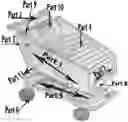
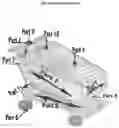
Part 1
The storage compartment inside of the marCart
Part 2
The module Controller attached to the rear pushing/pulling bar
Part 3
The marCart Logo
Part 4
The top cover, sliding front to rear to close and rear to front to open
Part 5
The Bottom of the marCart: extra storage, a battery compartment, extension front and rear to provide a standing/seating area for children (weight restrictions to be determined by manufacturers)
Part 6
The 4 wheels of the marCart
Part 7
Anti-shoplifters Alert system (Visual and audio) also serves as a reflector.
Part 8
Brake lights also part of safety features of the marCart
Part 9
The Scanning device (Portable scanning device with holder attached to the marCart)
Part 10
marCart cooling system control
Part 11
Hauling system (use to pull the marCart from behind a vehicle. The marCart come with safety features in compliance with regulations in put in place by proper authority.
Claims
1. marCart is a personal electronic shopping cart shoppers use when shopping at different commercial establishments like, super markets, pharmacy, etc . . . A marCart Docking Station will be made available within the store parking lot or other designated places for shoppers. Shoppers rent the marCart to bring inside of the store. Shoppers may be able to acquire it from either a docking station where it can be rented. The marCart can also be purchased from retail stores/manufactures. Inside the store it is pushed or rolled by human or battery power. The marCart can be hauled from behind any vehicle when leaving the store. Shoppers Scan each item using the marCart scanner then place them inside the marCart. When shopping is completed, shoppers then proceed to the store's marCart Wireless Self Checkout Register. The store's marCart Wireless Self Checkout Register has a security check out mechanism to disable the mobility of the marCart, making it immobile until the check out process is completed. The marCart also visually and audibly alerts store loss prevention staffs/security, should a shopper not complete the check out process while the marCart is still mobile and attempt to leave the store without paying. A receipt is produced by the marCart Self Checkout Register to show at exits upon request.
Images & Drawings included:
Sources:
- United States Patent and Trademark Office - verify current appl. status at the USPTO↗
Recent applications in this class:
- » 20250118174 2025-04-10
SYSTEM AND METHOD FOR SELF-CHECKOUT USING SELF-DEACTIVATING TAGS - » 20250111758 2025-04-03
ELECTRONIC CASH REGISTER, DATA CARRIER, AND METHOD FOR COLLECTING DATA FROM A RECEIPT PRODUCED BY AN ELECTRONIC CASH REGISTER AT A POINT OF SALE - » 20240212462 2024-06-27
MERCHANDISE SALES DATA PROCESSING DEVICE AND MEDIUM - » 20230360502 2023-11-09
IMAGE BASED POS SYSTEM FOR THE FAST FOOD INDUSTRY - » 20230125971 2023-04-27
SELF-CENTERING USER INTERFACE FOR INPUTTING INFORMATION - » 20230042348 2023-02-09
Information processing apparatus and control program therefor - » 20220130216 2022-04-28
SMART VENDING MACHINE SYSTEM FOR INDUSTRIALIZED PRODUCT SALES - » 20220122430 2022-04-21
REGISTER MACHINE FOR A CHECKOUT SYSTEM - » 20220122429 2022-04-21
Methods and apparatus for anomaly detection in self-checkout retail environments - » 20220092948 2022-03-24
MONITORING POINT OF SALE PERIPHERAL DEVICES