PLATINUM COMPLEXES HAVING BINAPHTHYL-BASED DIPHOSPHINE LIGANDS FOR THE SELECTIVE CATALYSIS OF THE HYDROXYCARBONYLATION OF ETHYLENICALLY UNSATURATED COMPOUNDS
US20220177504A1
2022-06-09
17/544,179
2021-12-07
Abstract:
Platinum complexes having binaphthyl-based diphosphine ligands for the selective catalysis of the hydroxycarbonylation of ethylenically unsaturated compounds.
Inventors:
- Robert Franke 221 🇩🇪 Marl, Germany
- Matthias Beller 70 🇩🇪 Ostseebad Nienhagen, Germany
- Ralf Jackstell 48 🇩🇪 Rostock, Germany
- Carolin Schneider 17 🇩🇪 Monheim am Rhein, Germany
Assignee:
- Evonik Operations GmbH 1,024 🇩🇪 Essen, Germany
Interested in similar patents?
Get notified when new applications in this technology area are published.
Classification:
C07F15/0093 » CPC main
Compounds containing elements of Groups 8, 9, 10 or 18 of the Periodic System compounds of the platinum group; Platinum compounds without a metal-carbon linkage
B01J2231/321 » CPC further
Catalytic reactions performed with catalysts classified in; Addition reactions at carbon centres, i.e. to either C-C or C-X multiple bonds; Addition reactions to C=C or C-C triple bonds Hydroformylation, metalformylation, carbonylation or hydroaminomethylation
B01J2531/828 » CPC further
Additional information regarding catalytic systems classified in; Complexes comprising metals of Group VIII as the central metal; Metals of the platinum group Platinum
B01J31/2409 » CPC further
Catalysts comprising hydrides, coordination complexes or organic compounds containing coordination complexes; Phosphines, i.e. phosphorus bonded to only carbon atoms, or to both carbon and hydrogen atoms, including e.g. sp2-hybridised phosphorus compounds such as phosphabenzene, phosphole or anionic phospholide ligands; Cyclic ligands, including e.g. non-condensed polycyclic ligands, the phosphine-P atom being a ring member or a substituent on the ring with more than one complexing phosphine-P atom
C07F15/00 IPC
Compounds containing elements of Groups 8, 9, 10 or 18 of the Periodic System
B01J31/24 IPC
Catalysts comprising hydrides, coordination complexes or organic compounds containing coordination complexes Phosphines, i.e. phosphorus bonded to only carbon atoms, or to both carbon and hydrogen atoms, including e.g. sp2-hybridised phosphorus compounds such as phosphabenzene, phosphole or anionic phospholide ligands
Description
The present invention relates to platinum complexes having binaphthyl-based diphosphine ligands for the selective catalysis of the hydroxycarbonylation of ethylenically unsaturated compounds.
The hydroxycarbonylation of ethylenically unsaturated compounds is a process of increasing significance. A hydroxycarbonylation is understood to mean the direct reaction of ethylenically unsaturated compounds such as olefins with carbon monoxide in the presence of a metal or a metal complex and a ligand to give the corresponding acids:
EP 3388414 A1 describes a process for hydroformylation of cyclooctadiene (COD) using 4-([1,1′:3′,1″-terphenyl]-2′-yloxy)-S-dinaphtho[2,1-d:1′,2′-f][1,3,2]dioxaphosphepine.
A disadvantage of palladium is its high cost.
The technical problem addressed by the present invention is that of providing novel complexes having a less costly metal than palladium as the central atom. The complexes are additionally to achieve good n/iso selectivities in hydroxycarbonylations.
This object is achieved by a complex according to Claim 1.
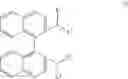
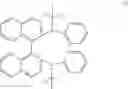
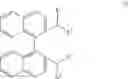
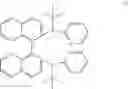
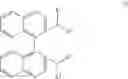
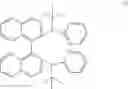
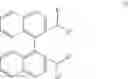
Complex comprising Pt and a compound of formula (I)
where
R1, R2, R3, R4 are each independently selected from —(C1-C12)-alkyl and —(C6-C20)-heteroaryl.
The expression (C1-C12)-alkyl encompasses straight-chain and branched alkyl groups having 1 to 12 carbon atoms. These are preferably (C1-C8)-alkyl groups, more preferably (C1-C6)-alkyl, most preferably (C1-C4)-alkyl.
The expression (C6-C20)-heteroaryl encompasses mono- or polycyclic aromatic hydrocarbyl radicals having 6 to 20 carbon atoms, where one or more of the carbon atoms are replaced by heteroatoms. Preferred heteroatoms are N, O and S. The (C6-C20)-heteroaryl groups have 6 to 20, preferably 6 to 14 and more preferably 6 to 10 ring atoms. Thus, for example, pyridyl in the context of this invention is a C6-heteroaryl radical.
Suitable (C6-C20)-heteroaryl groups having at least six ring atoms are especially pyridyl, pyridazinyl, pyrimidyl, pyrazinyl, benzofuranyl, indolyl, isoindolyl.
In one embodiment, at least two of the R1, R2, R3, R4 radicals are a —(C6-C20)-heteroaryl radical having at least six ring atoms.
In one embodiment, the R1 and R3 radicals are each a —(C6-C20)-heteroaryl radical having at least six ring atoms.
In one embodiment, the R1 and R3 radicals are each 2-pyridyl.
In one embodiment, R2 and R4 are —(C1-C12)-alkyl.
In one embodiment, R2 and R4 are tert-butyl.
In one embodiment, the compound (I) has the structure (1):
The invention further relates to the use of a complex according to the invention for catalysis of a hydroxycarbonylation reaction.
Process comprising the process steps of:
a) initially charging an ethylenically unsaturated compound;
b) adding a complex as described above, or
-
- a compound of formula (I)
where
R1, R2, R3, R4 are each independently selected from —(C1-C12)-alkyl and —(C6-C20)-heteroaryl and
a substance comprising Pt;
c) adding an acid;
d) feeding in CO;
e) heating the reaction mixture from a) to d), with conversion of the ethylenically unsaturated compound to a carboxylic acid.
In this process, process steps a), b), c) and d) can be effected in any desired sequence. Typically, however, the addition of CO is effected after the co-reactants have been initially charged in steps a) to c). In addition, CO can also be fed in in two or more steps, in such a way that, for example, a portion of the CO is first fed in, then the mixture is heated, and then a further portion of CO is fed in.
The ethylenically unsaturated compounds used as reactant in the process according to the invention contain one or more carbon-carbon double bonds. These compounds are also referred to hereinafter as olefins for simplification. The double bonds may be terminal or internal.
In one variant of the process, the ethylenically unsaturated compound does not comprise any further functional groups apart from carbon-carbon double bonds.
In one variant of the process, the ethylenically unsaturated compound is selected from: ethene, propene, 1-butene, cis- and/or trans-2-butene, isobutene, 1,3-butadiene, 1-pentene, cis- and/or trans-2-pentene, 2-methyl-1-butene, 3-methyl-1-butene, 2-methyl-2-butene, hexene, tetramethylethylene, heptene, 1-octene, 2-octene, di-n-butene, or mixtures thereof.
In one variant of the process, the acid in process step c) is selected from: acetic acid, perchloric acid, sulfuric acid, phosphoric acid, methylphosphonic acid, methanesulfonic acid, trifluoromethanesulfonic acid, tert-butanesulfonic acid, p-toluenesulfonic acid (PTSA), 2-hydroxypropane-2-sulfonic acid, 2,4,6-trimethylbenzenesulfonic acid, dodecylsulfonic acid, camphorsulfonic acid.
In one variant of the process, the acid in process step c) is acetic acid (AcOH).
In one variant of the process, the substance comprising Pt is selected from: platinum dichloride (PtCl2), platinum(II) acetylacetonate [Pt(acac)2], platinum(II) acetate [Pt(OAc)2], dichloro(1,5-cyclooctadiene)platinum(II) [Pt(cod)2Cl2], bis(dibenzylideneacetone)platinum [Pt(dba)2], bis(acetonitrile)dichloroplatinum(II) [Pt(CH3CN)2Cl2], (cinnamyl)platinum dichloride [Pt(cinnamyl)Cl2].
In one variant of the process, the substance comprising Pt is selected from: platinum dichloride (PtCl2), platinum(II) acetylacetonate [Pt(acac)2], platinum(II) acetate [Pt(OAc)2].
CO is fed in in step d) preferably at a partial CO pressure between 0.1 and 10 MPa (1 to 100 bar), preferably between 1 and 8 MPa (10 to 80 bar), more preferably between 2 and 6 MPa (20 to 60 bar).
The reaction mixture is heated in step e) of the process according to the invention preferably to a temperature in the range from 60° C. to 160° C., preferably in the range from 60 to 140° C., more preferably in the range from 60 to 100° C., in order to convert the ethylenically unsaturated compound to an acid.
The invention is to be illustrated in detail hereinafter by a working example.
Conversion of 1-octene to the Acid
Reaction conditions: 1-octene (1.0 mmol), PtCl2 or PdCl2 (0.01 mmol, 1.0 mol %), ligand (1) (0.022 mmol, 2.2 mol %), sulfuric acid [0.6 M] 0.5 ml, AcOH (1.5 ml), pressure (CO): 40 bar, temperature: 60/80/100° C., reaction time: 20 h.
The series of experiments was conducted under analogous conditions, once with PtCl2 and once with PdCl2. Each series of experiments here comprises three experiments that differ merely in the temperature: 60° C., 80° C. and 100° C. The results are shown in the following table:
| Entry | Metal-Cl2(1 mmol) | Temperature (° C.) | Selectivity (n/iso) |
| 1* | Pt | 60 | 94/6 |
| 2 | Pd | 88/12 | |
| 3* | Pt | 80 | 90/10 |
| 4 | Pd | 76/24 | |
| 5* | Pt | 100 | 82/18 |
| 6 | Pd | 75/25 | |
| *process according to the invention |
With Pt as complex metal, it was possible to achieve better n/iso selectivity at all three temperatures than with the comparative Pd complex.
The cost of Pt is below that of Pd. The object is thus achieved by a complex according to the invention.
Claims
1. Complex comprising Pt and a compound of formula (I)
where
R1, R2, R3, R4 are each independently selected from —(C1-C12)-alkyl and —(C6-C20)-heteroaryl.
2. Complex according to claim 1,
wherein at least two of the R1, R2, R3, R4 radicals are a —(C6-C20)-heteroaryl radical having at least six ring atoms.
3. Complex according to claim 1,
wherein the R1 and R3 radicals are each a —(C6-C20)-heteroaryl radical having at least six ring atoms.
4. Complex according to claim 1,
wherein the R1 and R3 radicals are each 2-pyridyl.
5. Complex according to claim 1,
wherein R2 and R4 are —(C1-C12)-alkyl.
6. Complex according to claim 1,
wherein R2 and R4 are tert-butyl.
8. Process comprising the process steps of:
a) initially charging an ethylenically unsaturated compound;
b) adding a complex according to claim 1, or
a compound of formula (I)
where
R1, R2, R3, R4 are each independently selected from —(C1-C12)-alkyl and —(C6-C20)-heteroaryl and
a substance comprising Pt;
c) adding an acid;
d) feeding in CO;
e) heating the reaction mixture from a) to d), with conversion of the ethylenically unsaturated compound to a carboxylic acid.
9. Process according to claim 8,
wherein the ethylenically unsaturated compound is selected from: ethene, propene, 1-butene, cis- and/or trans-2-butene, isobutene, 1,3-butadiene, 1-pentene, cis- and/or trans-2-pentene, 2-methyl-1-butene, 3-methyl-1-butene, 2-methyl-2-butene, hexene, tetramethylethylene, heptene, 1-octene, 2-octene, di-n-butene, or mixtures thereof.
10. Process according to claim 8,
wherein the acid in process step c) is selected from acetic acid, perchloric acid, sulfuric acid, phosphoric acid, methylphosphonic acid, methanesulfonic acid, trifluoromethanesulfonic acid, tert-butanesulfonic acid, p-toluenesulfonic acid, 2-hydroxypropane-2-sulfonic acid, 2,4,6-trimethylbenzenesulfonic acid, dodecylsulfonic acid, camphorsulfonic acid.
11. Process according to claim 8,
wherein the acid in process step c) is acetic acid.
12. Process according to claim 8,
wherein the substance comprising Pt is selected from: platinum dichloride (PtCl2), platinum(II) acetylacetonate [Pt(acac)2], platinum(II) acetate [Pt(OAc)2], dichloro(1,5-cyclooctadiene)platinum(II) [Pt(cod)2Cl2], bis(dibenzylideneacetone)platinum [Pt(dba)2], bis(acetonitrile)dichloroplatinum(II) [Pt(CH3CN)2Cl2], (cinnamyl)platinum dichloride [Pt(cinnamyl)Cl2].
13. Process according to claim 8,
wherein the substance comprising Pt is selected from: platinum dichloride (PtCl2), platinum(II) acetylacetonate [Pt(acac)2], platinum(II) acetate [Pt(OAc)2].
Images & Drawings included:


Sources:
- United States Patent and Trademark Office - verify current appl. status at the USPTO↗
Recent applications in this class:
- » 20250059224 2025-02-20
PLATINUM-ACRIDINE COMPOUNDS AND METHODS OF TREATING CANCERS - » 20250051381 2025-02-13
ORGANIC ELECTROLUMINESCENT MATERIALS AND DEVICES - » 20240400596 2024-12-05
PLATINUM-BASED PHOTOINITIATOR AND PHOTOCROSSLINKER, THEIR USE FOR ADDUCT FORMATION - » 20240140974 2024-05-02
PLATINUM/PEPTIDE/CUCURBITURIL COMPLESES: WELL-DEFINED ARCHITECTURES BUILT BY SUPRAMOLECULAR SELF-SORTING FOR THE TARGETING OF CYSTEINE PROTEASES - » 20240002419 2024-01-04
RADIATION-ACTIVATED TETRAVALENT PLATINUM COMPLEX AND USE THEREOF - » 20230339997 2023-10-26
CLASS OF PLATINUM COMPOUNDS FOR TREATING CANCER, AND METHOD FOR PREPARATION THEREOF - » 20230192743 2023-06-22
Pt-biphenyl-iodine complex and Pt-biphenyl-bromine complex - » 20230183281 2023-06-15
Low pressure process for synthesis of Pt(PF)involving a soluble intermediate and storage of obtained Pt(PF) - » 20230024341 2023-01-26
PLATINUM(IV) COMPLEXES, METHODS OF MANUFACTURE, COMPOSITIONS CONTAINING, AND METHODS OF USE THEREOF - » 20220389042 2022-12-08
PRECIOUS METAL COMPOUNDS
Recent applications for this Assignee:
- » 20250171790 2025-05-29
METHOD FOR THE FERMENTATIVE PRODUCTION OF GUANIDINOACETIC ACID - » 20250171719 2025-05-29
BIO BASED COMPOSITION - » 20250171607 2025-05-29
DEPOLYMERIZATION OF POLYURETHANES WITH ORGANIC AMINE BASES - » 20250164110 2025-05-22
A METHOD FOR CONTROLLING A THERMAL COMBUSTION SYSTEM - » 20250163481 2025-05-22
IMPROVED BIOTECHNOLOGICAL METHOD FOR PRODUCING GUANIDINO ACETIC ACID (GAA) BY USING NADH-DEPENDENT DEHYDROGENASES - » 20250163345 2025-05-22
COMPOSITION COMPRISING BIOSURFACTANT AND PERSICOMYCIN - » 20250163237 2025-05-22
DEPOLYMERIZATION OF POLYURETHANES WITH ORGANIC AMINE BASES - » 20250163205 2025-05-22
USE OF RECYCLED POLYOL FROM AMINE-BASED HYDROLYSIS PROCESS TO PRODUCE PU FOAM - » 20250161906 2025-05-22
METHOD FOR REMOVING GASES - » 20250154390 2025-05-15
ADHESIVE FORMULATIONS COMPRISING SILANES AND HYDROPHOBIZED FUMED SILICA