Platinum complexes having binaphthyldiphosphine ligands for the catalysis of the hydroxycarbonylation of ethylenically unsaturated compounds
US20220177506A1
2022-06-09
17/544,254
2021-12-07
✅ Patent granted
US 11,655,266 B2
2023-05-23
-
-
Sikarl A Witherspoon
Smith, Gambrell & Russell, LLP
2041-12-07
Abstract:
Platinum complexes having binaphthyldiphosphine ligands for the catalysis of the hydroxycarbonylation of ethylenically unsaturated compounds.
Inventors:
- Robert Franke 229 🇩🇪 Marl, Germany
- Matthias Beller 73 🇩🇪 Ostseebad Nienhagen, Germany
- Ralf Jackstell 51 🇩🇪 Rostock, Germany
- Carolin Schneider 19 🇩🇪 Monheim am Rhein, Germany
Assignee:
- Evonik Operations GmbH 1,062 🇩🇪 Essen, Germany
Applicant:
Interested in similar patents?
Get notified when new applications in this technology area are published.
Classification:
C07F15/0093 » CPC main
Compounds containing elements of Groups 8, 9, 10 or 18 of the Periodic System compounds of the platinum group; Platinum compounds without a metal-carbon linkage
B01J31/2409 » CPC further
Catalysts comprising hydrides, coordination complexes or organic compounds containing coordination complexes; Phosphines, i.e. phosphorus bonded to only carbon atoms, or to both carbon and hydrogen atoms, including e.g. sp2-hybridised phosphorus compounds such as phosphabenzene, phosphole or anionic phospholide ligands; Cyclic ligands, including e.g. non-condensed polycyclic ligands, the phosphine-P atom being a ring member or a substituent on the ring with more than one complexing phosphine-P atom
B01J2231/321 » CPC further
Catalytic reactions performed with catalysts classified in; Addition reactions at carbon centres, i.e. to either C-C or C-X multiple bonds; Addition reactions to C=C or C-C triple bonds Hydroformylation, metalformylation, carbonylation or hydroaminomethylation
B01J2531/828 » CPC further
Additional information regarding catalytic systems classified in; Complexes comprising metals of Group VIII as the central metal; Metals of the platinum group Platinum
C07F15/00 IPC
Compounds containing elements of Groups 8, 9, 10 or 18 of the Periodic System
B01J31/24 IPC
Catalysts comprising hydrides, coordination complexes or organic compounds containing coordination complexes Phosphines, i.e. phosphorus bonded to only carbon atoms, or to both carbon and hydrogen atoms, including e.g. sp2-hybridised phosphorus compounds such as phosphabenzene, phosphole or anionic phospholide ligands
C07C51/14 IPC
Preparation of carboxylic acids or their salts, halides or anhydrides by reaction with carbon monoxide on a carbon-to-carbon unsaturated bond in organic compounds
Description
Platinum complexes having binaphthyldiphosphine ligands for the catalysis of the hydroxycarbonylation of ethylenically unsaturated compounds
The present invention relates to platinum complexes having binaphthyldiphosphine ligands for the catalysis of the hydroxycarbonylation of ethylenically unsaturated compounds.
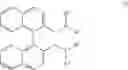
The hydroxycarbonylation of ethylenically unsaturated compounds is a process of increasing significance. A hydroxycarbonylation is understood to mean the direct reaction of ethylenically unsaturated compounds such as olefins with carbon monoxide in the presence of a metal or a metal complex and a ligand to give the corresponding acids:
Scheme 1: General reaction equation of the hydroxycarbonylation of an ethylenically unsaturated compound
EP 3388414 A1 describes a method of hydroformylation of cyclooctadiene (COD) using 4-([1,1′:3′,1″-terpheny]-2′-yloxy)-S-dinaphtho[2,1-d:1′,2′-f][1,3,2]dioxaphosphepine.
A disadvantage of palladium is its high cost.
The technical problem addressed by the present invention is that of providing novel complexes having a less costly metal than palladium as the central atom. The complexes are additionally to achieve good conversions in hydroxycarbonylations.
This object is achieved by a complex according to claim 1.
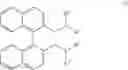
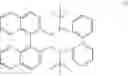
Complex comprising Pt and a compound of formula (I)
where
R1, R2, R3, R4 are each independently selected from -(C1-C12)-alkyl, -(C6-C20)-heteroaryl.
The expression (Ci-C12)-alkyl encompasses straight-chain and branched alkyl groups having 1 to 12 carbon atoms. These are preferably (C1-C8-alkyl groups, more preferably (C1-C6)-alkyl, most preferably (Ci-C4)-alkyl.
The expression (C6-C20)-heteroaryl encompasses mono- or polycyclic aromatic hydrocarbyl radicals having 6 to 20 carbon atoms, where one or more of the carbon atoms are replaced by heteroatoms. Preferred heteroatoms are N, O and S. The (C6-C20)-heteroaryl groups have 6 to 20, preferably 6 to 14 and more preferably 6 to 10 ring atoms. Thus, for example, pyridyl in the context of this invention is a C6-heteroaryl radical.
Suitable (C6-C20)-heteroaryl groups having at least six ring atoms are especially pyridyl, pyridazinyl, pyrimidyl, pyrazinyl, benzofuranyl, indolyl, isoindolyl.
In one embodiment, at least two of the R1, R2, R3, R4 radicals are a -(C6-C20)-heteroaryl radical having at least six ring atoms.
In one embodiment, the R1 and R3 radicals are each a -(C6-C20)-heteroaryl radical having at least six ring atoms.
In one embodiment, the R1 and R3 radicals are each 2-pyridyl.
In one embodiment, R2 and R4 are -(C1-C12)-alkyl.
In one embodiment, R2 and R4 are tent-butyl.
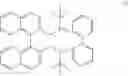
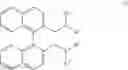
In one embodiment, the compound (I) has the structure (1):
The invention further relates to the use of a complex according to the invention for catalysis of a hydroxycarbonylation reaction.
Process comprising the process steps of:
a) initially charging an ethylenically unsaturated compound;
b) adding a complex as described above, or a compound of formula (I)
where
R1, R2, R3, R4 are each independently selected from -(C1-C12)-alkyl, -(C6-C20)-heteroaryl and a substance comprising Pt; c) adding an acid; d) feeding in CO; e) heating the reaction mixture from a) to d), with conversion of the ethylenically unsaturated compound to a carboxylic acid.
In this process, process steps a), b), c) and d) can be effected in any desired sequence. Typically, however, the addition of CO is effected after the co-reactants have been initially charged in steps a) to c). In addition, CO can also be fed in in two or more steps, in such a way that, for example, a portion of the CO is first fed in, then the mixture is heated, and then a further portion of CO is fed in.
The ethylenically unsaturated compounds used as reactant in the process according to the invention contain one or more carbon-carbon double bonds. These compounds are also referred to hereinafter as olefins for simplification. The double bonds may be terminal or internal.
In one variant of the process, the ethylenically unsaturated compound does not comprise any further functional groups apart from carbon-carbon double bonds.
In one variant of the process, the ethylenically unsaturated compound is selected from: ethene, propene, 1-butene, cis- and/or trans-2-butene, isobutene, 1,3-butadiene, 1-pentene, cis-and/or trans-2-pentene, 2-methyl-1-butene, 3-methyl-1-butene, 2-methyl-2-butene, hexene, tetramethylethylene, heptene, 1-octene, 2-octene, di-n-butene, or mixtures thereof.
In one variant of the process, the acid in process step c) is selected from: acetic acid, perchloric acid, sulfuric acid, phosphoric acid, methylphosphonic acid, methanesulfonic acid, trifluoromethanesulfonic acid, tert-butanesulfonic acid, p-toluenesulfonic acid (PTSA), 2-hydroxypropane-2-sulfonic acid, 2,4,6-trimethylbenzenesulfonic acid, dodecylsulfonic acid, camphorsulfonic acid.
In one variant of the process, the acid in process step c) is acetic acid (AcOH).
In one variant of the process, the substance comprising Pt is selected from: platinum dichloride (PtC12), platinum(II) acetylacetonate [Pt(acac)2], platinum(II) acetate [Pt(OAc)2], dichloro(1,5-cyclooctadiene)platinum(II) [Pt(cod)2Cl2], bis(dibenzylideneacetone)platinum [Pt(dba)2], bis(acetonitrile)dichloroplatinum(II) [Pt(CH3CN)2Cl2], (cinnamyl)platinum dichloride [Pt(cinnamyl)C12].
In one variant of the process, the substance comprising Pt is selected from: platinum dichloride (PtC12), platinum(II) acetylacetonate [Pt(acac)2], platinum(II) acetate [Pt(OAc)2].
CO is fed in in step d) preferably at a partial CO pressure between 0.1 and 10 MPa (1 to 100 bar), preferably between 1 and 8 MPa (10 to 80 bar), more preferably between 2 and 6 MPa (20 to 60 bar).
The reaction mixture is heated in step e) of the process according to the invention preferably to a temperature in the range from 60° C. to 160° C., preferably in the range from 80 to 140° C., more preferably in the range from 80 to 120° C., in order to convert the ethylenically unsaturated compound to an acid.
The invention is to be illustrated in detail hereinafter by a working example.
Conversion of 1-octene to the acid
Reaction conditions: 1-octene (1.0 mmol), PtC12 (0.01 mmol, 1.0 mol%), ligand: bidentate phosphine ligand (0.022 mmol, 2.2 mol%), sulfuric acid [0.3 M] 0.5 ml, AcOH (1.5 ml), pressure (CO): 40 bar, temperature: 120° C., reaction time: 18 h.
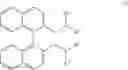
The reaction was conducted in a process according to the invention with the ligand (1), and as a comparative experiment with the ligand (2):
The process according to the invention with ligand (1) gave a yield of 50% here. In the comparative experiment with ligand (2), by contrast, only a yield of 26% was achieved.
The cost of Pt is below that of Pd. The object is thus achieved by a complex according to the invention.
Claims
1. Complex comprising Pt and a compound of formula (I)
where
R1, R2, R3, R4 are each independently selected from -(C1-C12)-alkyl, -(C6-C20)-heteroaryl.
2. Complex according to claim 1, wherein at least two of the R1, R2, R3, R4 radicals are a -(C6-C20)-heteroaryl radical having at least six ring atoms.
3. Complex according to Claim 1, wherein the R1 and R3 radicals are each a -(C6-C20)-heteroaryl radical having at least six ring atoms.
4. Complex according to Claim 1, wherein the R1 and R3 radicals are each 2-pyridyl.
5. Complex according to Claim 1, wherein R2 and R4 are -(C1-C12)-alkyl.
6. Complex according to Claim 1, wherein R2 and R4 are tent-butyl.
7. Complex according to Claim 1, wherein the compound (I) has the structure (1):
8. Process comprising the process steps of:
a) initially charging an ethylenically unsaturated compound;
b) adding a complex according to Claim 1, or a compound of formula (I)
where
R1, R2, R3, R4 are each independently selected from -(C1-C12)-alkyl, -(C6-C20)-heteroaryl and a substance comprising Pt;
c) adding an acid;
d) feeding in CO;
e) heating the reaction mixture from a) to d), with conversion of the ethylenically unsaturated compound to a carboxylic acid.
9. Process according to claim 8, wherein the ethylenically unsaturated compound is selected from: ethene, propene, 1-butene, cis- and/or trans-2-butene, isobutene, 1,3-butadiene, 1-pentene, cis- and/or trans-2-pentene, 2-methyl-1-butene, 3-methyl-1-butene, 2-methyl-2-butene, hexene, tetramethylethylene, heptene, 1-octene, 2-octene, di-n-butene, or mixtures thereof.
10. Process according to claim 8, wherein the acid in process step c) is selected from: acetic acid, perchloric acid, sulfuric acid, phosphoric acid, methylphosphonic acid, methanesulfonic acid, trifluoromethanesulfonic acid, tert-butanesulfonic acid, p-toluenesulfonic acid (PTSA), 2-hydroxypropane-2-sulfonic acid, 2,4,6-trimethylbenzenesulfonic acid, dodecylsulfonic acid, camphorsulfonic acid.
11. Process according to claim 8 any of claims 8 to 10, wherein the acid in process step c) is acetic acid.
12. Process according to claim 8 any of claims 8 to 11, wherein the substance comprising Pt is selected from: platinum dichloride (PtC12), platinum(II) acetylacetonate [Pt(acac)2], platinum(II) acetate [Pt(OAc)2], dichloro(1,5-cyclooctadiene)platinum(II) [Pt(cod)2C12], bis(dibenzylideneacetone)platinum [Pt(dba)2], bis(acetonitrile)dichloroplatinum (II) [Pt(CH3CN)2Cl2], (cinnamyl)platinum dichloride [Pt(cinnamyl)Cl2].
13. Process according to claim 8 any of claims 8 to 12, wherein the substance comprising Pt is selected from: platinum dichloride (PtCl2), platinum(II) acetylacetonate [Pt(acac)2], platinum(II) acetate [Pt(OAc)2].
Images & Drawings included:



Sources:
- United States Patent and Trademark Office - verify current appl. status at the USPTO↗
Recent applications in this class:
- » 20250197433 2025-06-19
NOVEL ORGANOPLATINUM COMPOUND, METHOD FOR MANUFACTURING SAME, METHOD FOR MANUFACTURING THIN FILM USING SAME, AND METHOD FOR MANUFACTURING HIGH-PERFORMANCE OPTICAL SENSOR FOR DETECTING MID-INFRARED RAYS USING SAME - » 20250059224 2025-02-20
PLATINUM-ACRIDINE COMPOUNDS AND METHODS OF TREATING CANCERS - » 20250051381 2025-02-13
ORGANIC ELECTROLUMINESCENT MATERIALS AND DEVICES - » 20240400596 2024-12-05
PLATINUM-BASED PHOTOINITIATOR AND PHOTOCROSSLINKER, THEIR USE FOR ADDUCT FORMATION - » 20240140974 2024-05-02
PLATINUM/PEPTIDE/CUCURBITURIL COMPLESES: WELL-DEFINED ARCHITECTURES BUILT BY SUPRAMOLECULAR SELF-SORTING FOR THE TARGETING OF CYSTEINE PROTEASES - » 20240002419 2024-01-04
RADIATION-ACTIVATED TETRAVALENT PLATINUM COMPLEX AND USE THEREOF - » 20230339997 2023-10-26
CLASS OF PLATINUM COMPOUNDS FOR TREATING CANCER, AND METHOD FOR PREPARATION THEREOF - » 20230192743 2023-06-22
Pt-biphenyl-iodine complex and Pt-biphenyl-bromine complex - » 20230183281 2023-06-15
Low pressure process for synthesis of Pt(PF)involving a soluble intermediate and storage of obtained Pt(PF) - » 20230024341 2023-01-26
PLATINUM(IV) COMPLEXES, METHODS OF MANUFACTURE, COMPOSITIONS CONTAINING, AND METHODS OF USE THEREOF
Recent applications for this Assignee:
- » 20250290142 2025-09-18
DETECTING OXIDATIVE STRESS IN CELL(S) USING EPIGENETIC MEANS - » 20250290141 2025-09-18
DIAGNOSTIC BIOMARKER FOR OXIDATIVE STRESS - » 20250283127 2025-09-11
METHOD FOR THE FERMENTATIVE PRODUCTION OF L-LYSINE USING C. GLUTAMICUM STRAINS EXPRESSING A HETEROLOGOUS NICOTINAMIDE NUCLEOTIDE TRANSHYDROGENASE PNTAB AND HAVING AN INCREASED ACTIVITY OF A MYO-INOSITOL PERMEASE - » 20250282703 2025-09-11
PROCESS FOR PRODUCING PROPANAL FROM METHANOL AND SYNGAS USING HETEROGENEOUS CATALYSTS - » 20250277226 2025-09-04
IMPROVED BIOTECHNOLOGICAL METHOD FOR PRODUCING GUANIDINO ACETIC ACID (GAA) BY INACTIVATION OF AN AMINO ACID EXPORTER - » 20250277086 2025-09-04
POLYAMIDE POWDER FOR SELECTIVE SINTERING METHODS - » 20250276024 2025-09-04
A METHOD OF CELL REJUVENATION - » 20250270378 2025-08-28
STABILIZERS FOR POLYURETHANE FOAMS CONTAINING RECYCLED POLYOL - » 20250270098 2025-08-28
SPHERICAL, LOW SURFACE AREA PRECIPITATED SILICAS AS MATTING AGENTS IN POWDER COATINGS - » 20250256248 2025-08-14
IMPROVED NANOCARRIER MANUFACTURING