Wire Wheel Brush
US20220183453A1
2022-06-16
17/525,324
2021-11-12
Abstract:
The improved wire wheel brush is of the type having a plurality of bristles extending radially from a hub to a periphery, the bristles defining a brush head. The improvement comprises: a ring of polymeric material through which the bristles extend from the hub, the ring having an outer perimeter smaller in circumference than the periphery of the wire wheel brush such that the bristles protrude therefrom.
Interested in similar patents?
Get notified when new applications in this technology area are published.
Classification:
A46B9/026 » CPC main
Arrangements of the bristles in the brush body; Position or arrangement of bristles in relation to surface of the brush body, e.g. inclined, in rows, in groups where the surface of the brush body or carrier is not in one plane, e.g. not flat
A46B9/025 » CPC further
Arrangements of the bristles in the brush body; Position or arrangement of bristles in relation to surface of the brush body, e.g. inclined, in rows, in groups the bristles or the tufts being arranged in an angled position relative to each other
A46B9/02 IPC
Arrangements of the bristles in the brush body Position or arrangement of bristles in relation to surface of the brush body, e.g. inclined, in rows, in groups
Description
FIELD
The invention relates to the field of wire wheel brushes.
BACKGROUND
Wire wheel brushes are widely used in industry.
SUMMARY OF THE INVENTION
Forming one aspect of the invention is an improved wire wheel brush of the type having a plurality of bristles extending radially from a hub to a periphery, the bristles defining a brush head. The improvement comprises: a ring of polymeric material through which the bristles extend from the hub, the ring having an outer perimeter smaller in circumference than the periphery of the wire wheel brush such that the bristles protrude therefrom.
According to another aspect, the outer perimeter of the ring can be about 1″ smaller in diameter than the periphery of the brush.
According to another aspect, the ring and the brush head each can have a thickness measured in the direction of the rotation axis of the brush, the thickness of the ring being about 0.25″ greater than the thickness of the brush head.
According to another aspect, each bristle
- can be about 0.015″ in diameter
- can be heated treated, brass-coated steel, the steel comprising alloying elements in about the following amounts:
| C | .70% | |
| Mn | .55% | |
| P | .006% | |
| S | .007% | |
| Si | .21% | |
- can have physical properties in about the following amounts
| tensile strength | 390,000 | psi | |
| breaking strength | 68 | pounds. | |
According to another aspect, the polymeric material can have a durometer of about 57.5 a
Advantages, features and characteristics of the invention will become apparent upon review of the following detailed description with reference to the appended drawings, the latter being briefly described hereinbelow.
BRIEF DESCRIPTION OF THE FIGURES
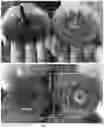
FIG. 1 is a photograph showing a wire wheel brush according to an embodiment of the invention alongside a prior art brush;
FIG. 2 is another photograph of the structures of FIG. 1;
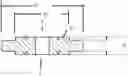
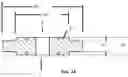
FIG. 2A is a schematic cross section of the inventive brush
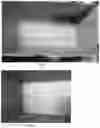
FIG. 3 is a photograph of a box to be used for testing; and
FIG. 4 is a photograph of the box of FIG. 3 after testing.
DETAILED DESCRIPTION
A wire wheel brush 20 according to an embodiment of the invention is shown in FIG. 1 and FIG. 2 alongside a prior art brush of similar dimensions. The inventive brush in shown in schematic cross-section in FIG. 2.1
The brush 20 will be understood to be of the general type having a hub 22 and a plurality of bristles 24.
The hub 22 defines a rotation axis X-X.
Each bristle 24:
- is about 0.015″ in diameter
- is heated treated, brass-coated steel, the steel comprising alloying elements in about the following amounts:
| C | .70% | |
| Mn | .55% | |
| P | .006% | |
| S | .007% | |
| Si | .21% | |
- has physical properties in about the following amounts:
| tensile strength | 390,000 | psi | |
| breaking strength | 68 | pounds. | |
The plurality of bristles extend radially from the hub to a periphery and define a brush head, the periphery having a diameter D1 of about 3″ and the brush head having a thickness T1, measured in the direction of the rotation axis, of about 0.4″. The disclosed brush differs from the prior art brush in that it includes a ring 26 of polymeric material through which the bristles 24 extend from the hub 22:
- the ring having an outer perimeter D2 that is about 1″ smaller in diameter than the periphery of the brush head such that the bristles protrude therefrom
- the ring having a thickness T2 of about 0.65″, i.e. about 0.25″ greater than the thickness of the brush head
- the polymeric material having a durometer of about 57.5 a
Experimental Tests
The inventive brush of FIG. 1 and FIG. 2 was rotated at about 25000 RPM for 5 minutes in a cardboard box. The prior art brush of FIG. 1 and FIG. 2 of similar dimensions was exposed to the same test. Photos of the cardboard boxes are shown, respectively, in FIG. 3 and FIG. 4. Eight (8) bristles from the prior art brush are seen to have been released from the hub and lodged into the sidewall of the box. In contrast, a careful inspection of the cardboard box in which the inventive brush was tested showed no bristles to have been dislodged.
Experimental Use
An inventive brush of the type shown in FIG. 1 and FIG. 2 was provided to an industrial user of the prior art brush shown in FIG. 1 and FIG. 2. The user reported that the inventive brush was used to the end of its useful life in the same task to which the prior art brush was applied and lasted about five times longer than the typical lifespan of the prior art brush.
Variations
Whereas a single brush is illustrated and described, it is speculated, without intending to be bound by theory, that the excellent abrasion and bristle retention characteristics of the brush are a result of the combination of:
- a relatively large diameter, which reduces the wear rate on the periphery
- the resilience provided by the ring, which reduces the stresses placed upon the bristles during cycle-on and cycle-off
- the resilience provided the ring, which reduces fatigue that would otherwise occur at the fixed end of each bristle
- the support against flexure provided by the radially projecting portions of the ring
thereby suggesting the potential for many variations that preserve the above structural features, including but not limited to:
- the periphery of the brush can vary
- the thickness of the brush head can vary
- the bristle diameter can vary
- bristles of materials other than heat-treated, brass-coated steel could be used
- the steel could be alloyed otherwise than as specified
- the physical properties of each bristle may vary
- the thickness of the ring could be increased
- the trim-out could be increased or decreased from ½″ the hardness and elasticity of the polymeric material can vary
Accordingly, the invention should be understood to be limited only by the accompanying claims, purposively construed.
Claims
1. An improved wire wheel brush of the type having a plurality of bristles extending radially from a hub to a periphery, the bristles defining a brush head, the improvement comprising:
a ring of polymeric material through which the bristles extend from the hub, the ring having an outer perimeter smaller in circumference than the periphery of the wire wheel brush such that the bristles protrude therefrom.
2. The wire wheel brush according to claim 1, wherein the outer perimeter of the ring is about 1″ smaller in diameter than the periphery of the brush.
3. The wire wheel brush according to claim 1, wherein the ring and the brush head each has a thickness measured in the direction of the rotation axis of the brush, the thickness of the ring being about 0.25″ greater than the thickness of the brush head.
4. The wire wheel brush according to claim 1, wherein each bristle
is about 0.015″ in diameter
is heated treated, brass-coated steel, the steel comprising alloying elements in about the following amounts:
| C | .70% | |
| Mn | .55% | |
| P | .006% | |
| S | .007% | |
| Si | .21% | |
has physical properties in about the following amounts
| tensile strength | 390,000 | psi | |
| breaking strength | 68 | pounds. | |
5. The wire wheel brush according to claim 1, wherein the polymeric material has a durometer of about 57.5 a
Images & Drawings included:
Sources:
- United States Patent and Trademark Office - verify current appl. status at the USPTO↗
Recent applications in this class:
- » 20240415273 2024-12-19
HAND BRUSH FOR CLEANING A GOLF CLUB HANDLE - » 20240341461 2024-10-17
BRUSH AND/OR BRUSH HOLDER - » 20240298787 2024-09-12
WAFER CLEANING BRUSH, WAFER CLEANING DEVICE INCLUDING THE SAME, AND WAFER CLEANING METHOD USING THE SAME - » 20230380581 2023-11-30
SANITARY DEVICE FOR REMOVING DEBRIS FROM A NOSTRIL - » 20230218072 2023-07-13
T- Shaped Brush Head Assembly - » 20230148742 2023-05-18
Interdental cleaning tool - » 20230093907 2023-03-30
Crematory brush - » 20230008462 2023-01-12
METHOD AND APPARATUS FOR PET HAIR REMOVAL - » 20230000240 2023-01-05
METHOD AND APPARATUS FOR PET HAIR REMOVAL - » 20220183454 2022-06-16
Truck Bed Liner Cleaning Tool