METHOD FOR SIMULATING AND EVALUATING AN ELECTRONIC SYSTEM
US20230077751A1
2023-03-16
17/799,749
2020-12-14
✅ Patent granted
US 12,619,897 B2
2026-05-05
WO; PCT/DE2020/101060; 20201214
WO; WO2021/180258; 20210916
Justin C Mikowski
Collard & Roe, P.C.
2043-06-04
Abstract:
Quantum mechanical systems, such as for instance electronic states in molecules or solid bodies, can be simulated using quantum computers. However, at present quantum computers only provide a limited quantity of qubits for the calculation. This deficiency is attributable to unsolved problems in connection with inherent noise and scalability, with the result that quantum computers currently only enable simulations of small quantum systems. A method simulates and evaluates an electronic system with a continuous spectral density on the basis of the interruption of the quantum simulation by measurements. The quantum simulation is interrupted to read the qubits, the qubit measurements are stored in a classical parity register and restored to the qubits, and the simulation is continued after the restore.
Assignee:
- HQS Quantum Simulations GmbH 5 🇩🇪 Karlsruhe, Germany
Applicant:
Interested in similar patents?
Get notified when new applications in this technology area are published.
Classification:
G06N10/60 » CPC main
Quantum computing, i.e. information processing based on quantum-mechanical phenomena Quantum algorithms, e.g. based on quantum optimisation, quantum Fourier or Hadamard transforms
G06N10/20 » CPC main
Quantum computing, i.e. information processing based on quantum-mechanical phenomena Models of quantum computing, e.g. quantum circuits or universal quantum computers
Description
The present invention relates to a method for simulating and evaluating an electronic system, in particular a solid body or a molecule with a continuous spectral density using a quantum computer having a plurality of qubits, wherein features of the electronic system are simulated on individual qubits and read from the qubits.
Such a method is already known from DE 10 2019 135 807 A1. This solves the problem of inherent noise and scalability deficiencies for the calculation and simulation of quantum mechanical systems, such as electronic systems, by means of a simulator for large, continuous quantum systems by using the noise as a resource to produce a continuous bath.
A quantum computer is a technically well-controlled quantum system of which the calculation is based on the use of the laws of quantum mechanics. The basic unit of the quantum computer is the quantum bit, the so-called qubit. Like the well-known classical bit, the qubit can assume the values 0 and 1. The main difference from the classical states is that the quantum memory can be in any superposition of the possible bit strings. It follows that a quantum register of N qubits encodes the information of 2N variables. A sufficiently large and well-functioning quantum computer can be used to solve certain mathematical problems that cannot be solved by classical computers. Such problems also include simulations of other quantum mechanical systems.
However, there are many technical difficulties in building a large quantum computer. These difficulties can be roughly broken down into two major challenges, namely isolating the qubits from a noisy environment and controlling a large number of qubits simultaneously. These two sets of problems are not independent of one another, and improving the quantum computer with regard to one of the two problems usually adversely affects the quantum computer with regard to the other. It is currently possible to build quantum computers with around 20 to 50 qubits that work comparatively well. It is expected that more than 100 physical qubits will be available for commercial use in the near future.
A very promising application of small quantum computers is the simulation of other quantum mechanical systems. In fact, it can be shown that quantum simulation algorithms can be faster than any classical computer, even for a small number of qubits.
Against this background, the present invention is based on the object of providing an alternative to the previously known method for simulating and evaluating an electronic system by artificially generating a continuous electronic spectrum that makes it possible to simulate large electronic quantum systems with a small number of qubits.
This is achieved by a method for simulating and evaluating an electronic system according to the features of independent claim 1. Further meaningful configurations of such a system can be found in the subsequent dependent claims.
According to the invention, gate-based quantum simulation is considered in the present case. Here, the evolution of system time is reproduced by fast control pulses applied to physical qubits, which in turn describe the quantum state of the modeled system in some way. More specifically, the quantum simulation generated by the quantum computer is controlled by the Hamiltonian HQc(t), which works with qubits of the quantum computer. The simulated system is described by the Hamiltonian H, which controls the time evolution of the electrons. These systems are ideally equivalent, meaning that there is an accurate mapping between the physical quantum state and the simulated quantum state.
The quantum simulation time evolution operator UQc is designed to reproduce the system time evolution operator U in the following sufficient approximation:
U=exp[−iHt]≈UQC=T exp[−∫0tdt′HQC(t′)]
Units are used in which h=1 is applicable.
A gate-based quantum evolution is created by successive applications of identical Trotter steps, each representing a small time evolution over the simulation time dt. Ideally, each sequence performs the operation
U QC ( dt ) = ∏ sets exp ( - iH set dt )
Here, all terms oscillate within Hset. All sets together cover all terms of the simulated Hamiltonian. The multiplication takes place in a selected, optimal order. The total time evolution over time t=ndt is then
UQC(t)=[UQc(dt)]n.
A widely studied model of various electronic systems that the present quantum computer system can simulate is the cluster-bath model defined by a Hamiltonian of the type
H = H C + H B + H I H C = ∑ pq ∈ cluster t pq c p † c q + 1 2 ∑ pqrs ∈ cluster h pqrs c p † c q † c r c s H B = ∑ i ∈ bath ω i c i † c i H I = ∑ p ∈ cluster , i ∈ bath t pi c p † c i + t ip c i † c p
The system description is divided into three parts: Cluster HC, which fully describes electrons with interaction, a bath HB of non-interacting electrons, and electron hopping between the two regions HI. The modeling within the cluster is as accurate as possible, while the bath and interaction are accounted for in the mean field approach. This provides the most detailed solvable description of many solid bodies and is the basis of dynamical mean field theory (DMFT). This can also be an efficient description of large molecules with a small reactive center: the cluster.
In such a model, the central function describing the effect of the bath on the cluster is the spectral density S±(ω). The bath spectral density depends on whether it describes filled bath states (+) or empty bath states (−). The filled or empty states mean the populations of the bath when they are not interacting with the cluster. The spectral density S±(ω), as seen from the cluster orbital p, has the form
S p ∈ cluster + ( ω ) = ∑ i ∈ bath ρ + ( ω i ) t pi 2 δ ( ω + ω i ) S p ∈ cluster - ( ω ) = ∑ i ∈ bath ρ - ( ω i ) t pi 2 δ ( ω - ω i )
Here, the delta function δ(ω±ωi) produces a sharp spectral peak with area 1 in the bath state with frequency ∓ωi, where the factor ρ+(ω) indicates the probability with which the bath state with the frequency co is occupied when not interacted with and ρi−=1−ρi+.
In thermal equilibrium, the following applies
ρ + = 1 1 + exp ( + ω k B T ) ρ - = 1 1 + exp ( - ω k B T )
where T is the bath temperature. The effect that the bath has on the cluster depends only on such bath spectral densities. In the case of a large bath, they can be approximated as continuous functions of frequency ω.
In detail, the present method for simulating and evaluating an electronic system provides that the quantum simulation is interrupted to read the qubits, the qubit measurements are stored in a classical parity register and restored to the qubits, and the simulation is continued after the restore.
A quantum simulation of an electronic cluster-bath model with continuous spectral density requires a quantum computer with continuous qubit density. In the prior art, this is already achieved by exploiting the inherent noise of quantum computers in order to generate a quasi-continuous qubit density of states with a finite number of broadened qubits. However, an alternative method for generating the continuous system is proposed here, which is based on the interruption of a quantum simulation by measurements.
In such a simulation, the sharp spectral peaks of a plurality of bath states are broadened to Lorentzian functions.
S ± ( ω ) = 1 π ∑ i ∈ bath ρ ± ( ω i ) t pi 2 γ i γ i 2 + ( ω ± ω i ) 2
The broadening γj corresponds, for example, to the decay rate of the qubit. Broadenings γj can be controlled by measurements in the quantum simulation. This allows a continuous spectral density to be reproduced or matched by a limited number of qubits.
In order to reproduce the fermion statistics of the electrons, a classical bit registration must now also be implemented according to the invention, which stores the measurement results and whose values can be called up quickly before each gate sequence, i.e. each Trotter step.
A gate-based quantum simulation is constructed by successive application of Trotter steps. A step-by-step quantum simulation with physical measurements is provided, which causes a broadening of the qubits and corresponding bath states. Based on the same key processes, i.e. measurements on so-called auxiliary qubits and the use of a classical parity register, other similar methods can also be developed that lead to the same effect.
First, a method for expanding a bath state that is empty in the non-interactive state will be discussed. The bath state occupancy is described by the qubit states 0 and 1. Here a single Trotter step is realized as
- (i) an application-time evolution operation UQC(dt), i.e. the original Trotter step,
- (ii) carrying out an excitation exchange between a bath qubit and an auxiliary qubit assigned thereto,
- (iii) measuring the auxiliary qubit,
- (iv) if the auxiliary qubit was in the excited state, it is restored to its ground state. Then iteration takes place from step (i).
Such a time development realizes the effective decay, i.e. the amplitude damping, of the bath qubit, the excited state 1 of the bath qubit decaying toward its ground state 0 at the rate γ=p/dt, where p<<1 is the permutation probability in step (ii). This corresponds to a Lorentzian function S−(ω), with ρ−=1 for an empty state.
An expansion of the filled states [S+(ω) with ρ+=1] can be realized by always initializing the auxiliary qubit with the state 1. Similarly, the parity R is changed only if the auxiliary qubit was measured in state 0. In addition, the finite temperature can be modeled by using a statistical distribution for the initialized auxiliary qubit state. For this purpose, in step (iv) the initial state after the measurement is set to 0 with the probability ρ− and to 1 with the probability ρ+. In doing so, the parity R is preferably changed only if the previously inserted auxiliary qubit state in step (iv) and thereafter the measured auxiliary qubit state in step (iii) do not match.
In the case of N>1 bath states to be broadened, a bath qubit can be selected at random in step (ii), the excitation of which is swapped with the associated auxiliary qubit. The broadening of the bath state i is in this case γi=pi/(Ndt), where pi is the permutation probability selected separately for each bath qubit. In another implementation, all bath qubits have their own auxiliary qubits, and all permutations and subsequent measurements are done in parallel. Here, γi=pi/dt.
A major difficulty in realizing a quantum electronic simulation with a quantum computer is the antisymmetry of the fermionic wave function. The antisymmetry is not automatically taken into account by physical qubits, but must be encoded in the calculation. This can be done, for example, by the Jordan-Wigner decomposition of fermionic operators into qubit operators.
An example is an electron jump operator from state i to state p, which can be represented by the corresponding qubit exchange operators and the Jordan-Wigner decomposition as
{circumflex over (T)}pi=ĉp†ĉi→{circumflex over (σ)}p−{circumflex over (σ)}i+Πp>k>i{circumflex over (σ)}kz
Here, σkz is a Pauli matrix describing the qubit k, and the Jordan-Wigner chain is
S=Πp>k>l{circumflex over (α)}kz
It should be noted that this decomposition preserves quantum parallelism, since exponentially many variations of collective qubit states can be operated simultaneously.
A broadened bath does not yet describe a continuous fermionic bath, since the antisymmetry of the entire fermionic wave function is not taken into account. It has been shown that this can be accounted for by a certain type of counting of measured states of auxiliary qubits that are stored in the parity register R. The parity register R is a classical register. After each Trotter step, it contains a series of binary values. The missing parity is taken into account by using jump operators of the form
{circumflex over (T)}pi={circumflex over (σ)}p+{circumflex over (σ)}i−Πp>k>l{circumflex over (α)}kz(1−2Rk)
Here, the Jordan-Wigner chain was generalized to
S=Πp>k>l{circumflex over (α)}kz(1−2Rk)
Here, the factors 1−2Rk are either 1 or −1. This factor is then taken into account when performing step (i) of the Trotter step.
The invention described above is explained in more detail below with reference to an embodiment.
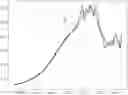
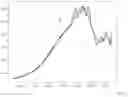
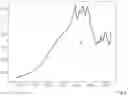
FIG. 1 is an example of the adjustment of the original continuous spectral density by means of three Lorentzian functions, FIG. 2 by twenty Lorentzian functions using the least squares method. In the system considered, each Lorentzian function corresponds to a bath qubit. The adjustment optimizes the positions ωt, broadenings γi and couplings ti of bath qubits. A spectral curve 1 and an approximation curve 2 are shown.
The following example describes how the amplitude damping of bath states occurs according to the method described above. Step (ii) of the Trotter step described above is analogous for all bath qubits, so it suffices to record it for just one bath qubit.
An exchange between the bath qubit B1≡B and the auxiliary qubit A is then considered. In the following, all other qubits except B1 and A are referred to as the rest. Initially, the auxiliary qubit A is in state (|0)). Step (ii) corresponds to a transformation from an uncorrelated product state with the auxiliary qubit (|product) to an entangled state (|entangled). The corresponding unitary operation acts only in the subspace of the single excitation and is spanned by the states (|A=0)(|B=1) and (|A=1)(|B=0). It can take the form
Uswap=exp(i{tilde over (p)}σySE)=cos {tilde over (p)}ISE+i sin {tilde over (p)}σySE
cos {tilde over (p)}=√{square root over (1−p)}
sin {tilde over (p)}=√{square root over (p)}
If the state is not in the subspace of the single excitation, i.e. in the state (|A=0)(|B=0) or (|A=1)(|B=1), then only the identity operation is carried out. The result of the Uswap operation applied to the state initialized before step (i) within the Trotter step is then
U swap ( ❘ "\[LeftBracketingBar]" product ) 〉 = U swap [ ❘ "\[LeftBracketingBar]" ( Ψ 0 〉 rest ) ❘ "\[LeftBracketingBar]" ( 0 〉 B ) + ❘ "\[LeftBracketingBar]" ( Ψ 1 〉 rest ) ❘ "\[RightBracketingBar]" ( 1 〉 B ) ] ⊗ ❘ "\[RightBracketingBar]" ( 0 〉 A ) = ❘ "\[LeftBracketingBar]" ( Ψ 0 〉 rest ) ❘ "\[RightBracketingBar]" ( 0 〉 B ( 0 〉 A ) + 1 - p ❘ "\[LeftBracketingBar]" ( Ψ 1 〉 rest ) ❘ "\[RightBracketingBar]" ( 1 〉 B ) ❘ "\[RightBracketingBar]" ( 0 〉 A ) + p ❘ "\[LeftBracketingBar]" ( Ψ 1 〉 rest ) ❘ "\[LeftBracketingBar]" ( 0 〉 B ) ❘ "\[LeftBracketingBar]" ( 1 〉 A )
Here, the excited state of the bath qubit B is transferred with the probability p≤1 to the auxiliary qubit A. A common normalization factor 1/√{square root over (2)} was neglected in this case. In the following, p<<1 is assumed.
Step (iii) of the Trotter step corresponds to measuring the state of the auxiliary qubit A. The new state of the system, due to the measurement result, is
|(product)=|(Ψ0rest)|(0B)|(0A+√{square root over (1−p)})|(Ψ1rest)|(1B)|(0A)
for measured A=0, and
|(product)=√{square root over (p)}|(Ψ1rest)|(0B)|(1A)
for measured A=1.
Here, too, the state normalization was neglected. If A=1 is measured, an excitation jumps into the auxiliary qubit. In this case, the parity information of the corresponding classical register must be updated, Ri→Ri+1(mod 2).
In the Hilbert space, which is spanned by the bath states |(B=0≡(1.0)) and |(B=1≡(0.1)), this measurement can be represented in the form of Kraus operators
M 0 = ( 1 0 0 1 - p ) M 1 = ( 0 p 0 0 )
Using the Kraus operators, the initial pure state described by a matrix having a reduced density {circumflex over (D)}=|(pure)(pure|) changes to a probabilistic mixture
{circumflex over (D)}→M0{circumflex over (D)}M0†+M1{circumflex over (D)}M1†
Our central assumption is the exchange probability p<<1, which allows us to approximate the matrix M0 as follows
M 0 ≈ ( 1 0 0 1 - p 2 )
In this approximation, the density matrix changes as follows
D ^ → M 0 D ^ M 0 † + M 1 D ^ M 1 † ≈ D ^ + p σ - D ^ σ + - p 2 σ + σ - D ^ - p 2 D ^ σ + σ - ≡ D ^ + ℒ [ D ^ ]
where the Lindblad superoperator can be identified with
[{circumflex over (D)}]≡p(σ−{circumflex over (D)}σ+−½σ+σ−{circumflex over (D)}−½{circumflex over (D)}σ+σ−)
and σ−≡|(0)(1|) and σ+≡|(1)(0|).
Therefore, by repeatedly performing similar entanglement operations and measurements of A, a probabilistic decay of bath operating populations with the decay rate γ=p/dt is approximately generated. This in turn corresponds to a Lorentzian peak in the bath spectral density.
A method for simulating and evaluating an electronic system is thus described above, providing an alternative to the previously known method for simulating and evaluating an electronic system by artificially generating a continuous electronic spectrum that makes it possible to simulate large electronic quantum systems with a small number of qubits.
LIST OF REFERENCE SIGNS
-
- 1 Spectral curve
- 2 Approximation curve
Claims
1. A method for simulating and evaluating an electronic system, in particular a solid body or a molecule with a continuous spectral density using a quantum computer having a plurality of qubits, wherein features of the electronic system are simulated on individual qubits and read from the qubits, wherein the quantum simulation is interrupted to read the qubits, the qubit measurements are stored in a classical parity register and restored to the qubits, and the simulation is continued after the restore.
2. The method according to claim 1, wherein the simulation of the electronic system comprises the accurate simulation of a cluster, as well as the simulation of a bath and an electron hopping interaction according to the mean field approach for describing the electron-electron correlations in the modeled electronic system.
3. The method according to claim 2, wherein sharp, spectral peaks of states of the qubits of the quantum computer associated with the bath are broadened to Lorentzian functions.
4. The method according to claim 2, wherein the qubits are read in a Trotter step which iteratively carries out the steps of
applying the time evolution operation UQC (dt,R) taking into account parities stored in the parity register R,
exchanging excitation states between a bath qubit and an auxiliary qubit assigned to this bath qubit,
measuring the state of the auxiliary qubit, and
if the result of the measurement was 1, changing an associated parity R→R+1 (mod 2) and rotating the corresponding auxiliary qubit to state 0, and returning to the first step
5. The method according to claim 4, wherein the auxiliary qubit is initialized to state 1.
6. The method according to claim 4, wherein the parity R is changed only if the auxiliary qubit is measured in state 0.
7. The method according to claim 4, wherein in the last step an initial state after the measurement is set to 0 with a probability ρ− and to 1 with a probability ρ+, wherein the parity R is changed only if the initial state of the auxiliary qubit and the measured state of the auxiliary qubit do not match.
8. The method according to claim 2, wherein auxiliary qubits are uniquely assigned to a number of bath qubits and a number of auxiliary qubits are read in parallel.
9. The method according to claim 1, wherein the antisymmetry of the fermionic wave function is taken into account by coding using the Jordan-Wigner decomposition.
Images & Drawings included:







Sources:
- United States Patent and Trademark Office - verify current appl. status at the USPTO↗
Similar patent applications:
Recent applications in this class:
- » 20260119954 2026-04-30
METHOD FOR TRAINING QUANTUM NEURAL NETWORK AND METHOD FOR CLASSIFYING DATA - » 20260119953 2026-04-30
3D POINT CLOUD PROCESSING USING QUANTUM GRAPH NEURAL NETWORKS - » 20260119952 2026-04-30
IMPLEMENTING QUANTUM GRAPH NEURAL NETWORKS - » 20260119951 2026-04-30
NON-BOOLEAN QUANTUM AMPLITUDE AMPLIFICATION AND QUANTUM MEAN ESTIMATION SYSTEMS AND METHODS - » 20260119950 2026-04-30
System and method for data content feature extraction and evaluation using a hybrid quantum and classical neural network - » 20260119949 2026-04-30
Hybrid Quantum Neural Network - » 20260119948 2026-04-30
NON-TRANSITORY COMPUTER-READABLE RECORDING MEDIUM STORING INFORMATION PROCESSING PROGRAM, INFORMATION PROCESSING METHOD, AND INFORMATION PROCESSING DEVICE - » 20260119947 2026-04-30
VISUALIZING AND MANIPULATING QUANTUM COMPUTATIONS ACROSS MULTIPLE LAYERS OF ABSTRACTION OF A QUANTUM STACK - » 20260111785 2026-04-23
METHOD AND SYSTEM FOR CONSTRUCTING CLASSICAL EQUIVALENT MODEL OF TRAINED QUANTUM MACHINE LEARNING MODEL - » 20260111784 2026-04-23
COMPUTING METHOD FOR OBTAINING SLACK VARIABLES IN OBJECTIVE FUNCTION
Recent applications for this Assignee:
- » 20250291975 2025-09-18
DETERMINING SIMULATION INPUT DATA - » 20230048091 2023-02-16
METHOD FOR ERROR REDUCTION IN A QUANTUM COMPUTER - » 20220398482 2022-12-15
METHOD FOR SIMULATING A REAL SPIN SYSTEM, MORE PARTICULARLY A NOISY SPIN SYSTEM, BY MEANS OF A QUANTUM COMPUTER - » 20210232739 2021-07-29
Method for modeling of a system by means of a quantum computer