ENERGY SOURCE
US20230352201A1
2023-11-02
17/923,036
2021-05-07
Abstract:
An energy source using low-enriched nuclear fuel to produce heat contains a compact transportable pressure vessel containing a cylinder with the core with heating element formed by nuclear fuel and continually agitated by a directed flow of heat-exchange liquid, to which a second pressure vessel is connected with a closed water bath circuit and a heat exchanger for production of steam, while the compact transportable pressure vessel can be placed in a space selected from the group underground concrete space with stainless steel lining, sea-river vessel and container modification for road and/or railway transport.
Inventors:
- Frantisek CERMAK 1 🇨🇿 Praha, Czech Republic
- Bronislav KULIKOV 1 🇨🇿 Zlata, Czech Republic
- Martin GROCH 1 🇨🇿 Praha, Czech Republic
- David CHROBOK 1 🇨🇿 Hradec Kralov, Czech Republic
- Martin ULCAK 1 🇨🇿 Praha, Czech Republic
Assignee:
- WITKOWITZ ATOMICA A.S. 1 🇨🇿 11000 Praha 1. Nove Mesto, Czech Republic
Interested in similar patents?
Get notified when new applications in this technology area are published.
Classification:
G21D3/001 » CPC further
Control of nuclear power plant Computer implemented control
G21D5/02 » CPC main
Arrangements of reactor and engine in which reactor-produced heat is converted into mechanical energy Reactor and engine structurally combined, e.g. portable
G21C15/28 » CPC further
Cooling arrangements within the pressure vessel containing the core; Selection of specific coolants Selection of specific coolants Additions to the reactor coolants, e.g. against moderator corrosion
G21C17/112 » CPC further
Monitoring; Testing Maintaining; Structural combination of fuel element, control rod, reactor core, or moderator structure with sensitive instruments, e.g. for measuring radioactivity, strain Measuring temperature
G21C9/033 » CPC further
Emergency protection arrangements structurally associated with the reactor, e.g. safety valves provided with pressure equalisation devices; Means for effecting very rapid reduction of the reactivity factor under fault conditions, e.g. reactor fuse; Control elements having arrangements activated in an emergency by an absorbent fluid
Description
BACKGROUND AND SUMMARY
The invention relates to an energy source using low-enriched nuclear fuel for the production of heat, with an expected production in the power range of 2 to 100 MW.
In the technical practice, various designs of nuclear reactors are known, which are of the pressurized water type, but usually do not have forced cooling of the core and the refueling is done in the standard way as in large reactors.
No solution has been found that would allow extensive unification of power series.
The above shortcomings are, to a large extent, eliminated by the energy source using low-enriched nuclear fuel for the production of heat according to an aspect of this invention. Its principle is that it consists of or comprises a compact transportable pressure vessel, which contains a core with nuclear fuel, while the refueling can be performed only at a dedicated workplace. In the overall concept of the energy source (EZ), this part practically forms a heating element (TT) with a continuously agitated heat-exchange liquid, which may be in the form of boric acid. The internal flow of the liquid is directed and thus ensures the cooling of the cylinder, which at the same time serves as a shield against free neutrons and prevents accelerated degradation of the material of the pressure vessel.
From the above body, the heat created by the nuclear core fission process is transferred through the steel wall to the other pressure vessel with a closed water bath circuit, where the water heated by the described process if forced into the heat exchanger, where the heat transferred in this way is used in the standard way to produce steam that is used for production of electric power or utility heat in the standard way. This heating method ensures double separation of radioactive fuel from the utility steam.
The design of the core is entirely within the competence of the exclusive fuel supplier. The safety of operation of the device is further ensured by its construction placement in a space selected from the group underground concrete space with stainless steel lining, sea-river vessel and container modification for road and/or railway transport.
The concept of the layout of the main parts of the EZ allows safe handling for TT replacement and further transport in a manner already known and technically processed worldwide. The measurement of the core temperature is another information parameter for the application software ensuring safe operation for the entire period of the anticipated replacement of the TT.
The structural arrangement of the core for the given contracted power is entirely within the competence of the fuel supplier.
The conceptual design uses materials and core cooling using a long-time proven way.
This present solution provides manufacturing unification in the power series of the source or in the end use.
BRIEF DESCRIPTION OF DRAWINGS
The energy source according to this technical solution will be further described on specific examples using the attached drawings, where
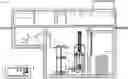
FIG. 1 shows its schematic outline, and
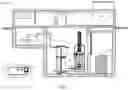
FIG. 2 its ground plan.
DETAILED DESCRIPTION
An example energy source using low-enriched nuclear fuel as a heat source consists of or comprises a compact transportable pressure vessel 3, which contains a core 1 with nuclear fuel 4, while the refueling can be performed only at a dedicated workplace. In the overall concept of the energy source (EZ), this part practically forms a heating element 5 (TT) with a continuously agitated heat exchange liquid, which may be in the form of boric acid. The internal flow of the liquid is directed and thus ensures the cooling of the cylinder 2, which at the same time serves as a shield against free neutrons and prevents accelerated degradation of the material of the pressure vessel 3. Compact transportable pressure vessel 3 can be placed in a space selected from the group underground concrete space with stainless steel lining, sea-river vessel and container modification for road and/or railway transport. The bottom 6 of the pressure vessel 3 is filled with lead as a protective element for an unforeseen accident.
From the above pressure vessel 3, the heat created by the nuclear core fission process is transferred through the steel wall to the other pressure vessel with a closed water bath circuit, where the water heated by the described process if forced by pump 8 into the heat exchanger 7, where the transferred heat is used in the standard way to produce steam for production of electric power in the turbine 10 with a three-phase generator 11, or for production of utility heat in the standard way with condenser 9. This heating method ensures double separation of radioactive fuel from the utility steam.
The energy source is equipped with a temperature meter in the core with diamond-based sensors.
The energy source is equipped with another information parameter for application software ensuring safe operation for the entire period of the anticipated replacement of the heating element 5.
The heating element 5 is transported to the core 1 dismantling place in a transport container 12.
All parts are from the same steels that are used for nuclear devices of type VVER 440 MW and VVER 1000 MW
The energy source according to this technical solution will find application primarily as a backup power source in municipal energy industry, in the production of electricity and heat, as a stable ecological source of heat and energy.
Claims
1. An energy source using low-enriched nuclear fuel to produce heat, comprising a compact transportable pressure vessel containing a cylinder with the core with heating element formed by nuclear fuel and continually agitated by a directed flow of heat-exchange liquid, to which a second pressure vessel is connected with a closed water bath circuit and a heat exchanger f for production of steam, while the compact transportable pressure vessel can be placed in a space selected from the group underground concrete space with stainless steel lining, sea-river vessel and container modification for road and/or railway transport.
2. The energy source according to claim 1, wherein the heat-exchange liquid contains boric acid.
3. The energy source according to claim 1, wherein after the heat exchanger there is condenser and/or turbine with three-phase generator (11).
4. The energy source according to claim 1, wherein it is equipped with a temperature meter in the core with diamond-based sensors.
5. The energy source according to claim 1, wherein a bottom (6) of the pressure vessel is filled with lead as a protective element for an unforeseen accident.
6. The energy source according to claim 1, wherein it is equipped with another information parameter for application software ensuring safe operation for the entire period of the anticipated replacement of the heating element.
7. The energy source according to claim 1, wherein it is equipped with a double protection of the utility steam against any radiation contamination.
Images & Drawings included:

Sources:
- United States Patent and Trademark Office - verify current appl. status at the USPTO↗
Similar patent applications:
- » 20150041512
Carrier system for a backpack energy source, energy source and backpack energy source assembly - » 20170138539
Control method for energy source supply system that stores an energy source and supplies the energy source to one or more vehicles - » 20080148555
Method Of Manufacturing An Electrochemical Energy Source,Electrochemical Energy Source Thus Obtained And Electronic Device - » 20180258767
Energy source supply systems, energy source supply devices, and related methods - » 20180257504
Energy source supply systems, energy source supply devices, and related methods - » 20200230755
Energy source supply systems, energy source supply devices, and related methods - » 20100174643
System and method for integrating billing information from alternate energy sources with traditional energy sources - » 20090112369
System for controlling room temperature in a building using a free energy source, an additional energy source, and predictive control - » 20180257503
Energy source supply systems, energy source supply devices, and related methods - » 20210370784
Energy source supply systems, energy source supply devices, and related methods
Recent applications in this class:
- » 20240420859 2024-12-19
Mixed Particle Nuclear Reactions - » 20240331886 2024-10-03
TRANSPORTABLE SUB-CRITICAL MODULES DISPOSED IN INTERMODAL TRANSPORT CONTAINER FOR POWER GENERATION - » 20230253128 2023-08-10
ENGINE COMPRISING A DEVICE FOR INDUCING NUCLEAR FUSION REACTIONS BY ACCELERATED IONS - » 20230040232 2023-02-09
METHOD OF OBTAINING TRANSURANIC ELEMENTS AND CREATING A NANOFUEL FROM THE TRANSURANIC ELEMENTS - » 20220375641 2022-11-24
ADJUSTING WAIT TIME BETWEEN BURN CYCLES OR MERGING BURN CYCLES - » 20220367077 2022-11-17
Space-Based Radioisotope Production and Methods of Use - » 20220115156 2022-04-14
Transportable sub-critical modules disposed in intermodal transport container for power generation - » 20210110946 2021-04-15
Integrated system for converting nuclear energy into electrical, mechanical, and thermal energy - » 20200365290 2020-11-19
Functionally graded lattice cermet fuel structure with shape corresponding to a mathematically-based periodic solid, particularly for nuclear thermal propulsion applications - » 20200357531 2020-11-12
Nuclear thermal propulsion nuclear reactor interface structure