ANTIMICROBIAL PACKAGING
US20240397963A1
2024-12-05
18/697,143
2022-09-23
Smart Summary: Antimicrobial packaging helps keep fruits, vegetables, and herbs fresh for a longer time. It uses special ingredients that prevent the growth of harmful microbes. These ingredients can be mixed into a coating or added directly to the packaging material. The goal is to protect the food from spoilage and extend its shelf life. This technology aims to reduce waste and improve food safety. 🚀 TL;DR
Abstract:
This invention relates to a preservative and/or antimicrobial composition for inclusion in an active substrate and/or a solvent-based coating for preservation of fruit, vegetables or herbs as well as an active substrate including the preservative and/or antimicrobial composition, or a solvent-based coating composition including the preservative and/or antimicrobial composition, or an active substrate including the preservative and/or antimicrobial composition and coated with the solvent-based coating composition including the preservative and/or antimicrobial composition for use in the preservation of fruit, vegetables or herbs.
Applicant:
Interested in similar patents?
Get notified when new applications in this technology area are published.
Classification:
A23B7/157 » CPC main
Preservation or chemical ripening of fruit or vegetables; Preserving or ripening with chemicals not covered by groups or in the form of liquids or solids Inorganic compounds
A23B7/10 » CPC further
Preservation or chemical ripening of fruit or vegetables Preserving with acids; Acid fermentation
A23B7/154 » CPC further
Preservation or chemical ripening of fruit or vegetables; Preserving or ripening with chemicals not covered by groups or in the form of liquids or solids Organic compounds; Microorganisms; Enzymes
A23B7/16 » CPC further
Preservation or chemical ripening of fruit or vegetables Coating with a protective layer; Compositions or apparatus therefor
B65D65/42 » CPC further
Wrappers or flexible covers; Packaging materials of special type or form; Packaging materials of special type or form Applications of coated or impregnated materials
B65D81/28 » CPC further
Containers, packaging elements, or packages, for contents presenting particular transport or storage problems, or adapted to be used for non-packaging purposes after removal of contents; Adaptations for preventing deterioration or decay of contents; Applications to the container or packaging material of food preservatives, fungicides, pesticides or animal repellants Applications of food preservatives, fungicides, pesticides or animal repellants
B65D85/34 » CPC further
Containers, packaging elements or packages, specially adapted for particular articles or materials for articles particularly sensitive to damage by shock or pressure for fruit, e.g. apples, oranges or tomatoes
Description
FIELD OF THE INVENTION
This invention relates to a preservative and/or antimicrobial composition for inclusion in an active substrate and/or a solvent-based coating for preservation of fruit, vegetables or herbs as well as an active substrate including the preservative and/or antimicrobial composition, or a solvent-based coating composition including the preservative and/or antimicrobial composition, or an active substrate including the preservative and/or antimicrobial composition and coated with the solvent-based coating composition including the preservative and/or antimicrobial composition for use in the preservation of fruit, vegetables or herbs.
BACKGROUND OF THE INVENTION
Today, consumers expect to be able to purchase a wide range of fresh produce or botanicals, including fruit and vegetables, flowers and herbs throughout the year and regardless of whether the product is produced locally or must be imported.
It is important to be able to maintain a shelf-life of at least a few days in order for such products to be commercially viable.
There are a number of commercial packaging products for fresh fruit and vegetables as well as flowers which preserve the products and prevent microbiological growth and spoilage of these fresh products. Most commonly, these include the use of a sulphur dioxide or chlorine generating compound activated under conditions of humidity.
Use of sulfur dioxide generating compounds are less desirable now, due to country and product-specific limitations on the allowable sulfur dioxide content. In addition, depending on the concentration of sulfur dioxide released, this can result in sulfur dioxide damage to the fresh produce, such as bleaching and burning, in particular with regard to sensitive produce such as berries. One way that sulfur dioxide generating compounds have been used in packaging materials to address these issues are to use multi-layer laminate products or pads that comprise the sulfur dioxide generating compounds within a matrix in the packaging, thereby to prevent direct contact of the sulfur dioxide generating compounds with the packaged fresh produce and to manage the concentration of sulfur dioxide generated by the sulfur dioxide generating compounds over time within the packaging material. However, these multi-layer materials are complex and expensive to produce, requiring multi-step fabrication and processing.
It would be useful if a simpler and less harsh preservative and/or antimicrobial product for packaging fresh produce including fruit, vegetables and/or herbs was available which was still able to provide a preservative and/or antimicrobial effect.
A further disadvantage of the commercial products used presently for preservation of fresh produce is that these are presently typically made from polymers that are not easily recyclable or potentially even biodegradable or compostable.
It would therefore be highly beneficial to develop an environmentally friendly preservative and/or antimicrobial product that is recyclable and possibly may even be biodegradable or compostable. It would be further useful if such a product could be simple and cost effective to produce.
SUMMARY OF THE INVENTION
According to a first aspect of the invention, there is provided a preservative and/or antimicrobial composition for inclusion in an active substrate and/or a solvent-based coating for preservation of fruit, vegetables or herbs, comprising or consisting of the following combination of ingredients:
-
- calcium chloride (CaCl2));
- sodium chloride (NaCl);
- citric acid;
- calcium hypochloride (Ca(OCl)2);
- nano-silver (Nano-Ag);
- optionally calcium oxide (CaO); and
- one or more dessicants, carriers, including polyethylenes and process aids, including one or more zeolites, silica, stearates, including calcium stearate or a combination thereof,
wherein the active substrate comprises or consists of a substrate polymer selected from polyethylene including low density polyethylene (LDPE) or linear low density polyethylene (LLDPE) or a blend thereof, polyethylene terephthalate (PET), polypropylene (PP), biaxially oriented polypropylene (BOPP), cellulose, bio-polymers, thermoplastic starch (TPS), polylactic acid (PLA), non-woven PP and non-woven PET; and
wherein the solvent-based coating comprises or consists of the following ingredients: - a solvent-based urethane composition with a greater part of a ester blend, including an elastomeric aliphatic solvent-based urethane;
- one or more solvents selected from the group comprising: a polar aprotic solvent, further including ethyl acetate; a polar protic solvent, further including ethanol; and one or more organic solvents further including one or more glycol ethers, including ethoxy propanol, n-propyl acetate and/or 1-propyl acetate or any combination of said solvents;
- a binder including nitrocellulose, further including a nitrocellulose RS grade ⅛ sec varnish;
- optionally a slip, scratch or rub resistance, gloss retention and overprintability additive, including a micronized spherical Fischer-Tropsch linear hydrocarbon chain hardwax, including a 50% Fischer-Tropsch liquid wax mixture; and
- optionally a viscosity modifier including bentonite clay organically modified with a quaternary alkylammonium compound.
In one embodiment of the invention, the solvent-based coating comprises or consists of:
-
- an elastomeric aliphatic solvent-based urethane with a greater part of a ester blend;
- a polar aprotic solvent, further including ethyl acetate;
- a polar protic solvent, further including ethanol;
- one or more organic solvents further including one or more glycol ethers, including ethoxy propanol, n-propyl acetate and/or 1-propyl acetate;
- a slip, scratch or rub resistance, gloss retention and overprintability additive, including a micronized spherical Fischer-Tropsch linear hydrocarbon chain hardwax, including a 50% Fischer-Tropsch liquid wax mixture;
- a nitrocellulose varnish, including a nitrocellulose RS grade ⅛ sec varnish; and
- a viscosity modifier including bentonite clay organically modified with a quaternary alkylammonium compound.
The solvent-based coating may be used for coating one or both surfaces of a substrate selected from the group comprising or consisting of paper, polyethylene including low LDPE or LLDPE or a blend thereof, PET, PP, BOPP, cellulose, bio-polymers, TPS, PLA, non-woven PP and non-woven PET or a portion thereof, including the active substrate.
The solvent-based coating may be used for coating a substrate selected from the group comprising a single layer substrate or a multi-layer substrate, including a laminated multi-layer substrate.
In one embodiment of the invention, the solvent-based coating may be used for coating a substrate selected from the group consisting of paper, a substrate comprising a blend of LDPE and LLDPE, and a substrate comprising TPS. In another embodiment of the invention, the solvent-based coating may be used for coating the active substrate.
In one embodiment of the invention the solvent-based coating composition in which the preservative and/or antimicrobial composition is included comprises or consists of a mixture of the following ingredients:
-
- (i) a combination of preservative and/or antimicrobial agents provided as percentage weight/weight (% (w/w)) of the combination of preservative and/or antimicrobial agents selected from the group comprising or consisting of:
- 0.003% to 0.08% (w/w), or 0.008% to 0.05% (w/w), or 0.01% to 0.05% (w/w), or 0.05% to 0.08% (w/w) nano-silver (nano-Ag),
- 1.0% to 6.5% (w/w), or 2.0% to 5.0% (w/w), or 3.0% to 5.5% (w/w), or 4.0% to 6.5% (w/w), calcium hypochloride (Ca(OCl)2),
- 0.5% to 6.5% (w/w), or 2.0% to 5.0% (w/w), or 3.0% to 5.5% (w/w), or 4.0% to 6.5% (w/w), sodium chloride (NaCl),
- 1.0% to 10.0% (w/w), or 2.0% to 6.0% (w/w), or 4.0 to 8.0% or 5.0 to 10.0% (w/w) citric acid,
- 0.05% to 0.65% (w/w), or 0.20% to 0.50% (w/w), or 0.30% to 0.55% (w/w), or 0.40% to 0.65% (w/w) calcium chloride (CaCl2)),
- optionally 1% to 5% (w/w) calcium oxide (CaO), and
- additional one or more dessicants, carriers, including polyethylenes and process aids, including one or more zeolites, silica, stearates, including calcium stearate to make up the remainder of the % (w/w) of the combination of preservative and/or antimicrobial agents; and
- (ii) a solvent-based coating composition provided as % (w/w) comprising or consisting of the following ingredients:
- (i) a combination of preservative and/or antimicrobial agents provided as percentage weight/weight (% (w/w)) of the combination of preservative and/or antimicrobial agents selected from the group comprising or consisting of:
| Component | % Amount (w/w) |
| solvent-based urethane with a greater part of a | 45-55% |
| ester blend | |
| one or more solvents selected from the group | 25-35% |
| comprising: a polar aprotic solvent, further | |
| including ethyl acetate; a polar protic solvent, | |
| further including ethanol; and one or more | |
| organic solvents further including one or more | |
| glycol ethers, including ethoxy propanol, n- | |
| propyl acetate and/or 1-propyl acetate or any | |
| combination of said solvents | |
| slip, scratch or rub resistance, gloss retention | 1-5% |
| and overprintability additive, including | |
| micronized spherical Fischer-Tropsch linear | |
| hydrocarbon chain hardwax including a 50% | |
| Fischer-Tropsch liquid wax mixture | |
| a binder including nitrocellulose, further | 20-30% |
| including a nitrocellulose RS grade ⅛ sec | |
| varnish | |
| a viscosity modifier including bentonite clay | 8-12% |
| organically modified with a quaternary | |
| alkylammonium compound | |
-
- wherein the ratio of the preservative and/or antimicrobial agent combination to the solvent-based coating composition in the mixture is about 40:60 to 90:10, or about 50:50, or about 60:40, or about 70:30, or about 80:20 respectfully.
More specifically, the solvent-based coating composition may comprise or consist of the following ingredients:
| Component | % Amount (w/w) |
| Elastomeric aliphatic solvent-based urethane | 30.7 |
| Polar aprotic solvent including ethyl acetate | 5.2 |
| Ethanol 95% | 31.7 |
| Organic solvent including a glycol ether | 9.7 |
| including ethoxy propanol | |
| Organic solvent including n-propyl acetate or 1- | 8.2 |
| propyl acetate | |
| Slip, scratch or rub resistance, gloss retention | 1.0 |
| and overprintability additive, including | |
| micronized spherical Fischer-Tropsch linear | |
| hydrocarbon chain hardwax | |
| Binder including nitrocellulose, including | 10.2 |
| nitrocellulose RS grade ⅛ sec | |
| Viscosity modifier including bentonite clay | 3.3 |
| organically modified with a quaternary | |
| alkylammonium compound | |
| Total | 100 |
In one embodiment of the invention the active substrate containing the preservative and/or antimicrobial composition comprises or consists of a mixture of the following ingredients:
-
- (i) a combination of preservative and/or antimicrobial agents provided as % (w/w) selected from the group comprising or consisting of:
- 0.10-4.00% (w/w), or 0.15-2.00% (w/w), or 0.2-1.00% (w/w) or 0.10 to 0.50 (w/w) nano-Ag,
- 0.05-4.00% (w/w), or 0.15-2.50% (w/w), or 1.50-3.50% (w/w), or 2.00-4.00% (w/w) Ca(OCl)2,
- 0.05-4.00% (w/w), or 0.15-2.50% (w/w), or 1.50-3.50% (w/w), or 2.50-4.00% (w/w) sodium chloride (NaCl),
- 0.1%-8.0% (w/w), or 3.0%-7.5% (w/w), or 4.0%-7.5% (w/w), or 5.0%-8.0% citric acid,
- 0.008-1.000% (w/w), or 0.020-0.100% (w/w), or 0.080-0.500% (w/w), or 0.300 to 1.000% (w/w) calcium chloride (CaCl2)),
- optionally 0.10-5.00% % (w/w) calcium oxide (CaO), and additional one or more dessicants, carriers, including polyethylenes and process aids, including one or more zeolites, silica, stearates, including calcium stearate to make up the remainder of the % (w/w) of the combination of preservative and/or antimicrobial agents; and
- (ii) a substrate polymer selected from polyethylene including LDPE or LLDPE or a blend thereof, PET, PP, BOPP, cellulose, bio-polymers, TPS, PLA, non-woven PP and non-woven PET,
- wherein the ratio of the combination of preservative and/or antimicrobial agents to the substrate polymer in the mixture is from 1.4:98.6 to 6.0:94.0, or from 2.5:97.5 to 5.0:95.0, or from 4.0:96.0 to 6.0:94.0.
- (i) a combination of preservative and/or antimicrobial agents provided as % (w/w) selected from the group comprising or consisting of:
According to a further aspect of the invention there is provided a substrate, including an active substrate according to the invention coated on one or both surfaces, or a portion thereof, with a monolayer or with a plurality of layers of the preservative and/or antimicrobial coating composition of the invention, wherein the substrate is selected from the group comprising or consisting of paper, polyethylene LDPE or LLDPE or a blend thereof, PET, PP, BOPP, cellulose, bio-polymers, TPS, PLA, non-woven PP and non-woven PET. Preferably, the substrate is paper, a substrate comprising a blend of LDPE and LLDPE or TPS or is the active substrate.
Alternatively, one or more additional coating layer(s) comprising one or more oxygen transmission rate (OTR) and/or moisture vapour transmission rate (MVTR) modifier(s) which are well known in the art may be applied to one or both surfaces of the substrate or a portion thereof in addition to the one or more layers of preservative and/or antimicrobial coating composition(s).
The preservative and/or antimicrobial coated layer(s) may be applied to the substrate surface prior to or subsequent to application of the one or more OTR and/or MVTR coating layer(s).
Furthermore, the one or more preservative and/or antimicrobial coating composition(s) and/or additional coating layer(s) may comprise one or more coloured pigment(s) and/or ultra violet inhibitor compound(s), which are well known in the art and commercially available depending on the product desired to be included.
The active substrate or coated substrate, including the active, coated substrate according to the invention may be a film or sheet, or may be processed to form one or more of a liner, cover, pad and/or bag. The liner, cover, pad and/or bag may comprise a plurality of perforated apertures.
The film, sheet, liner, cover, pad and/or bag formed from or comprising the coated substrate may be used for packaging fruit, vegetables or herbs, thereby to preserve them wherein the preservation is to provide browning and/or dessication, including of stems and/or fruit and/or prevent, inhibit, control, or delay growth of, or kill fungi, including Botrytis sp. fungi.
According to a further aspect of the invention there is provided a method of formulating the preservative and/or antimicrobial coating composition of the invention comprising or consisting of the following steps:
-
- (a) adding about 30 to 40% (w/w) of the solvent-based coating composition and 100% (w/w) of the preservative and/or antimicrobial combination to a stainless steel mixer bowl and whisking the mixture for about 20 minutes until a homogenous mixture is obtained;
- (b) adding the remaining about 60 to 70% (w/w) of the solvent-based coating composition to the homogeneous mixture of step (a) and whisking the mixture for a further about 30 minutes until a homogenous solvent-based preservative and/or antimicrobial coating composition mixture is obtained, wherein the ratio of the preservative and/or antimicrobial agent combination to the solvent-based coating composition in the final homogenous mixture is about 40:60 to 90:10, or about 50:50, or about 60:40, or about 70:30, or about 80:20 respectfully;
- (c) decanting the homogenous composition mixture of step (b) into a container or a drum with continual stirring and/or circulation of the mixture including with the use of a centrifugal pump, thereby to prevent partial separation of the ingredients and for pumping the final solvent-based preservative and/or antimicrobial coating composition to a coating head of a coating system for coating of a substrate.
According to a further aspect of the invention there is provided a method of producing a substrate coated with the preservative and/or antimicrobial coating composition of the invention comprising the use of a coating system comprising one or more coating head(s) fitted to a frame having offwinds and rewinds of a desired substrate, wherein each coating head (10) comprises:
-
- I. a reservoir tray (12) for holding a volume of the preservative and/or antimicrobial coating composition of the invention;
- II. an uplift roller (14) for uplifting the preservative and/or antimicrobial coating composition to a regulation roller (16);
- III. a regulation roller (16) for transferring the preservative and/or antimicrobial coating composition to an impression roller (18);
- IV. an impression roller (18) for impressing the preservative and/or antimicrobial coating composition transferred by the regulation roller (16) onto the desired surface of the substrate which is supported by web support roller (20); and
- V. a web support roller (20) for supporting the substrate when in contact with impression roller (18), and
wherein the method comprises the following steps: - A. decanting the mixed preservative and/or antimicrobial coating composition into a container or drum with continual stirring and/or circulation of the mixture including with the use of a centrifugal pump, in preparation for coating;
- B. fitting a regulation roller (16) having a desired surface roughness to the coating head;
- C. fitting an impression roller (18) having the desired width to the coating head;
- D. webbing the substrate between the impression roller (18) and a web support roller (20);
- E. pumping the preservative and/or antimicrobial coating composition from the container or drum into a reservoir tray (12);
- F. checking the viscosity of the preservative and/or antimicrobial coating composition to ensure that it is from about 90 seconds to 4 minutes;
- G. activating the coating head so that the preservative and/or antimicrobial coating composition is uplifted from the reservoir tray (12) by the uplift roller (14), is transferred to the regulation roller (16), and then transferred to the impression roller (18) which impresses the preservative and/or antimicrobial coating composition onto the desired surface of the substrate webbed between the impression roller (18) and the web support roller (20).
The regulation roller preferably has a degree of roughness of from about 1.6 to 4.8 Ra. Ra is the Roughness Average of a surfaces measured microscopic peaks and valleys.
Where there is more than one coating head, the coating system may comprise a drying tunnel fitted downstream of the each coating head for drying of the coating on the substrate between the coating heads. Typically the drying temperature is from about 40 to 60° C., dependent on the coating speed and weight of the antimicrobial coating composition.
According to a further aspect of the invention there is provided an active substrate comprising or consisting of:
-
- a preservative and/or antimicrobial composition comprising or consisting of the following combination of ingredients:
- 0.10-4.00% (w/w), or 0.15-2.00% (w/w), or 0.2-1.00% (w/w) or 0.10 to 0.50 (w/w) nano-Ag,
- 0.05-4.00% (w/w), or 0.15-2.50% (w/w), or 1.50-3.50% (w/w), or 2.00-4.00% (w/w) Ca(OCl)2,
- 0.05-4.0% (w/w), or 0.15-2.5% (w/w), or 1.50-3.5% (w/w), or 2.50-4.0% (w/w) sodium chloride (NaCl),
- 0.1%-8.0% (w/w), or 3.0%-7.5% (w/w), or 4.0%-7.5% (w/w), or 5.0%-8.0% citric acid,
- 0.008-1.000% (w/w), or 0.020-0.100% (w/w), or 0.080-0.500% (w/w), or 0.300 to 1.000% (w/w) calcium chloride (CaCl2)),
- optionally 0.10-5% % (w/w) calcium oxide (CaO), and
- any one or more of additional desiccants, including nylon or polyoxymethylene and carriers, including polyethylenes and process aids, including one or more zeolites, silica, stearates, including calcium stearate or a combination thereof to make up the remainder of the % (w/w) of the combination of preservative and/or antimicrobial agents; and
- a film-forming polymer selected from the group comprising or consisting of polyethylene LDPE or LLDPE or a blend thereof, PET, PP, BOPP, cellulose, bio-polymers, TPS, PLA, non-woven PP and non-woven PET mixed with the preservative and/or antimicrobial composition at a ratio of from 1.4:98.6 to 6.0:94.0, or from 2.5:97.5 to 5.0:95.0, or from 4.0:96.0 to 6.0:94.0 respectively.
- a preservative and/or antimicrobial composition comprising or consisting of the following combination of ingredients:
Preferably, the film-forming polymer is formed from a blend of LDPE and LLDPE or TPS.
In particular, the active substrate is an extruded substrate, further in particular, a blown film extruded substrate.
The active substrate may be processed from the extruded film or a sheet into an preservative and/or antimicrobial packaging including a liner, cover, pad or bag for use in the packaging of fruit, vegetables or herbs thereby to preserve these products and/or prevent, retard, control, delay or kill fungi, including Botrytis sp. fungi. The liner, cover, pad and/or bag may comprise a plurality of perforated apertures.
According to a further aspect of the invention, there is provided a process for the formulation of an active substrate according to the invention, comprising or consisting of the following steps:
-
- (A) providing a first masterbatch mixed with a film-forming polymer, selected from the group comprising or consisting of polyethylene, including LDPE or LLDPE or a blend thereof, PET, PP, BOPP, cellulose, bio-polymers, TPS, PLA, non-woven PP and non-woven PET at a ratio of from 1.4:98.6 to 6.0:94.0, or from 2.5:97.5 to 5.0:95.0, or from 4.0:96.0 to 6.0:94.0 respectively, wherein the first masterbatch consists of:
- i. 0.008-1.000% (w/w), or 0.020-0.100% (w/w), or 0.080-0.500% (w/w), or 0.300 to 1.000% (w/w) calcium chloride (CaCl2));
- ii. 0.05-4.00% (w/w), or 0.15-2.50% (w/w), or 1.50-3.50% (w/w), or 2.50-4.00% (w/w) NaCl;
- iii. 0.1%-8.0% (w/w), or 3.0%-7.5% (w/w), or 4.0%-7.5% (w/w), or 5.0%-8.0% (w/w) citric acid; and
- iv. one or more additives including a desiccant, a carrier and/or process aids, including one or more zeolites, further including silica, calcium stearate or a combination of both to make up the remainder % (w/w); and
- (B) providing a second masterbatch mixed with a film-forming polymer, selected from the group comprising or consisting of polyethylene, including LDPE or LLDPE or a blend thereof, PET, PP, BOPP, cellulose, bio-polymers, TPS, PLA, non-woven PP and non-woven PET at a ratio of from 1.4:98.6 to 6.0:94.0, or from 2.5:97.5 to 5.0:95.0, or from 4.0:96.0 to 6.0:94.0 respectively, wherein the second masterbatch consists of:
- i. 0.05-4.00% (w/w), or 0.15-2.50% (w/w), or 1.50-3.50% (w/w), or 2.00-4.00% (w/w) Ca(OCl)2; and
- ii. one or more additives including a desiccant, a carrier and/or process aids, including one or more zeolites, further including silica, calcium stearate or a combination of both to make up the remainder % (w/w); and
- (C) providing a third masterbatch mixed with a film-forming polymer, selected from the group comprising or consisting of polyethylene, including LDPE or LLDPE or a blend thereof, PET, PP, BOPP, cellulose, bio-polymers, TPS, PLA, non-woven PP and non-woven PET at a ratio of from 1.4:98.6 to 6.0:94.0, or from 2.5:97.5 to 5.0:95.0, or from 4.0:96.0 to 6.0:94.0 respectively, wherein the third masterbatch consists of:
- i. 0.10-4.00% (w/w), or 0.15-2.00% (w/w), or 0.2-1.00% (w/w) or 0.10 to 0.50 (w/w) nano-Ag; and
- ii. one or more additives including a desiccant, a carrier and/or process aids, including one or more zeolites, further including silica, calcium stearate or a combination of both to make up the remainder % (w/w); and
- (D) adding the mixture of step (A) into the mixture of step (B), followed by adding the mixture of step (C) to the mixture of steps (A) and (B) with continual stirring and/or circulation of the mixture including with the use of a centrifugal pump, thereby to prevent partial separation of the ingredients and for pumping the final active substrate mixture to an extruder, including a single screw blown film extruder; and
- (E) extruding the active substrate of step (D) into a sheet or film.
- (A) providing a first masterbatch mixed with a film-forming polymer, selected from the group comprising or consisting of polyethylene, including LDPE or LLDPE or a blend thereof, PET, PP, BOPP, cellulose, bio-polymers, TPS, PLA, non-woven PP and non-woven PET at a ratio of from 1.4:98.6 to 6.0:94.0, or from 2.5:97.5 to 5.0:95.0, or from 4.0:96.0 to 6.0:94.0 respectively, wherein the first masterbatch consists of:
Preferably, the film-forming polymer is formed from a blend of LDPE and LLDPE or TPS.
The active substrate may further be coated with one or more layer(s) of the preservative and/or antimicrobial coating composition of the invention on one or both surfaces of the active substrate, or a portion thereof.
The active substrate may further comprise one or more colour pigment(s) and/or ultra violet inhibitor compound(s), which are well known in the art and commercially available depending on the product desired to be included.
The extruded active substrate may optionally be corona treated to allow for print decoration or the application of coating layers, including one or more preservative and/or antimicrobial coating layers, MVTR and/or OTR coatings to enhance film performance further. In addition, colour pigment(s) and/or ultra violet inhibitors known in the art may be added if desired.
The extruded active substrate or active, coated substrate may be processed to form any one or more of a liner, cover, pad and/or bag. The liner, cover, pad and/or bag may comprise a plurality of perforated apertures.
According to a further aspect of the invention there is provided a method of preserving products selected from fruit, vegetables or herbs and/or preventing, inhibiting, controlling, or delaying growth of, or killing fungi, including Botrytis sp. on, in, or associated with such products comprising the use of the active substrate according to the invention, or the use of the preservative and/or antimicrobial coating composition on packaging substrate of the products. The active substrate or packaging may be in the form of a liner, cover, pad and/or bag. The liner, cover, pad and/or bag may comprise a plurality of perforated apertures.
In particular, the packaging may be used for fruits such as berries, including blueberries, blackberries, raspberries, strawberries and the like, which are particularly sensitive to the use of sulfur dioxide generating preservatives, although the packaging may also be used for other fruits such as grapes, as well as for vegetables or herbs where fungal infection is problematic or where preservation is required to prevent dessication or browning of the product.
DETAILED DESCRIPTION OF THE INVENTION
This invention relates to a preservative and/or antimicrobial composition for inclusion in an active substrate and/or a solvent-based coating for preservation of fruit, vegetables or herbs as well as an active substrate including the preservative and/or antimicrobial composition, or a solvent-based coating composition including the preservative and/or antimicrobial composition, or an active substrate including the preservative and/or antimicrobial composition and coated with the solvent-based coating composition including the preservative and/or antimicrobial composition for use in the preservation of fruit, vegetables or herbs.
The following description of the invention is provided as an enabling teaching of the invention, is illustrative of the principles of the invention and is not intended to limit the scope of the invention. It will be understood that changes can be made to the embodiment/s depicted and described, while still attaining beneficial results of the present invention. Furthermore, it will be understood that some benefits of the present invention can be attained by selecting some of the features of the present invention without utilising other features. Accordingly, those skilled in the art will recognise that modifications and adaptations to the present invention are possible and can even be desirable in certain circumstances, and are a part of the present invention.
Preservative and/or Antimicrobial Coating Composition
The applicant has developed a preservative and/or antimicrobial solvent-based coating composition consisting of an coating mixture (or “Carrier Mix”) as listed in Table 1, together with a combination of preservative and/or antimicrobial agents.
The preservative and/or antimicrobial combination typically consists of a mixture of the following ingredients provided as % (w/w):
-
- 0.003% to 0.08% (w/w), or 0.008% to 0.05% (w/w), or 0.01% to 0.05% (w/w), or 0.05% to 0.08% (w/w) nano-Ag,
- 1.0% to 6.5% (w/w), or 2.0% to 5.0% (w/w), or 3.0% to 5.5% (w/w), or 4.0% to 6.5% (w/w), Ca(OCl)2,
- 0.5% to 6.5% (w/w), or 2.0% to 5.0% (w/w), or 3.0% to 5.5% (w/w), or 4.0% to 6.5% (w/w), NaCl,
- 1.0% to 10.0% (w/w), or 2.0% to 6.0% (w/w), or 4.0 to 8.0% or 5.0 to 10.0% (w/w) citric acid,
- 0.05% to 0.65% (w/w), or 0.20% to 0.50% (w/w), or 0.30% to 0.55% (w/w), or 0.40% to 0.65% (w/w) CaCl2),
- optionally 1% to 5% (w/w) CaO, and
- additional one or more dessicants, carriers, including polyethylenes and process aids, including one or more zeolites, silica, stearates, including calcium stearate to make up the remainder of the % (w/w) of the combination of preservative and/or antimicrobial agents.
| TABLE 1 |
| Carrier Mix |
| Component | % Amount (w/w) |
| Elastomeric aliphatic solvent-based urethane | 30.7 |
| Polar aprotic solvent including ethyl acetate | 5.2 |
| Ethanol 95% | 31.7 |
| Organic solvent including a glycol ether | 9.7 |
| including ethoxy propanol | |
| Organic solvent including n-propyl acetate or 1- | 8.2 |
| propyl acetate | |
| Slip, scratch or rub resistance, gloss retention | 1.0 |
| and overprintability additive, including | |
| micronized spherical Fischer-Tropsch linear | |
| hydrocarbon chain hardwax | |
| Binder including nitrocellulose, including | 10.2 |
| nitrocellulose RS grade ⅛ sec | |
| Viscosity modifier including bentonite clay | 3.3 |
| organically modified with a quaternary | |
| alkylammonium compound | |
| Total | 100 |
The ratio of the preservative and/or antimicrobial agent combination to the solvent-based coating composition “Carrier Mix” in Table 1 in the mixture can be about 40:60 to 90:10, or about 50:50, or about 60:40, or about 70:30, or about 80:20 respectfully. The coating mixture has a viscosity of 60-70″ Zahn #2 @ 25 °18.
The solvent-based preservative and/or antimicrobial coating composition is created by taking 30 to 40% (w/w) of the required Carrier Mix and mixing this with a 100% (w/w) of the preservative and/or antimicrobial agent combination in a stainless steel bowl and whisking for about 20 minutes until a homogenous mixture is obtained.
Thereafter, the remaining 60 to 70% (w/w) of the Carrier Mix relative to the total weight of Carrier Mix in the final solvent-based preservative and/or antimicrobial coating composition is added to the homogeneous mixture and the final solvent-based preservative and/or antimicrobial coating composition is whisked for a further about 30 minutes until homogenous.
The final mixture, in preparation for coating, is then decanted into a container such as a drum with continual stirring and/or circulation of the mixture such as with the use of a centrifugal pump, thereby to prevent partial separation of the components whilst awaiting coating and for pumping the final mixture to the coating head for coating of the substrate.
The substrate is typically paper or a substrate comprising a blend of LDPE and LLDPE or TPS. However, it is to be appreciated that it would also be possible to use PET, PP, BOPP, cellulose, bio-polymers, PLA, a PP non-woven or a PET non-woven.
The preservative and/or antimicrobial coating composition can be coated as a monolayer or as a plurality of layers onto the whole surface of the substrate, or to a portion thereof as desired, whether an upper, lower or middle portion or a combination of these.
If desired, additional active compounds such as OTR and/or MVTR modifiers that are well known in the art can be included into the combination of preservative and/or antimicrobial agents. Alternatively, one or more additional coating layer(s) comprising one or more OTR and/or MVTR modifier(s) can be applied to the substrate or a portion thereof in addition to the one or more layers of preservative and/or antimicrobial coating composition(s).
Furthermore, the one or more preservative and/or antimicrobial coating composition(s) and/or additional coating layer(s) can include one or more coloured pigment(s) and/or ultra violet inhibitor compound(s) if desired, which are well known in the art and commercially available depending on the product desired to be included.
In one possible example the preservative and/or antimicrobial coating composition contains 30% of the combination of preservative and/or antimicrobial agent(s) and 70% of a MVTR.
The coated substrate may be a film or sheet, or may be processed to form packaging including a liner, cover, pad and/or bag. The liner, cover, pad and/or bag may comprise a plurality of perforated apertures.
The packaging is used for preservation and/or to prevent, inhibit, control, or delay growth of, or kill fungi, including Botrytis sp. Fungi in fruits, vegetables or herbs. In particular, the packaging may be used for fruits such as berries, including blueberries, blackberries, raspberries, strawberries and the like, which are particularly sensitive to the use of sulfur dioxide generating preservatives, although the packaging may also be used for other fruits such as grapes, as well as for vegetables or herbs where fungal infection is problematic or where preservation is required to prevent dessication or browning of the product.
Process for Coating Substrate with Preservative and/or Antimicrobial Coating Composition
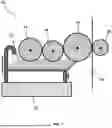
With reference to FIG. 1, one or more coating head(s) are fitted to a frame having offwinds and rewinds of a desired substrate (24). Preferably the system comprises a drying tunnel fitted downstream of the one or more coating head(s) for drying of the coating on the substrate.
Each coating head (10) typically comprises:
-
- a reservoir tray (12) for holding a volume of the preservative and/or antimicrobial coating composition of the invention;
- an uplift roller (14) for uplifting the preservative and/or antimicrobial coating composition to a regulation roller (16);
- a regulation roller (16) for transferring the preservative and/or antimicrobial coating composition to an impression roller (18);
- an impression roller (18) for impressing the preservative and/or antimicrobial coating composition transferred by the regulation roller (16) onto the desired surface of the substrate (24) which is supported by web support roller (20); and
- a web support roller (20) for supporting the substrate when in contact with impression roller (18).
The uplift roller (14) is typically a rubber coated roller having about 70-75 shore hardness.
The regulation roller (16) is typically a roller having impressions or indentations, such as a sandblasted roller for collection of the desired volume of preservative and/or antimicrobial coating composition from the uplift roller, and transfer of the preservative and/or antimicrobial coating composition to the impression roller (18). For example, the regulation roller preferably has a degrees of roughness of from about 1.6 to 4.8 Ra.
The impression roller (18) is typically a rubber coated roller having about 70-75 shore hardness and a width to match the substrate area to be coated. The edges of rubber coated surface have a chamfer of 45 degrees. The impression roller impresses the preservative and/or antimicrobial coating composition on the substrate which is supported by web support roller (20).
Where there is more than one coating head, drying between the coating heads is preferred. Typically the drying temperature is from about 40 to 60 degrees Celsius, dependent on the coating speed and weight of the preservative and/or antimicrobial coating composition.
To operate each coating head (10) the following procedure is followed:
-
- the mixed preservative and/or antimicrobial coating composition is decanted into the drum (22) with continual stirring and/or circulation of the mixture such as with the use of a centrifugal pump, in preparation for coating;
- the desired regulation roller (16) is fitted to the coating head;
- the desired width impression roller (18) is fitted to the coating head;
- the desired substrate is webbed between the impression roller (18) and the web support roller (20);
- the preservative and/or antimicrobial coating composition is pumped from the drum into the reservoir tray (12);
- the viscosity of the preservative and/or antimicrobial coating composition is checked against specification and may vary from 90 seconds to 4 minutes, depending on the preservative and/or antimicrobial coating composition and desired final application weight of the preservative and/or antimicrobial coating composition;
- the preservative and/or antimicrobial coating composition is uplifted from the reservoir tray (12) by the uplift roller (14), transferred to the regulation roller (16), and then transferred to the impression roller (18) which impresses the preservative and/or antimicrobial coating composition onto the desired surface of the substrate webbed between the impression roller (18) and the web support roller (20).
The primary control of the preservative and/or antimicrobial coating composition coating weight on the substrate is typically regulated by the pore or indentation size on the surface of the regulation roller (16) and the preservative and/or antimicrobial coating composition viscosity, but further adjustments to the coating weight are possible by adjusting the gaps between uplift roller (14) and regulation roller (16), and regulation roller (16) and impression roller (18). For example, the gap adjustments may vary from about 0.05 mm to about 0.15 mm with the use of appropriate feeler gauges known in the art.
‘Active’ Preservative and/or Antimicrobial Substrate Formulation
The applicant has also developed an “active substrate” in which a film-forming polymer is combined with the combination of preservative and/or antimicrobial agents.
The polymers used to form the ‘active’ preservative and/or antimicrobial substrate could be any of polyethylene (including low density polyethylene (LDPE) or linear low density polyethylene (LLDPE)), polyethylene terephthalate (PET), polypropylene (PP), biaxially oriented polypropylene (BOPP), cellulose, bio-polymers, and thermoplastic starch (TPS), polylactic acid (PLA), PP non-woven and PET non-woven. Preferably, the active substrate is formed from a blend of LDPE and LLDPE or TPS.
The combination of preservative and/or antimicrobial agents are nano-silver (nano-Ag), calcium hypochloride (Ca(OCl)2), sodium chloride (NaCl), citric acid, calcium chloride (CaCl2)), and optionally calcium oxide (CaO).
Optionally, the active substrate can further include a hygroscopic desiccant compound such as nylon or polyoxymethylene, and one or more polymer processing aids including one or more polyethylenes, zeolites, silica, stearates, including calcium stearate or a combination thereof.
Once formulated, the active substrate can then be extruded, typically by blown film extrusion using a single screw blown film extruder, to form a sheet or film, which can then be further processed into one or more of liners, covers, pads and bags for use in the packaging of fruit, vegetables or herbs, thereby to prevent, retard, control, delay or kill fungi, including Botrytis sp. fungi. The liner, cover, pad and/or bag may be further processed to include a plurality of perforated apertures.
A typical example of the active substrate includes mixing either a blend of LDPE and LLDPE polymers or TPS with a first masterbatch at a ratio of between 98% to 95%:2% to 5% (w/w) respectively, wherein the first masterbatch consists of:
-
- 0.3% (w/w) CaCl2);
- 2.5% (w/w) NaCl;
- 7.5% (w/w) citric acid;
- 5% (w/w) desiccant; and
- 84.7% (w/w) carrier and process aids, including one or more polyethylenes, zeolites, silica, stearates, including calcium stearate or a combination thereof,
mixing a blend of LDPE and LLDPE polymers or TPS with a second masterbatch at a ratio of between 95% to 93%:5% to 7% (w/w) respectively, wherein the second masterbatch consists of: - 2% Ca(OCl)2 (w/w); and
- 98% (w/w) carrier and process aids, including one or more polyethylenes, zeolites, silica, stearates, including calcium stearate or a combination thereof,
mixing a blend of LDPE and LLDPE polymers or TPS third masterbatch at a ratio of between 95% to 93%:5% to 7% (w/w) respectively, wherein the third masterbatch consists of: - 4% (w/w) Nano-Ag; and
- 96% (w/w) carrier and process aids, including one or more polyethylenes, zeolites, silica, stearates, including calcium stearate or a combination thereof,
followed by combining the mixtures above to form the final active substrate with continual stirring and/or circulation of the combined mixture typically with the use of a centrifugal pump, thereby to prevent partial separation of the ingredients and for pumping the final active substrate mixture to a single screw blown film extruder for extrusion into a sheet or film.
The active substrate may further be coated with one or more layer(s) of the preservative and/or antimicrobial coating composition of the invention on one or both surfaces of the active substrate, or a portion thereof.
It is to be appreciated that where desired, the active substrate may further comprise one or more colour pigment(s) and/or ultra violet inhibitor compound(s), which are well known in the art and commercially available depending on the product desired to be included.
The extruded active substrate may optionally be corona treated to allow for print decoration or the application of coating layers, including one or more preservative and/or antimicrobial coating layers, MVTR and/or OTR coatings to enhance film performance further. In addition, colour pigment(s) and/or ultra violet inhibitors known in the art may be added if desired. There are a number of different desiccants and processing aids available commercially and it is to be appreciated that any of these options may be used in replacement of the examples provided above.
The extruded active substrate or active, coated substrate may be processed to form any one or more of a liner, cover, pad and/or bag.
Active Substrate Film Extrusion Process
Extrusion was performed with the use of a single screw blown film extruder having a L/D ratio of 24:1 (i.e. the ratio of the flighted length of the screw to its outside diameter, calculated by dividing the flighted length of the screw by its nominal diameter), with annular dies of 90 mm to 200 mm diameter.
The blow up ratio used was 1:5-2:5 to 1 and the temperature profile used was from about 160° C. to about 190° C.
The extruded film produced may optionally be corona treated to allow for print decoration or the application of coating layers, such as preservative and/or antimicrobial coatings, MVTR and/or OTR coatings to enhance film performance further. In addition, colour pigment(s) and/or ultra violet inhibitors may be added as desired.
Trial with ‘Active’ Preservative and/or Antimicrobial Substrate
Trial 1: Active Substrate for Grape Preservation
The applicant has developed an active substrate comprising a combination of preservative and/or antimicrobial agents for use as a packaging medium for grapes. The active substrate may also regulate moisture vapor transmission and respiration.
Test Details
| Commencement: | 28 Jun. 2021 @ 12:40 hours |
| Aim: | To verify, moisture retention, and preservative |
| and/or antimicrobial properties of bag | |
| Grape Varietal: | Allison |
| Origin: | South African, packed in PET punnet, with |
| perforated lid | |
| Temperature & | |
| RH at time of | 12° C. & 100%. |
| re-packing: | |
Test Method
Active substrate bags of dimensions 200 mm×150 mm @ 28 gsm film weight where made. The bags were not perforated to accelerate potential fungal growth and contained 250 to 300 grams of grapes. Each bag had inside a 100 mm×100 mm 30 gsm absorbent filter paper.
Control bags A to D were formed from standard polyethylene. Test bags E to H were formed from a blend of LDPE (2 MFI 0.922 density) and LLDPE (1 MFI 0.922 density) at a ratio of 2:1 comprising a mixture of preservative and/or antimicrobial agent master batches (“MBs”), process aids and desiccant as set out below. To 50 kg:25 kg volume of LDPE:LLDPE, the following MB quantities were added:
| 2 kg MB 1 | 4 kg MB 2 | 5 kg MB 3 |
| 0.3% calcium chloride | 2% calcium hypochlorite | 4% nano-Ag |
| 2.5% sodium chloride | 98% polyethylene carrier | 96% polyethylene |
| and process aid comprising | carrier and process | |
| silica and calcium stearate | aid comprising | |
| silica and calcium | ||
| stearate | ||
| 7.5% citric acid | ||
| 5% desicant | ||
| 84.75% polyethylene | ||
| carrier and process aid | ||
| comprising silica and | ||
| calcium stearate | ||
Eight bunches of grapes were weighed and one bunch was placed into each of the bags A to H, following which the bags were sealed and re-weighed.
Test storage temperature for refrigeration was set at 2° C. The bags A to H containing grapes were placed on stacked shelves in the refrigerator, with alternate control and test bags on each shelf for comparative evaluation.
Test Results
Day 1 of 15: All bags were weighed. No measurable loss was detected, nor any fungal activity noted.
Day 5 of 15: One control bag (D) and one test bag (G) were randomly selected from the bottom shelf, front row of the refrigerator. The bags were weighed and then stored at ambient temperature with exposure to sunlight for 4 days.
Day 9 of 15: The control (D) and test (G) bags were opened, weighed and photographed and mould growth was detected on grapes in control bag (D). The bags were then closed again and maintained at ambient temperature with exposure to sunlight for a further 3 days. The grapes in test bag (G) showed no mould growth.
Day 12 of 15: The control (D) and test (G) bags were opened, weighed and photographed and mould growth was widespread on grapes in control bag (D), and the grape stems were shriveled. The grapes in test bag (G) showed no mould growth.
Day 15 of 15: The control (D) and test (G) bags were opened, weighed and photographed. Grapes in control bag (D) were all infected with mould and stems were shriveled. Slight mould growth was detected on 1 berry from the grapes in test bag (G).
Analysis
The test bag (G) showed the ability to suppress and delay fungal infection of grapes relative to the control bag (D).
Furthermore, in the test period, grapes in test bag (G) had a total weight loss of 0.13% whereas grapes in control bag (D) had a total weight loss of 0,223%. The condition of the berries and the stems of test bag (G) relative to control bag (D) was representative of the reduced moisture loss, indicating that test bag (G) also has the ability to regulate moisture loss and therefore maintain healthier stems and berries. Results are shown in Table 2.
| TABLE 2 |
| Fungal infection and moisture loss |
| Sample | Initial weight (gm) | Weight at Day 15 | Weight infected | Loss % |
| Control D | 274.71 | 273.72 | 273.72 | 100% |
| Test G | 272.84 | 272.22 | 7.88 | 2.90% |
Trial 2: Active Substrate for Blueberry Preservation
Background
A study was undertaken to compare the applicant's active preservative and/or antimicrobial substrate bag with or without a current commercially used SO2-dual-release generating sheet that has been formulated specially to preserve berries stored in clamshell packaging.
Test Method
The active preservative and/or antimicrobial substrate bag contained the following composition of preservative and/or antimicrobial agents:
| Nano Ag | 0.11% (w/w) | |
| Calcium hypochlorite | 0.16% (w/w) | |
| Sodium chloride | 0.18% (w/w) | |
| Calcium chloride | 0.02% (w/w) | |
| Citric Acid | 0.54% (w/w) | |
In addition, desiccant at 0.42% (w/w) was added. The remainder of the bag composition was made up of polyethylene carrier and process aid comprising silica and calcium stearate and a blend of LDPE (2 MFI 0.922 density) and LLDPE (1 MFI 0.922 density) at a ratio of 2:1 having a total of 98.57% (w/w). The bags were perforated for air circulation.
The commercial SO2-generating product was a commercially available multi-layer, dual-release liner containing sodium metabisulphite granules (SMBS) that when reacted with water vapour releases SO2 gas. The commercial product is recommended for use with blueberries, blackberries or raspberries packaged in punnets or clamshells for protection over three to four days of transit or storage.
All treatments were applied at the packhouse after cooling the fruit from the field temperature to 6° C. Five cartons were packed for each treatment and only one blueberry variety from one planting block was used in the treatments.
Treatments for Clamshell Packaging were as Follows:
-
- Treatment 1: Applicant's preservative and/or antimicrobial substrate perforated bag
- Treatment 3: Applicant's preservative and/or antimicrobial substrate perforated bag and a Commercial Berrisys fast sheet
The test was performed at 6° C. and punnets of blueberries were observed after 7 days for any visual damage to the fruit. Tasting was also done to assess whether the treatment had had any negative effect on the taste of the fruit.
Results
No physical or taste damage was observed in fruit over the first 7 days of storage in either of the treatments.
Trial 3: Active Substrate Plus Preservative and/or Antimicrobial Coating for Grape Preservation
Background
The applicant tested 5 different formulations to assess their impact on the freshness of bunches of grapes (Grape varietal: Allison) during storage and distribution.
Test Components
Four packaging films, 25 μm thick, were created using standard blown film extrusion. Bags 150 mm wide×250 mm long were manufactured from each of the films and were perforated with 8×6 mm diameter holes.
Five bags were included in the trial with the following compositions:
Bag 1 (Control)
-
- 67% LDPE
- 33% LLDPE
Bag 2 (Test 1)
-
- 63.4% LDPE
- 31.6% LLDPE
- 5.0% MB1 containing 2% Nano Ag and 98% polyethylene carrier and process aid comprising silica and calcium stearate
Bag 3 (Test 2)
-
- 63.4% LDPE
- 31.6% LLDPE
- 5.0% MB1 containing 2% Nano Ag and 98% polyethylene carrier and process aid comprising silica and calcium stearate
The bag further contained a sheet of 10 mm×50 mm extruded LDPE:LLDPE (67%:33%) coated on one side with 1.5 g of coating medium comprising 0.08 g of preservative and/or antimicrobial agents consisting of 33% Calcium Hypochlorite, 16% Sodium Chloride, 49% Citric Acid and 2% Calcium Chloride to simulate a coated activated substrate.
Bag 4 (Test 3)
-
- 63.8% LDPE
- 31.9% LLDPE
- 4.3% MB1 containing 6% Calcium Hypochlorite, 3.3% Sodium Chloride, 9.3% Citric Acid, 0.4% Calcium Chloride and 81% polyethylene carrier and process aid comprising silica and calcium stearate.
Bag 5 (Test 4)
-
- 62% LDPE
- 31% LLDPE
- 5% MB1 containing 2% Nano Ag and 98% polyethylene carrier and process aid comprising silica and calcium stearate
- 1% MB2 containing 50% Calcium Oxide and 50% polyethylene carrier and process aid comprising silica and calcium stearate
- 1% MB3 containing 20% Calcium Hypochlorite and 80% polyethylene carrier and process aid comprising silica and calcium stearate.
Test Method
Prior to start of the trial, the bunches of grapes were checked for disease, damage and then weighed and packed in bags 1 to 5. The bags were not sealed, to replicate bunch bag conditions. Included in all bags was a 100×100 mm 50 gsm absorbent sheet placed at the bottom of the bag.
The 5 bags of grapes were packed in a cardboard box lined with an 18 micron thermoplastic starch liner having no perforations.
The box of grapes was then stored in a refrigerator at a temperature of 0° C.
On days 17, 24 and 27 the bags were removed from the fridge and each bunch of grapes was individually weighed to record moisture loss. On day 27 the bags of packed grapes were removed from the refrigerator and stored at an ambient temperature of about 20 to 24° C. On the 31st day the grapes were removed from the packaging and the following evaluations performed:
-
- Final weight
- Analysis of stem colour.
- Berry firmness, graded from 1 to 5, with 5 being a good quality berry
- Diseased berries counted and weighed
- Loose berries counted and weighed
Analysis
Grapes were analysed and the weight (g) and percentage variation (VAR %) for each bag compared to the start of the trial is set out in Table 4. The reduction in weight is indicative of moisture loss and likelihood of fungal infection.
| TABLE 4 |
| Moisture loss |
| DAYS |
| 0 | 17 | 24 | 27 | 31 | |||||
| Wt/g | Wt/g | VAR % | Wt/g | VAR % | Wt/g | VAR % | Wt/g | VAR % | |
| Bag 1 | 167 | 150.53 | 9.86 | 147.74 | 11.5 | 145.62 | 12.8 | 145.34 | 12.97 |
| Bag 2 | 214 | 206.63 | 3.44 | 204.84 | 4.2 | 199.53 | 6.8 | 198.83 | 7.1 |
| Bag 3 | 217 | 211.16 | 2.69 | 209.07 | 3.65 | 207.69 | 4.2 | 207.15 | 4.5 |
| Bag 4 | 213 | 205.64 | 3.46 | 202.98 | 4.7 | 199.68 | 6.25 | 197.55 | 7.2 |
| Bag 5 | 201 | 190.9 | 5.07 | 187.98 | 6.4 | 186.54 | 7.2 | 186.02 | 7.4 |
The berry assessment is provided in Table 5 below.
| TABLE 5 |
| Berry assessment |
| No. | No. | ||||||||
| Stem | Firmness | diseased | Wt/ | loose | Wt/ | ||||
| Sample | colour | (1-5) | berries | g | % | berries | g | % | comments |
| Bag 1 | Brown | 2 | 0 | 0 | Decay | ||||
| Bag 2 | Slightly | 3 | 1 | 5.15 | 2.6 | 1 | 4.27 | 1.99 | Botritis |
| Brown | infection | ||||||||
| Bag 3 | Brown | 4 | 0 | 0 | Nil | ||||
| Bag 4 | Brown | 3.5 | 0 | 0 | Nil | ||||
| Bag 5 | Green/Brown | 4 | 0 | 0 | Nil | ||||
In conclusion, the best performing bag overall was Bag 3, which simulated the use of a preservative and/or antimicrobial coating plus a preservative and/or antimicrobial active substrate. However, Bags 4 and 5 were also considered to be acceptable for preservation of the grapes and antimicrobial prevention.
Claims
1. A preservative and/or antimicrobial composition for inclusion in a substrate to form an active substrate and/or in a solvent-based coating for preservation of fruit, vegetables or herbs, such that the active substrate alone or in combination with the solvent-based coating comprises or consists of the following combination of ingredients:
calcium chloride (CaCl2));
sodium chloride (NaCl);
citric acid;
calcium hypochlorite (Ca(OCl)2);
nano-silver (Nano-Ag); and
one or more dessicants, carriers, comprising polyethylenes and process aids, comprising one or more zeolites, silica, stearates, comprising calcium stearate or a combination thereof,
wherein the substrate comprises or consists of a substrate polymer selected from polyethylene comprising low density polyethylene (LDPE) or linear low density polyethylene (LLDPE) or a blend thereof, polyethylene terephthalate (PET), polypropylene (PP), biaxially oriented polypropylene (BOPP), cellulose, bio-polymers, thermoplastic starch (TPS), polylactic acid (PLA), non-woven PP and non-woven PET; and
wherein the solvent-based coating comprises or consists of the following ingredients:
a solvent-based urethane composition with a greater part of a ester blend, comprising an elastomeric aliphatic solvent-based urethane;
one or more solvents selected from the group comprising: a polar aprotic solvent, further comprising ethyl acetate; a polar protic solvent, further comprising ethanol; and one or more organic solvents further comprising one or more glycol ethers, comprising ethoxy propanol, n-propyl acetate and/or 1-propyl acetate or any combination of said solvents;
a binder comprising nitrocellulose, further comprising a nitrocellulose RS grade ⅛ sec varnish;
optionally a slip, scratch or rub resistance, gloss retention and overprintability additive, comprising a micronized spherical Fischer-Tropsch linear hydrocarbon chain hardwax, comprising a 50% Fischer-Tropsch liquid wax mixture; and
optionally a viscosity modifier comprising bentonite clay organically modified with a quaternary alkylammonium compound.
2. The preservative and/or antimicrobial composition according to claim 1, wherein the solvent-based coating is formulated for coating one or both surfaces of a substrate selected from the group comprising or consisting of paper, polyethylene comprising low LDPE or LLDPE or a blend thereof, PET, PP, BOPP, cellulose, bio-polymers, TPS, PLA, non-woven PP and non-woven PET or a portion thereof, comprising the active substrate in which the preservative and/or antimicrobial composition is included.
3. The preservative and/or antimicrobial composition according to claim 1, wherein the solvent-based coating in which the preservative and/or antimicrobial composition is included is coated onto a substrate selected from the group comprising a single layer substrate or a multi-layer substrate, comprising a laminated multi-layer substrate.
4. The preservative and/or antimicrobial composition according to claim 1, wherein the solvent-based coating in which the preservative and/or antimicrobial composition is included is coated onto a substrate selected from the group consisting of paper, a substrate comprising a blend of LDPE and LLDPE, and a substrate comprising TPS.
5. The preservative and/or antimicrobial composition according to claim 1, wherein the solvent-based coating in which the preservative and/or antimicrobial composition is included is coated onto the active substrate in which the preservative and/or antimicrobial composition is included.
6. A solvent-based coating composition in which the preservative and/or antimicrobial composition according to claim 1 is included, comprising or consisting of a mixture of the following ingredients:
(i) a combination of preservative and/or antimicrobial agents provided as percentage weight/weight (% (w/w)) of the combination of preservative and/or antimicrobial agents selected from the group comprising or consisting of:
0.003% to 0.08% (w/w), or 0.008% to 0.05% (w/w), or 0.01% to 0.05% (w/w), or 0.05% to 0.08% (w/w) nano-silver (nano-Ag),
1.0% to 6.5% (w/w), or 2.0% to 5.0% (w/w), or 3.0% to 5.5% (w/w), or 4.0% to 6.5% (w/w), calcium hypochlorite (Ca(OCl)2),
0.5% to 6.5% (w/w), or 2.0% to 5.0% (w/w), or 3.0% to 5.5% (w/w), or 4.0% to 6.5% (w/w), sodium chloride (NaCl),
1.0% to 10.0% (w/w), or 2.0% to 6.0% (w/w), or 4.0 to 8.0% or 5.0 to 10.0% (w/w) citric acid,
0.05% to 0.65% (w/w), or 0.20% to 0.50% (w/w), or 0.30% to 0.55% (w/w), or 0.40% to 0.65% (w/w) calcium chloride (CaCl2)),
and
additional one or more dessicants, carriers, comprising polyethylenes and process aids, comprising one or more zeolites, silica, stearates, comprising calcium stearate or a combination thereof to make up the remainder of the % (w/w) of the combination of preservative and/or antimicrobial agents; and
(ii) a solvent-based coating composition provided as % (w/w) comprising or consisting of the following ingredients:
| (iii) Component | % Amount (w/w) |
| solvent-based urethane with a greater part of a | 45-55% |
| ester blend | |
| one or more solvents selected from the group | 25-35% |
| comprising: a polar aprotic solvent, further | |
| comprising ethyl acetate; a polar protic | |
| solvent, further comprising ethanol; and | |
| one or more organic solvents further | |
| comprising one or more glycol ethers, | |
| comprising ethoxy propanol, n-propyl | |
| acetate and/or 1-propyl acetate or any | |
| combination of said solvents | |
| slip, scratch or rub resistance, gloss retention | 1-5% |
| and overprintability additive, comprising | |
| micronized spherical Fischer-Tropsch linear | |
| hydrocarbon chain hardwax comprising | |
| a 50% Fischer-Tropsch liquid wax mixture | |
| a binder comprising nitrocellulose, | 20-30% |
| further comprising a nitrocellulose RS | |
| grade ⅛ sec varnish | |
| a viscosity modifier comprising | 8-12% |
| bentonite clay organically modified with a | |
| quaternary alkylammonium compound | |
wherein the ratio of the preservative and/or antimicrobial agent combination to the solvent-based coating composition in the mixture is about 40:60 to 90:10, or about 50:50, or about 60:40, or about 70:30, or about 80:20 respectfully.
7. An active substrate in which the preservative and/or antimicrobial composition according to claim 1 is included comprising or consisting of a mixture of the following ingredients:
I. a combination of preservative and/or antimicrobial agents provided as % (w/w) selected from the group comprising or consisting of:
0.10-4.00% (w/w), or 0.15-2.00% (w/w), or 0.2-1.00% (w/w) or 0.10 to 0.50 (w/w) nano-Ag,
0.05-4.00% (w/w), or 0.15-2.50% (w/w), or 1.50-3.50% (w/w), or 2.00-4.00% (w/w) Ca(OCl)2,
0.05-4.00% (w/w), or 0.15-2.50% (w/w), or 1.50-3.50% (w/w), or 2.50-4.00% (w/w) sodium chloride (NaCl),
0.1%-8.0% (w/w), or 3.0%-7.5% (w/w), or 4.0%-7.5% (w/w), or 5.0%-8.0% citric acid,
0.008-1.000% (w/w), or 0.020-0.100% (w/w), or 0.080-0.500% (w/w), or 0.300 to 1.000% (w/w) calcium chloride (CaCl2)),
and
one or more dessicants, carriers, comprising polyethylenes and process aids, comprising one or more zeolites, silica, stearates, comprising calcium stearate or a combination thereof to make up the remainder of the % (w/w) of the combination of preservative and/or antimicrobial agents; and
II. a substrate polymer selected from polyethylene comprising LDPE or LLDPE or a blend thereof, PET, PP, BOPP, cellulose, bio-polymers, TPS, PLA, non-woven PP and non-woven PET,
wherein the ratio of the combination of preservative and/or antimicrobial agents to the substrate polymer in the mixture is from 1.4:98.6 to 6.0:94.0, or from 2.5:97.5 to 5.0:95.0, or from 4.0:96.0 to 6.0:94.0.
8. A substrate comprising an active substrate according to claim 7 coated on one or both surfaces, or a portion thereof, with a monolayer or with a plurality of layers of a preservative and/or antimicrobial coating composition comprising or consisting of a mixture of the following ingredients:
(i) a combination of preservative and/or antimicrobial agents provided as percentage weight/weight (% (w/w)) of the combination of preservative and/or antimicrobial agents selected from the group comprising or consisting of:
0.003% to 0.08% (w/w), or 0.008% to 0.05% (w/w), or 0.01% to 0.05% (w/w), or 0.05% to 0.08% (w/w) nano-silver (nano-Ag),
1.0% to 6.5% (w/w), or 2.0% to 5.0% (w/w), or 3.0% to 5.5% (w/w), or 4.0% to 6.5% (w/w), calcium hypochlorite (Ca(OCl)2),
0.5% to 6.5% (w/w), or 2.0% to 5.0% (w/w), or 3.0% to 5.5% (w/w), or 4.0% to 6.5% (w/w), sodium chloride (NaCl),
1.0% to 10.0% (w/w), or 2.0% to 6.0% (w/w), or 4.0 to 8.0% or 5.0 to 10.0% (w/w) citric acid,
0.05% to 0.65% (w/w), or 0.20% to 0.50% (w/w), or 0.30% to 0.55% (w/w), or 0.40% to 0.65% (w/w) calcium chloride (CaCl2), and
additional one or more dessicants, carriers comprising including polyethylenes and process aids, comprising including one or more zeolites, silica, stearates, including calcium stearate or a combination thereof to make up the remainder of the % (w/w) of the combination of preservative and/or antimicrobial agents; and
(ii) a solvent-based co ting composition provided as % (w/w) comprising or consisting of the following ingredients:
| (iii) Component | % Amount (w/w) |
| solvent-based urethane with a greater part of a | 45-55% |
| ester blend | |
| one or more solvents selected from the group | 25-35% |
| comprising: a polar aprotic solvent, further | |
| comprising ethyl acetate, a polar protic solvent | |
| further comprising ethanol; and one or more | |
| organic solvent comprising one or more | |
| glycol ethers, comprising ethoxy propanol, n- | |
| propyl acetate and/or 1-propyl acetate or any | |
| combination of said solvents | |
| slip, scratch or rub resistance, gloss retention | 1-5% |
| and overprintability additive, comprising | |
| micronized spherical Fischer-Tropsch linear | |
| hydrocarbon chain hardwax including a 50% | |
| Fischer-Tropsch liquid wax mixture | |
| a binder including nitrocellulose, further | 20-30% |
| comprising a nitrocellulose RS grade ⅛ sec | |
| varnish | |
| a viscosity modifier comprising bentonite clay | 8-12% |
| organically modified with a quaternary | |
| alkylammonium compound | |
wherein the ratio of the preservative and/or antimicrobial agent combination to the solvent-based coating composition in the mixture is about 40:60 to 90:10, or about 50:50, or about 60:40, or about 70:30, or about 80:20 respectfully, and
wherein the substrate is selected from the group comprising or consisting of paper, polyethylene LDPE or LLDPE or a blend thereof, PET, PP, BOPP, cellulose, bio-polymers, TPS, PLA, non-woven PP and non-woven PET.
9. The substrate according to claim 8, selected from the group consisting of paper, a substrate comprising a blend of LDPE and LLDPE, TPS.
10. The substrate according to claim 8, further comprising one or more additional coating layer(s) selected from the group comprising one or more oxygen transmission rate (OTR) and/or moisture vapour transmission rate (MVTR) modifier(s) applied to one or both surfaces of the substrate or a portion thereof.
11. The substrate according to claim 10, wherein the layer(s) of the preservative and/or antimicrobial coating composition is applied to the substrate surface(s) prior to or subsequent to application of the one or more additional coating layer(s).
12. The active substrate according to claim 7, that is processed to form one or more of a liner, cover, pad and/or bag, comprising where the liner, cover, pad and/or bag comprises a plurality of perforated apertures.
13. The active substrate according to claim 12, wherein the film, sheet, liner, cover, pad and/or bag is used in the packaging of fruit, vegetables or herbs.
14. The preservative and/or antimicrobial composition according to claim 1, wherein the preservation is to provide browning and/or dessication, comprising of stems and/or fruit, and/or to prevent, inhibit, control, or delay growth of, or kill fungi, comprising Botrytis sp. fungi.
15.-17. (canceled)
18. A process for the formulation of an active substrate according to claim 7, comprising or consisting of the following steps:
(A) providing a first masterbatch mixed with a film-forming polymer, selected from the group comprising or consisting of polyethylene, comprising LDPE or LLDPE or a blend thereof, PET, PP, BOPP, cellulose, bio-polymers, TPS, PLA, non-woven PP and non-woven PET at a ratio of from 1.4:98.6 to 6.0:94.0, or from 2.5:97.5 to 5.0:95.0, or from 4.0:96.0 to 6.0:94.0 respectively, wherein the first masterbatch consists of:
i. 0.008-1.000% (w/w), or 0.020-0.100% (w/w), or 0.080-0.500% (w/w), or 0.300 to 1.000% (w/w) calcium chloride (CaCl2));
ii. 0.05-4.00% (w/w), or 0.15-2.50% (w/w), or 1.50-3.50% (w/w), or 2.50-4.00% (w/w) NaCl;
iii. 0.1%-8.0% (w/w), or 3.0%-7.5% (w/w), or 4.0%-7.5% (w/w), or 5.0%-8.0% (w/w) citric acid; and
iv. one or more additives comprising desiccants, carriers, comprising polyethylenes and process aids, comprising one or more zeolites, silica, stearates, comprising calcium stearate or a combination thereof to make up the remainder % (w/w); and
(B) providing a second masterbatch mixed with a film-forming polymer, selected from the group comprising or consisting of polyethylene, comprising LDPE or LLDPE or a blend thereof, PET, PP, BOPP, cellulose, bio-polymers, TPS, PLA, non-woven PP and non-woven PET at a ratio of from 1.4:98.6 to 6.0:94.0, or from 2.5:97.5 to 5.0:95.0, or from 4.0:96.0 to 6.0:94.0 respectively, wherein the second masterbatch consists of:
i. 0.05-4.00% (w/w), or 0.15-2.50% (w/w), or 1.50-3.50% (w/w), or 2.00-4.00% (w/w) Ca(OCl)2; and
ii. one or more additives comprising desiccants, carriers, comprising polyethylenes and process aids, comprising one or more zeolites, silica, stearates, comprising calcium stearate or a combination thereof to make up the remainder % (w/w); and
(C) providing a third masterbatch mixed with a film-forming polymer, selected from the group comprising or consisting of polyethylene, comprising LDPE or LLDPE or a blend thereof, PET, PP, BOPP, cellulose, bio-polymers, TPS, PLA, non-woven PP and non-woven PET at a ratio of from 1.4:98.6 to 6.0:94.0, or from 2.5:97.5 to 5.0:95.0, or from 4.0:96.0 to 6.0:94.0 respectively, wherein the third masterbatch consists of:
i. 0.10-4.00% (w/w), or 0.15-2.00% (w/w), or 0.2-1.00% (w/w) or 0.10 to 0.50 (w/w) nano-Ag; and
ii. one or more additives comprising desiccants, carriers, comprising polyethylenes and process aids, comprising one or more zeolites, silica, stearates, comprising calcium stearate or a combination thereof to make up the remainder % (w/w); and
(D) adding the mixture of step (A) into the mixture of step (B), followed by adding the mixture of step (C) to the mixture of steps (A) and (B) with continual stirring and/or circulation of the mixture comprising with the use of a centrifugal pump; and
(E) extruding the active substrate of step (D) into a sheet or film with an extruder, comprising a single screw blown film extruder.
19. The process according to claim 18, wherein the film-forming polymer is formed from a blend of LDPE and LLDPE or TPS.
20. A method of preserving products selected from fruit, vegetables or herbs wherein the fruit comprises berries, further comprising blueberries, blackberries, raspberries, and strawberries and/or preventing, inhibiting, controlling, or delaying growth of, or killing fungi, comprising Botrytis sp. on, in, or associated with said products comprising the use of the preservative and/or antimicrobial composition according to claim 1.
21. (canceled)
Images & Drawings included:

Sources:
- United States Patent and Trademark Office - verify current appl. status at the USPTO↗
Similar patent applications:
- » 20110262603
Antimicrobial packaging system - » 20100078336
Packaged antimicrobial medical device and method of preparing same - » 20100163435
Method of making a packaged antimicrobial suture - » 20050271780
Method of preserving food using antimicrobial packaging - » 20080220036
Antimicrobial packaging material - » 20060091034
Method of preparing an antimicrobial packaged medical device - » 20060091035
Method of preparing a packaged antimicrobial medical device - » 20050101993
Antimicrobial packaged medical device and method of preparing same - » 20090301033
Method of preparing a packaged antimicrobial medical device - » 20120087968
Antimicrobial Packaging Material and Methods of Making and Using the Same
Recent applications in this class:
- » 20240298659 2024-09-12
SUPPRESSION OF ETHYLENE PRODUCTION IN HARVESTED FRUIT AND OTHER PRODUCE USING CO2-INFUSED WATER - » 20240237662 2024-07-18
AQUEOUS DISPERSIONS OF MAGNESIUM COMPOUNDS FOR USE IN PRESERVATION OF HARVESTED PRODUCTS - » 20230413835 2023-12-28
Method for preserving fresh food - » 20230143052 2023-05-11
METHOD FOR PRESERVING FRESH PRODUCE, SOLID COMPOSITION FOR APPLICATION IN A METHOD FOR PRESERVING FRESH PRODUCE AND PRESERVED FRESH PRODUCE - » 20220400694 2022-12-22
BIOPOLYMER EMULSION FOR ACTIVE PACKAGING, USES AND METHOD OF MANUFACTURING - » 20210169095 2021-06-10
Anti-spoilage freshness preservation formulation and method for making same - » 20210084921 2021-03-25
Polymer film for preservation of fruits and vegetables - » 20200352184 2020-11-12
Prevention of Postharvest Physiological Deterioration using Sulfur-Donating Compounds - » 20200236960 2020-07-30
METHOD FOR THE OPTIMISATION OF ORGANOLEPTIC PROPERTIES IN VEGETABLE PRODUCTS CONTAINING CHLOROPHYLLOUS PIGMENTS - » 20200170268 2020-06-04
Treatment of Fresh Produce Material