RETRACTABLE LOW-PROFILE FOLD-DOWN STEP SYSTEM FOR BOATS
US20250128790A1
2025-04-24
18/925,435
2024-10-24
Smart Summary: A sliding entry and exit system is designed for boats, especially pontoon boats. It features a track and a fold-down step that can be easily accessed. When needed, the step slides out and pivots to create a flat surface for getting on or off the boat. After use, it can be folded back up to stay hidden under the deck. This design keeps the step out of the way and does not interfere with boating activities. 🚀 TL;DR
Abstract:
A simple and elegant sliding entry/exit system for a boat that mounts below a pontoon boat deck or other similar boat structure. The system has a slide track assembly and a fold-down step assembly. The fold-down step assembly includes a sliding frame that slides along a slide track and pivots to a pre-set step pitch orientation where the step can be folded out of a compact seated position within the sliding frame to provide a generally horizontal surface for entering or exiting the boat. The system can easily be folded back up to provide a compact and low-profile stowaway position underneath the boat deck that is out of the way and does not impact boating activities.
Applicant:
Interested in similar patents?
Get notified when new applications in this technology area are published.
Classification:
B63B27/146 » CPC main
Arrangement of ship-based loading or unloading equipment for cargo or passengers of ramps, gangways or outboard ladders ; Pilot lifts Pilot ladders or similar outboard ladders, e.g. bathing ladders; Pilot lifts
B63B27/14 IPC
Arrangement of ship-based loading or unloading equipment for cargo or passengers of ramps, gangways or outboard ladders ; Pilot lifts
Description
BACKGROUND OF THE INVENTION
The present disclosure relates to boats and more particularly to a retractable fold-down step for a boat.
Entering and exiting a boat can present challenges. To assist, ladders are often used by recreational boat users to enter and exit a boat. Some boats include integral ladders, while others are fitted with separate ladders that can be removed and stored when not in use. A range of boat ladders are available in the boating market. Although ladders provide some level of assistance, they have a number of characteristics that can make them difficult to use, particularly for the elderly and the physically challenged. For example, the ladder rungs are generally in a near vertically arrangement which makes use awkward. Further, removable ladders are often hung somewhat loosely in place and therefore have a tendency to wobble and move during use.
In an effort to provide an improved system, at least one conventional swim platform available in the market includes a fold down step that can be used to enter and exit the boat via the swim platform. Although the fold down step may be easier to use than a conventional ladder, it has a number of drawbacks. For example, it takes up space on the swim platform and leaves the swim platform with an irregular upper surface when the step is folded down for use. To reduce these issues, it is desirable to keep the size of the step to a minimum. However, reducing the size of the step can make it more difficult to use and reduce its effectiveness.
There remains a need for an improved entry and exit system for a boat.
SUMMARY OF THE INVENTION
The present disclosure provides a retractable fold-down step system for a boat. The system is configured to mount below a pontoon boat deck, swim platform, access platform or other similar boat structures, and has a pair of guide rails that allow a fold-down step assembly to manually slide between a retracted, stowed, position and an extended, fold-down, position. In the retracted position, the step assembly is folded into a compact arrangement under the boat deck (or other mounting structure), where it occupies limited space, is generally hidden from view, and is unlikely to affect operation. In the extended position, the step assembly rotates to a fixed orientation set by the position of a cross-member between the pair of guide-rails and the fold-down step rotates away from the sliding frame to a generally horizontal orientation fixed by a cross-member of the sliding frame such that the step extends beyond the boat deck (or other mounting structure), where it can be used to conveniently enter and exit the boat or as place to rest, lounge, sit or otherwise enjoy the water.
In one embodiment, the system includes a pair of guide rails and a foldable step-assembly slidably coupled to the pair of rails. In one embodiment, the pair of rails are mounted to the undersurface of a suitable mounting structure, such as a pontoon boat deck.
The present invention provides a simple and effective retractable fold-down step system. The unique structure of the guide rails and step assembly provides a simple, effective, and stable fold-down step for entering and exiting a boat that can also be easily stowed and secured in a retracted position.
These and other features of the invention will be more fully understood and appreciated by reference to the description of the embodiments and the drawings.
BRIEF DESCRIPTION OF THE DRAWINGS
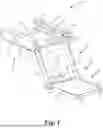
FIG. 1 is an isolated top perspective view of a retractable fold-down step system in accordance with an embodiment of the present invention shown with the step extended.
FIG. 2 is a bottom perspective view of the retractable fold-down step system shown mounted below a boat deck with the step extended.
FIG. 3 is a bottom perspective view of the retractable fold-down step system with the step folded up into the sliding frame of the step assembly.
FIG. 4 is a bottom perspective view of the retractable fold-down step system with the step assembly oriented and aligned for retraction into the guide rails.
FIG. 5 is a bottom perspective view of the retractable step system with the step assembly fully retracted and stowed with the cross member engaging the step assembly holders.
FIG. 6 is an exploded view.
FIG. 7 illustrates a custom extrusion including a C-channel portion and a mounting strip portion.
Before the embodiments of the invention are explained in detail, it is to be understood that the invention is not limited to the details of operation or to the details of construction and the arrangement of the components set forth in the following description or illustrated in the drawings. The invention may be implemented in various other embodiments and of being practiced or being carried out in alternative ways not expressly disclosed herein. Also, it is to be understood that the phraseology and terminology used herein are for the purpose of description and should not be regarded as limiting. The use of “including” and “comprising” and variations thereof is meant to encompass the items listed thereafter and equivalents thereof as well as additional items and equivalents thereof. Further, enumeration may be used in the description of various embodiments. Unless otherwise expressly stated, the use of enumeration should not be construed as limiting the invention to any specific order or number of components. Nor should the use of enumeration be construed as excluding from the scope of the invention any additional steps or components that might be combined with or into the enumerated steps or components.
DESCRIPTION OF CURRENT EMBODIMENTS
A retractable low-profile fold-down step system for a boat in accordance with an embodiment of the present invention is shown in FIG. 1. The fold-down step system 10 is configured to mount below a boat deck (e.g., a pontoon boat deck), access platform, swim platform or other similar boat structures, and is selectively movable between a retracted position in which the fold-down step assembly is stowed compactly with a low-profile and an extended position in which the fold-down step assembly is extended from the guide rails for use (e.g., to enter or exit the boat or for lounging). In the illustrated embodiment, the system includes a slide track assembly 12 and a fold-down step assembly 14 movably coupled to the slide track assembly. FIGS. 2-5 show the slide track assembly 12 mounted to the undersurface of a pontoon boat deck BD, but the system 10 may be mounted to other suitable mounting structure, such as the undersurface of a swim platform.
For purposes of disclosure the present invention is described in the context of a retractable fold-down step system 10 mounted beneath a boat deck BD located at the fore end of a pontoon boat. To facilitate disclosure in this context the terms fore and aft may be used to denote directions relative to the boat. These terms are not intended to limit the mounting position or orientation of the system 10 with respect to the boat. Instead it should be understood that the system 10 may be mounted at other locations and at other orientations. For example, a fold-down step system 10 may be mounted to the undersurface of the aft deck (or swim platform) of a boat, in which case the terms fore (or forward) and aft would be reversed.
The retractable fold-down step system 10 will now be described in more detail with reference to FIGS. 1-6. As noted above, the system 10 generally includes a slide track assembly 12 and a fold-down step assembly 14 movably coupled to the slide track assembly 12. In the illustrated embodiment, the fold-down step assembly 14 includes a sliding frame 40 and a fold-down step 90 that folds up into the sliding frame 40 while being stowed and folds down out of the sliding frame 40 to provide a step for entering and exiting the boat. FIGS. 1 and 2 illustrate the fold-down step assembly 14 in its fully extended position (with FIG. 2 showing the system coupled to the underside of a boat deck BD). FIGS. 3-5 illustrate a progression of folding up (FIG. 3), re-orienting and aligning (FIG. 4), and stowing (FIG. 5) the fold-down step assembly 14 within the slide track assembly 12. The same views, in reverse, also depict a progression of deploying the fold-down step from a stowed position (FIG. 5), by sliding out the fold-down step assembly 14 along the slide track (FIG. 4), rotating the fold-down step assembly 14 to its step pitch orientation (FIG. 3), and then rotating the step out from the sliding frame to its horizontal, extended, orientation (FIGS. 1 and 2).
In the illustrated embodiment, the slide track assembly 12 includes two C-channels 20 separated by a fore cross-member 22 mounted to the bottom of the C-channels 20 and an aft cross-member 24 mounted to the top of the C-channels 20 to form a generally rectangular structural framework. The slide track assembly 12 can also include mounting strips 26, which can be joined (integrally or by fasteners) with the top surface of the C-channels 20 to facilitate mounting the slide track assembly 12 to a generally planar undersurface. The mounting strips 26 and the aft cross member 24 can form a flush surface such that both the mounting strips 26 and the aft cross member 24 facilitate mounting the slide track assembly 12 to a generally planar undersurface. The system may, however, be configured to mount to non-planar surfaces, if desired. In some embodiments, the C-channel and mounting strip can be formed by way of a custom extrusion, as depicted in FIG. 7.
Perhaps as best shown in the exploded view of FIG. 6, the slide track assembly 12 also includes a pair of slides 30 that are moveable within the respective channels provided by the slide track assembly 12. In the depicted embodiment, each slide is generally a rectangular prism that fits within and can slide along one of the C-channels 20. The slide can be made from essentially any material that facilitates sliding along the C-channel surfaces, which can be aluminum, another metal, or another material that provides low-friction interaction with the slides. For example, the slides 30 can be made from essentially any plastic (e.g., polyoxymethylene (Delrin), polyurethane, polyethylene, polypropylene, polycarbonate, or other similar material) that has low friction interaction with a metallic C-channel surface. In the current embodiment, the slides are polyoxymethylene, which is a high-performance plastic known for, among other characteristics, its low friction. Each of the slides 30 can include (e.g., receive or define integrally) a plastic bushing 31 (e.g., polyoxymethylene or similar urethane bushing) that can facilitate rotation of the fold-down step assembly 14 relative to the slide track assembly 12, which is discussed in more detail below.
The slide track assembly 12 also includes a pair of handle holders 34, 36 configured to receive the stowaway handle 60 (e.g., dowel) of the fold-down step assembly 14. In the current embodiment, each holder 34, 36 is permanently mounted within the C-channels 20 with a pair of screws through mounting apertures 37 in the side of the respective C-channel. The holders 34, 36 can serve multiple functions including: 1) preventing the slides 30, 32 from sliding past the holders 34, 36 in the C-channels 20 when the slides move toward the fore end of the channels; 2) preventing the stowaway handle 60 of the fold-down step assembly 14 from sliding past the holders 34, 36 in the C-channels 20 when the slides 30 move toward the aft end of the channels 20 (which prevents the slides 30 from sliding out of the aft end of the channels 20); and 3) providing a secure and convenient place for the stowaway handle 60 of the fold-down step assembly 14 to rest securely while the fold-down step assembly 14 is stowed away compactly in the slide track 12. In the current embodiment, the holders 34, 36 are J-shaped to facilitate this, however, the size, shape, and configuration of the holders 34, 36 may vary from application to application as desired.
In the current embodiment, the fold-down step assembly 14 has been further improved by the addition of a stowaway assist handle 150. In the current embodiment, the stowaway assist handle 150 is a water-jet-cut component welded to the stowaway handle 60. This enhancement provides additional leverage and assistance when folding the step assembly 14 from its deployed position back into its stowed configuration within the slide track assembly 12, as well as when unfolding it into its deployed position. The stowaway assist handle 150 is designed to be welded at a suitable angle, depending on the operator's ergonomic preferences or specific installation needs. This flexibility allows for tailored configurations for different vessels or user requirements.
During the stowing and unstowing processes as well as once the fold-down step assembly 14 is fully stowed or fully extended, the stowaway assist handle 150 does not impede the assembly from sliding along the slide track assembly 12 or the stowaway handle 60 from working in conjunction with the handle holders 34, 36, which are positioned within the C-channels 20 of the slide track assembly 12. In the current embodiment, the stowaway assist handle 150 extends generally downwardly and at a suitable angle such that the stowaway assist handle 150 can be grasped from outside the boat and used to pull the fold-down step assembly 14 from its stowed position. The operator of the stowaway assist handle 150 can use it to leverage the stowaway handle 60 upward and out of the holders 34, 36, which normally secure the stowaway handle 60. Once disengaged, the stowaway assist handle 150 can be used to pull the fold-down step assembly 14 along the track into its extended configuration. The stowaway assist handle can also be used to lift the assembly 14 and slide it into its stowed position with the stowaway handle 60 resting in the handle holders 34, 36.
The stowaway assist handle 150 can be constructed from corrosion-resistant materials to ensure durability and long-term performance in marine environments. Suitable materials for the handle can include marine-grade stainless steel, which provides resistance to corrosion and maintains structural integrity in saltwater conditions. Alternatively, in some embodiments, lightweight materials such as aluminum may be used, offering a balance of strength and corrosion resistance. In some cases, other durable metals or composite materials may be utilized, depending on the specific application and desired properties, ensuring that the handle remains reliable under varying environmental conditions.
The stowaway assist handle 150 can be manufactured and attached with any suitable method. In the current embodiment, the stowaway assist handle 150 is water-jet cut and welded to the stowaway handle 60, which offers strength and durability. Alternative embodiments can provide a stowaway assist handle 150 that is manufactured and attached through other methodologies. In some embodiments, the stowaway handle 60 and the stowaway assist handle 150 can be manufactured as a single component.
By enhancing the user's grip and control, the stowaway assist handle 150 simplifies the folding and unfolding process of the step assembly 14, enhancing convenience for operators transitioning between the step's deployed and stowed positions. While the current embodiment includes a stowaway assist handle 150, it should be understood that it is optional and other embodiments may forgo the addition of the stowaway assist handle 150. The stowaway handle 60 can be used to accomplish similar functionality.
The illustrated slide track assembly 12, including cross-members 22, 24, mounting strips 26, slides 30, and holders 34, 36 are merely exemplary. The design and configuration of the slide track assembly 12 may vary from application to application as desired. For example, the size, shape and configuration of the slide track assembly and its various components may vary. In some embodiments, the slide track assembly 12 may not include any cross members or mounting strips and instead may include two separate C-channels that are secured to a boat undersurface at a specific distance apart to form a slide track. Further, while the current embodiment includes C-channels that form the slide track, in alternative embodiments other types of channels or guides can form the slide track, such as L-, J-, or T-shaped channels. In yet other embodiments, a single U- or O-shaped (or other shaped) channel may form the slide track instead of a pair of channels.
The sliding frame 40 includes a pair of primary rails 42, 44 joined by a pair of supporting cross-members 46, 48. The rails and support members can be made from essentially any sturdy and rigid material. For example, they can be made from aluminum or another metal. The sliding frame also includes a slide frame pivot member 52 that provides a pivot point in conjunction with the end bushings 31 of the slides 30 of the slide track assembly 12. The ends of the slide frame pivot member 52 are inserted through and permanently fixed to the primary rails 42, 44 such that rotation of the slide frame pivot member 52 also results in rotation of the entire fold-down step assembly 14. In the current embodiment, the slide frame pivot member 52 is an aluminum dowel that rotates with respect to the slide track assembly 12, but the size, shape, and material of the pivot member can vary from application to application.
In the current embodiment, a portion of the slide frame pivot member 52 juts out from each end of the primary rails 42, 44 and is supported at opposite ends by the end bushings 31 of the slides 30. That is, bushings (or bearings) may be disposed about the slide frame pivot member 52 to facilitate rotation with respect to the slide track assembly 12. In the current embodiment, opposite ends of the slide frame pivot member 52 are fitted with end bushings 31, which are defined by or secured in the slides 30 of the slide track assembly 12. For example, FIG. 6 is an exploded view showing one of the bushings 70 separate from the end of the slide frame pivot member 52. In this embodiment, the opposite end of the slide frame pivot member 52 is essentially identical. In this embodiment, the end bushings 31 are integrally formed with and defined by the slides 30. However, in other embodiments, the end bushings can be joined to the slides. For example, fasteners (not shown) may extend through the slides 30 into screw holes in the outer surfaces of the end bushings. In the illustrated embodiment, the end bushings 31 are Delrin bushings or similar urethane bushings, but the slide frame pivot member 52 may be supported at opposite ends by other types of bushings or bearings.
The sliding frame 40 (by virtue of the slide frame pivot member 52) can rotate about a pivot point to rotate between a horizontal orientation where the primary rails are generally aligned with the slide track created by the C-channels 20 and a step pitch orientation where the primary rails of the sliding frame 40 are offset about 60 degrees below the horizontal orientation. The angle of the sliding frame 40 step pitch orientation can vary from application to application. In the step pitch orientation (shown in FIGS. 1 and 2), the sliding frame 40 is prevented from further rotation by the physical interaction between the primary rails 42, 44 and the fore cross-member 22 of the slide track assembly 12. That is, the relative arrangement of the fore-cross member 22, pivot point P1, and the primary rails 42, 44 provide a pre-set step pitch orientation while the sliding frame is slid to the fore end of the slide track 12. This arrangement and orientation of the sliding frame 40 relative to the slide track 12 also prevents the sliding frame 40 from sliding toward the aft end of the slide track 12 unless and until it is rotated back to the horizontal orientation.
In the illustrated embodiment, the fold-down step assembly 14 includes a step 90. The step 90 includes a pair of step brackets 92, 94 joined together by step framework 96 that spans between the pair of step brackets 92, 94. The step brackets 92, 94 are configured to support opposite ends of the step 90. More specifically, on one side of the system 10, step bracket 92 is pivotally connected to primary rail 42 of the slide frame 40 and, on the opposite side, step bracket 94 is pivotally connected to primary rail 44 of the slide frame 40.
In the current embodiment, bushings 95 form the pivotal connection and facilitate rotation of the step 90 with respect to the sliding frame 40. Perhaps as best shown in FIG. 6, the bushings 95 are joined to the primary rails 42, 44 such that apertures 99 in the step brackets 92, 94 surround the bushings 95 to provide a pivot point for the step 90 relative to the sliding frame 40. In this embodiment, the bushings 95 are separately installed within apertures 45 of the primary rails 42, 44. However, in other embodiments, the bushings can be integrally formed with and defined by the rails 42, 44. In the illustrated embodiment, the bushings 95 are Delrin bushings or similar urethane bushings, but in alternative embodiments they may be other types of bushings or bearings. The pivotal connections between the step 90 and the primary rails 42, 44 work in conjunction to provide a pivot point about which the step 90 can rotate between a folded-up position where the step 90 is seated against the cross-beam members 46, 48 of the slide track assembly 12 (perhaps as best shown in FIG. 3) and a folded-down position where the step 90 is fixed at a step orientation, e.g., generally horizontal or parallel with the boat deck (perhaps as best shown in FIGS. 1 and 2). In the step orientation (shown in FIGS. 1 and 2), the step 90 is prevented from further clockwise rotation by the physical interaction between the step brackets 92, 94 and the fore cross-member 48 of the sliding frame 40. That is, the relative arrangement of the fore-cross member 48, pivot point, and the step brackets 92, 94 provide a pre-set step orientation.
The step framework 96 is configured to join the step brackets 92 and 94, and to provide structural support for the step 90. In the illustrated embodiment, the step framework 96 for the step 90 includes two cross members 97, 98. The top surface of the step framework 96 may include step tread 100 to facilitate use of the surface as a step. For example, the step tread 100 can be manufactured from marine board, plastic composite, or other suitable materials. The step framework 96 and brackets 92, 94 can be metal or another suitable material.
In the illustrated embodiment, the step 90 has a length of about 24 inches and a depth of about 20 inches from the boat deck set by the step pitch orientation of the sliding frame 40 in the extended position. In the current embodiment, while the fold-down step assembly 14 is stowed within the slide track assembly 12, the entire system has a height of about 6 inches. That is, because the step 90 folds into the sliding frame 40 and the sliding frame 40 fits entirely within the slide track assembly 12, the entire system stows away to a compact position the height of the C-channels 20—which in the current embodiment is about 6 inches. These dimensions are exemplary, however, and the size, shape, orientation, and configuration of the step may vary from application to application. In the illustrated embodiment, the depth of the step is selected so that a single step is sufficient to enter the boat from the ground or dock, or to exit the boat to the ground or dock.
After a user has entered or exited the boat and the step needs to be stowed, the user can grasp the lip 102 of the step framework 96 and fold the step 90 into its seated position between the primary rails 42, 44 of the sliding frame 40 (as shown in FIG. 3). From there, the user can grasp the stowaway handle 60 (either from the ground/dock or from on the boat deck) and align the sliding frame 40 with the slide track of the slide track assembly 12 (as shown in FIG. 4). Then, once generally aligned, the user can push or pull the sliding frame 40 along the slide track until the ends 61, 63 of the stowaway handle 60 reach the respective holders 34, 36, where the stowaway handle 60 can be placed to secure the fold-down step assembly 14 (as shown in FIG. 5). Referring to FIG. 5, when in the retracted position, the fold-down step assembly 14
is folded into a compact arrangement under the mounting structure, where it occupies limited space and is generally hidden from view. In the extended positions (e.g., FIGS. 1-2), the step 90 extends beyond the boat deck (or other mounting structure), where it can be used to climb up or down from the boat deck. Further, the extended step 90 can be used as a place to rest, lounge, sit or otherwise enjoy the water. The track assembly 12 and the fold-down step assembly 14 are configured to provide a compact low-profile system 10 when in the fully retracted position.
Directional terms, such as “aft,” “fore,” “forward,” “vertical,” “horizontal,” “top,” “bottom,” “upper,” “lower,” “inner,” “inwardly,” “outer” and “outwardly,” are used to assist in describing the invention based on the orientation of the embodiments shown in the illustrations. The use of directional terms should not be interpreted to limit the invention to any specific orientation(s).
The above description is that of current embodiments of the invention. Various alterations and changes can be made without departing from the spirit and broader aspects of the invention as defined in the appended claims, which are to be interpreted in accordance with the principles of patent law including the doctrine of equivalents. This disclosure is presented for illustrative purposes and should not be interpreted as an exhaustive description of all embodiments of the invention or to limit the scope of the claims to the specific elements illustrated or described in connection with these embodiments. For example, and without limitation, any individual element(s) of the described invention may be replaced by alternative elements that provide substantially similar functionality or otherwise provide adequate operation. This includes, for example, presently known alternative elements, such as those that might be currently known to one skilled in the art, and alternative elements that may be developed in the future, such as those that one skilled in the art might, upon development, recognize as an alternative. Further, the disclosed embodiments include a plurality of features that are described in concert and that might cooperatively provide a collection of benefits. The present invention is not limited to only those embodiments that include all of these features or that provide all of the stated benefits, except to the extent otherwise expressly set forth in the issued claims. Any reference to claim elements in the singular, for example, using the articles “a,” “an,” “the” or “said,” is not to be construed as limiting the element to the singular.
Claims
The embodiments of the invention in which an exclusive property or privilege is claimed are defined as follows:1. A sliding retractable step system for a boat, comprising:
a slide track assembly having:
a pair of slide tracks;
a pair of holders each of the holders being uniquely associated with a corresponding one of the pair of slide tracks, wherein each of the holders are disposed toward an end of the corresponding one of the pair of slide tracks;
a pair of slides slidably coupled to the slide tracks for sliding between an extended position where the pair of slides are disposed proximal to the pair of holders and a stowed position where the pair of slides are disposed distal to the pair of holders; and
a fold-down step assembly having:
a sliding frame having a pair of primary rails joined by a slide frame pivot member, wherein the slide frame pivot member is rotatably coupled to the pair of slides about a sliding frame pivot point between a stow orientation and a step pitch orientation, wherein the sliding frame is slidable relative to the slide track, by virtue of coupling to the pair of slides within the pair of slide tracks, between the extended position and the stowed position while the sliding frame is pivoted in the stow orientation, and wherein the sliding frame is rotatable from the stow orientation to the step pitch orientation while the sliding frame is in the extended position; and
a step having a pair of step brackets joined by step framework and a stowaway handle, wherein the pair of step brackets are rotatably coupled to the pair of primary rails about a step pivot point between a seated orientation and a step orientation; and
wherein the pair of holders of the slide track are configured to receive the stowaway handle of the step.
2. The sliding retractable step system of claim 1 wherein the pair of slide tracks comprise a pair of C-channels.
3. The sliding retractable step system of claim 1 wherein the step pitch orientation is about 60 degrees from horizontal.
4. The sliding retractable step system of claim 1 wherein the slide track assembly includes a cross member spanning the pair of slide tracks, and wherein the cross-member, sliding frame pivot point, and the pair of primary rails cooperate to provide the step pitch orientation while the sliding frame is slid to the extended position by the cross-member preventing rotation of the pair of primary rails about the sliding frame pivot point past the step pitch orientation.
5. The sliding retractable step system of claim 1, wherein the sliding frame includes a cross-member spanning the pair of primary rails and wherein in the seated orientation, the step seats against the cross-member of the sliding frame.
6. The sliding retractable step system of claim 1, wherein the step framework includes a tread, and wherein in the step orientation, the step framework provides a generally horizontal surface for entering or exiting the boat.
7. The sliding retractable step system of claim 1 wherein the sliding frame includes a cross member spanning the pair of primary rails, and wherein the cross-member, step pivot point, and the pair of step brackets cooperate to provide the step orientation by the cross-member preventing rotation of the pair of step brackets about the step pivot point past the step orientation.
8. The sliding retractable step system of claim 1 wherein, in the stowed position, the height of the sliding track assembly and fold-down step assembly is less than 10 inches.
9. The sliding retractable step system of claim 1 wherein the slide track assembly is configured to mount to the undersurface of a pontoon boat dock.
10. The sliding retractable step system of claim 1, further comprising a stowaway assist handle attached to the stowaway handle, wherein the stowaway assist handle assists in both folding the fold-down step assembly from the deployed position to the stowed position and unfolding the fold-down step assembly from the stowed position to the deployed position.
11. A retractable step system for a boat, comprising:
a slide track assembly having a pair of slide tracks;
a fold-down step assembly slidably coupled to the slide track assembly, wherein the fold-down step assembly comprises:
a stowaway handle configured to engage with a pair of holders within the slide track assembly to secure the fold-down step assembly in a stowed position;
a stowaway assist handle attached to the stowaway handle, wherein the stowaway assist handle assists in both folding the fold-down step assembly from a deployed position to a stowed position and unfolding the fold-down step assembly from the stowed position to the deployed position;
wherein the fold-down step assembly is configured to move between a stowed position within the slide track assembly and an extended position where the fold-down step assembly is deployed for use.
12. The retractable step system of claim 11, wherein the stowaway assist handle is welded to the stowaway handle at an angle to accommodate access from off the boat when the fold-down step assembly is in the stowed position.
13. The retractable step system of claim 11, wherein the stowaway assist handle is constructed from corrosion-resistant materials selected from the group consisting of marine-grade stainless steel, aluminum, or composite materials.
14. The retractable step system of claim 11, wherein the slide tracks are C-channels that receive slides attached to the fold-down step assembly, allowing the fold-down step assembly to slide between the stowed and extended positions.
15. The retractable step system of claim 11, wherein the stowaway assist handle allows an operator to disengage the stowaway handle from the holders and transition the fold-down step assembly from the stowed position to the extended position.
16. The retractable step system of claim 11, wherein the fold-down step assembly further comprises a step framework having a pair of step brackets and a tread, and wherein the step framework is rotatable between a seated orientation and a step orientation to provide a generally horizontal surface for entering or exiting the boat.
17. The retractable step system of claim 16, wherein the step framework is configured to seat against a cross-member in the slide track assembly when the fold-down step assembly is in the seated orientation.
18. The retractable step system of claim 11, wherein the height of the slide track assembly and fold-down step assembly in the stowed position is less than 10 inches, allowing for a low-profile installation beneath a pontoon boat dock or similar structure.
Images & Drawings included:



Sources:
- United States Patent and Trademark Office - verify current appl. status at the USPTO↗
Recent applications in this class:
- » 20240227986 2024-07-11
BOARDING PLATFORM - » 20240190536 2024-06-13
POCKET STYLE FOLDING BOAT LADDER ASSEMBLY - » 20240017797 2024-01-18
Hydraulic marine vessel door assembly - » 20230415857 2023-12-28
Watercraft swim platform with deployable steps - » 20230234676 2023-07-27
ILLUMINATED MARINE LADDER - » 20220363348 2022-11-17
Watercraft swim platform with deployable steps - » 20220363347 2022-11-17
Powered retractable ladder - » 20220126953 2022-04-28
Stern platform arrangement and marine vessel - » 20220089254 2022-03-24
ATTACHMENTS FOR A COLLAPSIBLE MARINE LADDER - » 20220081076 2022-03-17
Panel drop down boarding point for a recreational watercraft