COMBINATION DISPLAY AND TRANSPORT CASE FOR THREE-DIMENSIONAL (3D) FIGURINES
US20250197095A1
2025-06-19
18/987,555
2024-12-19
Smart Summary: A new case has been designed to both display and transport 3D figurines. It features a base with a screw seam and a clamp lip to securely hold the figurine in place. The base rim is designed to fit perfectly with the clamp lip, ensuring stability. A lid with its own screw seam can be attached to the base, keeping the figurine safe inside. This combination makes it easy to show off the figurine while also protecting it during transport. 🚀 TL;DR
Abstract:
Aspects of the disclosure are directed to a display and transport case for three-dimensional (3D) figurine. In accordance with one aspect, the disclosure includes a base, wherein the base includes an outer screw seam and a clamp lip; a base rim to hold a figurine, wherein the base rim mates to the clamp lip; and a lid, wherein the lid includes an inner screw seam and wherein the inner screw seam mates to the outer screw seam.
Inventors:
- Teagan Morrison 3 🇺🇸 Santa Monica, CA, United States
- Jordan Diatlo 1 🇺🇸 Astoria, NY, United States
- Anna Gross 1 🇺🇸 New York, NY, United States
- James Paulius 1 🇺🇸 Ridgewood, NY, United States
- Clotilde Sautai 1 🇺🇸 Brooklyn, NY, United States
Assignee:
- Sky Castle Studios, LLC 5 🇺🇸 San Francisco, CA, United States
Applicant:
Interested in similar patents?
Get notified when new applications in this technology area are published.
Classification:
B65D85/00 » CPC main
Containers, packaging elements or packages, specially adapted for particular articles or materials
Description
CLAIM OF PRIORITY UNDER 35 U.S.C. § 119
The present application for patent claims priority to Provisional Application No. 63/612,276 entitled “Combination Display and Transport Case for 3D Miniature Figurines” filed Dec. 19, 2023, and assigned to the assignee hereof and hereby expressly incorporated by reference herein.
TECHNICAL FIELD
This disclosure relates generally to the field of three-dimensional (3D) printing, and, in particular, to display and transport case for three-dimensional (3D) figurines.
BACKGROUND
A three-dimensional (3D) physical object, such as a three-dimensional (3D) miniature figurine, may be generated by a 3D printer based on a 3D digital model. The 3D physical object (i.e., 3D miniature figurine) may be displayed at one location and then displayed at another spatially distinct location. In this case, the 3D physical object needs to be transported in a secure manner from one location to another. Hence, there is a need for a combination display and transport case for the 3D physical object.
SUMMARY
The following presents a simplified summary of one or more aspects of the present disclosure, in order to provide a basic understanding of such aspects. This summary is not an extensive overview of all contemplated features of the disclosure, and is intended neither to identify key or critical elements of all aspects of the disclosure nor to delineate the scope of any or all aspects of the disclosure. Its sole purpose is to present some concepts of one or more aspects of the disclosure in a simplified form as a prelude to the more detailed description that is presented later.
In one aspect, the disclosure provides three-dimensional (3D) printing. Accordingly, the present disclosure discloses a combination display and transport case including: a base, wherein the base includes an outer screw seam and a clamp lip; a base rim to hold a figurine, wherein the base rim mates to the clamp lip; and a lid, wherein the lid includes an inner screw seam and wherein the inner screw seam mates to the outer screw seam.
In one example, the lid further includes a lip which surrounds an inside surface of the lid. In one example, the base includes a flat rim, and wherein the flat rim mates with the lip to secure the lid to the base. In one example, the base further includes at least one clamp base and an upper groove, wherein the at least one clamp base includes an annular groove. In one example, the at least one clamp base includes at least one decorative element on an upper surface of the at least one clamp base. In one example, the upper groove is conjugately mated to the annular groove. In one example, base further includes a pedestal 250, wherein the pedestal 250 is configured to provide structural support to the base rim. In one example, the lid is made of a transparent material. In one example, the lid is made of either plastic or glass. In one example, the base 210 further includes a base plate. In one example, the at least one clamp base includes at least one hole for pouring a material to attach the at least one clamp base to the base plate.
These and other aspects of the present disclosure will become more fully understood upon a review of the detailed description, which follows. Other aspects, features, and implementations of the present disclosure will become apparent to those of ordinary skill in the art, upon reviewing the following description of specific, exemplary implementations of the present invention in conjunction with the accompanying figures. While features of the present invention may be discussed relative to certain implementations and figures below, all implementations of the present invention can include one or more of the advantageous features discussed herein. In other words, while one or more implementations may be discussed as having certain advantageous features, one or more of such features may also be used in accordance with the various implementations of the invention discussed herein. In similar fashion, while exemplary implementations may be discussed below as device, system, or method implementations it should be understood that such exemplary implementations can be implemented in various devices, systems, and methods.
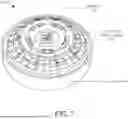
BRIEF DESCRIPTION OF THE DRAWINGS
FIG. 1 illustrates an overview perspective example of a combination display and transport case for a three-dimensional (3D) miniature figurine.
FIG. 2 illustrates an example of a combination display and transport case for a three-dimensional (3D) miniature figurine.
FIG. 3 illustrates an example flow diagram for assembly of a combination display and
transport case.
FIG. 4 illustrates two examples of combination display and transport cases.
FIG. 5 illustrates the two examples of combination display and transport cases of FIG. 4 with placements of a three-dimensional (3D) miniature figurine in each of the combination display and transport cases.
FIG. 6 illustrates an example of a combination display and transport case divided into sections.
FIG. 7 illustrates a first example base.
FIG. 8 illustrates a second example base.
FIG. 9 illustrates an example clamp base showing a top view, a bottom view and a detailed top view.
FIG. 10 illustrates an example clamp base showing a perspective view and a perspective view with a cross-sectional view.
FIG. 11 illustrates an example top view of three bases with different pedestal shapes.
FIG. 12 illustrates an example top view of two different size bases.
FIGS. 13-16 illustrate examples of a portion of a base in various disassembled configurations.
FIG. 17 illustrates an assembled view of the portion of the base illustrated in FIGS. 13-16.
DETAILED DESCRIPTION
The detailed description set forth below in connection with the appended drawings is intended as a description of various configurations and is not intended to represent the only configurations in which the concepts described herein may be practiced. The detailed description includes specific details for the purpose of providing a thorough understanding of various concepts. However, it will be apparent to those skilled in the art that these concepts may be practiced without these specific details. In some instances, well known structures and components are shown in block diagram form in order to avoid obscuring such concepts.
While for purposes of simplicity of explanation, the methodologies are shown and described as a series of acts, it is to be understood and appreciated that the methodologies are not limited by the order of acts, as some acts may, in accordance with one or more aspects, occur in different orders and/or concurrently with other acts from that shown and described herein. For example, those skilled in the art will understand and appreciate that a methodology could alternatively be represented as a series of interrelated states or events, such as in a state diagram. Moreover, not all illustrated acts may be required to implement a methodology in accordance with one or more aspects.
In one example, a three-dimensional (3D) physical object, such as a 3D miniature figurine, may be produced using a 3D printer. The 3D printer uses a 3D digital model as input. The 3D digital model is a numeric and symbolic representation of a desired physical object. For example, the numeric and symbolic representation may be a digital coding of a 3D representation of the desired physical object.
In one example, the 3D printer produces the 3D physical object with physical properties corresponding to the desired physical object. For example, the size and dimensions of the 3D physical object may be scaled based on the size and dimensions of the desired physical object. For example, the 3D physical object may be a scaled replica of the desired physical object.
In one example, after production by the 3D printer, the 3D physical object may be displayed at an initial location and then displayed at a subsequent location. In this case, the 3D physical object needs to be transported in a secure manner from the initial location to the subsequent location.
For example, the 3D physical object may be displayed at the initial location or at the subsequent location using a display case for secure display. For example, the display case may serve as a mounting structure for the 3D physical object. For example, the 3D physical object may be transported from the initial location to the subsequent location using a transport case for secure transport. For example, the transport case may serve as a packaging structure for the 3D physical object.
In one example, instead of using a display case for secure display and a transport case for secure transport, a combination display and transport case may be used for both secure display and secure transport. For example, the combination display and transport case may incorporate integrated design features which satisfy the need for display and for transport.
In one example, the 3D physical object, for example, a 3D miniature figurine, may have a certain scale, for example, 30 millimeter (mm) scale. In one example, the scale refers to a height of the 3D physical object. In one example, a display case for 30 mm miniature figurines may have a width of at least 1.5 inches (i.e., at least 38 mm). For example, the width may depend on the miniature figurine size. One skilled in the art would understand that the example dimensions disclosed herein are examples and should not be construed as limiting. That is, other dimensions, not explicitly disclosed herein, are also within the scope and spirit of the present disclosure.
FIG. 1 illustrates an overview perspective example 100 of a combination display and transport case 101 for a 3D miniature figurine 105. In one example, the combination display and transport case 101 is referred to as the “transport case 101”. In one example, the case width is 4 inches (i.e., 102 mm). In one example, the combination display and transport case 101 includes a transparent lid 115 which is attached with screws (not shown) to a base 110. In one example, the transparent lid 115 clamps down on two plates which secure the 3D miniature figurine in place. One skilled in the art would understand that the example dimensions disclosed in FIG. 1 are examples and should not be construed as limiting. That is, other dimensions, not explicitly disclosed herein, are also within the scope and spirit of the present disclosure.
FIG. 2 illustrates an example 200 of a combination display and transport case 201 for a 3D miniature figurine 205. The numerical labels listed in FIG. 2 are as follows:
| 205 | 3D miniature figurine |
| 210 | base |
| 215 | bell jar case lid |
| 220 | lip |
| 230 | miniature base rim |
| 235 | clamp lip |
| 240 | clamp base (first half) |
| 241 | clamp base (second half) |
| 245 | decorative element |
| 250 | pedestal with a round groove |
| 260 | upper groove |
| 265 | outer screw seam |
| 270 | inner screw seam |
| 225 | flat rim |
| 255 | annular groove |
In one example, the combination display and transport case 201 is referred to as the “transport case 201”. In one example, the base 210 includes one or more of the following: miniature base rim 230, clamp lip 235, clamp base (first half) 240, clamp base (second half) 241, decorative element 245, pedestal 250 with a round groove, upper groove 260, outer screw seam 265, flat rim 225, and/or annular groove 255. Although the pedestal 250 is shown with a round groove, one skilled in the art would understand that in other example, the pedestal 250 need not include a round groove and that other form of securing the pedestal to attenuate movement within the combination display and transport case are also within the scope and spirit of the present disclosure.
In one example, the transport case 201 includes the base 210 and the bell jar case lid 215. Although the lid is shown in the shape of an inverted U, and labeled as a “bell jar case lid”, one skilled in the art would understand that the shape of the lid may include other shapes within the scope and spirit of the present disclosure. For example, a lid in the shape of a square or rectangular volume would also be within the scope and spirit of the present disclosure. In another example, the shape of the lid could be a partially spherical shape.
In one example, the 3D miniature figurine 205 is placed within the transport case 201. One skilled in the art would understand that the labeling of the figurine 205 as a miniature figurine does not imply that it has a specific dimension or that its dimension must be “miniature”. The dimension of the figurine is not restricted to a particular dimension or size. In one example, the transport case 201 includes a base 210 with a symmetrical shape. For example, the symmetrical shape may be a circular shape. One skilled in the art would understand that other shapes for the base 210 are within the spirit and scope of the present disclosure. In one example, the base 210 may provide space for aesthetic decorations. For example, the base 210 may include a lip (not shown) to hide screw mechanisms.
In one example, a bell jar case lid 215 forms a top cover of the combination display and transport case 201. In one example, the bell jar case lid 215 is made of a transparent material such as plastic, glass or a combination of plastic and glass. Although plastic and glass are disclosed herein, other transparent material are within the spirit and scope of the present disclosure. In one example, the bell jar case lid 215 may have a decorative shape or a cylindrical shape with a flat top to allow stacking. And, other shapes are of the case lid 215 are also within the spirit and scope of the present disclosure.
In one example, the transport case 201 includes a lip 220 which surrounds inside of the bell jar case lid 215. In one example, the flat rim 225 is in contact (e.g., mates) with the lip 220. For example, the lip 220 clamps down on a flat rim 225 when attaching the bell jar case lid 215 to the base 210. In one example, the flat rim 225 connects in a flush manner with lip 220. In one example, the base 210 snuggles up to the lip 220 wherein the lip 220 may function to hold the base 210 in place with the bell jar case lid 215. One skilled in the art would understand that other examples of how the lip 220, the flat rim 225 and the bell jar case lid 215 and/or other components of the transport case 201 may fit together are also within the spirit and scope of the present disclosure.
In one example, a miniature base rim 230 connects (i.e., mates) to a clamp lip 235. In one example, the clamp lip 235 has two halves with each half being a contiguous piece located on either the first half of the clamp base 240 or the second half of the clamp base 241. In one example, an edge of base 210 may be at different angle with the clamp lip 235. One skilled in the art would understand that there are many configurations of the clamp lip 235 that would allow it to clamp/hold on to the miniature base rim 230 and these many configurations are also within the spirit and scope of the present disclosure. In one example, the clamp lip 235 is designed to be flush with miniature base rim 230. One skilled in the art would understand that other configurations of the clamp lip 235 (e.g., being separate piece(s) from the clamp base 240, 241) are also within the spirit and scope of the present disclosure. And, furthermore, one skilled in the art would understand that the labeling of the base rim 230 as a miniature base rim does not imply that it has a specific dimension or that its dimension must be “miniature”. Furthermore, it should be understood that the dimension of the base rim 230 should be such that the base rim 230 can accommodate the figurine 205.
For example, the miniature base rim 230 has a shape which may be round, hexagonal, square, etc., which matches with the shape of the clamp lip 235. However, one skilled in the art would understand that there may be shapes of the miniature base rim 230 which need not match with the shape of the clamp lip 235 and are still within the spirit and scope of the present disclosure. In one example, the clamp lip 235 need not clamp the entirety of the miniature base rim 230.
In one example, an edge of base 210 may be at a different angle with the clamp lip 235. One skilled in the art would understand that there are many configurations of the clamp lip 235 that would allow it to clamp/hold on to the miniature base rim 230 and these many configurations are also within the spirit and scope of the present disclosure. In one example, the clamp lip 235 is designed to be flush with miniature base rim 230. In one example, the clamp lip 235 provides for a secure display and transport case as a packaging structure. In one example, the clamp lip 235 minimizes movement and undesired vibration of the 3D miniature figurine 205 by securing to the miniature base rim 230 (which is attached to the 3D miniature figurine 205) and attenuating movement.
In one example, a clamp base is placed below the bell jar case lid 215. In one example, the clamp base includes a first half clamp base 240 and a second half clamp base 241. In one example, the first half clamp base 240 and the second half clamp base 241 are two separate piece which may be assembled to fit with each other to form a single piece. In one example, the clamp base 240, 241 is assembled by placing the first half clamp base 240 and the second half clamp base 241 adjacent to each other in a symmetric manner. Although, the clamp base 240, 241 is disclosed has having a first half and a second half, one skilled in the art would understand that other examples wherein the clamp base is composed of multiple pieces greater than two are also within the spirit and scope of the present disclosure. For example, the clamp base may be composed of quantity of constituents greater than two.
In one example, the clamp base 240, 241 includes decorative elements 245, for example, on an upper surface. For example, the decorative elements 245 may be situated in an annular region of the upper surface of the clamp base 240, 241. In one example, the decorative elements 245 are purely ornamental. In another example, some of the decorative elements 245 may partially be ornamental while may also include a functional purpose. One skilled in the art would understand that other types of decorative elements may be included as part of the spirit and scope of the present disclosure.
In one example, the base 210 includes a pedestal 250 with a round groove on its upper surface. For example, the round groove may facilitate placement of the 3D miniature figurine 205 in a center of the pedestal 250. One skilled in the art would understand that the other shapes for the pedestal and/or the groove are also within the spirit and scope of the present disclosure.
In one example, the clamp base 240, 241 includes an annular groove 255. In one example, the annular groove 255 surrounds the pedestal 250 on an upper surface of the base 210. In one example, the annular groove 255 is located on the bottom portion of the clamp base 240, 241. In one example, the annular groove 255 may be used to secure the clamp base 240, 241 to the rest of the base 210. In one example, the annular groove 255 provides a secure display and transport case as a packaging structure.
In one example, an upper groove 260 is positioned on a top surface of the base 210. For example, the upper groove 260 is conjugately mated to the annular groove 255 to facilitate securing the base 210 to the clamp base 240, 241. By mating the annular groove 255 to the upper groove 260, movement of the clamp base 240, 241 from the base 210 is attenuated; thus, also attenuating movement of the miniature base rim 230 (which is attached to the 3D miniature figurine 205).
For example, conjugately mated refers to a pair of matched shapes which may be connected together. In one example, the upper groove 260 is integral with the base 210 as one piece together. In another example, the upper groove 260 is a separate piece from the base 210. In one example, the upper groove 260 is a sliding track with fasteners secured to the base 210. In the example, wherein the upper groove 260 is a sliding track with fasteners, the lip 220 may not be needed to secure the clamp base 240, 241 and the bell jar case lid 215 together. In one example, the upper groove 260 provides for a secure display and transport case as a packaging structure. One skilled in the art would understand that there are many techniques that allow securing the upper groove 260 to the rest of the base 210 if the upper groove 260 is a separate piece and that these techniques are within the spirit and scope of the present disclosure.
In one example, an outer screw seam 265 is positioned on an outer periphery of the base 210. For example, the outer screw seam 265 may have a plurality of outer annular ridges. One skilled in the art would understand that other types of screw seams are also within the spirit and scope of the present disclosure.
In one example, an inner screw seam 270 is positioned on an inner periphery of the bell jar case lid 215. For example, the inner screw seam 270 may have a plurality of conjugate annular ridges. For example, the plurality of conjugate annular ridges of the inner screw seam 270 may be conjugately mated to the plurality of outer annular ridges of the outer screw seam 265. In one example, the mating of the inner screw seam 270 and the outer screw seam 265 secures the bell jar case lid 215 to the base 210. Thus, the mating of the inner screw seam 270 and the outer screw seam 265 provides for a secure display and transport case as a packaging structure by attenuating movement of the bell jar case lid 215 relative to the base 210.
FIG. 3 illustrates an example flow diagram 300 for assembly of a combination display and transport case. In block 310, assemble a pedestal 250 with a round groove onto a base 210. In one example, a pedestal 250 with a round groove is assembled onto a base 210. In one example, the pedestal 250 with a round groove is placed on an upper surface of the base 210. In one example, an outer screw seam 265 is positioned on an outer periphery of the base 210. For example, the outer screw seam 265 may have a plurality of outer annular ridges. In one example, the base 210 has a symmetrical shape. For example, the symmetrical shape may be a circular shape. For example, the base 210 may provide space for aesthetic decorations. For example, the base 210 may include a lip to hide screw mechanisms.
In block 320, insert a 3D miniature figurine 205 with a miniature base rim 230 onto the pedestal 250 with a round groove. That is, in one example, the pedestal 250 with a round groove supports the miniature base rim 230. In one example, a 3D miniature figurine 205 with a miniature base rim 230 is inserted onto the pedestal 250 with a round groove. In one example, the round groove may facilitate placement of the 3D miniature figurine 205 in a center of the pedestal. For example, the miniature base rim 230 has a shape which may be round, hexagonal, square, etc., with matching clamp lip shapes.
In block 330, secure a plurality of constituents of a clamp base 240, 241 to the pedestal 250 with a round groove. In one example, a plurality of constituents of a clamp base 240, 241 is secured to the pedestal 250 with a round groove. In one example, the plurality of constituents includes a first half clamp base 240 and a second half clamp base 241. In one example, the first half clamp base 240 and the second half clamp base 241 are adjacent to each other in a symmetric manner.
In one example, the clamp base 240, 241 includes decorative elements 245 on an upper surface. For example, the decorative elements 245 are situated in an annular region of an upper surface of the clamp base 240, 241. In one example, the clamp base 240, 241 includes an annular groove 255 which surrounds the pedestal 250. For example, the annular groove 255 may be used to secure the base 210 (or portions thereof) to the clamp base 240, 241. In one example, an upper groove 260 is positioned on a top surface of the base 210. For example, the upper groove 260 is conjugately mated to the annular groove 255 to facilitate securing the base 210 (or portions thereof) to the clamp base 240, 241. For example, conjugately mated refers to a pair of matched shapes which may be connected together.
In block 340, secure a bell jar case lid 215 to the base 210 to form a combination display and transport case 201. In one example, a bell jar case lid 215 is secured to the base 210 (or portions thereof) to form a combination display and transport case 201. In one example, an inner screw seam 270 is positioned on an inner periphery of the bell jar case lid 215. In one example, the inner screw seam 270 includes a plurality of conjugate annular ridges. In one example, an outer screw seam 265 is positioned on an outer periphery of the base 210. In one example, the outer screw seam 265 includes a plurality of outer annular ridges. In one example, the plurality of conjugate annular ridges of the inner screw seam 270 may be conjugately mated to the plurality of outer annular ridges of the outer screw seam 265 to secure the bell jar case lid 215 to the base 210.
One skilled in the art would understand that the example steps of FIG. 3 flow diagram are not exclusive. Some of the disclosed steps may be elaborated or eliminated without violating the spirit and scope of the present disclosure. Additionally, other steps may be included within the spirit and scope of the present disclosure.
FIG. 4 illustrates two examples 400A, 400B of combination display and transport cases. As illustrated, the two combination display and transport cases are of different sizes. One of the combination display and transport case 400B is larger in width, height and radius than the other combination display and transport case 400A. One skilled in the art would understand that the combination display and transport case may be of different dimensions. And, in one example, the combination display and transport case may be of a different shape than as illustrated in FIG. 4, for example, but not limited to, a having rectangular volume.
FIG. 5 illustrates the two examples 400A, 400B of combination display and transport cases of FIG. 4 with placements of a three-dimensional (3D) miniature figurine 205a, 205b in each of the combination display and transport cases. In one example, the 3D miniature figurine differ in size (dimensions) in each of the two examples 400A, 400B of combination display and transport cases. In one example, different 3D miniature figurines are placed in each of the two examples 400A, 400B of combination display and transport cases. Although not shown, a combination display and transport case may accommodate more than one 3D miniature figurine.
FIG. 6 illustrates an example of a combination display and transport case 601 divided into sections. For example, as shown in FIG. 6, the combination display and transport case 601 includes four sections: lid, pedestal, co-molded sliding door(s) and base cover. In one example, the co-molded means that pieces (e.g., doors) are formed together (e.g., simultaneously). In one example, the co-molded sliding doors are the clamp base 240, 241.
FIG. 7 illustrates a first example base 710. As shown, the example base 710 is divided into three sections: pedestal 720, co-molded sliding doors 730 and base cover 740. In one example, the co-molded means that pieces (e.g., doors) are formed together (e.g., simultaneously). In one example, the co-molded sliding doors are the clamp base 240, 241 (as shown in FIG. 2). In another example, the co-molded sliding door(s) is a single piece, for example, a single clamp base that covers a 360 degree periphery. In one example, the pedestal is slightly indented with respect to the co-molded sliding door(s). That is, from a height perspective, the pedestal is below the height of the highest point of the co-molded sliding door(s). In one example, the base cover is larger in diameter than the diameter of the co-molded sliding door(s). And, in one example, there may be a space between the base cover and the co-molded sliding door(s). Also in one example, the co-molded sliding door(s) may include decorative elements, such as the decorative elements 245 shown in FIG. 2.
FIG. 8 illustrates a second example base 810. As shown, the example base 810 is divided into four sections: pedestal 820, co-molded sliding doors 830, base plate 850 and base cover 840. In one example, the co-molded means that pieces (e.g., doors) are formed together (e.g., simultaneously). In one example, the co-molded sliding doors are two pieces, for example, the clamp base 240, 241 (as shown in FIG. 2). In one example, the pedestal and the co-molded sliding doors are of the same height. That is the pedestal's height is the same as the highest point of the co-molded sliding doors. In another example, from a height perspective, the pedestal is below the height of the highest point of the co-molded sliding door(s). In one example, the co-molded sliding doors may be positioned such that the two pieces of the co-molded sliding doors are fitted to each other to minimize any gap between them such that they may appear as a single piece. In another example, the co-molded sliding doors may be positioned such that the two pieces of the co-molded sliding doors are placed above the base plate 850 with a gap 831 between the two pieces, for example, as shown in FIG. 8. And, other gaps 821 may also be present. As shown in FIG. 8, the base 810 includes a base plate 850 which is situated between the co-molded doors and the base cover. Thus, in one example, the interior of the base cover may be hollow.
FIG. 9 illustrates an example clamp base 940 showing a top view, a bottom view and a detailed top view. As shown in FIG. 9, the example, clamp base 940 includes an outer piece 941 and two inner pieces 945. The two inner pieces 945 form the inner section of the clamp base 940. In one example, the two inner pieces 945 are identical in structural makeup to each other. The detailed top view of the clamp base 940 illustrates a groove and a ledge for materials to be filled and attached onto. And, holes (e.g., openings) on the clamp base are shown. The holes, for example, may allow material to flow through and grip onto rigid plastic with multiple anchor points. In one example, FIG. 9 illustrates molding a rigid plastic sliding door which makes up the clamp base 940. In one example, the multiple anchor points and rigid plastic sliding door(s) provide for a secure display and transport case as a packaging structure by attenuating movement of the 3D miniature figurine housed within.
FIG. 10 illustrates an example clamp base 1040 showing a perspective view and a perspective view with a cross-sectional view. In one example, the clamp base 1040 includes an outer piece 1041 and a single inner piece 1045. The inner piece 1045 fits to the outer piece 1041 to form the clamp base 104. In the perspective view with a cross-sectional view, a cross sectional cutout of the inner piece 1045 is shown to include a flow area 1047 for material to flow through opening on the top surface of the inner piece 1045 to create a secure attachment. In one example, one or more of the markings 1046 are opening on the top surface of the inner piece 1045. In one example, FIG. 10 illustrates co-molding onto the rigid part. In one example, the flow area 1047 provide for a secure display and transport case as a packaging structure by attenuating movement among the various parts of the base.
FIG. 11 illustrates an example top view 1100 of three bases 1110A, 1110B, 1110C with different pedestal shapes. Base 1110A includes a circular shape pedestal. Base 1110B includes a square shape pedestal. Base 1110C includes a hexagon shape pedestal. One skilled in the art would understand that other shapes of the pedestal, although not shown here, are also within the scope and spirit of the present disclosure.
FIG. 12 illustrates an example top view 1200 of two different size bases 1210A, 1210B. Base 1210A differs from base 1210B in its dimension. Base 1200B is a small scale of base 1200A. Additionally, the bases 1210A, 1210B have a pedestal shape that is different from the three bases 1110A, 1110B, 1110C shown in FIG. 11.
FIGS. 13-16 illustrate examples of a portion of a base in various disassembled configurations. Although various parts of the base are shown in the various disassembled configurations, one skilled in the art would understand that these various parts are not exclusive and that other parts (not shown) may make up the structure of the base. Additionally, in one example, the various parts shown may or may not be needed to make up the structure of the base, depending on the particular assembly of the base. Additionally, any of the parts shown may be replaced with other shapes and be within the scope and spirit of the present disclosure. FIG. 13 illustrates that in one example, fins are used as part of the structure to ensure proper alignment of the pedestal on the base. FIG. 14 illustrates that screws and washers may be used for attaching various hardware parts that make up the structure of the base. And, FIG. 15 illustrates that the sliding door(s) and pedestal may be attached to portions of the base using various attachment hardware, including but not limited to screws and washers. FIG. 16 illustrates an adhesive foot ring attached to a portion of the base, utilizing adhesive on a surface of the adhesive foot ring. FIG. 16 also shows that one or multiple screws may be used as base attachment screws; that is for attaching various portions of the base.
FIG. 17 illustrates an assembled view 1700 of the portion of the base illustrated in FIGS. 13-16.
In one aspect, one or more of the steps for assembly of a combination display and transport case in FIG. 3 may be executed by one or more processors which may include hardware, software, firmware, etc. The one or more processors, for example, may be used to execute software or firmware needed to perform the steps in the flow diagram of FIG. 3. Software shall be construed broadly to mean instructions, instruction sets, code, code segments, program code, programs, subprograms, software modules, applications, software applications, software packages, routines, subroutines, objects, executables, threads of execution, procedures, functions, etc., whether referred to as software, firmware, middleware, microcode, hardware description language, or otherwise.
The software may reside on a computer-readable medium. The computer-readable medium may be a non-transitory computer-readable medium. A non-transitory computer-readable medium includes, by way of example, a magnetic storage device (e.g., hard disk, floppy disk, magnetic strip), an optical disk (e.g., a compact disc (CD) or a digital versatile disc (DVD)), a smart card, a flash memory device (e.g., a card, a stick, or a key drive), a random access memory (RAM), a read only memory (ROM), a programmable ROM (PROM), an erasable PROM (EPROM), an electrically erasable PROM (EEPROM), a register, a removable disk, and any other suitable medium for storing software and/or instructions that may be accessed and read by a computer. The computer-readable medium may also include, by way of example, a carrier wave, a transmission line, and any other suitable medium for transmitting software and/or instructions that may be accessed and read by a computer. The computer-readable medium may reside in a processing system, external to the processing system, or distributed across multiple entities including the processing system. The computer-readable medium may be embodied in a computer program product. By way of example, a computer program product may include a computer-readable medium in packaging materials. The computer-readable medium may include software or firmware. Those skilled in the art will recognize how best to implement the described functionality presented throughout this disclosure depending on the particular application and the overall design constraints imposed on the overall system.
Within the present disclosure, the word “exemplary” is used to mean “serving as an example, instance, or illustration.” Any implementation or aspect described herein as “exemplary” is not necessarily to be construed as preferred or advantageous over other aspects of the disclosure. Likewise, the term “aspects” does not require that all aspects of the disclosure include the discussed feature, advantage or mode of operation. The term “coupled” is used herein to refer to the direct or indirect coupling between two objects. For example, if object A physically touches object B, and object B touches object C, then objects A and C may still be considered coupled to one another-even if they do not directly physically touch each other. The terms “circuit” and “circuitry” are used broadly, and intended to include both hardware implementations of electrical devices and conductors that, when connected and configured, enable the performance of the functions described in the present disclosure, without limitation as to the type of electronic circuits, as well as software implementations of information and instructions that, when executed by a processor, enable the performance of the functions described in the present disclosure.
One or more of the components, steps, features and/or functions illustrated in the figures may be rearranged and/or combined into a single component, step, feature or function or embodied in several components, steps, or functions. Additional elements, components, steps, and/or functions may also be added without departing from novel features disclosed herein. The apparatus, devices, and/or components illustrated in the figures may be configured to perform one or more of the methods, features, or steps described herein. The novel algorithms described herein may also be efficiently implemented in software and/or embedded in hardware.
It is to be understood that the specific order or hierarchy of steps in the methods disclosed is an illustration of exemplary processes. Based upon design preferences, it is understood that the specific order or hierarchy of steps in the methods may be rearranged. The accompanying method claims present elements of the various steps in a sample order, and are not meant to be limited to the specific order or hierarchy presented unless specifically recited therein.
The previous description is provided to enable any person skilled in the art to practice the various aspects described herein. Various modifications to these aspects will be readily apparent to those skilled in the art, and the principles defined herein may be applied to other aspects. Thus, the claims are not intended to be limited to the aspects shown herein, but are to be accorded the full scope consistent with the language of the claims, wherein reference to an element in the singular is not intended to mean “one and only one” unless specifically so stated, but rather “one or more.” Unless specifically stated otherwise, the term “some” refers to one or more. A phrase referring to “at least one of” a list of items refers to any combination of those items, including single members. As an example, “at least one of: a, b, or c” is intended to cover: a; b; c; a and b; a and c; b and c; and a, b and c. All structural and functional equivalents to the elements of the various aspects described throughout this disclosure that are known or later come to be known to those of ordinary skill in the art are expressly incorporated herein by reference and are intended to be encompassed by the claims. Moreover, nothing disclosed herein is intended to be dedicated to the public regardless of whether such disclosure is explicitly recited in the claims. No claim element is to be construed under the provisions of 35 U.S.C. § 112, sixth paragraph, unless the element is expressly recited using the phrase “means for” or, in the case of a method claim, the element is recited using the phrase “step for.”
One skilled in the art would understand that various features of different embodiments may be combined or modified and still be within the spirit and scope of the present disclosure.
Claims
What is claimed is:1. A combination display and transport case comprising:
a base, wherein the base includes an outer screw seam and a clamp lip;
a base rim to hold a figurine, wherein the base rim mates to the clamp lip; and
a lid, wherein the lid includes an inner screw seam and wherein the inner screw seam mates to the outer screw seam.
2. The combination display and transport case of claim 1, wherein the lid further comprises a lip which surrounds an inside surface of the lid.
3. The combination display and transport case of claim 2, wherein the base comprises a flat rim, and wherein the flat rim mates with the lip to secure the lid to the base.
4. The combination display and transport case of claim 3, wherein the base further comprises at least one clamp base and an upper groove, wherein the at least one clamp base includes an annular groove.
5. The combination display and transport case of claim 4, wherein the at least one clamp base includes at least one decorative element on an upper surface of the at least one clamp base.
6. The combination display and transport case of claim 4, wherein the upper groove is conjugately mated to the annular groove.
7. The combination display and transport case of claim 3, wherein base further comprises a pedestal, wherein the pedestal is configured to provide structural support to the base rim.
8. The combination display and transport case of claim 1, wherein the lid is made of a transparent material.
9. The combination display and transport case of claim 8, wherein the lid is made of either plastic or glass.
10. The combination display and transport case of claim 4, wherein the base 210 further comprises a base plate.
11. The combination display and transport case of claim 10, wherein the at least one clamp base includes at least one hole for pouring a material to attach the at least one clamp base to the base plate.
Images & Drawings included:




Sources:
- United States Patent and Trademark Office - verify current appl. status at the USPTO↗
Recent applications in this class:
- » 20250115415 2025-04-10
Display Package for an Inflatable Ball - » 20200354139 2020-11-12
Kit for building a shower enclosure with well-aligned plumb walls - » 20200115144 2020-04-16
Shower enclosure system for aligning lower and upper enclosure members - » 20180319574 2018-11-08
Shower enclosure system for aligning lower and upper enclosure members - » 20180105350 2018-04-19
APPARATUS FOR TRANSPORTING REAL-ESTATE SIGNS AND METHOD - » 20170320655 2017-11-09
Nutritional substance label system for adaptive conditioning - » 20170233173 2017-08-17
Spur Case - » 20150329274 2015-11-19
GERM SHIELD KIT - » 20150314947 2015-11-05
Removable Plastic Components that Separate and Organize Merchandise Protection Supplies - » 20150203282 2015-07-23
Dispenser-packaging for protective eyewear
Recent applications for this Assignee:
- » 20250046006 2025-02-06
CONVERSION OF THREE-DIMENSIONAL DIGITAL MODEL INTO TWO-DIMENSIONAL ORTHOGRAPHIC PROJECTION IMAGES - » 20240257447 2024-08-01
SYNTHESIZING A VISUAL CHARACTERISTIC IN A 3-DIMENSIONAL PRINT - » 20240203057 2024-06-20
BLENDING REGIONAL MESH MORPHS - » 20240140041 2024-05-02
Print On Demand