AMINO ACID HAVING FLUORINE AT a-POSITION, AND DERIVATIVE OF SAME
US20250353815A1
2025-11-20
18/873,930
2023-06-16
Smart Summary: Researchers have created a new type of amino acid that has a fluorine atom attached to a specific part called the α-position. This process allows for high yields, meaning a lot of the desired product can be made efficiently. Additionally, the method ensures that the fluorination is highly selective, resulting in a specific form of the amino acid. The new amino acids and their related compounds could have various applications in science and medicine. Overall, this work enhances the ability to produce fluorinated amino acids effectively. 🚀 TL;DR
Abstract:
A first object of the present invention is to provide an amino acid compound having the α-position fluorinated by fluorinating the α-position with high yields. A second object of the present invention is to provide an amino acid compound having the α-position fluorinated by fluorinating the α-position with high enantioselectivity. Provided are amino acids having fluorine at the α-position and their derivatives.
Inventors:
- Pengyu XU 5 🇯🇵 Kanagawa, Japan
- Shin YONEYAMA 5 🇯🇵 Kanagawa, Japan
- Satoru ARIMITSU 1 🇯🇵 Okinawa, Japan
- Riko GENKA 1 🇯🇵 Okinawa, Japan
Assignee:
- University of the Ryukyus 17 🇯🇵 Okinawa, Japan
- SYNCREST INC. 5 🇯🇵 Kanagawa, Japan
Applicant:
Interested in similar patents?
Get notified when new applications in this technology area are published.
Classification:
C07D209/48 » CPC main
Heterocyclic compounds containing five-membered rings, condensed with other rings, with one nitrogen atom as the only ring hetero atom condensed with one carbocyclic ring; Iso-indoles; Hydrogenated iso-indoles with oxygen atoms in positions 1 and 3, e.g. phthalimide
Description
TECHNICAL FIELD
The present invention relates to an amino acid having a fluorine atom at the α-position and a derivative thereof.
BACKGROUND ART
Non-patent literature 1 discloses a method for synthesizing an amino acid having the α-position fluorinated by performing the Michael addition reaction using a nitro group.
CITATION LIST
Non-Patent Literature NPL 1: Org. Biomol. Chem., 13, 2350-2359, 2015
SUMMARY OF INVENTION
Technical Problem
A first object of the present invention is to provide an amino acid compound having the α-position fluorinated by performing fluorination on the α-position with high yields.
A second object of the present invention is to provide an amino acid compound having the α-position fluorinated by performing fluorination on the α-position with high enantioselectivity.
Solution to Problem
The present inventors conducted intensive research to achieve the objects above and found that the α-position of an amino acid compound can be fluorinated with high yields and high enantioselectivity by reacting an amino acid compound having the amine protected (Nphth group) with a phthaloyl group (Phth group) with a fluorinating agent, such as 1-chloromethyl-4-fluoro-1,4-diazoniabicyclo[2.2.2]octane bis(tetrafluoroborate), in an organic solvent in the presence of a catalyst,
The present inventors conducted further research based on this finding and completed the present invention.
Specifically, the present invention includes the following fluorinated amino acid compound and a production method for the fluorinated amino acid compound.
Item 1
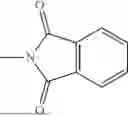
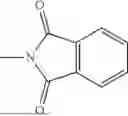
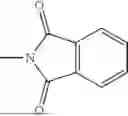
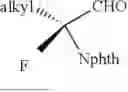
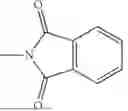
A fluorinated amino acid compound represented by the following formula (1);
wherein
-
- R represents an alkyl group, an alkoxy group, an aryl group, an ester group, an aralkyl group, an alkenyl group, or an alkynyl group, and
- Nphth represents an N-phthaloyl group:
Item 2
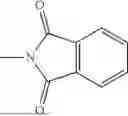
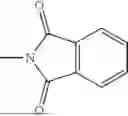
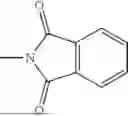
A method for producing a fluorinated amino acid compound represented by the following formula (2):
wherein
-
- R represents an alkyl group, an alkoxy group, an aryl group, an ester group, an aralkyl group, an alkenyl group, or an alkynyl group, and
- Nphth represents an N-phthaloyl group:
-
- the method comprising mixing a compound represented by the following formula (3):
wherein R and Nphth are as defined in formula (1) above
-
- with a fluorinating agent in an organic solvent in the presence of a catalyst to fluorinate the α-position of the compound represented by formula (3).
Item 3
The method according to Item 2, wherein the organic solvent is at least one organic solvent selected from the group consisting of nitrile solvents, nitro solvents, alcohol solvents, halogen solvents, ether solvents, ester solvents, hydrocarbon solvents, and aromatic solvents.
Item 4
The method according to Item 2 or 3, wherein the catalyst is an amine compound.
Item 5
The method according to any one of Items 2 to 4, wherein the fluorinating agent is at least one fluorinating agent selected from the group consisting of N-fluorobenzenesulfonimide, 1-chloromethyl-4-fluoro-1,4-diazoniabicyclo[2.2.2]octane bis(tetrafluoroborate), 1-fluoro-2,4,6-trimethylpyridinium tetrafluoroborate, 2,6-dichloro-1-fluoropyridinium tetrafluoroborate, and 2,6-dichloro-1-fluoropyridinium triflate,
The compounds represented by formulas (1) and (2) can synthesize amino acid compounds having the α-position fluorinated,
The compound represented by formula (2) can improve the stability of the amino acid compound in the transition state by using an aldehyde compound, and can smoothly proceed with the fluorination of the o-position of the amino acid compound.
Advantageous Effects of Invention
First, the present invention produces an amino acid compound having the α-position fluorinated by performing fluorination on the α-position with high yields.
Secondly, the present invention produces an amino acid compound having the α-position fluorinated by performing fluorination on the α-position with high enantioselectivity.
DESCRIPTION OF EMBODIMENTS
The present invention is described in detail below. In the present specification, the terms “comprise” and “contain” include the concepts of comprising, consisting essentially of, and consisting of.
In the present specification, a numerical range indicated by “A to B” means “A or more and B or less.”
[1] Method for Producing Fluorinated Amino Acid Compound
The method for producing an fluorinated amino acid compound of the present invention (a method for producing an amino acid compound having the α-position fluorinated (which is also referred to as “the production method of the present invention”)) includes mixing an amino acid compound having the amine protected (Nphth group) with a phthaloyl group (Phth group) with a fluorinating agent in a liquid phase in the presence of a catalyst to allow fluorination of the α-position of the amino acid compound.
The production method of the present invention can stably produce an amino acid compound having the α-position fluorinated from an amino acid compound, which is a raw material compound, with high yields (74% to 99% yield) and with high enantioselectivity (75% ee to 95% ee).
[1-1] Amino Acid Compound (Substrate, Raw Material Compound)
The production method of the present invention includes fluorinating the α-position of an amino acid compound by using the amino acid compound (an amino acid compound having the amine protected (Nphth group) with a phthaloyl group (Phth group)) as a substrate.
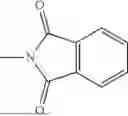
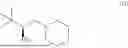
The substrate is an amino acid compound having the structure represented by the following formula (3):
In formula (3), R is an alkyl group, an alkoxy group, an aryl group, an ester group, an aralkyl group, an alkenyl group, or an alkynyl group.
Nphth is an N-phthaloyl group.
Using an aldehyde compound as a substrate ensures stability in the transition state and allows fluorination of the α-position of the amino acid compound to smoothly proceed.
In formula (3), R is an alkyl group, an alkoxy group, an aryl group, an ester group, an aralkyl group, an alkenyl group, an alkynyl group, or the like.
The alkyl group is preferably a linear, branched, or cyclic alkyl group. Specific examples include a C1-4 linear or branched alkyl group, such as methyl, ethyl, n-propyl, isopropyl, n-butyl, isobutyl, sec-butyl, tert-butyl, and 1-ethylpropyl; a C1-18 linear or branched alkyl group, such as n-pentyl, isopentyl, neopentyl, n-hexyl, isohexyl, 3-methylpentyl, n-heptyl, n-octyl, n-nonyl, n-decyl, n-undecyl, n-dodecyl, 5-propylnonyl, n-tridecyl, n-tetradecyl, n-pentadecyl, hexadecyl, heptadecyl, and octadecyl; a C3-8 cyclic alkyl group, such as cyclopropyl, cyclobutyl, cyclopentyl, cyclohexyl, cycloheptyl, and cyclooctyl.
The alkoxy group is preferably a linear, branched, or cyclic alkoxy group. Specific examples include a C1-4 linear or branched alkoxy group, such as methoxy, ethoxy, n-propoxy, isopropyloxy, n-butyloxy, isobutyloxy, sec-butyloxy, tert-butyloxy, and 1-ethylpropyloxy; a C1-18 linear or branched alkoxy group, such as n-pentyloxy, isopentyloxy, neopentyloxy, n-hexyloxy, isohexyloxy, 3-methylpentyloxy, n-heptyloxy, n-octyloxy, n-nonyloxy, n-decyloxy, n-undecyloxy, n-dodecyloxy, 5-propylnonyloxy, n-tridecyloxy, n-tetradecyloxy, n-pentadecyloxy, hexadecyloxy, heptadecyloxy, and octadecyloxy; a C3-8 cyclic alkoxy group, such as cyclopropyloxy, cyclobutyloxy, cyclopentyloxy, cyclohexyloxy, cycloheptyloxy, and cyclooctyloxy.
The aryl group is preferably phenyl, biphenyl, naphthyl, dihydroindenyl, 9H-fluorenyl, or the like.
The ester group is preferably a group with which the alkyl group described above is bonded via an ester bond. The ester group is also represented by an alkoxycarbonyl group, an alkoxycarbonylalkyl group, or a carboxyalkyl group. The ester group is preferably a methyl ester group (COOMe), an ethyl ester group (COOEt), or the like. The ester group is preferably a 3-carboxypropyl group ((CH2)3COOH), a 3-methyloxycarbonylpropyl group ((CH2)3COOMe), or the like.
The aralkyl group is preferably benzyl, phenethyl, trityl, 1-naphthylmethyl, 2-(1-naphthyl) ethyl, 2-(2-naphthyl)ethyl, or the like,
The alkenyl group is preferably an ethenyl group (vinyl group), a 2-propenyl group (allyl group), an isopropenyl group, a butenyl group, an isobutenyl group, a tert-butenyl group, a pentenyl group, a hexenyl group, a heptenyl group, an octynyl group, an isooctynyl group, a nonenyl group, or the like.
The alkynyl group is preferably an ethynyl group, a propynyl group, an isopropynyl group, a butynyl group, an isobutynyl group, a tert-butynyl group, a pentynyl group, a hexynyl group, an octynyl group, or a nonynyl group.
In formula (3), Nphth is an N-phthaloyl group.
The phthaloyl group (Phth group) is a protecting group for an imide-based amine. Phthaloyl protection is performed by dehydration condensation of phthalic anhydride with an amine.
[1-2] Organic Solvent
The production method of the present invention includes fluorinating the α-position of an amino acid compound having the amine protected (Nphth group) with a phthaloyl group (Phth group) in an organic solvent.
The organic solvent is preferably at least one organic solvent selected from the group consisting of nitrile solvents (e.g., acetonitrile), nitro solvents (e.g., nitromethane), alcohol solvents (e.g., hexafluoroisopropanol (HFIP)), halogen solvents, ether solvents, ester solvents, hydrocarbon solvents, and aromatic solvents.
The nitrile solvents include acetonitrile and acrylonitrile.
The nitro solvents include nitromethane, nitroethane, and nitropropane.
The alcohol solvents include hexafluoroisopropanol (HFIP), trifluoromethanol, and pentafluoroethanol.
The halogen solvent is preferably dichloromethane (CH2Cl2), trichloromethane (CHCl3), or the like.
The ether solvent is preferably tetrahydrofuran (THF), dioxane, diethyl ether (Et2O), isopropyl ether (IPE), or the like.
The ester solvent is preferably ethyl acetate (AcOEt) or the like.
The hydrocarbon solvent is preferably n-hexane or the like.
The aromatic solvent is preferably toluene or the like.
The organic solvent is more preferably acetonitrile, nitromethane, or hexafluoroisopropanol (HFIP).
The amount of the organic solvent used is adjusted so that the concentration (M (mol/L)) of the amino acid compound having the structure represented by formula (3) (substrate) is preferably 0.005 M to 5 M, and more preferably 0.05 M to 2 M.
[1-3] Catalyst
The production method of the present invention includes fluorinating the α-position of an amino acid compound having the structure represented by formula (3) (substrate) in the presence of a catalyst.
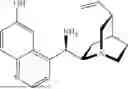
The catalyst used in the production method of the present invention is preferably the following amine compounds.
The catalyst used in the production method of the present invention is preferably the following amine compound.
The catalyst used in the production method of the present invention is preferably an amine compound represented by the following formula (A):
In formula (A), R is preferably an alkyl group, an aralkyl group, or the like.
The alkyl group is preferably a linear, branched, or cyclic alkyl group. Specific examples include C1-4 linear or branched alkyl groups, such as methyl, ethyl, n-propyl, isopropyl, n-butyl, isobutyl, sec-butyl, tert-butyl, and 1-ethylpropyl; C1-18 linear or branched alkyl groups, such as n-pentyl, isopentyl, neopentyl, n-hexyl, isohexyl, 3-methylpentyl, n-heptyl, n-octyl, n-nonyl, n-decyl, n-undecyl, n-dodecyl, 5-propylnonyl, n-tridecyl, n-tetradecyl, n-pentadecyl, hexadecyl, heptadecyl, and octadecyl; and C3-8 -cyclic alkyl groups, such as cyclopropyl, cyclobutyl, cyclopentyl, cyclohexyl, cycloheptyl, and cyclooctyl.
The aralkyl group is preferably benzyl, phenethyl, trityl, 1-naphthylmethyl, 2-(1-naphthyl) ethyl, 2-(2-naphthyl) ethyl, or the like.
In formula (A), R is preferably an alkyl group, such as methyl or tert-butyl, or an aralkyl group, such as benzyl.
The catalyst used in the production method of the present invention is preferably an amine compound represented by the following formula (B):
In formula (B), R and R′ may be the same or different and are preferably each a hydrogen atom, an alkyl group, an aralkyl group, or the like.
The alkyl group is preferably a linear, branched, or cyclic alkyl group. Specific examples include C1-4 linear or branched alkyl groups, such as methyl, ethyl, n-propyl, isopropyl, n-butyl, isobutyl, sec-butyl, tert-butyl, and 1-ethylpropyl; C1-18 linear or branched alkyl groups, such as n-pentyl, isopentyl, neopentyl, n-hexyl, isohexyl, 3-methylpentyl, n-heptyl, n-octyl, n-nonyl, n-decyl, n-undecyl, n-dodecyl, 5-propylnonyl, n-tridecyl, n-tetradecyl, n-pentadecyl, hexadecyl, heptadecyl, and octadecyl; and C3-8 cyclic alkyl groups, such as cyclopropyl, cyclobutyl, cyclopentyl, cyclohexyl, cycloheptyl, and cyclooctyl.
The aralkyl group is preferably benzyl, phenethyl, trityl, 1-naphthylmethyl, 2-(1-naphthyl)ethyl, 2-(2-naphthyl)ethyl, or the like,
In formula (B), R and R′ may be the same or different and are preferably each a hydrogen atom, an alkyl group, such as ethyl or tert-butyl, or the like.
The catalyst used in the production method of the present invention is preferably an amine compound represented by the following formula (C);
In formula (C), R is preferably an alkyl group, an aralkyl group, or the like,
The alkyl group is preferably a linear, branched, or cyclic alkyl group. Specific examples include C1-4 linear or branched alkyl groups, such as methyl, ethyl, n-propyl, isopropyl, n-butyl, isobutyl, sec-butyl, tert-butyl, and 1-ethylpropyl; C1-18 linear or branched alkyl groups, such as n-pentyl, isopentyl, neopentyl, n-hexyl, isohexyl, 3-methylpentyl, n-heptyl, n-octyl, n-nonyl, n-decyl, n-undecyl, n-dodecyl, 5-propylnonyl, n-tridecyl, n-tetradecyl, n-pentadecyl, hexadecyl, heptadecyl, and octadecyl; and C3-8 cyclic alkyl groups, such as cyclopropyl, cyclobutyl, cyclopentyl, cyclohexyl, cycloheptyl, and cyclooctyl.
The aralkyl group is preferably benzyl, phenethyl, trityl, 1-naphthylmethyl, 2-(1-naphthyl) ethyl, 2-(2-naphthyl)ethyl, or the like.
In formula (A), R is preferably an alkyl group, such as methyl or isopropyl, an aralkyl group, such as benzyl, or the like.
In formula (C), n (the number of carbon atoms) is preferably an integer of 0, 1, or 2.
The catalyst used in the production method of the present invention is preferably an amine compound represented by the following formula (D):
In formula (D), X is preferably a carbon atom, an oxygen atom, or the like.
In the production method of the present invention, at least one amine compound selected from the group consisting of the amine compounds described above is preferably used.
The amount of the catalyst used in the fluorination reaction is, in terms of molar ratio, preferably 1 mol % to 50 mol %, more preferably 10 mol % to 40 mol %, and even more preferably 10 mol % to 25 mol %, as a concentration relative to the substrate, that is, the amino acid compound having the structure represented by formula (3) (when the substrate is taken as 100 mol %).
In the production method of the present invention, using the catalyst described above in performing the fluorination reaction enables the production of an amino acid compound having the α-position fluorinated with high yields and with high enantioselectivity.
[1-4] Fluorinating Agent
The production method of the present invention includes mixing an amino acid compound having the structure represented by formula (3) (substrate) with a fluorinating agent to fluorinate the α-position of the amino acid compound having the structure represented by formula (3) (substrate).
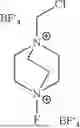
The fluorinating agent is preferably at least one fluorinating agent selected from the group consisting of N-fluorobenzenesulfonimide (NFSI), 1-chloromethyl-4-fluoro-1,4-diazoniabicyclo[2.2.2]octane bis(tetrafluoroborate) (Selectfluor (R)), 1-fluoro-2,4,6-trimethylpyridinium tetrafluoroborate, 2,6-dichloro-1-fluoropyridinium tetrafluoroborate, and 2,6-dichloro-1-fluoropyridinium triflate; more preferably N-fluorobenzenesulfonimide (NFSI), and 1-chloromethyl-4-fluoro-1,4-diazoniabicyclo[2.2.2]octane bis(tetrafluoroborate); and particularly preferably 1-chloromethyl-4-fluoro-1,4-diazoniabicyclo [2.2.2]octane bis(tetrafluoroborate).
1-Chloromethyl-4-fluoro-1,4-diazoniabicyclo[2.2.2]octane bis(tetrafluoroborate) (Selectfluor(R)) has the following structure:
The amount of the catalyst used in the fluorination reaction is, in terms of molar ratio, preferably 0.1 to 20 equivalents, more preferably 0.9 to 5 equivalents, and even more preferably 1 to 3 equivalents relative to the substrate, that is, an amino acid compound having the structure represented by formula (3) (when the substrate is taken as 1 equivalent).
In the production method of the present invention, using the fluorinating agent described above in performing the fluorination reaction enables the production of an amino acid compound having the α-position fluorinated with high yields and with high enantioselectivity.
[1-5] Acidic Compound (e.g., TFA)
-
- The production method of the present invention includes fluorinating the α-position of an amino acid compound having the structure represented by formula (3) (substrate) in the presence of an acidic compound (e.g., TFA) catalyst.
The catalyst is preferably at least one acidic compound selected from the group consisting of trifluoroacetic acid (TFA), trifluoromethanesulfonic acid (TEOH), sulfuric acid (H2SO4), acetic acid (AcOH), and formic acid (HCOOH).
The amount of the acidic compound used in the fluorination reaction is, in terms of the amount used in an organic solvent in a molar ratio (when the entire organic solvent is taken as 100 mol %), preferably 1 mol % to 100 mol %, more preferably 5 mol % to 50 mol %, and even more preferably 10 mol % to 30 mol %.
In the production method of the present invention, using the acidic compound described above in performing the fluorination reaction enables the production of an amino acid compound having the α-position fluorinated with high yields and with high enantioselectivity.
[1-6] Step of Fluorinating α-Position of Amino Acid Compound (Substrate)
The production method of the present invention enables the production of a compound having the α-position fluorinated with high yields (74% to 99% yield) and with high enantioselectivity (75% ee to 95% ee) from an amino acid compound having the structure represented by formula (3) as a substrate (raw material compound).
The reaction temperature in the fluorination reaction step is preferably 0° C. to 90° C., preferably 0° C. to 60° C., and more preferably 10° C. to 35° C. (e.g., room temperature).
The reaction time in the fluorination reaction step is preferably 0.5 hours to 70 hours, preferably 10 hours to 60 hours, and more preferably 20 hours to 50 hours.
[1-7] Fluorinated Amino Acid Compound (Target Compound)
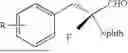
According to the production method of the present invention, a fluorinated amino acid compound having the structure represented by the following formula (2) can be obtained.
In formula (2), R represents an alkyl group, an alkoxy group, an aryl group, an ester group, an aralkyl group, an alkenyl group, or an alkynyl group; Nphth is an N-phthaloyl group:
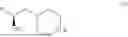
The present invention encompasses a fluorinated amino acid compound having the structure represented by the following formula (1). Oxidizing a fluorinated amino acid compound having the structure represented by formula (2) provides a fluorinated amino acid compound having the structure represented by the following formula (1),
A fluorinated amino acid compound represented by formula (1):
In formula (1), R is an alkyl group, an alkoxy group, an aryl group, an ester group, an aralkyl group, an alkenyl group, or an alkynyl group; Nphth is an N-phthaloyl group:
[2] Application Examples
An application example of the production method of the present invention is that diol compounds, aldol compounds, allyl compounds, etc. can be further produced with high enantioselectivity from the fluorinated amino acid compound prepared according to the production method of the present invention.
Embodiments of the present invention are described above; however, the present invention is not limited to these embodiments. Needless to say, the present invention can be performed in various forms without departing from the spirit and concept of the invention.
EXAMPLES
Embodiments of the present invention are described in more detail below based on Examples.
The present invention is not limited to these Examples.
[1] Fluorination Reaction
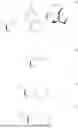
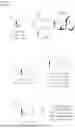
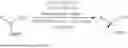
As shown in Scheme 1 and Table 1, the α-position of an amino acid compound (substrate) was fluorinated.
Organic solvent: substrate concentration 0.5 M/various organic solvents
-
- MeCN: acetonitrile
- MeNO2: nitromethane
- HFIP/MeCN: hexafluoroisopropanol/acetonitrile
- HFIP: hexafluoroisopropanol
- Catalyst: various catalysts 20 mol %/substrate
- Fluorinating agent: 1.5 equivalents/substrate
- Fluorinating agent: 1-chloromethyl-4-fluoro-1,4-diazoniabicyclo[2.2.2]octane bis(tetrafluoroborate) (Selectfluor (R))
- Acidic compound (additive): trifluoroacetic acid (TFA) 20 mol %/organic solvent
- Reaction conditions: room temperature, 2 hours to 48 hours
A substrate, an amino acid compound having the structure represented by formula (3) (compound 1a), was fluorinated by using N-fluorobenzenesulfonimide (NFSI, compound F1) as a fluorinating agent (F+ reagent) in the presence of various catalysts and various organic solvents, thereby obtaining a target compound, which is a fluorinated amino acid compound having the structure represented by formula (2) (compound 2a).
The substrate is an amino acid compound having the structure represented by formula (3) in which R is a benzyl group (Ph—CH2—, C6H5CH2—).
Example: Yield (%) (Catalysts C1 to C15)
The α-position of an amino acid compound (compound 1a) was fluorinated by using catalysts C1 to C13 in an organic solvent (MeCN, MeNO2, HFIP/MeCN, or HFIP). The fluorination reaction of an amino acid compound (compound 1a) by using catalysts C1 to C13 enabled the production of a fluorinated amino acid compound (compound 2a) with high yields.
| TABLE 1 | ||||
| Organic | Reaction Time | Yield (%) | ||
| Example | Catalyst | Solvent | (*a)(h) | (*b) |
| 1-1(*c) | C1 | MeCN | 22 | 81 |
| 1-2(*c) | C2 | MeCN | 24 | 93 |
| 1-3(*c) | C3 | MeCN | 22 | 76 |
| 1-4 | C4 | MeCN | 48 | 86 |
| 1-5 | C5 | MeCN | 2 | 86 |
| 1-6 | C6 | MeCN | 2 | 79 |
| 1-7 | C7 | MeCN | 3 | 94 |
| 1-8 | C8 | MeCN | 2 | 54 |
| 1-9 | C9 | MeCN | 4 | 80 |
| 1-10 | C10 | MeCN | 2 | 80 |
| 1-11 | C11 | MeCN | 3 | 90 |
| 1-12 | C12 | MeCN | 2 | 70 |
| 1-13 | C13 | MeCN | 3 | 92 |
| 1-14 | C13 | MeNO2 | 2 | >99 |
| 1-15 | C13 | HFIP/MeCN(*d) | 7 | >99 |
| 1-16 | C13 | HFIP | 27 | 84 |
| (*a): The reaction time for the fluorination reaction was determined by monitoring the consumption of substrate compound (1a) using TLC. | ||||
| (*b): The yield was determined based on 19F NMR of a crude reaction mixture using fluorobenzene as an internal standard. | ||||
| (*c): In the absence of TFA | ||||
| (*d): Examples 1-15, solvent HFIP/MeCN = 7/3 (v/v), substrate 0.3M/organic solvent, TFA 30 mol %/organic solvent |
Example: Enantioselectivity (% ee) (Solvent: MeNO2, HFIP/MeCN, HFIP)
The α-position of an amino acid compound (compound 1a) was fluorinated using catalyst C13 in an organic solvent (MeNO2, HFIP/MeCN, or HFIP). Fluorinating an amino acid compound (compound 1a) by using MeNO2, HFIP/MeCN, or HFIP as an organic solvent and catalyst C13 enabled the production of a fluorinated amino acid compound (compound 2a) with high enantioselectivity.
| TABLE 2 | ||||
| Reaction | Enantioselec- | |||
| Organic | Time | tivity | ||
| Example | Catalyst | Solvent | (*a)(h) | ee (%)(*b) |
| 2-1 | C13 | MeNO2 | 2 | 78 |
| 2-2 | C13 | HFIP/MeCN(*c) | 7 | 95 |
| 2-3 | C13 | HFIP | 27 | 93 |
| (*a): The reaction time for the fluorination reaction was determined by monitoring the consumption of substrate compound (1a) using TLC. | ||||
| (*b): After the Wittig reaction, enantioselectivity (ee %) was measured by HPLC equipped with Daicel Chiralpak OJ-3. | ||||
| (*c): Example 2-2, solvent HFIP/MeCN = 7/3 (v/v), substrate 0.3M/organic solvent, TFA 30 mol %/organic solvent |
[2] Scheme 2: Substrate Type
The range of substrates for the amino acid compound shown in scheme 2 was studied.
-
- Organic solvent: substrate concentration 0.5 M/solvent HFIP/MeCN=7/3 (v/v, ratio by volume)
- Catalyst: catalyst C13, 20 mol %/substrate
- Fluorinating agent: 1.5 equivalents/substrate
- Fluorinating agent: 1-chloromethyl-4-fluoro-1,4-diazoniabicyclo[2.2.2]octane bis(tetrafluoroborate) (Selectfluor (R))
- Acidic compound (additive): trifluoroacetic acid (TFA) 30 mol %/organic solvent
- Reaction conditions: room temperature, 7 hours to 23 hours
The yield represents an isolated yield.
The reaction time of the fluorination reaction was measured by monitoring the consumption of β-diketone compound 1 by TLC.
The enantioselectivity (ee(%)) was determined using HPLC equipped with a chiral stationary phase.
| Scheme 2: Range of Substrate |
| 2a 2b 2c 2d 2e 2f | R = H R = 4-F R = 4-Cl R = 4-me R = 4-TBSO R = 2-Me | 99% (7 h), 99% (7 h), 99% (7 h), 89% (7 h), 99% (7 h), 91% (7 h), | 95% ee 95% ee 94% ee 95% ee 96% ee 96% ee | 2s | ||
| 2g 2h 2i 2j | R = Me R = Et R = i-Pr R = iso-Bu | 91% (8 h), 98% (8 h), 99% (8 h), 96% (7 h), | 2r 70% (24 h), 95% ee TFA 20/22 mol %, 1.1 equiv. | 82% (7 h), 96% ee | ||
| indicates data missing or illegible when filed |
Even the use of the amino acid compounds represented by compounds 2a to 2s as substrates enabled the production of fluorinated amino acid compounds having the α-position fluorinated with high enantioselectivity with excellent yields.
[3] Scheme 3: Reference Example
A reference example (application in synthesis) of the fluorinated amino acid compounds produced by using the fluorination reaction of the present invention is shown below,
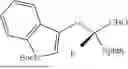
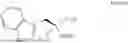
[3-1] Synthesis of α-fluorinated RG-108
RG-108 is an inhibitor of DNA methyltransferase (N-phthalyl-L-tryptophan) and inhibits the enzyme with an IC50 of 115 nM.
RG-108 has been shown to bind directly to the active site of the enzyme in molecular modeling.
RG-108 promotes the reprogramming of human and mouse somatic cells into iPS cells.
RG-108 has anticancer effects as an epigenomic drug.
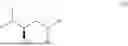
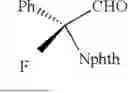
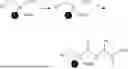
[3-2] Application in Dipeptides
How to Proceed with Step:
-
- (i) NaClO2 (10 equiv), NaH2PO4 (8 equiv), 2-methyl-2-butene (30 equiv), t-BUCH/H2O (v/v=2/1, 0.05 M), r.t.
- (ii) DIEP (3.0 equiv), HBTU (1.5 equiv), phenyl alanine methyl ester (1.1 equiv), THF (0.5 M), r.t.
Dipeptides were obtained as two diastereomers (17%+37%).
INDUSTRIAL APPLICABILITY
The method for producing a fluorinated amino acid compound (an amino acid compound having the α-position fluorinated) of the present invention enables the fluorination reaction of an amino acid compound with high yields and with high enantioselectivity.
The fluorinated amino acid compounds obtained according to the production method of the present invention can be derived into special fluorinated amino acids, and are expected to have a wide range of industrial applications. The fluorinated amino acid compounds obtained according to the production method of the present invention can be used, for example, as a precursor in the synthesis of pharmaceuticals or peptides containing an amino acid having a fluorine atom at the α-position.
Claims
1. A fluorinated amino acid compound represented by formula (1):
wherein
R represents an alkyl group, an alkoxy group, an aryl group, an ester group, an aralkyl group, an alkenyl group, or an alkynyl group, and
Nphth represents an N-phthaloyl group:
2. A method for producing a fluorinated amino acid compound represented by formula (2):
wherein
R represents an alkyl group, an alkoxy group, an aryl group, an ester group, an aralkyl group, an alkenyl group, or an alkynyl group, and
Nphth represents an N-phthaloyl group:
the method comprising mixing a compound represented by formula (3):
wherein R and Nphth are as defined in formula (1) above
with a fluorinating agent in an organic solvent in presence of a catalyst to fluorinate an α-position of the compound represented by formula (3).
3. The method according to claim 2, wherein the organic solvent is at least one organic solvent selected from the group consisting of nitrile solvents, nitro solvents, alcohol solvents, halogen solvents, ether solvents, ester solvents, hydrocarbon solvents, and aromatic solvents.
4. The method according to claim 2, wherein the catalyst is an amine compound.
5. The method according to claim 2, wherein the fluorinating agent is at least one fluorinating agent selected from the group consisting of N-fluorobenzenesulfonimide, 1-chloromethyl-4-fluoro-1,4-diazoniabicyclo[2.2.2]octane bis(tetrafluoroborate), 1-fluoro-2,4,6-trimethylpyridinium tetrafluoroborate, 2,6-dichloro-1-fluoropyridinium tetrafluoroborate, and 2,6-dichloro-1-fluoropyridinium triflate.
6. The method according to claim 4, wherein the fluorinating agent is at least one fluorinating agent selected from the group consisting of N-fluorobenzenesulfonimide, 1-chloromethyl-4-fluoro-1,4-diazoniabicyclo[2.2.2]octane bis (tetrafluoroborate), 1-fluoro-2,4,6-trimethylpyridinium tetrafluoroborate, 2,6-dichloro-1-fluoropyridinium tetrafluoroborate, and 2,6-dichloro-1-fluoropyridinium triflate.
Images & Drawings included:



Sources:
- United States Patent and Trademark Office - verify current appl. status at the USPTO↗
Recent applications in this class:
- » 20240254082 2024-08-01
Substituted Isoindoline-1, 3-diketone PDE4 Inhibitor and Pharmaceutical Application Thereof - » 20230278957 2023-09-07
TREX1 INHIBITORS AND USES THEREOF - » 20230167058 2023-06-01
GPX4 COMPOUNDS AND COMPOSITIONS AND METHODS OF TREATMENT USING SAME - » 20230111252 2023-04-13
THIOSEMICARBAZATES AND USES THEREOF - » 20220348542 2022-11-03
PROCESS FOR SYNTHESIZING APREMILAST - » 20220306577 2022-09-29
THIOSEMICARBAZATES AND USES THEREOF - » 20220127228 2022-04-28
Method for producing dichloro addition product of aliphatic olefin by photocatalysis under visible light - » 20210317082 2021-10-14
Diamine compound, polyimide precursor using same, and polyimide film - » 20210276953 2021-09-09
Phthalide derivative, preparation method and use thereof - » 20210253527 2021-08-19
Curable compound
Recent applications for this Assignee:
- » 20250326774 2025-10-23
METHOD FOR PRODUCING ORGANIC COPPER COMPOUND - » 20250282801 2025-09-11
TRITYL-BASED ALCOHOL PROTECTING GROUP - » 20250236642 2025-07-24
PHARMACEUTICAL COMPOSITION FOR TREATMENT OR PREVENTION OF ADULT T-CELL LEUKEMIA - » 20250066393 2025-02-27
AMINE-PROTECTING GROUP - » 20250059211 2025-02-20
ORGANIC ZINC COMPOUND AND PRODUCTION METHOD FOR ORGANIC ZINC COMPOUND - » 20240317853 2024-09-26
ANTI-CADM1 ANTIBODY - » 20240005544 2024-01-04
FUNCTIONAL EVALUATION SYSTEM OF HIPPOCAMPUS AND DATA CREATION METHOD - » 20220354885 2022-11-10
Constituent for preventing and/or treating skin wounds - » 20220344416 2022-10-27
IMAGING SENSOR AND DISPLAY DEVICE INCLUDING THE SAME - » 20210196747 2021-07-01
METABOLISM IMPROVING AGENT