TITANIUM ALLOY SHEET MATERIAL AND EXHAUST SYSTEM COMPONENT
US20260055720A1
2026-02-26
19/104,787
2023-08-14
Smart Summary: A new type of sheet material made from titanium alloys is designed for use in vehicle exhaust systems. It can withstand high temperatures and resist oxidation, remaining stable even when exposed to heat up to 800° C. The composition includes specific amounts of aluminum, molybdenum, silicon, and very low levels of other elements like iron and carbon. This material is strong against deformation and maintains its properties over time. Additionally, it can be easily shaped using cold forming techniques. 🚀 TL;DR
Abstract:
The invention relates to metallurgy, and more particularly to a sheet material made of titanium alloys that are resistant to high heat and oxidation and exhibit structural stability under prolonged operational exposure to temperatures in a range of up to 800° C. and can be used for manufacturing components of a vehicle exhaust system. The present titanium alloy sheet material for the manufacture of components contains: 1.5-3.0 wt % aluminium, 0.1-0.5 wt % molybdenum, 0.1-0.6 wt % silicon, not more than 0.2 wt % iron, not more than 0.15 wt % oxygen, not more than 0.1 wt % carbon, not more than 0.03 wt % nitrogen, not more than 0.015 wt % hydrogen, and the balance titanium. The sheet material has high creep resistance and oxidation resistance values, as well as a stable structure under prolonged operational exposure to temperatures in a range of up to 800° C. The material is suitable for cold forming.
Inventors:
- Elizaveta Aleksandrovna PLAKSINA 2 🇷🇺 Verkhnaya Salda, Russian Federation
- Mikhail Ottovich LEDER 1 🇷🇺 Verkhnaya Salda, Russian Federation
- Anatoliy Vladimirovich VOLKOV 1 🇷🇺 Verkhnaya Salda, Russian Federation
- Maksim Sergeevich KALIENKO 1 🇷🇺 Verkhnaya Salda, Russian Federation
- Tatiana Aleksandrovna LAVROVA 1 🇷🇺 Nizhniy Tagil, Russian Federation
- Aleksandr Sergeevich GREBENSHCHIKOV 1 🇷🇺 Verkhnaya Salda, Russian Federation
Applicant:
Interested in similar patents?
Get notified when new applications in this technology area are published.
Classification:
F01N13/16 » CPC main
Exhaust or silencing apparatus characterised by constructional features ; Exhaust or silencing apparatus, or parts thereof, having pertinent characteristics not provided for in, or of interest apart from, groups - , , Selection of particular materials
C22C14/00 » CPC further
Alloys based on titanium
Description
The invention relates to non-ferrous metallurgy, in particular to manufacture of sheet material from low-alloyed heat and oxidation resistant titanium alloys having stable structure during long-term operating holdings in the temperature range of up to 800° C. and can be used to manufacture products extensively operating at high temperatures, in particular components of vehicle engines exhaust systems.
Titanium-based alloys are used for production of components for different commercial applications such as manufacture of internal combustion engines and exhaust systems. Such components include intake and exhaust valves, housings, turbine impellers, pipes and tanks. Such engines and exhaust systems components made of low-alloyed titanium based alloys operate at temperatures of about 500-800° C. Therefore the operating properties of materials such as heat and oxidation resistance are in priority. Moreover, the material applied shall have sufficient technological plasticity, because the components are mainly produced by cold forming from rolled sheets and by bending welded pipes. To obtain high plasticity characteristics, it is important to create a structure with the globular morphology of α-phase grains in the material, since the globular microstructure provides better forming properties than the needlelike structure.
As internal combustion engine designers improve engine efficiency, such characteristics as boost pressure, compression ratio, and operating temperatures increase accordingly. Increasing the level of these characteristics causes the demand for materials resisting strain (creep) at higher operating temperatures and pressures in the combustion chamber and exhaust system than are currently achievable with traditional low-alloyed titanium alloys. Creep, which is the tendency of a solid material to slowly shift or residual strain under the loads, occurs when the metal is subjected to a constant tensile load at elevated temperatures. The high creep resistance allows the material to be extensively without distortion of shape and size, while maintaining the level of material original properties is important.
Consequently, materials that have, in addition to their low price, the greatest possible combination of high mechanical and operational properties are in demand.
Flat rolled products and exhaust system components are known, made of an oxidation-resistant, high-strength titanium alloy, consisting of (wt %): iron—0.06 to 0.5 oxygen—0.02 to 0.12, silicon—0.15 to 0.46, and titanium and accidental impurities in balance. Grain size of titanium alloy is 15.9um or less in average. (US Patent No. U.S. Pat. No. 8,349,096, published Aug. 1, 2013, IPC C22C14/00).
Rolled products have high plastic properties, but reduced resistance to high-temperature oxidation.
A material for the exhaust system made of a low-alloyed titanium alloy having excellent resistance to high-temperature oxidation and corrosion is known. It contains (wt %) Al: 0.30-1.50%, Si: 0.10-1.0% and additionally Nb: 0.1-0.5 (U.S. Pat. No. 7,166,367, publ. 23.01.2007, IPC B32B15/01;C22C14/00, F01N7/16). This material is a prior art.
The material made of the above mentioned alloy has high strength and plastic properties at room and elevated temperatures, however, the level of resistance to high-temperature creep is insufficient.
The objective of the invention is to develop low-alloyed titanium alloy sheet material with globular microstructure allowing manufacture of a wide range of products, including those used in engine components and exhaust systems of vehicles.
The technical result to be achieved upon implementation of the invention is the production of titanium alloy sheet material with a set of high mechanical and operational properties, including increased level of creep and oxidation resistance, as well as structural stability under extensive operational conditions in the temperature range up to 800° C. and possibility of cold forming.
The technical result is achieved if titanium alloy sheet material for manufacture of components extensively operating at high temperatures, according to the invention, contains the following elements, wt %:
| Aluminium | 1.5-3.0, | |
| Molybdenum | 0.1-0.5, | |
| Silicon | 0.1-0.6, | |
| Iron | max 0.2, | |
| Oxygen | max 0.15, | |
| Carbon | max 0.1, | |
| Nitrogen | max 0.03, | |
| Hydrogen | max 0.015, | |
| Balance - Ti. | ||
Provided that Mo to Si ratio (wt %) equals 0.4-3, sheet material contains at least 90% (vol.%) of α-case. The total content of the β-phase and intermetallic particles of titanium silicides is 0.5-5 vol. %. The average α-phase grain size varies from 5 to 100 μm. In addition, the sheet material is made in the form of rolled sheets up to 6 mm thick. The technical result is also achieved when a component of the vehicle exhaust system extensively operating at high temperatures and made of titanium alloy sheet material is proposed.
Alloying elements from various stabilizer groups are added into the titanium alloy material: alpha stabilizers: aluminum, oxygen, carbon, nitrogen; beta stabilizers: molybdenum, silicon.
Aluminium increases heat and creep resistance, reducing scale generation at high temperatures. Aluminium content in the alloy is assumed to be 1.5-3.0 wt. %. To maintain optimal technological plasticity, maximum aluminium content in the alloy is limited by 3.0 wt. %.
Oxygen, nitrogen and carbon content within the specified limits, along with an increase in strength, increases allotropic transformation temperature of titanium and allows to keep high level of strength and plasiticity. Higher concentrations of oxygen, carbon, and nitrogen reduce the technological plasticity and impact alloy strength.
Group of beta stabilizers (Mo, Si).
Alloying of the alloy with molybdenum in amount of 0.1-0.5 wt. % increases strength due to solid-solution hardening and appearance of β-phase interlayers in the structure, which are interfacial boundaries slowing down the movement of strain dislocations during deformation as well as prevent the gathering growth of α-grains at high temperatures during heat treatment and operation. The molybdenum content exceeding 0.5 wt. % reduces heat resistance, since the beta-transus temperature of alloy decreases and proportion of the β-phase in the structure increases.
The presence of silicon in the alloy, contained in titanium solid solution, increases creep resistance. The silicon content in the alloy is set in the range of 0.1 to 0.6 wt. %. In this range, silicon forms an intermetallic compound with titanium, a silicide of complex stoichiometric composition (TixSiy). Generation of the required amount of silicides in the alloy increases heat and creep resistance and prevents the growth of α-grains at high temperatures. In addition, silicon significantly increases the oxidation resistance if its conent does not exceed 0.8 wt. %. Greater content reduces technological plasticity/formability due to the generation of coarse-grained silicides. The absence of Zr and Sn in the alloy, reducing the eutectoid transformation temperature of silicides generation, allows to maximize the Si content in the solid solution, providing a maximum increase in heat resistance.
Maximum hydrogen content in the alloy, limited by 0.015 wt. %, allows to avoid embrittlement of the alloy due to the possible generation of titanium hydrides.
The iron content in the alloy is limited by 0.2 wt. %, because the greater content negatively affects creep resistance and short-term heat resistance.
The main factor in the stability of the structure during extencive operation at elevated temperatures is the presence of particles inhibiting grain growth. They are the β-phase particles in the alloy, as well as particles of silicides. The presence of both types of particles in the alloy is very important, and achieved by close content of Mo and Si. The preferred ratio of β-isomorphic molybdenum and β-eutectoid silicon Mo/Si in weight percentages ranges from 0.4 to 3. This ratio allows for increased oxidation and creep resistance, as well as structural stability during extensive operation.
Composition of elements added into alloy in claimed amount and characterized individually by a beneficial effect on the oxidation resistance of titanium allows to achieve an additive effect in terms of obtaining high creep resistance values while providing strength, plastic properties in combination with oxidation resistance relative to known low-alloyed titanium alloys.
An additional increase in material properties is achieved by regulating the structure, which affects cold-forming properties. The globular structure of the α-phase grains has higher values of plasticity and formability than the needlelike structure. For this reason, a homogeneous globular microstructure with average grain size of 5 to 100 μm is preferred to improve the formability of the sheet material. Obtaining a microstructure with an average α-phase grain size of less than 5 μm requires a large number of technological operations and, consequently, high costs. In microstructure with an average α-phase grain size of more than 100 μm, the boundaries of large grains become the starting points of fracture. Average diameter of α-phase grains in the titanium billet structure is measured in accordance with international standard ASTM E112 practice. Proportion of β-phase particles and silicides is calculated using a scanning electron probe microscope (SEM) in the backscattered electron mode and processing the images using software for quantitative analysis of microstructure by contrast of elements.
Preferred α-phase content in the material shall be at least 95 vol. %. to ensure stability of α-grain structure during operation. The total content of β-phase and intermetallic particles of titanium silicides in the material within the range of 0.5-5 vol. % increases creep resistance at high temperatures.
The industrial applicability of the invention is confirmed by an example of its specific implementation.
To study the properties of the proposed material, an ingot weighing 2,100 kg was melted using industrial technology by vacuum arc remelting. Chemical composition of alloy is shown in Table 1.
| TABLE 1 | |
| Sampling | Ingot composition. Content of elements, wt. % |
| area | Ti | Al | Mo | Si | Fe | O | C | N | H |
| Ingot top | Bal. | 1.92 | 0.25 | 0.41 | 0.034 | 0.098 | 0.003 | <0.003 | <0.003 |
| Ingot | Bal. | 1.91 | 0.25 | 0.39 | 0.033 | 0.095 | 0.003 | <0.003 | <0.003 |
| bottom | |||||||||
The ingot was forged and further rolled to obtain a 0.9 mm thick coil, the final stages of rolling were carried out at beta-transus temperature of 945° C., which is necessary for generation of globular α-grains structure. Specimens for alloy mechanical properties evaluation were taken in delivery condition. Mechanical properties were evaluated in the course of tensile tests carried out at temperatures of 20° C., 500° C., 700° C., and deep drawing tests according to Eriksen were carried out to evaluate material's formability criterion. Mechanical tensile properties of material in delivery condition (annealed) are given in Table.2 and the comparative diagram is shown in FIG. 1.
| TABLE 2 | ||
| Criterion of | ||
| Mechanical properties | Eriksen test, |
| Ultimate | Percentage | mean depth of | |||
| Test | Sampling | Yield strength | strengt | elongation | extruded hole, |
| temperature, ° C. | direction | σ0.2, MPa | σB, MPa | δ, % | IE, mm |
| 20° C. | Longitudinal | 500 | 621 | 21 | 5.7 |
| Transversal | 542 | 597 | 21.5 | ||
| 500° C. | Longitudinal | 212 | 332 | 21 | |
| Transversal | 209 | 316 | 21.6 | ||
| 700° C. | Longitudinal | 91 | 119 | >30 | |
| Transversal | 102 | 117 | >30 | ||
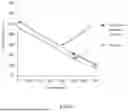
To simulate the operation of material in the product, samples were subjected to isothermal annealing in static laboratory air at temperatures of 560° C., 625° C. with a holding time of 1000 hours, and at 800° C. with a holding time of 200 hours. Tereafter the oxidation resistance was studied by calculating the weight gain of the samples (mg/cm2). The results of oxidation resistance evaluation in comparison with the prior art alloy are shown in diagrams representing dependence of alloy weight gain on the square root of the oxidation time at temperatures of 560° C., 625° C. and 800° C., shown, respectively, in FIGS. 2, 3, 4.
In addition, creep resistance at 500° C. was determined on the samples in delivery condition during 100 hours; it is expressed as a function of relative spcimen strain at a voltage of 30 MPa. Creep resistance results of the claimed material in comparison with the prior art are shown in the diagram given in FIG. 5.
Average α-phase grain size in the stock material structure in longitudinal section, determined in accordance with the international standard ASTM E112, is 15 μm. Proportion of α-phase—98 vol. %, and proportion of β-phase and particles of titanium silicides—2 vol. %. Proportion of β-phase and particles of titanium silicides was calculated using a scanning electron probe microscope (SEM) in the backscattered electron mode and image analysis program.
The grain structure of material with titanium silicide particles and β-phase interlayers after annealing at 625° C. during 1000 hours does not change in comparison with the initial one (FIG. 6), which indicates the stability of the structure.
Analysis of test results and research data has shown that the proposed titanium alloy sheet material has a set of high mechanical and operational properties, including resistance to high-temperature creep relative to the known low-alloyed alloys. Results of specimens oxidation resistance evaluation after extensive isothermal annealing demonstrate the durability of material.
PATENT CLAIM
-
- 1. Titanium alloy sheet material for manufacture of components extensively operating at high temperatures characterized by the following content of elements in titanium alloy, wt. %:
| Aluminium | 1.5-3.0, | |
| Molybdenum | 0.1-0.5, | |
| Silicon | 0.1-0.6, | |
| Iron | max 0.2, | |
| Oxygen | max 0.15, | |
| Carbon | max 0.1, | |
| Nitrogen | max 0.03, | |
| Hydrogen | max 0.015, | |
| Balance- Ti. | ||
-
- 2. Sheet material as per claim 1 characterized by the Mo to Si ratio (wt. %) of alloy comprising 0.4-3.
- 3. Sheet material as per claim 1 characterized by the average α-phase grain size varying from 5 to 100 μm.
- 4. Sheet material as per claim 1 characterized as containing at least 95 vol. % of α-phase.
- 5. Sheet material as per claim 1 characterized by the total content of β-phase and intermetallic particles of titanium silicide comprising 0.5-5 vol. %.
- 6. Sheet material as per claim 1 characterized by the fact that it is made in the form of flat rolled product with up to 6 mm thickness.
- 7. Vehicle exhaust system component extensively operating at high temperatures and made of titanium alloy sheet material characterized by the fact that it is made of sheet material under any of claims above.
ABRIDGEMENT
The invention relates to non-ferrous metallurgy, in particular to manufacture of sheet stock from low-alloyed titanium-based heat and oxidation resistant alloys having stable structure during extensive operation in the temperature range of up to 800° C. and can be used to manufacture products extensively operating at high temperatures, in particular components of vehicle engines exhaust systems.
Titanium alloy sheet material for the manufacture of components extensively operating at high temperatures, according to the invention, contains the following elements, wt %:
| Aluminium | 1.5-3.0, | |
| Molybdenum | 0.1-0.5, | |
| Silicon | 0.1-0.6, | |
| Iron | max 0.2, | |
| Oxygen | max 0.15, | |
| Carbon | max 0.1, | |
| Nitrogen | max 0.03, | |
| Hydrogen | max 0.015, | |
| Balance - Ti. | ||
Provided that Mo to Si ratio (wt %) equals 0.4-3, sheet material contains at least 90% (vol.%) of α-case. The total content of the β-phase and intermetallic particles of titanium silicides is 0.5-5 vol. %. The average α-phase grain size varies from 5 to 100 microns. In addition, the sheet material is made in the form of rolled sheets up to 6 mm thick. The technical result is also achieved when a component of the vehicle exhaust system extensively operating at high temperatures and made of titanium alloy sheet material is proposed.
The technical result to be achieved upon implementation of the invention is the production of titanium alloy sheet material with a set of high mechanical and operational properties, including increased level of creep and oxidation resistance, as well as structural stability under extensive operational conditions in the temperature range up to 800° C. and possibility of cold forming.
Claims
1-7. (canceled)
8. Titanium alloy sheet material for manufacture of components extensively operating at high temperatures characterized by the following content of elements in titanium alloy, wt. %:
| Aluminum | 1.5-3.0; | |
| Molybdenum | 0.1-0.5; | |
| Silicon | 0.1-0.6; | |
| Iron | max 0.2; | |
| Oxygen | max 0.15; | |
| Carbon | max 0.1; | |
| Nitrogen | max 0.03; | |
| Hydrogen | max 0.015; | |
| Balance- Ti. | ||
9. Sheet material as per claim 8 characterized by the Mo to Si ratio (wt. %) of alloy comprising 0.4-3.
10. Sheet material as per claim 8 characterized by the average α-phase grain size varying from 5 to 100 μm.
11. Sheet material as per claim 8 characterized as containing at least 95 vol. % of α-phase.
12. Sheet material as per claim 8 characterized by the total content of β-phase and intermetallic particles of titanium silicide comprising 0.5-5 vol. %.
13. Sheet material as per claim 8 characterized by the fact that it is made in the form of flat rolled product with up to 6 mm thickness.
14. Vehicle exhaust system component extensively operating at high temperatures and made of titanium alloy sheet material characterized by the fact that it is made of sheet material of claim 8.
15. A titanium alloy sheet material, comprising:
titanium;
aluminum in a weight percent of 1.5-3.0;
molybdenum in a weight percent of 0.1-0.5;
silicon in a weight percent of 0.1-0.6;
iron in a weight percent of 0-0.2;
oxygen in a weight percent of 0-0.15;
carbon in a weight percent of 0-0.1;
nitrogen in a weight percent of 0-0.03; and
hydrogen in a weight percent of 0-0.015.
16. Sheet material as per claim 15, wherein the Mo to Si ratio (wt. %) of alloy is between 0.4-3.
17. Sheet material as per claim 15, wherein the average α-phase grain size varies from 5 to 100 μm.
18. Sheet material as per claim 15, containing at least 95 vol. % of α-phase.
19. Sheet material as per claim 15, wherein the total content of β-phase and intermetallic particles of titanium silicide is between 0.5-5 vol. %.
20. Sheet material as per claim 15, made in the form of flat rolled product with up to 6 mm thickness.
21. Vehicle exhaust system component extensively operating at high temperatures and of titanium alloy sheet material formed of sheet material of claim 15.
Images & Drawings included:



Sources:
- United States Patent and Trademark Office - verify current appl. status at the USPTO↗
Recent applications in this class:
- » 20200340388 2020-10-29
Exhaust system for engine - » 20200232378 2020-07-23
Diffusion surface alloyed metal exhaust component with welded edges - » 20200232377 2020-07-23
Diffusion surface alloyed metal exhaust component with inwardly turned edges - » 20200232376 2020-07-23
Diffusion Surface Alloyed Metal Exhaust Component - » 20190353078 2019-11-21
Exhaust subsystem with fiber pipe and method of forming fiber pipe - » 20180298804 2018-10-18
Bonding strength enhancement for ceramic coating on high temperature alloy - » 20180238221 2018-08-23
Flexible automotive exhaust tube system - » 20180171858 2018-06-21
Corrosion resistant metal substrate - » 20180066563 2018-03-08
VORTEX FLOW APPARATUS - » 20170314448 2017-11-02
Exhaust System